
Nigeria continues to innovate on revenue collection. From federal to state governments, if we have put the energies we have exerted on how to collect taxes and fees from citizens and companies, we would have advanced. The latest one is coming from the center of excellence, though nothing excellent on this playbook. Yes, Lagos will now collect 10% service tax on Uber, Bolt and all e-taxis. That is for Lagos. This new 10% does not substitute current fees and taxes!
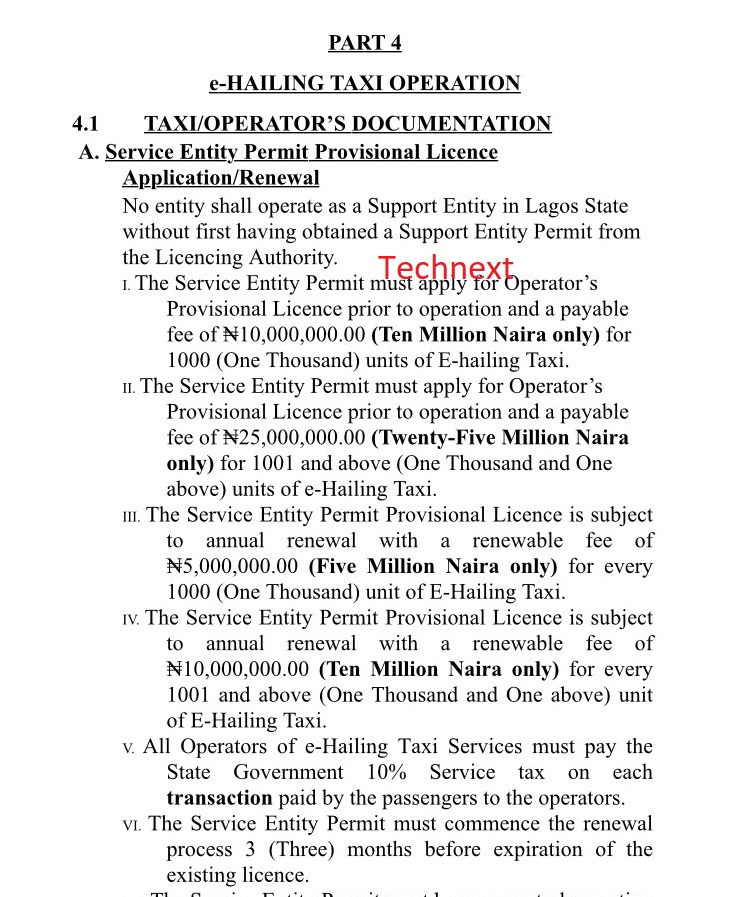
More so, “the law now mandates operators to acquire a provisional license at N10 million (about US$26,000) per 1,000 vehicles or less; N25 million (US$65,000) for a fleet above 1,000 and renew annually at N5 million and N10 million respectively“, TC Daily summarizes.
Come August 20, Guideline for On-Line Hailing Business Operation of Taxi in Lagos will come into effect. It is the Lagos State government’s approach towards regulating the ride-hailing sector in the commercial city and has been the cause of concern since last year when its existence was first hinted at. Both motorcycle and taxi operators have been at regulatory loggerheads with the state government since 2018. In January, the state government announced the ban of motorcycles, including the tech-enabled operators, from major areas in the state to the outrage of users and the operators. There was a peaceful march afterwards to protest the ruling. As was speculated then, the law now mandates operators to acquire a provisional license at N10 million (about US$26,000) per 1,000 vehicles or less; N25 million (US$65,000) for a fleet above 1,000 and renew annually at N5 million and N10 million respectively. The state government is also asking for a 10% service tax on every ride the operators complete.
Sing Ease of Doing Business improving…hahaha. Except foreign companies, which Nigerian entrepreneurs can raise N25 million just to get a piece of paper? It may not be really bad for Uber and Bolt. At least, the government has killed any local challenger for good.
Technext presents the evidence.
Poor ride-hailing sector players. California is already hitting them hard; it seems there is no escape velocity for these human aggregators.
A California judge has ordered Uber and Lyft to stop classifying its drivers as independent contractors, handing the state a signal victory in a battle over the gig economy Monday.
After the state passed a law broadly requiring more workers to be treated as employees, California Attorney General Xavier Becerra and city attorneys sued the ride-hailing firms this year, arguing they were violating the law by deeming their drivers to be independent contractors. Becerra went to court for an injunction immediately compelling the companies to treat their drivers differently.