DD
MM
YYYY

PAGES

DD
MM
YYYY

spot_img

PAGES

Home Blog Page 6219

Facebook Records 11% Q2 Revenue Growth As Its Community Hits 3.1 Billion

0

Facebook made its second quarter report showing slow revenue and increased number of users. Its stock rose more than 6% in extended trading while user growth recorded a new height of over 3 billion.

Its social media community saw a surge induced by the pandemic and ensured the quarter ended on high.

“This was a strong quarter for us, especially compared to what we expected at the start,” Said Facebook CEO, Mark Zuckerberg. “There are now more than 3.1 billion people using our services every month to stay connected and more than 180 million businesses who use our tools to connect with customers. We also had more than 9 million active advertisers across our services as many shifted their businesses online.”

Though the second quarter revenue growth has been the slowest since the 2012 IPO, it beats projections by analysts. The company said the surge in number of users compelled advertising that resulted in the growth.

“We are seeing signs of normalization in user growth and engagement as shelter in-place measures have eased around the world, particularly in developed markets where Facebook’s penetration is higher,” the company said in a statement.

As of Thursday’s close, Facebook shares were up 14% this year, to top the 0.5% gain for the S&P 500. The stock topped $252 in extended trading, above its record intraday high of $250.15 earlier this month. CNBC reported.

The Silicon Valley giant recorded revenues from other sources at the tone of $366 million for the Q2. The sources include the sales of devices such as the Oculus virtual reality headsets and the portal video-chatting devices.

Facebook’s cash and cash equivalents and marketable securities were $58.24 billion as of July 30, 2020, after paying $5.8 billion for a stake in Jio Platforms Limited.

The company made a total capital expenditure of $3.36 billion for the Q2 2020, which includes principal payments on finances and leases.

The pandemic unleashed unprecedented strains on businesses which affected ad revenues and put its profits in doubt, but Facebook scaled the hurdle by providing virtual platforms for users separated by government placed restrictions to interact.

“We’re glad to be able to provide small businesses the tools they need to grow and be successful online during these challenging times,” said Zuckerberg. “And we’re proud that people can rely on our services to stay connected when they can’t always be together in person.”

Facebook daily active users (DAUs), were 1.79 billion on average for June 2020, an increase of 12% year-on-year, while the monthly active users (MAUs) were 2.70 billion, with year-on-year increase of 12%.

Family daily active people (DAP), was 2.47 billion on average for June 2020, an increase of 15% year-on-year. Family monthly active people (MAP), was 3.14 billion, an increase of 14% year-on-year.

However, the ease of restrictions means the number of users will decline in coming months. Facebook said it expects the number of DAUs and MAUs to be flat or slightly down in most regions in the third quarter of 2020 compared to second quarter 2020, as shelter-in-place restrictions continue to ease.

Revenue generation for the third quarter will likely plummet as a result of “boycott Facebook” campaign, though it is expected to be on par with the growth rate of the first three weeks of July, which is 10%.

Apart from the impact of certain advertisers boycotting Facebook, and relaxation of the restrictions which will mean more physical interactions, there are other two factors that paint the future gleam for the platform.

They are macroeconomic uncertainty, including the pace of recovery and the prospects for additional economic stimulus; headwinds related to ad targeting and measurement, including the impact of regulation, such as the California Consumer Privacy Act, as well as headwinds from expected changes to mobile operating platforms, which is expected to increase significantly as the year progresses.

Facebook alongside other big tech companies including Amazon, Apple and Google faced the congress on Wednesday over allegations of monopoly. The companies have been accused of stifling competition with financial muscle, an allegation they all denied. But the investigation seems not to have ended as new information reveals the giants were going after competitors.

An email from Zuckerberg to his chief financial officer David Ebersman, before the acquisition of Instagram noted the Facebook founder saying: “Instagram can hurt us meaningfully without becoming a huge business.” This suggests there is intent to cripple platforms perceived as threats, a development the congress would want antitrust agencies to look into.

However, Zuckerberg said Facebook’s growth has been as a result of innovative products and services that improve lives and the platform will continue to create more products for people and businesses.

“As I told congress yesterday: I am proud of the services we build and how they improve people’s lives,” he said.

Register Now: Tekedia Mini-MBA (Aug 10 – Dec 3)

0

Across human history, knowledge has remained a critical factor of production. Pythagoras  postulated that the world is nothing but numbers. Indeed, the numbers of nations are knowledge of nations.  Firms build nations.

Today, in markets in Africa and beyond, companies are faced with daunting challenges, and they need to  create new innovative ways to manage economic paralysis triggered by a pandemic, and cushion the effect of volatility and global uncertainty. Predicting that future will require creating it.

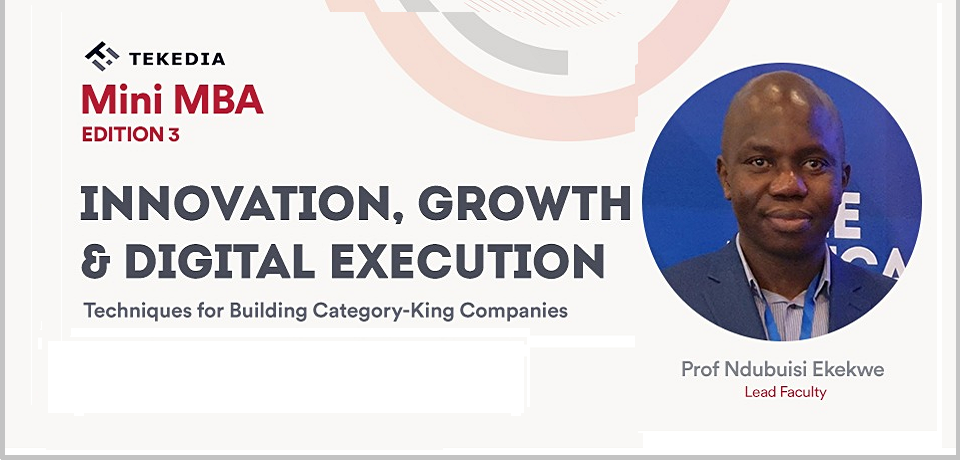
The upcoming Tekedia Mini-MBA, beginning on Aug 10 to Dec 3, will help nurture project champions and innovators, across industrial sectors, for that future. Combining flash cases, Tekedia Live, class notes and videos, we are preparing thousands on leadership ascent. 

Four months, online, and costs $140 or N50,000 naira. We also have Certificate courses on logistics, startups, innovation, etc. We hope you will join us, and get two of my books – Africa’s Sankofa Innovation, The Dangote System -, and a certificate course on Facyber free, along with great knowledge. 

Go for Knowledge, REGISTER.

CODE PROGRAM
MINI Tekedia Mini-MBA costs US$140 (N50,000 naira) per person.
MINR Add extra (optional) $30 or N10,000 if you want us to review and provide feedback on your labs.
Add extra (optional) $60 or N20,000 for each certificate specialty course. You must have attended, begun or about attending Tekedia Mini-MBA to qualify. The following Certificate tracks are available:
CLSM Certificate in Logistics and Supply Chain Management
CSBM Certificate in Startup and Small Business Management
CETS Certificate in Exponential Technologies and Singularity
CPCD Certificate in Personal Career Development
CPFM Certificate in Personal Finance & Wealth Management
CBIS Certificate in Business Innovation, Growth & Sustainability

The Certificate program is completely capstone-based. Tekedia capstone is a research paper or a case study exploring a topic, market, sector or a company. Tekedia Institute supervises the work.

How To Register: 

  1. PayPal: follow this link and pay $140 US dollars (or more if adding the optional components). It supports most global currencies.
  2. Bank transfer (Nigerian naira): Pay N50,000 (or more if adding the optional components) into any of:
    • GTBank 0114016493
    • UBA 1019195493
    • Account owner: First Atlantic Semiconductors & Microelectronics.
  3. Flutterwave: follow this link (naira) or this one (USD) to use your Verve, Visa, Mastercard, Amex, etc cards across Africa and beyond.
  4. Automatic Access: Pay via this Tekedia link for self-automatic enrollment with username.
  5. Zelle:  email us for the Zelle phone number for transfer

After payment, email tekedia@fasmicro.com with participant’s name and code or program paid for, to complete the registration.

Professor Benjamin Uzochukwu is University of Nigeria’s All Time Most Cited Researcher

3

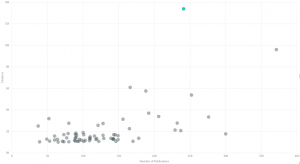
In continuation of our analysis of the issues and needs in the Nigerian higher education sector, our analyst has found that Professor Benjamin Uzochukwu is All Time Most Cited Researcher in the University of Nigeria, Nsukka. Professor Benjamin Uzochukwu led other academics in the University after analysis of the academics with over 1, 000 citations according to the Google Scholar. The areas of specialisations of Professor Benjamin Uzochukwu include Public Health, ?Health Systems and Policy.

Analysis indicates that the average publications of the 68 academics are 127 publications out of 8,698 articles published in the last few years. As at the time of writing this analysis, average citations of the academics are 2,122 with 21.67 as the average impact. Analysis further reveals the minimum publications as 37 published by Professor J.C Ani. These publications have been cited 2,500 times. The minimum citations, according to the analysis, is 1,005. This citation is from 65 publications of Professor Chinwuba Ijoma.

Exhibit 1: Professor Benjamin Uzochukwu [in green] among others

Source: Google Scholar, 2020; Infoprations Analysis, 2020

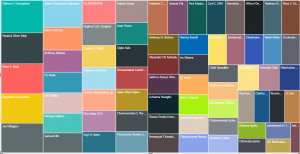
Despite being the leading researcher in terms of citations in the University, Professor Benjamin Uzochukwu’s publications are not more impactful [H-index=40] as those published by Professor Obinna E. Onwujekwe [H-index 44]. The four scores ahead of 40 recorded by Professor Benjamin Uzochukwu make Professor Obinna E. Onwujekwe more impactful in the global academic community. Professor Obinna E. Onwujekwe has 371 publications with 9, 602 all time citations.

Exhibit 2: Professor Obinna E. Onwujekwe is more impactful than Professor Benjamin Uzochukwu

Source: Google Scholar, 2020; Infoprations Analysis, 2020


The $288 Million African Exit

5

The decade of 2000 was the decade of voice telephony. The 2010s was the decade of mobile internet. Today, we are in the decade of application utility where software systems would be used to fix frictions in sectors which are yet to be digitally transformed. Logistics, payment, lending, retail, etc would all evolve in Africa.

The entrepreneurs, the high priests of these movements, would receive higher calls, not from IPOs, but pure buyouts. Yes, exits would ramp out in Africa as founders and early investors begin to cash out. Yes, with lackluster public exchanges for technology companies, most exits would be via acquisitions.

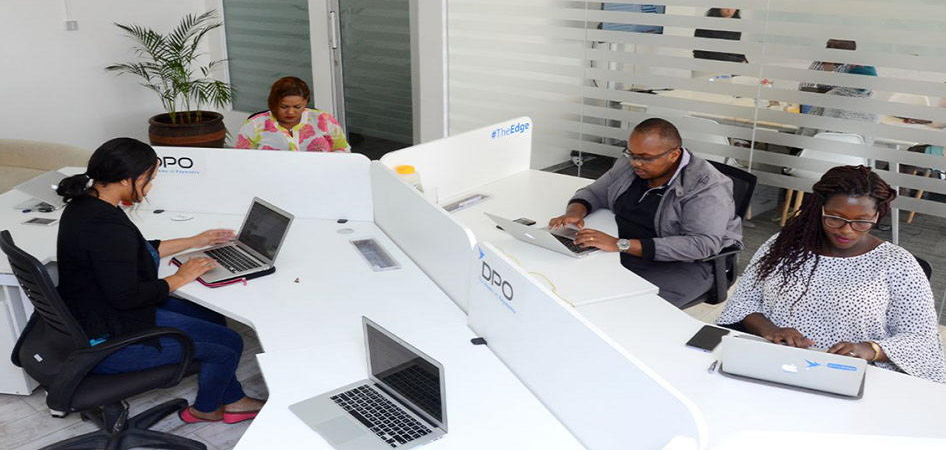
Dubai-based Network International Holdings plc is acquiring  Kenya’s DPO Group, an online commerce and fintech platform in Africa, for $288 million.

—press release below

Network International Holdings plc (the “Company” or “Network International”), the leading enabler of digital commerce across the Middle East and Africa (“MEA”), is pleased to announce that it has entered into an agreement to acquire DPO Group (“DPO”), the leading, high-growth online commerce platform in Africa, for a total consideration of approximately USD288 million (the “Transaction”). The consideration will be almost entirely funded through the proceeds from an equity placing representing 10.0% of the Company’s existing issued share capital, USD50 million vendor consideration shares issued to Apis Growth Fund I, managed by Apis Partners (“Apis”), USD13 million consideration shares issued to the DPO co-founders, with any small remaining balance to be funded via existing debt facilities.

DPO is the largest online commerce platform operating at scale across Africa

  • Rapid growth profile with revenue CAGR of c.40% from 2017-2019 and Total Processed Volume (“TPV”) CAGR of c.30% from 2017-2019. Revenues of USD16 million in 2019
  • Leading e-commerce and mobile money services for >47,000 merchants across high quality brands
  • Present in 19 countries across Africa with South Africa, Kenya and Tanzania representing major markets. Multiple distribution channels with on the ground presence to recruit merchants, combined with direct connectivity to acquiring banks

Strong strategic fit and growth accelerator for Network International

  • Market: consolidates and accelerates our presence in Africa, the most underpenetrated and fast growing payments market in the world. Africa expected to represent c.40% of Network International total revenue by 2024 (27% in 2019), giving us an evenly balanced business in Africa across Merchant and Issuer Solutions
  • Distribution and relationships: brings direct merchant and Mobile Network Operator (“MNO”) relationships, broadening our business in Africa across the entire payments value chain
  • Capabilities and innovation: widens our capabilities and exposure in fast growing online payments and mobile money, enabling merchants to accept a wide range of payments methods
  • Cross selling opportunities: combined incremental capabilities and solutions provide significant cross-sell opportunities to both Network International and DPO customers
  • Disciplined capital allocation: acquisition expected to be broadly EPS neutral in 2022, including integration costs. Double digit ROCE within 3-4 years, and significantly higher thereafter

DPO has seen strong current trading, following Covid-19 lockdowns

  • Digital and online payments market in Africa expected to grow at 19% CAGR [1] over the next five years and Covid-19 expected to accelerate this growth
  • E-commerce penetration in Africa is 0.3% of private consumption, versus c.5% in the United Kingdom and c.17% in China [2]
  • Following stringent lockdowns in DPO’s main market of South Africa during April:
  • DPO signed c.4,400 merchants in June 2020, an all-time high
  • TPV growth year-on-year was 27% in May (57% in constant FX) and 27% in June (49% in  constant FX)

Financing and structure

  • DPO Co-Founders incentivised and aligned through rollover of USD13 million of their DPO ownership into Network International shares (the “Co-Founders Consideration Shares”) and a two year holding period (from the point of acquisition signing)
  • Acquisition consideration to be almost entirely financed through proceeds from a 10% equity placing, USD50 million vendor consideration shares issued to Apis (subject to a three month lock-up from the point of acquisition completion), and the Co-Founders Consideration Shares, with any small remaining balance funded by existing debt facilities
  • Completion of the Transaction is expected in Q4 2020, subject to customary closing conditions including regulatory and anti-trust

Simon Haslam, Chief Executive Officer, commented:

“We are excited by the proposed acquisition of DPO, the leading high-growth online commerce platform operating at scale across Africa. Africa is a vast and diverse continent, representing the world’s most underpenetrated, nascent and fast growing payments markets, where we have seen recent signs of an acceleration in those trends. DPO will further consolidate our presence in Africa, strengthen our position across the entire payments value chain and accelerate our growth. This acquisition will widen our capabilities across online, mobile and alternative payments; bring an extensive and diverse range of direct merchant relationships to our business; and provide a wider range of solutions for our existing customers. We look forward to bringing our two businesses together and welcoming DPO’s colleagues into our group. Together, we have a powerful combination to accelerate digital payments across our regions and deliver significant shareholder value.”

Huawei Picks the Smartphone Prize

3
Most parts of the world have been pushing to cage Huwaei

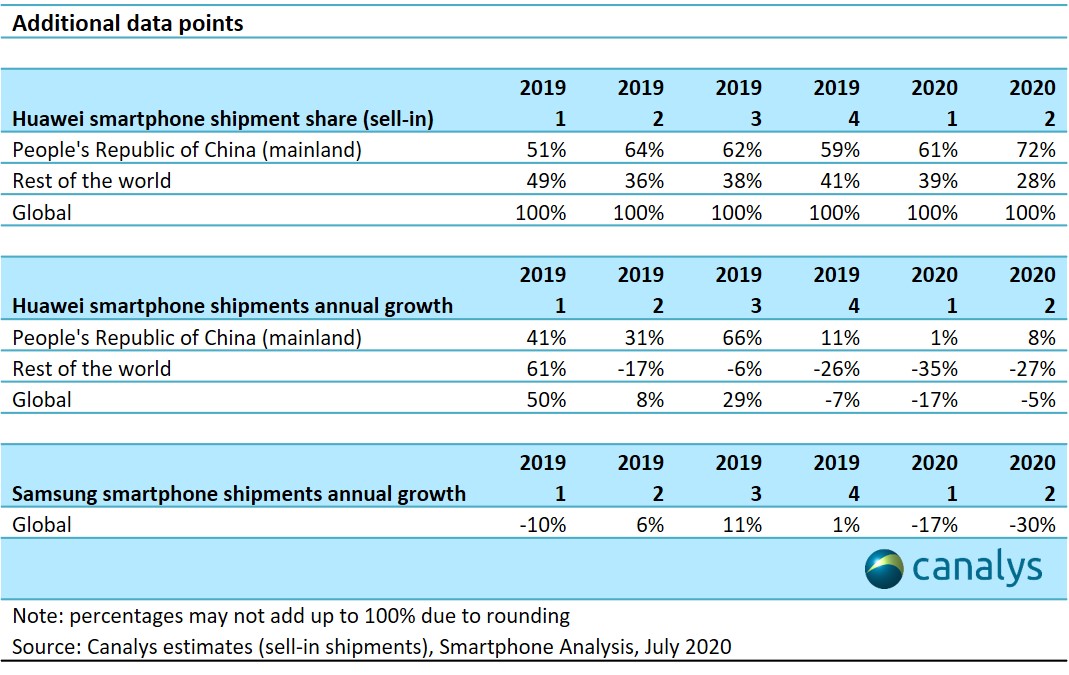
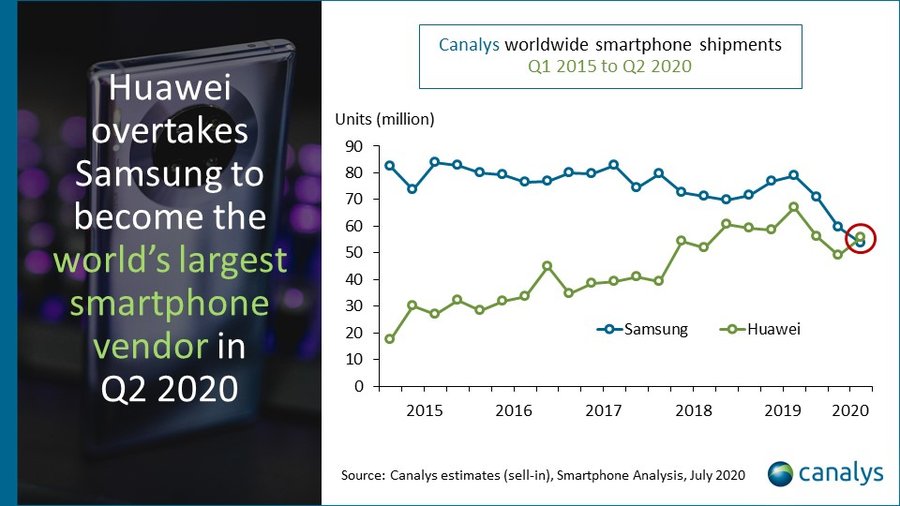
Huawei has overtaken Samsung as the world’s largest shipper of smartphones, on a quarterly basis, virus or no virus. This happened despite U.S. sanctions which forced Huawei to phase out Google services for  its own Harmony operating system, Canalys reports. How do you handle China? Nothing seems to be working for Washington!

Huawei shipped more smartphones worldwide than any other vendor for the first time in Q2 2020. It marks the first quarter in nine years that a company other than Samsung or Apple has led the market. Huawei shipped 55.8 million devices, down 5% year on year. But second-placed Samsung shipped 53.7 million smartphones, a 30% fall against Q2 2019.

Huawei is still subject to US government restrictions, which have stifled its business outside of mainland China. Its overseas shipments fell 27% in Q2. But it has grown to dominate its domestic market, boosting its Chinese shipments by 8% in Q2, and it now sells over 70% of its smartphones in mainland China. China has emerged strongest from the coronavirus pandemic, with factories reopened, economic development continuing and tight controls on new outbreaks.

Of course Samsung has a double play. It may no longer be the world’s smartphone king, but its Q2 profits were up 23% due to strong demand for its memory microchips. The company explains: The Memory Business saw robust demand for cloud applications related to remote working and online education as the impact from COVID-19 continued, while demand for mobile was relatively weak.”