DD
MM
YYYY

PAGES

DD
MM
YYYY

spot_img

PAGES

Home Blog Page 6264

A Job Interview Experience

2

It was late harmattan season, the trees had grown antlers, dried leaves were sometimes trailed into our apartment, and groceries were on short supply …

My roommate had just returned from a job assessment test, which he found easy and he was invited for an interview the following week.
_
He did attend the interview, answering questions fluidly and believed the job was all his to grab, but then a long empty silence followed for he was willing the phone to ring.

No email. No call. No SMS. He had delayed applying for other roles and even turned down offers in the hope of securing a gig at this company.
_
But unfortunately, he got a delayed response of their rejection after a long wasted period of time.

Which led him into a depressed state, feeling heavy and slow, his mind choked with mud as he pondered, he began to cry.

He felt like a small ball, adrift and alone in a big world of uncertainty which he had never foresaw after graduating from college.
_
My friend, my friend, alas! Thank goodness he has been off that pitch.

Here is a lesson for hiring managers and outsourcing agencies.

How and when you dismiss candidates speaks volumes about your company and its culture.
_
Once you’ve conducted an interview and have made your decision, quickly do the following:

• Let the rejected candidate(s) know as soon as possible of their disqualification.

• Explain in one succinct sentence or paragraph why you’re declining their application or can’t go any farther with them.

• Always personalize your rejection mail or phone call.

• No false promises of staying in touch, just wish them all the best in the future and leave it at that.

• Ask for feedback on your hiring process, tho’ this is optional.

P.S.: With this you won’t hurt anyone’s feeling. Rather you’ll help in putting them out of their misery as quickly as possible.

Gentlemen and Ladies, if you’ve ever been rejected, hear this: When the answer is NO, there is a better YES down the road.

… My friend is a living testimony!

The New US Education Rules Throw International Students into Crisis

0

Immigration and Customs Enforcement (ICE) announced modifications Monday that temporarily exempt non-immigrant students. The decision cuts across all categories of the Student and Exchange Visitor Program (SEVP), including the F-1 and M-1 students.

The news release published by the Department of Homeland Security said non-immigrant students are not allowed to switch to only online classes or change their course selection to participate in online classes only.

“Non-immigrant students within the United States are not permitted to take full course of study through online classes. If students find themselves in this situation, they must leave the country or take alternative steps to maintain their non-immigrant status such as a reduced course load or appropriate medical leave,” the news release said.

The development has thrown thousands of international students into risk of deportation. COVID-19 pandemic is forcing universities in the United States to switch completely to online studies, but for international students, it means leaving the United States.

The “alternative steps” suggested by ICE means transferring to schools with in-person instruction because universities using a hybrid model, such as a mix of online and in-person classes are exempt. But it is not so easy to transition to other schools in the middle of global health crisis, which means, it will only heighten the anxiety of the unprepared students.

But the guidance is seen as a result of president Trump’s push for schools to resume this fall. The guidelines’ announcement was made by the Immigration and Custom Enforcement on the same day that universities announced they’re going completely online.

Trump has insisted that schools and universities return to in-person instruction as soon as possible and reiterated his preachment for schools to resume in the fall after the guidance was announced.

Brad Farnsworth, vice president of the American Council on Education that represents about 1,800 students, said the announcement caught him and many others by surprise.

“We think this is going to create more confusion and more uncertainty. What we were hoping to see was more appreciation for all the different possible nuances that campuses will be exploring,” he said.

The situation is even more challenging considering that many countries are still on coronavirus lockdown that restricts international travels. And if in the fall the health crisis deteriorates, forcing the universities running the hybrid model to go completely online, the students’ lifeline would be quashed abruptly, leaving them in the middle of nowhere.

CNN reported that Theresa Cardinal Brown, director of immigration and cross-border policy at the Bipartisan Policy Center saying the situation doesn’t question the credibility of these universities, the problem is coronavirus.

“These are not some fly-by-night universities, these aren’t scams, these are legit universities who would normally have in-person curricula but for coronavirus. The bigger issue is some of these countries have travel restrictions on and they can’t go home, so what do they do then? It’s a conundrum for a lot of students,” she said.

For some universities, the ICE decision doesn’t come close as a solution to a complex problem. Harvard University that has moved all its classes online expressed concern over the plights that international students have been thrown into.

Larry Bacow, Harvard University president said the development undermines the thoughtful approach many institutions have taken on behalf of the students.

“We are deeply concern that the guidance issued today by US Immigration and Customs Enforcement imposes a blunt, one-size-fits-all approach to a complex problem giving international students, particularly those in online programs, few options beyond leaving the country or transferring schools” Bacow said.

He added that the guidance by ICE “undermines the thoughtful approach taken on behalf of students by so many institutions, including Harvard, to plan for continuing academic programs while balancing the health and safety challenges of the global pandemic.”

Many see the guidance as part of Trump’s way of advancing his anti-immigration policies. The Trump’s administration has intensified anti-immigration rules recently, using the COVID-19 pandemic as an excuse. Last month, the administration announced the ban on immigrant visas on the alibi of safeguarding jobs for the American people.

Though Bacow said they “will work closely with other colleges and universities around the country to chart a path forward,” the conditions appear to give the institutions a little or no choice. Part of the rules says that international students won’t be spared from deportation even if an outbreak forces their schools to move from in-person classes to online during the fall semester.

Financial Modelling in Tekedia Institute

0

To help our members deepen capabilities in financial modelling, our expert, Michael Olafusi will anchor a day during Review Week. Mike has received the Microsoft Most Valuable Professional (MVP)award  six times. He developed that Nigerian financial market analysis tool in Microsoft Office store and he led the development of the Nigerian stock analysis digital board. He created the Nigeria Market Data platform and has managed many financial modelling projects. Besides his regular Tekedia Mini-MBA session, the video session will help our members on financial modelling. Mike holds MBA and earned BEng from one of Nigeria’s best technical universities (FUT, Akure). I am confident after his session, we can all understand how to build financial models for our functional areas, companies or startups. Financial templates will be provided.

He is a Certified Advanced Financial Modeler (AFM), a 6-time Microsoft awarded Most Valuable Professional (MVP),a MCSA BI Reporting expert, and a Microsoft Certified Trainer (MCT).  He is a Financial Modelling and Valuation expert at California-based TopTal whose client base includes many fortune 500 companies. Michael Olafusi is the Lead Consultant at UrBizEdge and a Financial Analyst Fellow at Brightmore Capital where he analyses financial statements of prospective investments, reviews business plans, does financial modelling of projections and growth plans, and models valuation of potential investments (asset value, comparables, DCF, etc.), et.


6-Time Microsoft MVP To Lead Session on Financial Modeling & Tools at Tekedia Mini-MBA


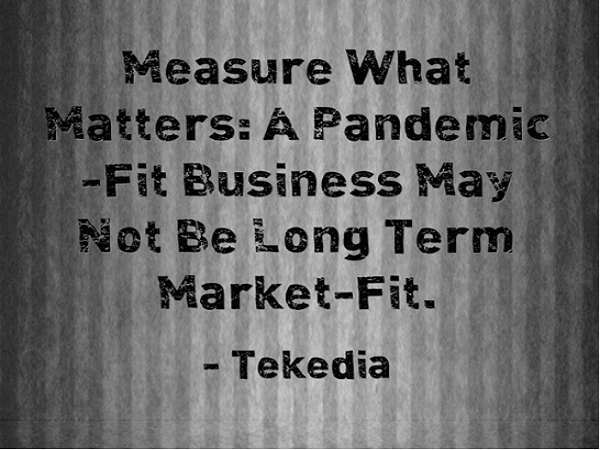
Measure What Matters: Long-term Value Creation Will Always RULE

1

The challenge before CEOs/founders is to make sure that the post-pandemic frictions are still relevant in their missions. I noted how some people are giving up coffee, after surviving lockdown without Starbucks. Yes, nothing bad happened without the coffee rituals. So, post-pandemic, they are now saving that $6 per cup of coffee, causing massive dislocations in the friction space for some coffee providers like Starbucks. So, even though coffee remains a market-fit product, the pandemic has changed it, at least for now. That is a change in a market and must be modelled in the playbook.

You cannot afford to be pursuing pandemic-fit opportunities, losing insights on the durable market-fit ones. You need to think long-term even as you take care of today’s opportunities: long-term (not ephemeral) value creation will always RULE.

Yes, as U.S. doctors abandon tele-medicine despite the optimism during the pandemic, many providers are learning that old habits do not just die easily. Tele-medicine does not fit into the insurance business model and doctors, especially in small clinics, struggle to get paid. But with in-person visits, insurers pay faster. So, fixing this paralysis in the U.S. will not come via just a better tele-medicine product, but rather, fixing the insurance framework. Until you measure, you will not understand what is driving the numbers.

Physicians initially responded to these changes. Based on a sample of more than 50,000 clinicians who are clients of Phreesia, a health care technology company where two of us (D.L. and H.H.) work, we saw a sudden and dramatic rise in telemedicine (see the chart below). From almost no telemedicine visits before the pandemic struck in the U.S., by early April almost 14% of the usual weekly number of pre-pandemic visits were being conducted via telemedicine. The assumption among many was that, after witnessing the benefits of telemedicine, physicians and patients would embrace it and growth would continue.

That hasn’t happened. In fact, the use of telemedicine is now steadily declining and during the week of June 14 was used for only 8% of the usual pre-pandemic number of visits.

Capstone for Tekedia Mini-MBA Certificate Courses

8

Tekedia Certificate courses are completely capstone-based. Tekedia capstone is a research paper or a case study exploring a topic, market, sector or a company.  You must have attended, begun or about attending Tekedia Mini-MBA to qualify to register. At the moment, we cover the following areas:


Sample Topics

You will pick a topic which the Institute will approve. Then you will go and execute that project. Think of this as a final year student product in a university. We expect it to last a maximum of 3 months. The member will submit a report at the end of the capstone. For someone who wants to start a business, you may choose a topic to do market study in that sector. You design a questionnaire and execute your study. Essentially, the essence of this is to apply what you have learnt in the Mini-MBA to produce a practical business document. Here, we provide potential capstone topics (the topics are limitless):

  • Developing a digital logistics strategy in Lagos
  • Agribusiness Business plan for ABC Limited  
  • Market study for website design business in Northern Nigeria
  • The competitiveness positioning of Jumia in African ecommerce
  • The future of fintech in Ghana
  • Implication of AI technologies in African banking
  • My personal career roadmap: 3, 5 and 10 years
  • Building wealth via Treasury Bills
  • Business longevity roadmap for ABC Limited
  • Angel investing market in Kenya
  • A comprehensive business plan with market data for ABC Limited
  • Mobile banking and impact of USSD

Procedures

Here are what to do:

  1. Pay, if you have not, for the Certificate program  here
  2. Send evidence of payment to Admin (email below). Include the Certificate program or programs you have selected (e.g. CBIS, CPFM)
  3. Email three research topics as suggestions for Admin to approve. If you chose more than one certificate program, you need to have three suggestions for each. Where you have registered for multiple programs, we will give you enough time to work on them. You do not need to have completed Mini-MBA to begin your capstone; both can run concurrently to save you time. 
  4. A small committee looks at the three proposed topics and then picks one. Once that is done, the member is asked to develop the topic. Here are options:
    • (A) Submit a one-page study structure: tell us how you plan to approach this research or project OR
    • (B) Submit a work-in-progress table of contents: tell us potential topics of sections in this work
    • While you can do both, we need just one. Once that is done, you will receive comments. Then, you begin your study.
  5. Begin your work and keep in touch with Admin with any question.
  6. Submit report or reports to Admin
  7. The Institute evaluates, and sends feedback. Update the report or reports where necessary and finalize.
  8. Receive your certificate(s) from Tekedia Institute for completing the work.

Contact: tekedia@fasmicro.com