DD
MM
YYYY

PAGES

DD
MM
YYYY

spot_img

PAGES

Home Blog Page 6265

Symplifix, An On-Demand Warehouse, Coldroom, etc Aggregator Raises Capital

3

Today, I am happy to announce that one of the startups participating in our Tekedia Mini-MBA has raised half of the early stage capital it needs. Symplifix is a digital marketplace which uses data and technology to aggregate grain dryers, silos, cold rooms and warehouses. It will begin operations in Nigeria in September.

The company’s goal is to offer these facilities to farmers, small and big enterprises, manufacturers, importers, exporters, freight companies, logistics services providers, etc, on an on demand pay as you use basis at pocket friendly rates.

In a note to Tekedia Institute, the company noted that food security sustenance in the communities is extremely important to it. To that end, it is paying special attention to small holder farmers who run a greater risk of losing their produce due to poor, inadequate and unavailable preservation and storage amenities.

Symplifix users will be able to save time, more money and also retain a larger percentage of the earnings from their businesses without having to shell out large sums of money to pay for renting warehouses on a long term basis, or to buy any of the equipment it will offer them to use.

Manufacturers can enlarge and reduce their distribution networks faster and get their products closer to their customers.

Our community of users will also be able to add warehouse capacity swiftly to manage the challenges of surplus inventory especially during peak seasons.

We are happy to announce that we have raised an undisclosed amount of funds from a family office.

We invite you to partner with us to unlock value for all the operators in the real sector and look forward to working with you.

Let’s join hands to grow businesses and change lives.


According to the CEO of Symplifix, Ejike Ekwenibe, Week 1 Challenge Assignment in Tekedia Mini-MBA was helpful for this raise. We certainly do not take any credit than to continue to work harder to help our members. Yes, at Tekedia, we will continue to provide practical education to the community of innovators, project champions and entrepreneurs. 

Please click and drop your contact so that Symplifix will tell you when it launches. And it is hiring!

If you are interested in our offerings and wish to be informed when we launch, please contact us

via info@symplifix.com

07041000710 sms only.

Remote Work: Security Implications for enterprise infrastructures

2
Virtual event or meeting has gone mainstream, benefiting Zoom

Thanks to coronavirus, many organizations that hitherto did not give remote work any significant consideration are seriously considering the possibility of a post-covid world where remote working is the norm among members of staff. Others are now considering large scale remote working (Work-From-Home, WFH) on a more permanent basis, as a cost cutting measure. 

Traditionally, security architectures are designed to have all (or most) trusted users within the high trust zone (internal company network) while VPNs, firewalls etc. are used to control and protect access from zones of lower trust. This paradigm has influenced how we approach security in very many ways -be it in security governance (policy controls), physical controls, technical controls and complimentary controls i.e. the use of one type of control to mitigate weakness linked to another type of control (e.g. physical access control to protect a system that is vulnerable to a JTAG memory extraction). Permanent, wholesale remote working will cause a shift in the tectonic plates of the threat landscape, altering known attack paths and thereby rendering known vulnerability mitigation strategies inadequate for the challenge. Companies must re-think, re-strategize and re-tool for the new realities that await. To get this conversation going, here are interesting points on some vulnerabilities that need to be re-assessed as companies adapt to this new reality. 

Legacy Systems

Legacy technology is like that old pair of jeans you wore as a teenager. “They are comfortable” was always your answer to any inquiry. In a world of exponential change, legacy technology is trouble. Continuing to use outdated technology of all sorts is costly beyond the financial spectrum.
In continuing reluctance to change, companies often justify continuous use of these legacy systems by using compensating measures like preventing internet access to such systems, thus reducing the attack surface of these systems. 

In the WFH workplace, some legacy systems will have to be put on the internet to allow for remote employee access. This action will widen the attack surface of the legacy systems and increase overall likelihood of an attacker infiltrating your entire infrastructure. For companies that must use legacy systems, (if you can avoid it, you should) there is a need to re-think and possibly re-design the compensating security measures to address this new reality. Examples include placing legacy devices in a separate network segment, hardening access control requirements for legacy systems, turning them on only during working hours, etc.

Network Availability

As WFH continues to gather steam, resilience of the enterprise network infrastructure becomes increasingly paramount as well. Managing load on the network will become an increasing challenge for CTOs. As they rapidly roll out enterprise VPNs and remote desktop solutions to give employees access to sensitive resources and internal applications, CTOs must find ways to balance the volume on the network. Plus, they need to keep it secure. 

On secure communications, companies now rely on VPN technology for secure remote access. VPN services are either locally hosted by the companies or paid for as a service. However, it is not the silver bullet that solves all network security issues. Firstly, a badly configured VPN will leave you as exposed to attacks as one with no VPN. Secondly, if service availability is not carefully considered in VPN installation, you could have a serious vulnerability of a “single point of failure”.

Vulnerability to service disruptions in WFH could practically ground the entire organizations’ activities. In a scenario where all users are dependent on some server(s) to access official tools & resources while working remotely, then anything going wrong to that server(s) (e.g. DOS) means everyone loses access and work grinds to a halt. The popular D/DOS attacks create large volumes of ‘garbage’ traffic to saturate the network, but there are others such as attacking the intricacies of the VPN protocol. A flow as little as 1Mbps can knock a VPN service offline. Sadly, in D/DOS circumstances (whatever the type), reverting to paper-based activities as a backup is not practicable due to geographical separation between WFH workers. Thus, in a WFH world, the impact of availability-linked attacks is significantly higher. 

Companies must re-evaluate their threat scenarios considering these new possibilities and respond appropriately with the right tools and enterprise infrastructure to mitigate this threat. Consider efficient bandwidth management, load balancing, cloud infrastructure, and prioritizing the use of trusted-vendor applications that are tested and certified to a certain degree of assurance.

(Un)Authorized Device Use 

It is often said that “our true self, is who we are when no one is watching”. This statement is no less true when people work from home. People tend to default to habits, including those they would not indulge in publicly. This ranges from benign habits like working in a pyjama to less agreeable ones like using official devices for viewing pornographic content. It is well known that pornographic sites are notorious for social engineering, drive-by and watering hole attacks. Thus, such employee actions should be worrying for employers. A recent study conducted by Kaspersky indicates that “51% of workers who admit they have started watching more adult content, since working from home, say they have done so on devices they use for work-related purposes. Nearly a fifth (18%) of workers even do this on devices provided to them by their employers, with 33% admitting to watching adult content on their personal devices that they also use to do their work.

Companies must critically reconsider what constitutes “acceptable use” policy of the organization and deploy appropriate tools that enforce these policies.

Shadow IT

The line between personal and official devices blurs for a significant number of users in a WFH setup. For example, the company’s computers are connected to home devices like printers, scanners etc. and connect to the internet via the home network. Sadly, most of these consumer-grade devices are notoriously insecure and have very serious security design flaws. In the name of usability (ease of use), they are simplistically designed, focusing only on the device’s core functionality. Most of them do not come with security-enhancing functionalities that may be found in enterprise versions of the same device. An example is a home device that fails to notify users when firmware updates become available, even though those updates are essential to patch security holes, some other devices will not accept long or complex passwords. On the other hand, consumer-devices that come with good security features tend to be too difficult to configure for the ordinary user and as such those features are left untouched. 

Thus, a vast majority of these devices are not properly maintained, not securely configured or their software might be unpatched, hence vulnerable. The increasing adoption of connected home automation (smart home) devices to the home network, further heightens the intractability of properly managing the attack vectors.

From an enterprise perspective, it is important to rethink the difference in context that WFH involves and how it impacts organizational risk posture. This should reflect on the choice of enterprise tools that must be deployed to protect devices and network communications. Such tools include endpoint protection software, secure routers/MODEMS, VPN software, etc.

Remote Access Policy

As people adopt WFH, traditional office centred security policies will serve increasingly smaller audience. Thus, policy regarding remote working environment should include prevention of eavesdropping by encouraging staff members to stay in secluded areas when participating in (sensitive) meetings where strategic company matters are discussed.

Policies regarding remote login should also be hardened. As much as possible prioritize multifactor authentication for user authentication.

Incident Response Turnaround

In the event of a cyber incident, responsiveness/turnaround time between when information is shared, to when it is acted upon becomes very difficult to predict and control. Hence a minimum responsiveness time should be defined for all WFH users to encourage active engagement and faster responsiveness. 

CONCLUSION

The vulnerabilities mentioned above are by no means exhaustive but should serve as a catalyst in starting the conversations around the long-term security implications of WFH and what changes must be done to equip the enterprise of the future.

Finally, changes to the threat landscape means that companies will need to be adaptable in taking preventive steps to mitigate risks and stay ahead in the game.

How Are You Making Decisions?

0

I want to share a thing with you in this piece that may guide your next couple years. It has guided mine so far as well. So please enjoy the read.

It’s about decision making

A few years ago when I was preparing for my ICAN Professional Exam, I took a course called Strategic Financial Management (SFM).

In SFM there was this topic called Derivatives. A derivative is one nuanced topic in SFM. Because of this, a lot of people tend to shy away from it, but I took a particular interest in it.

One, because knowing it means I will get the opportunity to teach those who don’t know it (never mind me, I like to teach). Two, because intelligence in it matters to me for self-esteem sake.

I took interest in it and became the go-to-person to consult on it. Mission accomplished :)

But that’s not where I’m going. A segment inside Derivative is called “Option.”

In a simple term, an option is a financial instrument that gives you the right, not the obligation to buy a given asset at a given price on a future date.

The implication of an option as a financial instrument is that it allows you to buy an asset for say $100 on a future date even if the asset’s market price is $164.

Invariably, you have an upside of $64 immediately if you exercise the option.

And if the asset’s market price on that future date is $45, you will choose not to exercise an option that allows you to buy the same asset for $100.

No harm! Just do what’s best for you.

What I’ve not told you yet about an option is that it has a price. Basically, for you to have an option, you will pay quite a small (negligible) price say $5 for an option of say $100.

The implication of the option price is simple.

If on that future date, the asset is selling for less than your option gives you a right to buy it, you won’t exercise such right (to buy) and you will lose the $5 (option price).

On the other hand, if the asset is selling for an amount higher than your option gives you the right to buy, you exercise such right and make a massive gain.


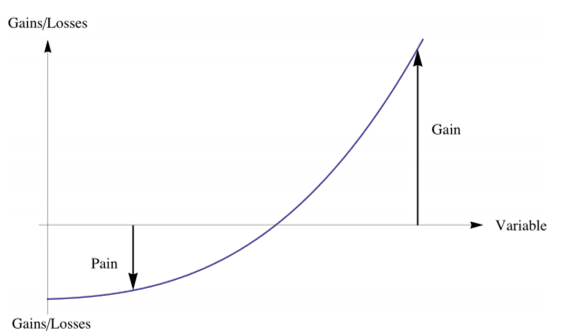
Now, from what I’ve described so far, you will agree with me that in this scenario, your maximum loss is capped at $5 while your maximum gain is theoretically unlimited, unbounded.

That was the lesson I learnt from derivative as a result of my fascination with it.

Let’s talk about how that applies. Before that, let me show you a visual representation of what I just described.


I taught this topic passionately to my Professional Colleague and we all finally got qualified as a Chartered Accountant one time or the other (I think I was part of the last batch to qualify).

Much later in life, the subject of decision making and taking bets will become of high priority for me. And I needed to devise a framework for making decisions.

The need to make smart decisions that have potentially unlimited upside and a known and well-defined downside quickly brought to my remembrance lessons from Derivatives.

Ever since I realized that anytime it’s time to make a decision (a bet), I start by accessing the worst-case scenario.

I am usually very objective and particular about my assessment of the worst-case scenario. That’s important because it’s critical for my decision.

If the worst-case scenario of such bet is acceptable, I move on to estimating the potential upside and characteristics of the upside (limited or unlimited).

Knowing those two variables and their nuances, I make decisions.

Now, where has that gotten me?

There are times that I lose. But remember I’ve established that they are acceptable losses. Life is a risk and we must be ready to accept some losses in other to stand a chance for potential upside.

Times of loss doesn’t particularly move me. I just write off my loss.

No angst at all. Of course, there is the feeling of I wished it had worked out. But never a feeling of that was too much a loss to suffer.

But I must say, the few upsides that I’ve gotten over the period has far more compensated for any loss I might have suffered.

That’s the way the principle works remember: Potentially Unlimited Upside

The message I’m trying to get home should be apparent by now.

Decision making is nuance and until you get better at it, you may be stuck in life. In fact, if you make an unwise decision, it will cost you more than you could possibly take. Devastating is sometimes such failures.

I’ve given you a simple framework that can potentially make you a super decision-maker who always win in a big way. Leverage that framework.

If you want to take a bet (not NairaBet please, I don’t encourage that) on a course of action,

  1. Determine the worst-case scenario under a very strict rule
  2. Estimate the potential upside its characteristics
  3. If the worst-case scenario is acceptable, and the upside is unlimited, go forward and take such bets. Otherwise, neglect it or gather more information.

Do that, and I can guarantee that you would be fine over time.

Post Covid-19 Survival Strategies for Business Owners

0

The Post COVID-19 period is here; though we’re already living in the reality of the “future shock” that was long predicted and most importantly, you can’t but make sure that you try your best to ensure that you move with the wave.

We are currently in the wave of change and it’s a massive wave of change. Change is inevitable. And, wisdom is required for direction if you’re going to make massive impacts Post COVID-19. Today, I’ll be trying my best to provide you with basic thoughts and ideas that I think will help you toward redefining your business as well as work in this Post COVID-19 Period. 

And, they are these things:

INFORMATION EXPLOSION. 

According to research conducted by a group of social scientists, It had already been predicted that by 2020, knowledge will increase in your field every 72 hours. You need to keep up with massive knowledge and new ideas and thoughts that’ll be shared in your field or areas of interest in 2020. So you’ve a lot to keep up with. Here are some actionable steps you can take: 

  • Register an account on an important thought leadership webpage in your field of interest, make sure that you’re updated with the latest industry knowledge in your field and industry. A Lot of things had practically changed. And, you need to keep yourself updated daily, weekly, monthly and yearly with new insights.  
  • Build a brand on LinkedIn and other professional development platforms that’ll help you gain access to visibility.  If you don’t have one, just launch the webpage here: www.linkedin.com to register an account.  Use Facebook and Twitter to build a remarkable thought leadership brand, followership and profiling. 
  • Learn Copywriting Skills to write a persuasive sale copy for your business.  
  • Learn Coding Skills and most importantly, you can pay to learn website development on platforms like alison.com; edx.com; cousera.com; a more localized e-learning platform are tuteria.com; prepschool.com; tutor.ng and learnfast.ng to learn website design, and some of you could opt-in for content management website programming and important high income skills 
  • Learn Public Speaking, Networking and Pitching Skills. This will help you know how to pitch your business offering to get funds. Check important platforms like opportunitydesk.org; opportunitiesforafricans.com; and thepollinationproject.org for funding, trainings, scholarship and fellowship opportunities

TECHNOLOGY REVOLUTION

Technology is the new amplifier and a gold mine, you can but leverage on tech tools now to amplify your market reach and to make massive impacts. Some steps to consider:

  • Design mobile apps to solve problem. 
  • Launch a website or a simple webpage. 
  • Leverage on digital marketing to push online marketing. 
  • Open a social media page for your business. 
  • Use free platforms like vconnect.com; flutterwave.com and nextmarketday.com for free classified ads for your businesses. 

INCREASED COMPETITION. 

We now live in a world of increased competition and the world is competition, competition and competition. Think of how you could be entrepreneurial in your organization. Even if you work for an organization, learn to include an entrepreneurial model to build scale and traction for your organization. To be competitive learn to amplify your knowledge access by using technology tools to build competitive advantage for yourself. Your ability to have access use technology tools will simplify your business operations. Some steps to consider:

  • Use disha.ng to build a simple profile page for yourself and business. 
  • Teach all of your workers on how to use digital tools like Skype and ZOOM to hold virtual meetings.
  • Use apps like “Slack App” for virtual co-working. 
  • Use Facebook Classified Ads to put your products and service offering in the faces of people who need it. 
  • Google Ads mainly Search Engine Optimization(SEO) to optimize your website for gaining visibility, profit making and impacts.

PIVOT YOUR BUSINESS MODEL.  

Look for new ways of doing things. Don’t be stereotypical to the past ways of doing things. Be open to new ideas and ways of business operational as well as study the current trends in your industry. Some steps to consider:

  • Look for new market trends. 
  • Look for ways to build business within basic areas of servicing the basic needs of your customers. 
  • Craft out a scalable model that directly connects you with your customer using the Business to Consumer(B2C) model. 
  • Learn tools like business model canvassing, business proposal writing as well as business pitch deck crafting to build a structure for your business. 

LOOK FOR INDUSTRIES WHERE YOU CAN MAKE PROFIT

In this season of global pandemic, most businesses and industries are not profitable. You need to look for ways to tweak your operational model as well as open your eyes widely to see industries that are highly profitable. Some steps to consider:

  • Launch an ICT oriented business. Set up website development, branding, social media management and online adverts placement company. Even if your business is not into IT service or product delivery, look for ways to include technology tools into your business operations. 
  • Launch Agricultural-based and Food Processing businesses. I have not seen anybody in this world who doesn’t need food for survival. Even if you don’t have the flare for agriculture businesses, you can also contribute within the value chain by contributing to food processing and packaging. 
  • Launch Medical Supplies business. With the current increase in the cases of people affected by Coronavirus; there are various guidelines given by WHO and various healthcare agencies. You can start businesses that constantly supply noise masks, face shields, hand sanitizers as well as thermal thermometer use for checking body temperature to individuals, companies, organization, agencies and industries.  

With these ideas of mine, I believe you can be battle ready to make a lasting impact to survive during Post COVID-19. 

Have a great time.

A Job Interview Experience

2

It was late harmattan season, the trees had grown antlers, dried leaves were sometimes trailed into our apartment, and groceries were on short supply …

My roommate had just returned from a job assessment test, which he found easy and he was invited for an interview the following week.
_
He did attend the interview, answering questions fluidly and believed the job was all his to grab, but then a long empty silence followed for he was willing the phone to ring.

No email. No call. No SMS. He had delayed applying for other roles and even turned down offers in the hope of securing a gig at this company.
_
But unfortunately, he got a delayed response of their rejection after a long wasted period of time.

Which led him into a depressed state, feeling heavy and slow, his mind choked with mud as he pondered, he began to cry.

He felt like a small ball, adrift and alone in a big world of uncertainty which he had never foresaw after graduating from college.
_
My friend, my friend, alas! Thank goodness he has been off that pitch.

Here is a lesson for hiring managers and outsourcing agencies.

How and when you dismiss candidates speaks volumes about your company and its culture.
_
Once you’ve conducted an interview and have made your decision, quickly do the following:

• Let the rejected candidate(s) know as soon as possible of their disqualification.

• Explain in one succinct sentence or paragraph why you’re declining their application or can’t go any farther with them.

• Always personalize your rejection mail or phone call.

• No false promises of staying in touch, just wish them all the best in the future and leave it at that.

• Ask for feedback on your hiring process, tho’ this is optional.

P.S.: With this you won’t hurt anyone’s feeling. Rather you’ll help in putting them out of their misery as quickly as possible.

Gentlemen and Ladies, if you’ve ever been rejected, hear this: When the answer is NO, there is a better YES down the road.

… My friend is a living testimony!