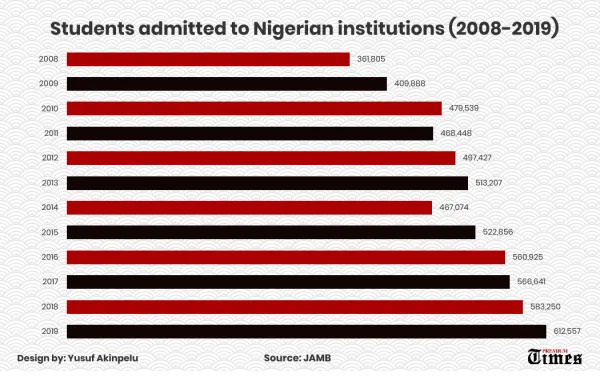
In Fall 2019 Semester, above 18.2 million students enrolled in U.S. post secondary educational systems. When you add the Spring and Summer of that year, you could be hitting close to 25 million students. In Nigeria, in 2019, two million applied for post secondary education but only about 613,000 enrolled due to mainly limited space; Nigeria has capacity for 600,000 students in our post secondary schools. The U.S. has a population of 328 million, Nigeria has 200 million.
If you run the numbers, you will see the massive gap: A 328 million-nation sends 25 million to post-secondary schools; another of 200 million people does only 613,000! Yet, we do read those – “Africa will leapfrog the West”, “It’s our century”, etc – because we are making mobile apps. But in reality, close to one million students stay home because Nigeria does not have space for them, even when they have passed the entrance exam and meet other requirements. Certainly, online education which removes the challenge of space should be considered as part of the future to fix the paralysis.
Nigeria needs to fix this challenge. It is an unfortunate career ceiling on the millions of our young people. Do not tell me there are no jobs for graduates upon graduation. Sure, that is unfortunate but the core reason for going to school is not to find jobs, but to liberate the mind. We need to make space available!
Across all the educational institutions in Nigeria, two-thirds of about two million Nigerian candidates who applied for tertiary education in 2019 were not admitted, according to the JAMB.
Data from the Joint Admissions and Matriculation Board shows that this is not because they did not pass, but because there is not enough room for all of them.
While about two million students applied for the Unified Tertiary and Matriculation Examinations and Direct Entry, the country’s institutions had a target of 600,000, but they ended up admitting 612,557 as of June.
The admission data released by JAMB shows that the nation’s universities admitted a total of 444,947 students; polytechnics and monotechnics, 96,423; colleges of education 69,810; and innovation enterprise institutions, 1,377.
Meanwhile, of the two million students who applied, a little above 1.7 million scored 140 and above, the cutoff.