DD
MM
YYYY

PAGES

DD
MM
YYYY

spot_img

PAGES

Home Blog Page 63

BNB’s Path to $1,400 Appears Clear, But Ozak AI Projection Shows 100x ROI Potential

0

BNB is once again capturing market attention as one of the most structurally strong large-cap tokens heading into the next crypto cycle. With deep liquidity, a massive global user base, and the expanding utility of the BNB Chain ecosystem, analysts increasingly believe BNB has a clear and achievable path toward the $1,400 region. Its long-term fundamentals, token burns, and exchange-driven demand provide a consistent base of support that many other altcoins cannot match.

Yet even with this compelling setup, analysts across multiple research desks agree that Ozak AI—a fast-rising AI-native token—offers far more explosive ROI potential. With early-stage affordability, real-time AI functionality, and accelerating presale demand, Ozak AI is emerging as one of the strongest high-growth contenders for 2025 and 2026.

BNB Shows Strong Structure as Demand Rebuilds

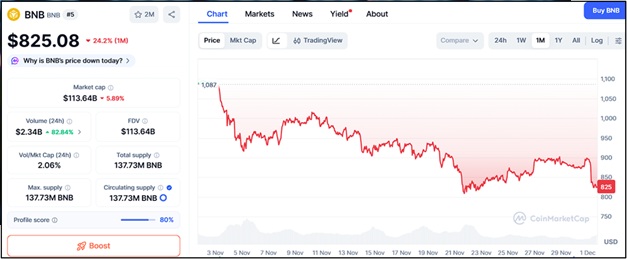
BNB, trading near $825, continues to maintain a healthy technical structure supported by strong accumulation zones at $802, $771, and $743, where long-term holders have repeatedly stepped in during corrections. These areas act as strong floors for BNB, reinforcing its reliability even during market volatility.

To trigger a broader upward expansion, BNB must break through resistance at $854, $892, and $930, each level representing a historically important point where momentum-driven rallies often begin. With stronger exchange activity, growing adoption across the BNB Chain ecosystem, and consistent burn mechanisms reducing supply, analysts project a long-term trajectory that could push BNB toward $1,400 in the upcoming cycle. However, as a large-cap asset, its ability to deliver extremely high multipliers is naturally limited.

Ozak AI Offers a Far Steeper ROI Curve Than Large-Cap Assets

While BNB’s growth outlook remains strong, Ozak AI (OZ) presents a vastly different opportunity—one centered on early-stage pricing and deep AI-native utility. Ozak AI is not simply a token; it is a high-performance intelligence layer that integrates real-time market prediction, cross-chain data processing, and automated decision-making into Web3 systems.

Its millisecond-speed AI prediction engines can analyze live market behaviors across multiple chains simultaneously, while its partnership with HIVE enables lightning-fast 30 ms trading signals used to identify actionable trends instantly. From traders to developers, the use cases for Ozak AI’s technology extend far beyond speculation, making it a functional tool in the world of automated crypto intelligence.
The ecosystem goes further with SINT-powered autonomous AI agents capable of interpreting voice commands, running automated trading strategies, analyzing on-chain data, and executing workflows across decentralized applications. This places Ozak AI squarely at the intersection of two of the fastest-growing global sectors: artificial intelligence and blockchain automation.
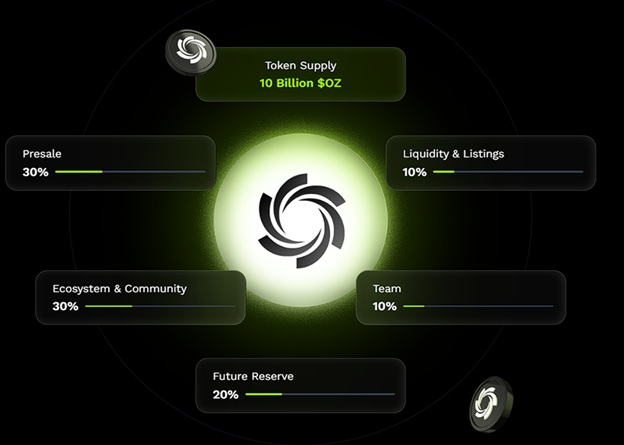
Because Ozak AI is still in the OZ presale phase, its multiplier potential is significantly higher than that of mature large caps like BNB.

Presale Acceleration Strengthens Ozak AI’s 100x Outlook

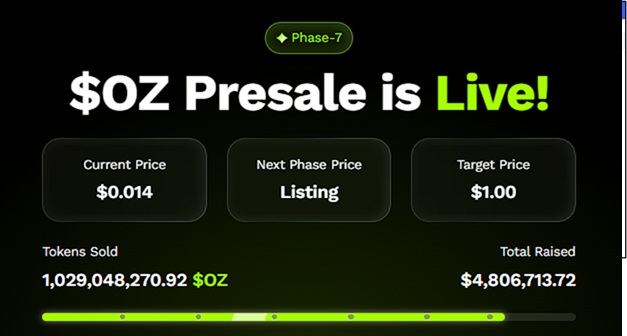
The strongest indicator of Ozak AI’s explosive potential is its rapidly growing presale performance. With over $4.8 million raised and more than 1 million tokens sold, the project’s early momentum mirrors the beginnings of past cycle giants that later delivered massive 50x–100x returns.

Investors are increasingly prioritizing AI-powered cryptocurrencies due to the rising demand for real-time automation and intelligence. Ozak AI’s early stage, combined with its high-utility infrastructure, positions it as one of the most promising new entries in the AI-crypto sector—and one of the few with genuine technological depth.

BNB Could Hit $1,400, but Ozak AI Holds the Real 100x Potential

BNB’s path toward $1,400 looks clearer than ever, backed by strong tokenomics, global adoption, and a supportive ecosystem. It remains one of the most stable and reliable large-cap assets for the upcoming market cycle.
But Ozak AI offers something far more powerful—a combination of early-stage affordability, deep AI-native functionality, and fast-growing presale momentum that analysts say could generate 50x–100x returns if adoption continues at its current pace. While BNB may deliver strong growth, Ozak AI stands out as the project with the steepest trajectory, making it the most compelling high-ROI opportunity heading into 2025 and 2026.

About Ozak AI

Ozak AI is a blockchain-based crypto project that provides a generation platform that specializes in predictive AI and superior information analytics for financial markets. Through machine learning algorithms and decentralized network technology, Ozak AI permits real-time, correct, and actionable insights to assist crypto enthusiasts and businesses in making the proper decision.


For more, visit:

Website: https://ozak.ai/

Telegram: https://t.me/OzakAGI

Twitter: https://x.com/ozakagi 

iPhone Shipments Forecast to Hit Record High in 2025, Fueled by China’s Demand for iPhone 17

0

Apple is projected to achieve a record year for iPhone shipments in 2025, driven by the phenomenal success of its latest models and a significant resurgence in its crucial China market, according to a highly bullish report released by research firm IDC on Tuesday.

This surge is not only expected to deliver a company record but also to catapult Apple past its greatest rival, Samsung, to claim the title of the world’s number-one smartphone vendor for the first time in 14 years.

IDC forecasts that Apple will ship a massive 247.4 million iPhones in 2025, representing a year-on-year increase of just over 6%. This figure comfortably surpasses the previous record of 236 million units sold in 2021, the year the iPhone 13 was released.

IDC Senior Research Director Nabila Popal attributed the growth to the new flagship line, stating, “thanks to the phenomenal success of its latest iPhone 17 series,” Apple is seeing accelerated performance globally.

The iPhone 17 and the China Comeback

The iPhone 17 series, launched in September, was viewed by investors as a critical product line for Apple, especially as the company simultaneously dealt with intense local competition in China and strategic questions regarding its Artificial Intelligence (AI) plans compared to fast-moving Android rivals. The latest device line has proved to be the key differentiator, especially in its largest market.

In a striking turnaround, IDC projects Apple’s shipments will jump by a significant 17% year-on-year in China during the fourth quarter (Q4). This massive demand, driven by the iPhone 17, has led the research firm to revise its outlook for the entire Chinese smartphone market from a previously projected 1% decline for the year to a positive 3% overall growth—a “phenomenal turnaround,” according to Popal. Apple’s success in China is particularly notable as local players like Huawei have been aggressively chipping away at its market share.

IDC anticipates that 2025 will be a record year not only in terms of unit shipments but also in value, forecasting that Apple’s total revenue for the period will exceed $261 billion, representing a 7.2% year-on-year growth. Shipments, a term used by analysts to refer to the number of devices sent by a vendor to its sales channels like stores or e-commerce partners, indicate the expected demand for a product, though they do not directly equate to end-user sales.

The IDC report reinforces a forecast made last week by Counterpoint Research, which indicates the monumental shift in market leadership.

Research Firm Apple (AAPL) Projected Shipments 2025 Samsung Projected Shipments 2025 Projected Market Share
IDC 247.4 million N/A N/A
Counterpoint 243 million 235 million Apple (19.4%) vs. Samsung (18.7%)

Counterpoint Research specifically projects Apple will ship approximately 243 million iPhones in 2025, marginally edging out Samsung, which is expected to ship 235 million smartphones. This would mark the first time since 2011 that Apple leads the global market in annual shipments.

The research firm attributes this shift to a key structural tailwind: the post-COVID replacement cycle hitting its inflection point, as millions of users who bought phones during the pandemic boom are now due for an upgrade, with Apple being the primary beneficiary.

Counterpoint also points to the 358 million second-hand iPhones sold between 2023 and mid-2025 as having created a huge installed base of users likely to transition to a new iPhone soon, effectively locking them into the iOS ecosystem.

While the near-term forecast is extremely bright, the reports highlight future potential headwinds for Apple. Bloomberg reported last month that Apple could delay the release of the base model of its next device, the iPhone 18, until 2027, which would break its regular cycle of releasing all its phones in the fall each year. IDC noted that this strategic shift could result in Apple’s shipments dropping by 4.2% in 2026.

Furthermore, IDC warns that the overall global smartphone market will decline by 0.9% in 2026 (a downward revision from a previously forecast growth) due to a combination of component shortages, particularly in memory chips, which is expected to constrain supply and raise prices.

This component shortage, however, is projected to affect low-to-mid range Android devices most significantly, as those buyers are more price-sensitive. Therefore, even in a shrinking market, Apple’s focus on the premium segment may allow it to maintain its revenue lead and market advantage.

Nigeria’s Business Confidence Climbs to 111.3 Points in October, Signaling Stronger Private-sector Optimism

0

Nigeria’s business climate gathered more momentum in October 2025, with the Business Confidence Index rising to 111.3 points from 107.9 in September, according to the latest NESG–Stanbic IBTC Business Confidence Monitor.

The new reading marks one of the strongest sentiment levels recorded this year and reinforces a growing sense of optimism across the private sector.

The BCM report shows that businesses are increasingly upbeat about current conditions, encouraged by easing inflation, a steadier exchange rate, and an improvement in overall macroeconomic stability. The upward movement also tracks a major year-on-year rebound from the 76.8 points recorded in October 2024, a period when operators were far more cautious about economic prospects.

The monitor noted that the domestic business environment “maintained its positive trajectory,” with the Current Business Performance Index holding firm in expansion territory. The warmth in sentiment reflects perceptions that the economy is adjusting to earlier shocks more effectively, allowing firms to plan with fewer disruptions.

A detailed sector review shows that all five major economic segments—Manufacturing, Trade, Agriculture, Services, and Non-Manufacturing—recorded expansion in October. Manufacturing and Trade delivered the most notable gains, rising by 8.8 points and 7.8 points respectively, to reach 111.3 and 115.4. Non-Manufacturing closed at 115.0, while Agriculture and Services posted 111.4 and 111.0.

Agriculture maintained its forward push, climbing from 107.3 points in September to 111.4 in October. Crop Production and Agro-Allied operations were the main drivers. Improved seed varieties, targeted government input programmes, and the softer inflation profile helped boost confidence among farmers and processors. Exchange-rate stability also eased pressure on operators who rely on imported inputs. Livestock and Forestry registered gains, though at a slower pace than the previous month.

Even with the improvement, Agriculture still faces barriers. Shortages of raw materials, recurring outbreaks of livestock diseases, and higher feed and input costs continue to squeeze producers. These pressures raise production costs and filter into market prices, limiting how far operators can push output without eroding margins.

Manufacturing posted one of its strongest recoveries this year. The sector’s index jumped to 111.3 points from 102.5 in September. Key segments such as Food, Beverage, and Tobacco, as well as Cement, recovered after slipping in the previous month. Businesses attributed the rebound to a more reliable power supply, improved access to finance, and better navigation of policy and regulatory hurdles.

Firms also reported that a more stable foreign exchange market helped them stabilize import planning and reduce the unpredictability that had weighed heavily on operations earlier in the year.

The Services sector maintained its modest growth path, rising to 111.0 points from 108.5 in September. The gains were backed by improvements across different service activities and a macroeconomic backdrop shaped by lower inflation and reduced currency volatility. However, Professional, Scientific and Technical Services, along with Other Services, recorded slower growth. The BCM noted that this exposes the fragility still lingering within the broader services industry, which remains sensitive to shifts in financing conditions and consumer spending power.

The report urged authorities to pursue economic reforms with greater urgency. It pointed to the need for infrastructure upgrades, security improvements, and expanded access to credit, warning that sustained momentum would require clearer policy coordination and firmer support for productive sectors.

The higher BCM reading carries broader implications. It shows that private-sector operators are beginning to rebuild confidence after years of unpredictable macroeconomic swings. The renewed optimism is tied to the pockets of stability that have emerged in recent months, from cooling inflation to a more predictable FX market. With all major sectors staying firmly in expansion mode, the recovery appears more evenly spread instead of being driven by isolated industries. Analysts often see broad-based expansion as a sign that underlying economic conditions are strengthening rather than masking weaknesses.

The BCM aligns with other indicators pointing to improved activity. For instance, the Composite Purchasing Managers’ Index rose to 56.4 in November from 55.4 in October, marking a stronger and more widespread increase in private-sector output. That rise reinforced the sense that the economy is gaining sturdier ground as the year progresses.

October’s BCM reading places Nigeria on a firmer footing heading into the final months of 2025. The challenge now lies in maintaining this momentum and ensuring that policy direction continues to support the conditions that have allowed confidence to rise across the country’s biggest economic sectors.

US Layoffs in 2025, A Surge Not Seen Since the COVID-19 Pandemic

0

U.S. employers have announced over 1.1 million job cuts through November 2025, marking the highest annual total since 2020, when the pandemic triggered more than 2.3 million layoffs by that point in the year.

This represents a 44% increase from the 761,000 cuts in all of 2024. The figure is the fifth-worst since 1993, following only the dot-com bust years (2001–2002), the 2008 financial crisis, and the 2020 pandemic shock. November alone saw 71,321 announced cuts, up 24% from November 2024 but down from October’s peak of 153,000.

These numbers come primarily from Challenger, Gray & Christmas, a Chicago-based outplacement firm that tracks planned layoffs. While official Bureau of Labor Statistics (BLS) data shows layoffs remaining relatively low around 1.6% of the workforce in August 2025, Challenger’s announcements capture forward-looking cuts that often materialize later.

Private payrolls also dipped by 32,000 in November per ADP data—the largest monthly drop in over 2.5 years—signaling strain, especially among small businesses. Layoffs in 2025 stem from a mix of post-pandemic corrections, economic pressures, and policy shifts.

This has been the hardest-hit area, with over 307,000 cuts announced through October—more than eight times the 2024 figure. The “DOGE Impact” (Department of Government Efficiency, led by Elon Musk under the Trump administration) is the top cited reason, involving widespread federal workforce reductions.

About 300,000 civil service jobs have been targeted overall, including 4,100 reductions in force (RIFs) during a brief government shutdown earlier this year. Agencies like the State Department finalized mass layoffs in December, unaffected by shutdown-ending deals.

Critics, including lawsuits, argue these cuts prioritize political motives over efficiency, disproportionately affecting women, minorities, and Black employees in DEI-focused roles.

Tech has seen 141,000–183,000 cuts across 626 companies, down from 2023 peaks but still elevated due to AI adoption cited in ~55,000 cases and post-pandemic over-hiring reversals.

Major players include, Amazon 14,000 corporate roles. Microsoft and Meta: Ongoing rounds targeting “low-performers.” Intel: 15% workforce reduction ~16,000 jobs in early 2025. Verizon: 13,000+ management positions.

Other Sectors like Warehousing and Retail with over 90,000 cuts, driven by e-commerce slowdowns and inventory gluts. Telecom: 15,000+ in November alone. Energy and Manufacturing: Oil shale layoffs up 60% amid low prices; Boeing, ConocoPhillips, and UPS 48,000 jobs cited efficiency.

Softer consumer spending, rising costs, tariffs blamed for manufacturing contraction over 9 months, and hiring freezes. Planned hires have plunged 35% year-over-year to ~500,000—the lowest since 2010.

Despite the layoffs, unemployment claims hit a low of 211,000 in late December 2024 pre-2025 surge, and overall job growth has held steady in BLS reports.

However, hiring is stuttering, and experts warn of a “squeezed” market: Q3 2025 saw 202,000 cuts, the highest since 2020. On X, discussions highlight cross-border effects, like Canadian mill closures tied to U.S. tariffs and steel loans funding automation-driven layoffs.

Layoffs erode household incomes, curbing spending on non-essentials like retail and travel. With voluntary turnover dropping and hiring freezes widespread, consumer confidence is eroding—evident in a 36.8% surplus of home sellers over buyers in October, the widest gap since 2013.

Growth forecasts have dipped from 2.8% in 2024 to around 2% this year, per BLS trends, as sectors like manufacturing contract under tariff pressures up 9 months straight. If December’s holiday hiring falters, this could shave 0.5–1% off GDP in early 2026.

Ironically, the surge is “good news” for Wall Street, as it pressures the Fed to accelerate cuts—now eyed for December 2025 and beyond—to avert a downturn. Unemployment’s stability masks fading job openings, but a moderate layoff uptick could spike it faster than usual, justifying cheaper borrowing.

Stocks have rallied on this like the S&P up 5% post-October data, but it risks inflating asset bubbles while real wages stagnate for low earners—the gap between rich and poor households is widening, reversing a decade of progress.

Government cuts 307,000+ via DOGE and tech/AI-driven losses 141,000+ are redirecting jobs to resilient areas like healthcare gaining 76,000/month and renewables. However, tariffs could hike costs in agriculture and construction, sparking labor shortages and food inflation—AI/automation may offset some, but not immediately.

Non-profits face 413% more cuts from federal funding slashes, straining social services. Public sentiment echoes frustration, with users calling out policy impacts on families and small businesses.

This isn’t a full recession signal yet—holiday spending could spur December hires—but it’s a stark reminder of 2020’s volatility. If you’re job hunting, sectors like AI roles like research scientists earning $200K+ remain in demand amid the cuts.

Coinbase’s New Bank Partnerships is A Major Step for Crypto Tradfi Integration

0

Coinbase CEO Brian Armstrong confirmed during a panel at the New York Times DealBook Summit that the exchange is actively collaborating with several of the largest U.S. banks on pilot programs.

These initiatives focus on integrating cryptocurrency infrastructure into traditional banking systems, marking a significant acceleration in Wall Street’s adoption of digital assets. Armstrong emphasized that “the best banks are leaning into this as an opportunity,” while those resisting risk being “left behind.”

The pilots are exploratory and low-risk for banks, allowing them to test crypto elements without full-scale commitments. Banks are experimenting with stablecoins like USDC, issued by Coinbase for faster settlements, cross-border payments, and tokenized finance.

These digital dollars could handle trillions in daily transactions with lower costs and near-instant execution. Armstrong projects the stablecoin market could reach $1.2 trillion by 2028, driven by thousands of use cases in payments and treasury management.

This involves secure storage of digital assets for institutional clients, addressing regulatory and security concerns. Banks can leverage Coinbase’s existing infrastructure to offer custody without building it in-house, reducing risks like hacks or compliance issues.

Pilots test direct crypto trading integrations, enabling banks to offer clients seamless access to buy, sell, and trade assets like Bitcoin or Ethereum through familiar platforms.

Specific bank names weren’t disclosed in Armstrong’s remarks, but recent partnerships provide context: JPMorgan Chase: Announced in July 2025, integrating USDC rewards, Chase card funding for crypto buys, and direct bank-to-Coinbase transfers for over 80 million users starting in 2026.

PNC Bank partnered in July 2025 to let 9 million customers buy, hold, and sell crypto directly in accounts, with PNC providing banking services to Coinbase in return. Citibank joined in October 2025 for cross-border payments using Coinbase’s tech, managing over $35 trillion in assets combined with JPMorgan.

These build on Coinbase’s role as a “bridge” between traditional finance (TradFi) and crypto, with pilots going live as early as this summer. The announcement came alongside BlackRock CEO Larry Fink, who reiterated Bitcoin’s role as a hedge against financial and geopolitical risks—echoing $23 billion in spot Bitcoin ETF inflows this year.

This convergence highlights a shift: Banks aren’t just dipping toes; they’re wiring crypto into core operations for efficiency gains, like 24/7 settlements and reduced reconciliation costs.

On X, the news sparked buzz about institutional adoption, with users noting it’s “not hype—it’s infrastructure” and predicting a “wealth shift” as banks merge with crypto rails.

Banks are no longer treating crypto as a speculative side bet — they’re integrating it into payments, custody, and treasury stacks. Crypto rails especially stablecoins will settle trillions annually by 2028, competing directly with SWIFT, FedWire, and correspondent banking.

Coinbase becomes the “AWS of money movement”, Circle (USDC), and any bank that moves fast. Banks that stay on the sidelines higher costs, slower settlement, client loss. Cross-border payments cost 6–7% and take 1–5 days.

With USDC/USDP on Coinbase + bank integrations: ~0.1% cost, seconds to settle, 24/7/365. JPMorgan, Citi, and PNC pilots prove banks now see stablecoins as upgrades, not threats. $2–3 trillion in annual stablecoin settlement volume by 2027.

Institutions that custody/trade crypto in-house via Coinbase Prime or direct integrations keep 50–80 bps of spread that currently goes to third-party brokers. Retail customers at partnered banks— JPM, PNC, Citi = 150+ million users get seamless crypto access ? explosive on-ramp volume.

Coinbase’s revenue mix shifts from volatile trading fees ? high-margin, recurring enterprise revenue. Stablecoin volumes are up 20% year-over-year, and with clearer rules like the pending CLARITY Act, more pilots could scale to production in 2026.

Coinbase’s stock (COIN) rose about 5% to around $277 on the news, buoyed by broader crypto rebounds Bitcoin above $92,000. This isn’t isolated—it’s part of a trend where exchanges like Coinbase evolve into financial “pipes,” blending banking and blockchain.

In short, these pilots signal crypto’s maturation: From fringe experiment to essential infrastructure. If you’re in finance or investing, this is the quiet revolution to watch.