DD
MM
YYYY

PAGES

DD
MM
YYYY

spot_img

PAGES

Home Blog Page 6317

Olusegun Obasanjo, Nigerian Government and AfDB Board Letters On Whistleblower Allegations

0

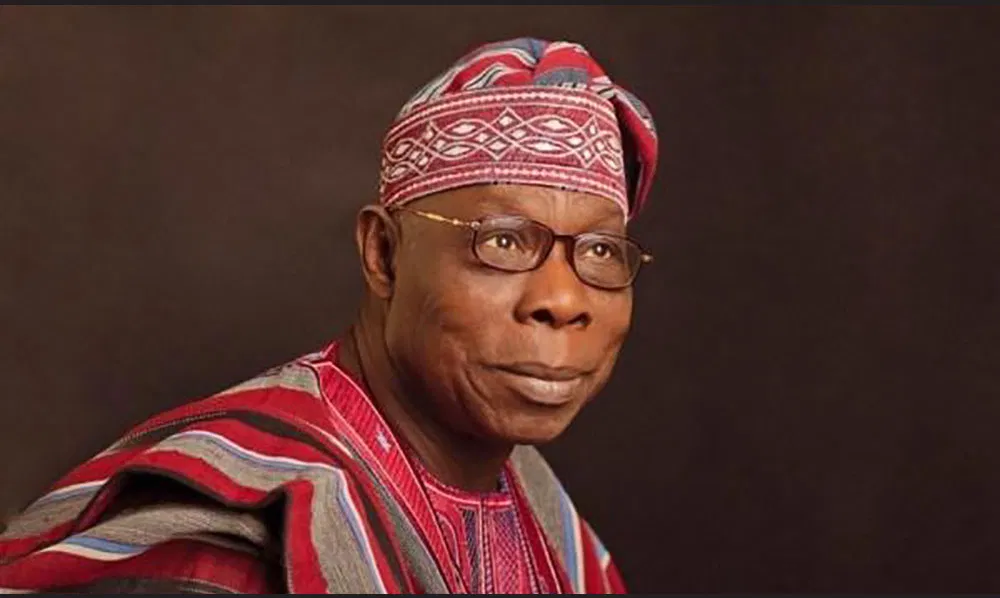
I have the letter written by Nigeria’s former President (Olusegun Obasanjo) to former presidents of African countries after the U.S. Treasury Secretary wrote, rejecting the conclusion of the African Development Bank (AfDB) Ethics Committee, and requesting a new investigation, on the allegations against the bank’s President.The key line: “It is also critical that we emphasize the need for the AfDB to remain an Africa-focused development Bank rather than one which serves interests outside Africa”. I will not share the full letter as it contains many personal details.
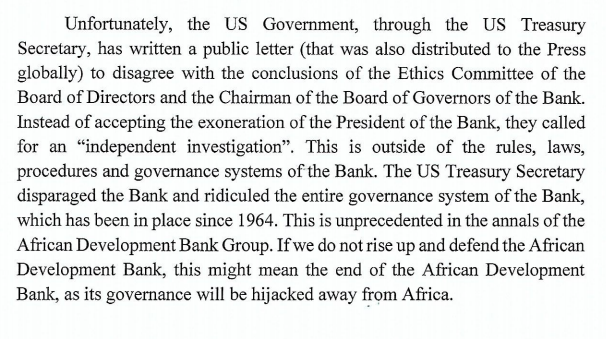
Meanwhile, the Chair of the Bureau of the Board of Governors, Niale Kaba, has released a letter making it clear that; “It is indeed false that the President of the Bank Group has been or is being asked to step down from his position”. Read the full letter below.
 

Communication Regarding the Whistleblowers’ Complaint Against the President of the Bank
ABIDJAN, Côte d’Ivoire, May 28, 2020,-/African Media Agency (AMA)/- The Bureau of the Boards of Governors of the African Development Bank met on Tuesday, 26 May to consider the matter arising from a whistleblowers’ complaint against the President of the Bank, which was dealt with by the Ethics Committee of Board of Directors of the Bank and for which I received letters from some shareholders expressing various views.
Following the meeting, my attention has been drawn to several publications in the national and international press regarding the content of the deliberations of the said meeting, and I am compelled to make clarifications in order to avoid any misunderstanding.
The Bureau, which I chair, wishes to reassure the public that it is seized with the matter and that it is treating it with the utmost seriousness that it deserves. Further, the Bureau informs the public that it has not taken any decision as falsely conveyed in some publications.
I must emphasise that there is no governance or constitutional crisis at the African Development Bank Group. It is indeed false that the President of the Bank Group has been or is being asked to step down from his position.
Everyone must allow the Bureau to do its work and allow due process to reign. All the Governors will be carried along in resolving the issue.
Chair of the Bureau of the Board


Meanwhile, the Nigerian government writes on the allegations, noting that ‘the call for an “independent investigations” of the President is outside of the laid down rules, procedures and governing system of the Bank and its Articles as it relates to the Code of Conduct on Ethics for the President.’ The full letter (PDF).

The “Bill Gates of Africa” – Herman Chinery-Hesse – Endorses Tekedia Mini-MBA [Video]

0

 Amzill, a management consulting company, managed by Fadilah Tchoumba, is Tekedia Country Partner for Ghana and Cameroon. Registrations for Tekedia Mini-MBA (edition 2) from governments, alumni associations, business clubs, companies and individuals should go through Amzil in these countries.

Contacts are provided below to reach the Amzil team. You can learn more here on Amzil Tekedia Mini-MBA web page.

And one of Africa’s greatest – Herman Chinery-Hesse – who at the early stage of the web economy came home to begin the digitization of our economy. He has great words via video on Tekedia Mini-MBA: “wonderful”, “fantastic”, “affordable”.

Why Work from Home (WFH) Could Be Bad for Your Young Career

3

Some young Africans have reached out to me, asking if they could take an option which is emerging in their respective companies on Work from Home (WFH). Largely, the companies would make it possible for people to work from home if they desire, for a very long time.

I am not a HR director or an employee counselor. Like I do most times, I will tell the person: “I will blog it on Tekedia”. There is a reason for that, using anything on Tekedia is simply following my opinion at your risk. But I do try to be balanced. That said, if I am in a position where I am offered an option to come to work, or work from home, in Africa or outside Africa, I will choose to come to work.

Yes, it seems crazy but let me assure you – if you are early in your career, WFH may not be evidently good for you. Sure, there are many personal benefits to it – no traffic to deal with, no stress to wake up early, potential saving from fuel, etc. But there is a huge risk: you can be isolated by your supervisors and relegated to filler-assignments. Because you do not provide immediacy, you become a mere backup to those they can see.

“Zoom fatigue” — a form of exhaustion from excessive video chatting — has swept the world as the technology has quickly gained widespread adoption for work, education and personal connection during the pandemic. Social scientists tell The Wall Street Journal that a number of factors are at play as the format disrupts “normal, instinctual” forms of human communication. Among the sources of stress: constantly seeing an image of yourself, an inability to read body language, a lack of real-time feedback and seeing giant faces on the scree.

Those days in banking, everyone wanted to be in the Head Office because the decision makers see you daily in the headquarters. The HR guys are eating with you in the canteen. You think most care for that guy in Umuahia when there is one who gave him a ride last night. Throughout my time in then-Diamond Bank, I delivered all good news to the Head of HR (Reginald) in person. Most were that The Guardian published my articles; he would say, “make a copy and give my staff for your file”. And when I received Cisco and Microsoft Certifications, I took the originals to show my Executive Director in person. They knew me – my name and my records, first hand. If I was in a branch, that connection would not have been possible! Then extrapolate to WFH in perpetuity – it may not help you.

Practically, unless your supervisor is working from home, do not attempt to work from home. Yes, if the immediate boss is coming to work, you must also report to work. He/she wants someone not distracted, and very visible to handle important assignments which can get feedback live in the conference room. Coming to office helps you build new relationships to advance with colleagues. You meet people who can help you in canteens, lobbies, etc. WFH makes such nearly impossible. And most importantly, WFH robs you of one of the most important things we get in companies: culture and how firms do things. You may think you can get those on your pajamas but I do tell you, you are mistaken.

Get your shirts, blouses, trousers, blazers and suits ready – and show up at work. No excuses, WFH option or not.

The U.S. Power Play In African Development Bank (AfDB)

5

So many questions from the community on the issue of the United States rejecting the conclusion of the Ethics Committee on allegations against the President of the African Development Bank (AfDB), Akinwumi Adesina.  Samples:  “Why is the United States interested in what is happening in African Development Bank?”, “Wetin concern Trump in Africa’s Bank”, “Can you explain why they should even listen to the United States – this is our bank”.

My general response to save time: The African Development Bank is not just owned by Africans and African countries. We should not be confused because the name has “Africa”. The U.S. became a member of the African Development Fund in 1976 and that of the African Development Bank in 1983. If you go to AfDB, they have nationals from Japan, Europe, etc and most are watching their investments; they call them representatives from their countries. 

More so, what the U.S. is doing is simple: fiduciary responsibility of the American taxpayers money. If they invested in this AfDB, they should pay attention to what goes in there. 

In 2009, I attended the African Union Congress. There were some activists protesting that Africa should buy out the UK, Japan and U.S. so that the bank could be wholly-African. That time the UK was holding around 14%, Japan 5.4% and U.S. 6.5%. I do expect the shareholding to have changed; Nigeria holds about 9% – the largest of any African country. In that Congress, one man asked the activists to come back with cash to pay off the Europeans, Japanese and Americans!

The United States is one of the Group of seven nations holding 28 per cent investment grade equity in AfDB.

The others include Germany and Japan. About 41 per cent of their Group’s shareholding is held by non-regionals and multilateral development finance institutions.

The AfDB Group comprises three entities: the African Development Bank (AfDB), the African Development Fund (ADF) and the Nigeria Trust Fund (NTF).

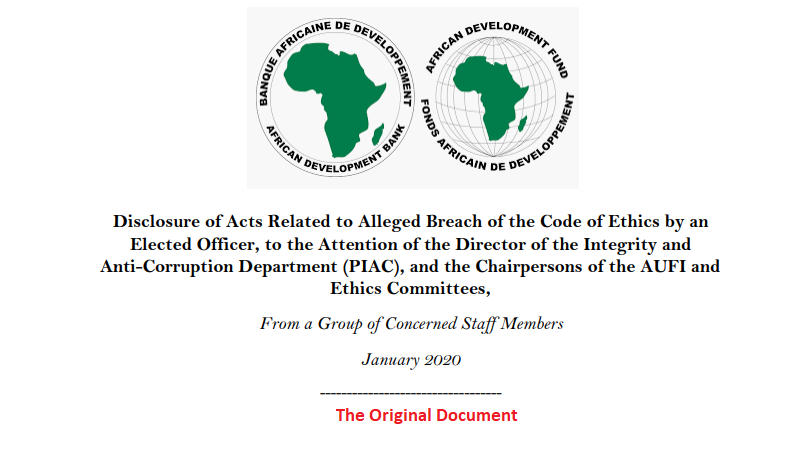
Largely, this matter is very complicated. Even though the U.S. has a right to protect its investments and asks questions, the issues are very trivial that the basis of U.S. strategic interests cannot be those allegations (read U.S. letter); you can read Adesina’s responses here. These allegations are mundane; the Board can handle them, and communicate to its shareholders. They are not things, in my opinion, for an external counsel to investigate. President Trump does what Mr. Adesina is accused daily in Washington DC! Adesina does not have his daughter and son-in-law working in his office or vacationing in his hotels! 

This is my conclusion: the U.S. is asking for a change of leadership in AfDB. It is as simple as that. Unfortunately, Adesina has arrived at the same conclusion himself. And that is the real problem: if the U.S. concludes that a bank is corrupt, it can fine or at extreme cut it out of the financial system until it cleans itself. That is why what the U.S.is saying is more important than what the African leaders (about 50 of them) have to say. Call it an asymmetric power play.

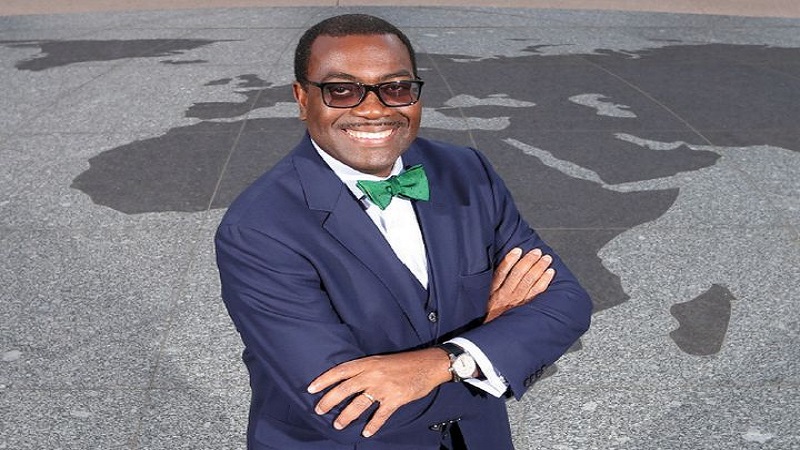
Akinwumi Adesina, AfDB President, Responds To The Allegations