By Eustace Onuegbu and Eunice Sampson
- Corporate Philanthropy, Corporate Social Responsibility (CSR), Environmental, Social and Governance (ESG), Corporate Sustainability (CS) and Sustainability
Corporate Philanthropy (CP), Corporate Social Responsibility (CSR), Environmental, Social and Governance (ESG) and Corporate Sustainability (CS) seem to be used interchangeably by most people, including a number of practitioners. But they do not mean the same thing, either in concept or practice.
Corporate Philanthropy is the act of a corporation or business promoting the welfare of others, generally through voluntary, charitable initiatives, such as community projects, cash donations, scholarships, etc. It could also be in the form of voluntary donation of time, skills, and other resources for community service initiatives through, for example, employee volunteering activities.
Recently, a major player in the Nigerian Cement industry donated quite a number of security vehicles to Lagos State and Ogun State Governments, to help boost security operations in those States. This is an example of a voluntary donation, and therefore, an act of Corporate Philanthropy.
On the other hand, International Organisation for Standards (ISO) defines Social Responsibility as:
“the responsibility of an organisation for the impact of its decisions and activities on the society and environment, through transparent and ethical behaviour that:
- contributes to sustainable development, including health and welfare of the society;
- takes into account the expectations of stakeholders;
- is in compliance with applicable laws and consistent with international norms of behaviour; and
- is integrated throughout the organisation and practised in its relationships.”
This definition demonstrates the difference between Corporate Philanthropy and (Corporate) Social Responsibility. While the former is voluntary, the latter is a “responsibility.” If it is a responsibility, then it is obligatory, and a business could therefore be branded as “irresponsible”, or probably, “unethical” if it fails to fulfil its corporate social responsibilities.
This explains the definition of Corporate Social Responsibility given by the World Business Council for Sustainable Development (WBCSD): “The continuing commitment by business to behave ethically and contribute to economic development while improving the quality of life of the workforce and their families as well as of the local community and society at large.”
This definition by WBCSD highlights some of the direct and indirect key stakeholders of businesses: workforce, families, local communities, society. These “people” or “social” agents broadly summarize the ideal focus of a business’ corporate social responsibility strategy.
Since businesses would usually take a lot from these actors (their workforce, host communities, households, etc.) in their day-to-day operations, and as part of their value chain activities, it makes sense that they should integrate SR principles that enable them to contribute to the wellbeing of these important influencers, not as one-off charity or philanthropic gesture, but creating shared stakeholder value.
We have said that a key responsibility of a business should entail making positive impact on its people, communities and society – which ultimately could be categorised as its “Social Responsibility.”
But “Social” is not the only responsibility that a business is held accountable for. A business also has a responsibility towards ensuring the wellbeing of the environment where it carries out its business and from where it extracts raw materials and other resources without which business operations would not be possible. Environmental stewardship includes deliberate efforts that a business makes to minimize and offset its negative environmental footprints, such as use of renewable energy as against fossil fuel, reforestation initiatives, energy consumption and greenhouse gas emission reduction programmes, responsible waste management practices, and so on.
Added to this is a business’ economic responsibility, that is, its economic impact and stewardship, with emphasis on the economic value it creates for all stakeholders and the larger economy (such as paying taxes to government, dividends to shareholders, salaries and wages to employees, and other forms of value creation, to local contractors and vendors, for example).
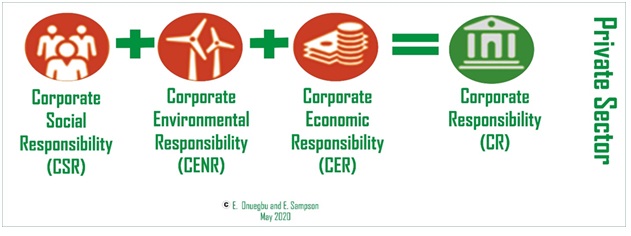
It is important to note that the concept of Social Responsibility applies to all organisations, not just businesses, any entity – government agencies, institutions or associations – comprising of one or more persons, having a particular purpose and interacting with some of the ‘social’ agents as earlier identified. This explains why ISO 26000 identifies this as Social Responsibility (SR), rather than just “Corporate” Social Responsibility.
While Corporate Responsibility is about a company’s engagement with its stakeholders and its commitment to socially, economically, and environmentally responsible practices (as shown in the diagram above), on the other hand, Environmental, Social and Governance (ESG) is a criteria mostly used by discerning global investors in assessing the “non-financial” and ethical practices and performance of companies that they invest or plan to invest in. Both concepts are aimed at driving a sense of responsibility in businesses, and when effectively managed over time, achieves Corporate Sustainability.
What then is Corporate Sustainability? For the business enterprise, sustainability means –
…adopting business strategies and activities that meet the needs of the enterprise and its stakeholders today while protecting, sustaining, and enhancing the human and natural resources that will be needed in the future.
Corporate Sustainability is therefore a business model that prioritizes the effective and proactive management of the impacts (positive or negative) that a business has on the society, environment and the economy, while leveraging good corporate governance practices to enhance the opportunities and minimize the risks that may arise from these impacts. In a nutshell, Corporate Sustainability is a long-term concept that covers social, environmental, economic and governance responsibilities of businesses.
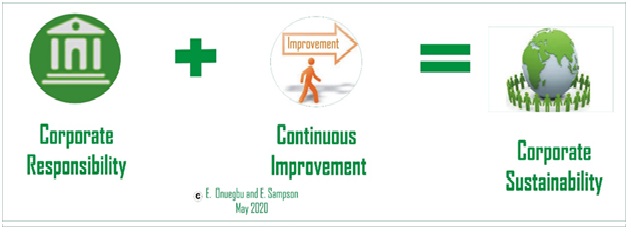
But Corporate Sustainability is only an angle of the broader societal Sustainability concept.
When the UN World Commission on Environment and Development defined Sustainable Development (Sustainability) in 1987 as “development that “meets the needs of the present without compromising the ability of future generations to meet their own needs,” the idea was not to entirely leave the burden of achieving global sustainable development on corporates. Governments (the broad spectrum of the public sector) and the civil society (citizens at individual and institutional levels) also have their roles to play.
Sustainability could therefore be defined as the collective responsibility and obligation that all social and economic agents hold, to pursue and achieve sustainable development – development that is accountable for the social, environmental, and economic wellbeing of current and future generations.
Defined in this way, sustainability balances resource usage and supplies over time. In other words, sustainability assures intergenerational equity. When the resources we use match the earth’s capacity to regenerate adequate future supply, then our systems remain balanced indefinitely. However, if resources used exceed this capacity, then current demand is being met by borrowing from the future, which will eventually lead to an inability to meet future societies’ needs. Achieving the sustainability milestone as a society, requires the combined efforts of businesses behaving in a responsible manner; the citizens performing their civic responsibilities; and the ability of the government to provide good and responsible governance.
The illustration below explains the relationship between these concepts.
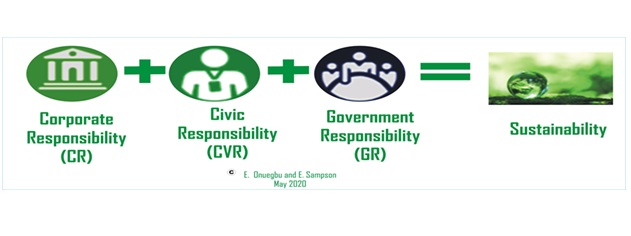
As shown in the diagram, in the long term, Corporate Responsibility translates to Corporate Sustainability, with an underline on the word “Corporate.” This underline is necessary because corporate sustainability as earlier stated is only one angle to “Sustainability.”
The quest to achieve sustainability best practices is already starting to transform the competitive landscape, and promises to compel companies, governments and other major global actors to change the way they think about governance, environmental wellbeing, business continuity, innovation, technologies, processes, profitability, growth, development and socioeconomic equity. It has become a key driver of disruptive innovation in both the public and private sectors, and particularly so during times of socioeconomic and environmental uncertainties.
By Eustace Onuegbu and Eunice Sampson
About the Authors:
Eustace Onuegbu is one of Africa’s leading management consultants with expertise in corporate sustainability – strategy and implementation. A certified Management Systems (ISO 26000, 14001 and 45001 standards) consultant, facilitator, and auditor.
Eunice Sampson is a seasoned Sustainability and CSR professional with two decades of experience working with high profile African businesses. She is one of the pioneer Sustainability practitioners in Nigeria and has supported diverse industry standards setting initiatives and programmes.
Like this:
Like Loading...