DD
MM
YYYY

PAGES

DD
MM
YYYY

spot_img

PAGES

Home Blog Page 6354

The Aviation Industry is Getting Desperate to Survive

0

The Federal Government of Nigeria announced on Sunday that a British airline company, Flair Aviation, has been grounded for flouting the “no flight” rule. The Minister of Aviation, Hadi Sirika, disclosed this on Twitter, explaining that the company was only authorized to operate humanitarian services but went on a commercial business.

“COVID-19 Flair Aviation, a UK company, was given approval for humanitarian operations but regrettably, we caught them conducting commercial flights. This is callous! The craft is impounded, the crew being interrogated. There shall be maximum penalty. Wrong time to try our resolve,” Sirika wrote on Twitter.

It could be recalled that the Federal Government had earlier this month, extended the “no flight” to four weeks, limiting flights to essential services only. The Aviation Minister said the Flair Aviation company would be penalized. However, the development tells of the struggle of the aviation industry to survive the COVID-19 pandemic that has brought it to its knees.

Punch has reported on Sunday that some foreign airlines are planning to resume flight activities to Lagos, Abuja and Port Harcourt airports. The Ministry of Aviation has however vowed to penalize any airline that flies into Nigeria in defiance of the ban. The Transport Service Senior Staff Association of Nigeria (TSSSAN) said no foreign or local airline is allowed to fly until the ban is lifted.

Despite the stance of aviation authorities of Nigeria on the matter, some foreign airlines are reportedly making plans to resume flight operations in June. Lufthansa Airlines has reportedly added Abuja and Port Harcourt among its 20 long-haul routes that is scheduled to kick off in June. Lufthansa has made its first batch of flight reservations available in its booking system according to people familiar with the matter.

On the other hand, Virgin Atlantic is reportedly lining up flight schedules for London Heathrow to Murtala Muhammed Airport Lagos. And beginning from May 16, services for its March 28, 2021 summer schedule flights. Though some other cities around the world are part of their flight plan, Nigerian Aviation authorities are not seeing the possibility in the nearest future unless the ban is lifted.

“They (foreign airlines) can’t operate scheduled passenger flights as long as the ban remains. The PTF on COVID-19 has the final remains. The PTF on COVID-19 has the final say on when flights can resume, based on the level of control of the pandemic.

“Of course, we in the sector can’t wait for activities to resume at the airports to forestall further loss of jobs and revenue. Aviation has been one of the hardest hit by the pandemic and it will be a great relief to have flights resume,” said James Odaudu, Director, Public Affairs, FMA.

The president of ATSSSAN, Ilitrus Ahmadu, said the decision to fly is not for foreign airlines to make. He said the Federal Government reserves the right to open and close its air space when it deems fit.

“It is not the foreign carriers that will decide for our country. So it is not their business and they cannot say they can fly into the country without government opening the airspace,” he said.

The aviation industry’s revenue has plunged massively since early in the year when countries started to halt flight activities. The plague has plummeted many companies into dire financial strains and near bankruptcy status despite governments’ bailout measures.

German national carrier Lufthansa, last month demanded a $11 billion bailout from the German government, on the agreement that it will take 25.1% stake in the company. Lufthansa has been losing $1.1 million per hour as a result of the global health crisis.

Virgin Atlantic also appealed to the UK government for a 500 million pounds bailout to save the airline from going out of business. In an open letter to the British Parliament in April, Virgin Atlantic founder, Richard Branson, who has already staked his private island for fund, said the coronavirus pandemic has forced the company to seek external funding.

“Because of significant costs to our business caused by unprecedented market conditions which the COVID-19 crisis has brought with it, we are exploring all available options to obtain additional external funding,” he said.

Around the world, every aviation company is on life support that requires sustainable intervention that many governments appear unable to offer right now. It seems that the desperation to survive is pushing airlines into sharp practices, and many of them are getting ready even to dare the “no flights” rules.


Uber About To Eat GrubHub, Air Peace Refreshing Its Aircrafts, Emirates to Cut 30k

0

As Emirates plans to cut 30,000 jobs to manage the paralysis resulting from Covid-19, the conclusion is that cuts are not just due to low current demand but rather projected dislocation in global aviation. Now that firms know that doing business on Zoom is legitimate over flying across cities, Chief Financial Officers in companies will work their models to accommodate this redesign. Simply, aviation will recover but not immediate to carry and hold unnecessary liabilities and expenses.

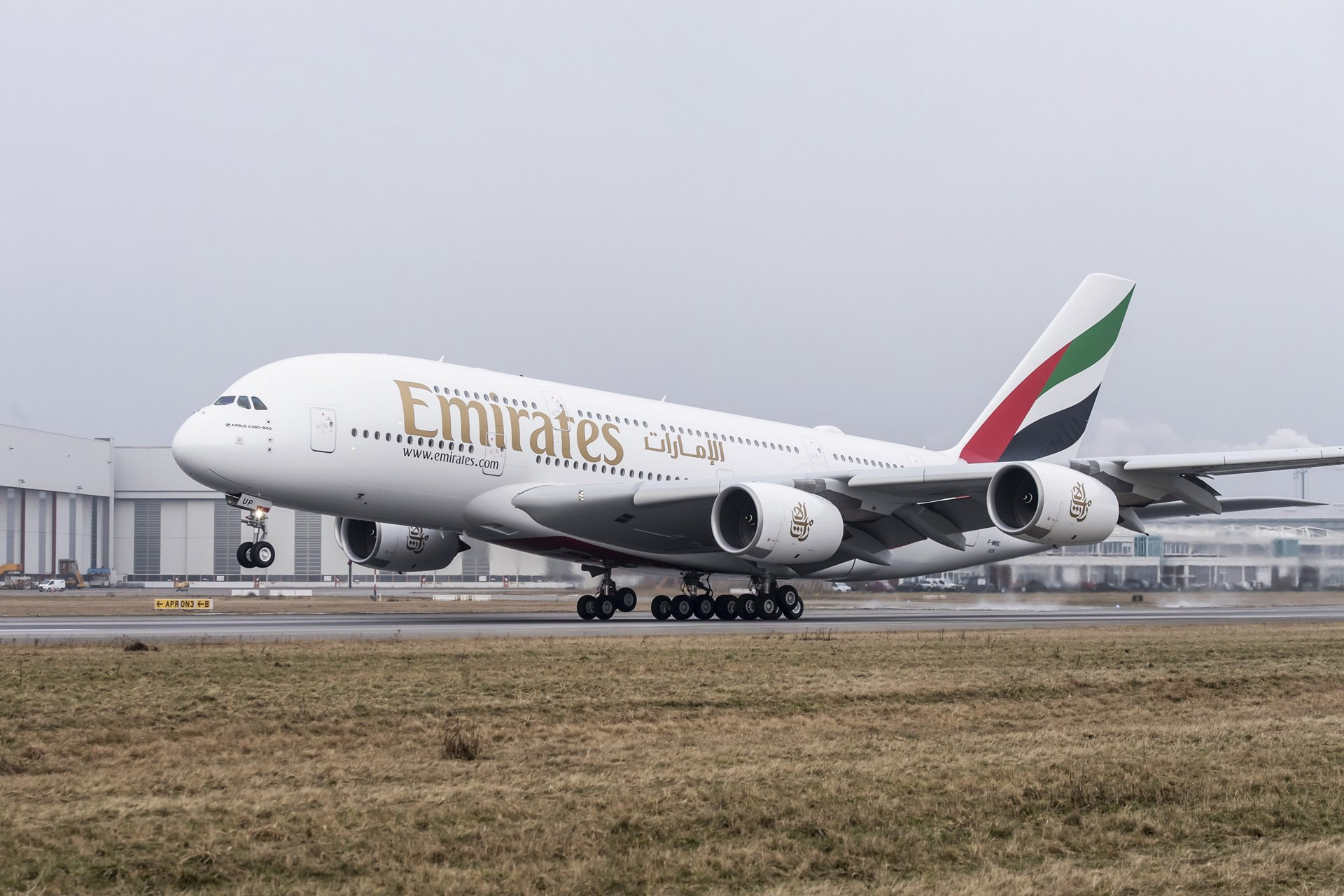
Dubai-based Emirates Airlines is reviewing its costs, which could lead to 30,000 job cuts and the fast-tracked retirement of its superjumbo A380 fleet. Sources tell Bloomberg that Emirates, the fourth-largest airline in terms of passengers, may slash 30% of its workforce. Emirates has not made an official announcement, but carriers worldwide have cut jobs after the near-total shutdown of travel during the pandemic.

Arik Air has spoken: 90% of staff are going on compulsory leave without pay while those remaining will see 80% pay cut. We are yet to read from Air Peace, the industry leader in Nigeria. But we do know that it is using this downtime to scale “up technical maintenance and cabin refresh of our aircraft to keep them safe for the skies again” Nigeria must not allow its aviation sector to collapse.

Arik Air, one of Nigeria’s major airline companies has ordered 90% of its staff to go on leave until further notice. This is as a result of lockdown that has paralyzed commercial activities in many states in Nigeria, and put aviation transportation to a halt.

The aviation company has also implemented an 80% pay cut for its personnel while the rest of its workforce has been sent on leave without pay.

Meanwhile, Uber plans to eat GrubHub, a meal delivery service competitor to Uber Eats, breaking apart the construct of antitrust.  I expect the regulators to bless it as this time is not normal.

Uber and GrubHub are continuing their takeover discussions, with GrubHub signaling over the weekend that the ride-share giant’s offer “is too low,” reports The Wall Street Journal, citing anonymous sources. Uber, which operates Uber Eats, approached its rival after the pandemic started, according to The New York Times. Uber has relied on its meal-delivery service to make up for severe losses in its main business amid the current crisis — the company reported losses of nearly $3 billion in the first quarter. A merged Uber Eats and Grubhub would account for 55% of the U.S. food delivery market, says the Times. DoorDash, which accounts for 35% of the market, would be its largest rival.

The one marketing mistake you mustn’t make during the COVID-19 pandemic

0

Nothing is going to be back, as usual, the situation presently at hand is the ”new normal” whether you like it or not, your disposition to this fact isn’t going to change a thing.

Many small and medium-sized businesses are shutting down, most companies are laying off staff and even the big guns in the world markets are losing millions of dollars by the day.

Although there are various downsides to the present COVID-19 economy, some businesses have found a way to remain afloat in these turbulent times. 

Apart from the health industry’s who are fighting on the front line to save our lives, Remote businesses offer the best potential of any form of survival during the COVID-19 pandemic. 

However, many remote businesses might be tempted to reduce or stop their advertisement altogether in order to reduce costs and sustain their business while the economy is at a low. 

This strategy looks like the fastest way to go out of business, but it is one that seems to make sense to the majority of business owners because it looks safe. 

Advertisement during this period shouldn’t be all about conversion, you must find a way to contribute and emphasize with your customers and prospect in these difficult times. 

In the process of doing this, you’re creating a positive image of your product/services in the kinds of your customers thereby giving you an edge over your competition when your audience decides to make a purchasing decision either during or after the COVID-19 pandemic. 

As the oracle of Omaha, Warren buffet rightly stated; “Be greedy when others are fearful and be fearful when others are greedy”.

Now is the time to be greedy, For your business to have a chance during and after this pandemic you can’t afford to cut down on advertisement, you have to continually put your product/service out there for your prospect to see.

Don’t fall into the trap of reducing the amount of your advertisement. The time to be greedy is now, the time to be fearful is tomorrow.

As you already know, you can’t afford to be late to the party in the business world 

Your advertisement is key to your business sustainability, you’ve got to get it right or you risk going out of business after the COVID-19 global pandemic.

Enterprising Muslims: Leading Muslims from Spiritual Knowledge to Sustainable Livelihood – A Book Review

0

Book: The Enterprising Muslims

Author: Mutiu Iyanda,LASISI

Publisher: Tekedia.com


A book is a treasure trove that contains nuggets. It is an avenue for a writer to propagate his philosophy or narrate an account of his experience. This captures Mutiu Iyanda Lasisi’s effort to propose a new approach to doing business the Islamic way. Iyanda marries Islamic principles with established scientific business management approach. As a research, data and business management consultant who has conducted trainings for business owners and entrepreneurs, his background reflects in the writing of the book. Having handled a number of business proposals for both local and international companies, he seems to know the terrain of business management and deploys all his management know-how in the book titled simply as Enterprising Muslims.

The book is a simple do-it-yourself piece that focuses on business development with a lens of Islamic principles and practice. The author combines so many roles at the same time. At a point in the book, he becomes an Islamic scholar providing copious textual references from both the Quran and the Hadith. At another point, he assumes the responsibility of a teacher and a knowledge management expert taking the readers through the process of establishing a data-driven, value capturing businesses built on a sustainable model solely on Islamic principles of business management. All in two modules- aided by an introduction and a strategic position- the author lays the facts bare.

The book, divided into four parts, opens with a look at Islam, Muslims and the rest of the world. The author rolls out data that could assist readers to have a clear understanding of the numbers, peculiarities and needs of a segment of the world they seek to serve in business. Certain demographic information and economic data contained in the book are capable of moving a willing person to invest in a vehicle that would cater for the needs of the Muslims both on the global stage and in Nigeria. For instance, the author quotes a statistics from Dinar Standard which puts spending by Muslim consumers on food and lifestyle at approximately $1.8 trillion in 2014. This is said to have an expectation to increase $2.6 trillion by 2020. The book establishes the need for Halal businesses run by Muslims both through data and textual references from the two guiding books of Islam.  With this, the writer has cleared the issues on why Muslims should be involved in doing businesses. However, he identifies the challenges militating against Muslim enterprises. Thus, he proceeds to the second module to address some of the identified challenges.

The second module takes the baton from the introduction by delving into the issues that affect and facilitate  Muslim entrepreneurship. Again, the chapter is rich in data. The author had sampled opinions from a class on same topic he had earlier organized before the book was published. Responses that are thematically organized yielded the existing problems and likely solutions to them. The chapter explores problems militating against Muslim entrepreneurs and some other factors that could contribute or facilitate entrepreneurship among Muslims. Identified factors in the section touches personal traits, organizational support, need to diversify or restrategize and others. However, it does not stop there. The section also highlights the risks that a Muslim entrepreneur faces in the course of establishing a business. They range from financial to knowledge, relationship to compliance and operational risks. For any reader curious to understand more, reading from the knowledge distilled in the chapter would go a long way to assist their quest for a sustainable business.

The third module delves into the meat of the book. The first section examines key business management concepts and ideas. It is here the author takes the reader into a mini-MBA class where concept and idea generation, idea refinement, value creation, value capturing and it tactics are discussed. He caps it up with a brainstorming unit for readers where they are challenged to describe how they would create and capture value for 50 business ideas! The second segment of the chapter brings in business model and its validation as well as the business model development plan. The do-it-yourself approach clearly reflects here again as readers are taken through a step-by-step process of creating a business model, validating it and developing a sustainable plan from the model. The key components of these critical framework documents are explained. The author goes further to show the expectations of funders from a business plan. The emphasis is on value creation.

The closing paragraph is just like an afterword where the author reiterates his belief that the Muslim Ummah in Nigeria could reduce the grinding rate of poverty among Muslim geographies in the country drawing from the principles of the religion. He again calls for the need to encourage members of Islamic organizations by the leadership of these organizations to go into establishing businesses based on Islamic principles.That this, however, should be done scientifically is his thesis.

Having described the content of the book so glowingly, does it mean the book has no limitation or blemishes? From my reading of the book, it has a limitation. This is inherent in its nature. It is a short book. Most of the concept and ideas discussed could be said to be introductory. The author needs to expand these concepts and demonstrate them with real life case scenarios. This would go a long way to fulfil the yearnings of both existing and  aspiring  entrepreneurs. Nevertheless, the piece is a must-read for anyone who intends to start a business. It is this that would fulfil the yearning of the author. He preaches a knowledge-driven, scientifically designed business ventures that would not only create and capture value but also be sustainable.

After a turbulent April, we can now see light at the end of Bonny

0

“At this point, we have seen a gradual easing of the situation. Those numbers of the uncommitted cargoes have gone down drastically and that’s why we see a gradual rise in prices in the last three to four days. It means that those uncleared transactions are now easing off.” Group Managing Director of Nigerian National Petroleum Corporation (NNPC), Mr Mele Kyari, 17th May 2020

“Today, I can share with you that there are over 12 stranded LNG cargoes in the market globally. It has never happened before. LNG cargoes that are stranded with no hope of being purchased because there is abrupt collapse in demand associated with the outbreak of coronavirus,” Mallam Kyari, 12th March 2020

“After ‘Black April’, the heaviest demand destruction may be behind us…” IEA Executive Director Fatih Birol tweeted. “We see early signs markets have begun the rebalancing process.”

Nigeria’s Bonny Light traded as low as $14.75 on 21st April, it has gained over 100% since then. At the weekend it gained over 10% to close at $29.84. The uptick in oil prices has fuelled the growth in the country’s Fx reserves.

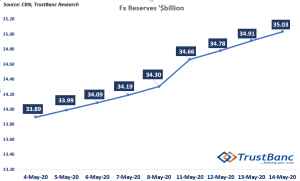
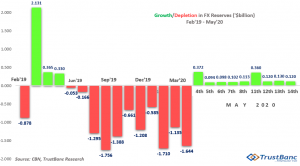
Fx reserve has added over $1.5 billion since the beginning of May following months of zero growth, raising hopes of a more stable exchange rate on the naira as soon as the CBN starts to supply dollars to the fx windows it has muted supply since March.

  • 14th May – $122.87 million
  • 13th May – $127.29 million
  • 12th May – $126.96 million
  • 11th May – $358.08 million
  • 8th May – $112.32 million
  • 7th May – $101.66 million
  • 6th May – $98.24 million
  • 5th May – $94.49 million
  • 4th May – $371.59 million

Headlines:

Nigeria Records 338 New COVID-19 Cases, Total Infections Near 6,000

Nigeria has recorded 338 new cases of the novel coronavirus, according to the Nigeria Centre for Disease Control. In a tweet on its official handle late Sunday, the NCDC said Lagos had recorded 177 new cases, while Kano posted 64 cases. Other regions with new cases include the FCT with 21, Rivers with 16, Plateau with 14, Oyo 11, Katsina nine, Jigawa and Kaduna with four each, and three cases from the trio of Abia, Bauchi, and Borno. Read more

COVID-19: President Buhari To Address the Nation On Monday

President Muhammadu Buhari will address Nigerians on Monday, even as the first phase of the gradual easing of the COVID-19 lockdown comes to an end. Mr. Aliyu made this disclosure when he appeared on Channels Television’s Sunday Politics. When asked if the PTF is thinking of taking a different direction seeing that many Nigerians have been flouting guidelines for the ease of lockdown, the task force coordinator noted that the President is the only one who can decide on whether or not the country should go ahead with the second phase of lockdown ease. Read more

Banks reject payment to foreign business partners

DEPOSIT Money Banks (DMBs) are turning down payment requests from customers seeking to pay business partners abroad with naira debit cards. Banks are asking customers paying clients abroad to do so in the currency of the beneficiary’s country, as against the previous practice where lenders debited the naira accounts of customers at the prevailing exchange rate and remitted dollar equivalent to the offshore beneficiary’s account. Read more

FG Impounds UK Aircraft for Conducting Commercial Flights

The Federal Government has impounded an aircraft owned by a British company for conducting commercial flights operation into Nigeria amid COVID-19 lockdown. This was announced on Sunday by Minister of Aviation, Hadi Sirika, via official Twitter handle @hadisirika. The Minister said the company, Flair Aviation, was given the approval to conduct humanitarian flights but was caught operating commercial flights. Read more

Report Predicts $17bn Decline in Nigerian Oil Revenue

Nigeria’s oil revenue is likely to decline by between 70 per cent and 80 per cent this year, representing between $15 billion and $17 billion, the Chief Executive Officer of Financial Derivatives Company Limited and a member of President Muhammadu Buhari’s Economic Advisory Council, Mr. Bismarck Rewane, has predicted. Rewane said this in a report he presented at the monthly Lagos Business School executive breakfast meeting for the month of May titled: “Making Hay While the Sun Has Set,” a copy of which was obtained by THISDAY at the weekend. Read more

Buhari okays suspension of deductions from states’ cash

THERE is reprieve for state governments following President Muhammadu Buhari’s approval of the suspension of deductions of loans and bailout funds from their monthly allocation. The Coronavirus pandemic has virtually destroyed the world’s economy – draining Nigeria’s oil revenue to the bottom. Read more

COVID-19: Private Sector, Labour Leaders Oppose Fresh Lockdown

As President Muhammadu Buhari addresses the nation today after 14 days of relaxation of the lockdown of the Federal Capital Territory (FCT), Lagos and Ogun states he had imposed March 30 to curb the spread of COVID-19, the organised private sector (OPS) and labour have indicated their opposition to a fresh shutdown of the economy. Read more

Asia shares follow S&P 500 higher, oil and gold jump

Asian shares were led higher by S&P 500 futures on Monday and oil prices hit a five-week peak as countries’ efforts to re-open their economies stirred hopes the world was nearer to emerging from recession. Summer weather is enticing much of the world to emerge from coronavirus lockdowns as centres of the outbreak from New York to Italy and Spain gradually lift restrictions that have kept millions cooped up for months. “The economies of Europe and the U.S. likely bottomed out in April and are slowly starting to come back to life,” wrote Barclays economist Christian Keller in a note. Read more

Alibaba’s Jack Ma resigns from SoftBank board

SoftBank Group Corp said on Monday that Alibaba co-founder Jack Ma will resign from its board, in the latest departure by a high-profile ally of CEO Masayoshi Son. The departure of Ma, who retired as Alibaba’s executive chairman in September, comes as he pulls back from formal business roles to focus on philanthropy. SoftBank will propose three new appointments to the board, including group Chief Financial Officer Yoshimoto Goto, at its annual general meeting on June 25. The number of board members will expand to 13. Read more

Oil prices hit one-month highs on output cuts, demand signs

Oil prices climbed by more than $1 a barrel on Monday, supported by output cuts and signs of gradual demand recovery amid easing coronavirus curbs, with U.S. oil showing no signs of last month’s contract expiry price rout. Brent crude LCOc1 was up $1.06, or 3.3%, at $33.56 a barrel by 0452 GMT, after touching its highest since April 13. U.S. West Texas Intermediate crude CLc1 was up $1.29, or 4.4%, at $30.72 a barrel, after rising to its highest since March 16. Read more

A month after negative oil prices, U.S. crude contract expiry looms

A month after sellers had to pay nearly $40 a barrel to get rid of U.S. oil futures, the next watershed moment looms with the expiry of the June contract on Tuesday – and so far there is little sign of a repeat of the historic plunge. The extent of the damage that the coronavirus pandemic had inflicted on the oil industry came into focus on April 20, when the U.S. benchmark WTI CLc1 contract plunged to minus $38 a barrel. Read more

Coronavirus widens climate rift between European and U.S. oil majors

Europe’s top oil and gas companies have diverted a larger share of their cash to green energy projects since the coronavirus outbreak in a bet the global health crisis will leave a long-term dent in fossil fuel demand, according to a Reuters review of company statements and interviews with executives. The plans of companies like BP (BP.L), Royal Dutch Shell (RDSa.L) and Total (TOTF.PA) are in step with the European Union’s efforts to transition to a lower-carbon economy and away from a century-old reliance on oil, and reflect the region’s widening rift with the United States where both the government and the top drillers are largely staying committed to oil and gas. Read more

Japan braces for worst postwar slump as pandemic tips economy into recession

Japan’s economy slipped into recession for the first time in 4-1/2 years in the last quarter, putting the nation on course for its deepest postwar slump as the coronavirus crisis ravages businesses and consumers. Monday’s first-quarter GDP data underlined the broadening impact of the outbreak, with exports plunging the most since the devastating March 2011 earthquake as global lockdowns and supply chain disruptions hit shipments of Japanese goods. Read more