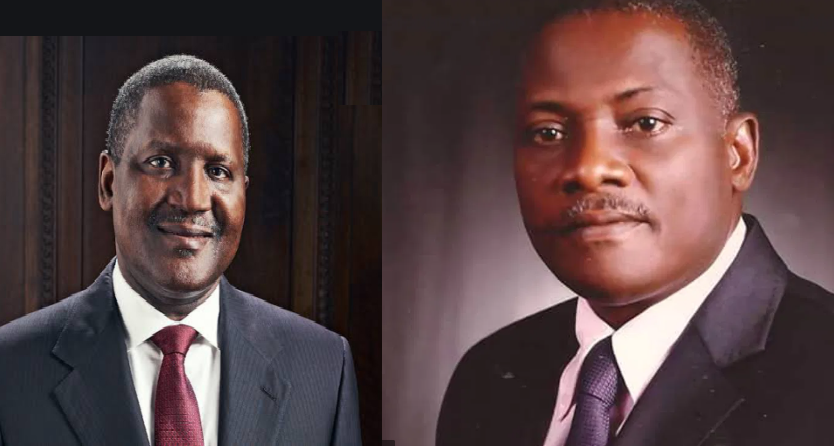
Great feedback on the Ubuntu and Igbo Apprenticeship System piece. Many have written comparing Dangote Group and Innoson Vehicle Motors (IVM). Some accurately noted that Dangote is now a big conglomerate while IVM is not. And Innoson Chukwuma, IVM Founder, may be controlling a huge part of that business while Dangote might have diluted to scale via outside funding.
The soul of the Igbo Apprenticeship System could be likened to the U.S. Federal Reserve which largely works to keep the U.S. dollars stable (by reducing inflation) and maximize employment through interest rates. So, the Reserve has defined main focus areas even though it can use its systems to do other things. Consequently, the U.S. Congress uses those two main factors to ascertain the effectiveness of the Reserve policy. For the Igbo Apprenticeship System, the main focus is to prevent poverty by mass-scaling opportunities for everyone, and not building conglomerates!
As someone who is close to these Igbo legends, I do note that what drives them is different. Yes, they do dilute their business controls by giving out market share, not via equity as in the typical European model. I have noted that the system has major defects; many will argue differently! With the Obi of Awka last year, I discussed the Umunneoma Economics in Nnamdi Azikiwe University.
When a child is born, he belongs to the community. That is why Igbos name their kids “Nwaoha” [the child of the community]. The parents are agents to bring children into the world; the communities have duties to ensure the children thrive.
So, under Igbo Apprenticeship System, you see men who could have built massive assets and empires dividing their acquired market shares for over four decades, happily. That is why you will not see any big conglomerate in Aba, Onisha etc because the Igbo Apprenticeship System is not designed to have one iroko but many trees in the forest!
From the continental and global levels, Igbo Apprenticeship System is defective.But from the community level, it is perfect. There is no beggar in my village in Ovim (Abia State) because there is always help. But those helps come by relinquishing market shares by market leaders even as they fund their future competitors.
The fact is this: people like IVM measure impacts differently. Nnewi has the highest per capita income in Nigeria according to many studies. Ohafia men will believe that it is better to have 10 men with $10k than two with $50k each. Across the Igbo Nation, and drawing from post-war experiences, strengthening communities was more important than personal empires. Many Igbo communities started community leagues and development associations to build schools, clinics, and roads. The Ovim Community League which manages my village was started in the 1970s to support the community since no one expected help from the Nigerian government. Despite their saving, Nigeria froze their bank accounts, and practically, all Igbos had to begin from near-ground zero.
To make progress, they called that Umunneoma spirit, asking those who made small efforts to come and pick their brethren. Men made business decisions designed not to make just money but to employ people. And community levies mushroomed as they wanted to make sure that even though they were venturing out of villages, those back home must still have schools and clinics. Most primary and secondary schools built post-war in Igbo Nation were built by community efforts, not government.
The Secondary Technical School Ovim which I attended was built in the mid-1970s. By 1981, it had woodwork, automotive, etc labs. Today, the state university uses it for computer labs as it has advanced computer labs. All the projects funded via Ovim Community League. The promising businessmen made enormous financial sacrifices to support those projects.
The Igbos came out of the Biafra war with assets (outside South East) frozen by the federal government; call it ground zero. Many Igbo communities started community leagues to build schools, clinics, etc. Elders pushed men to share opportunities to help brethren. The war shaped the tribe; young women trekked days, hiding from bombs to get salts, as men fought war. Mothers named their kids “Nwaoha”[child of the community], with confidence that the village would rise if orphaned.
The key is that companies like Dangote Group and IVM have different incentives because the founders see things differently. Most will not tell you that. Between building a dominant conglomerate, most of the Igbo players will prefer to build a stable community with many players. This cuts across trade and industries.They did not live through the war because of wealth, but through shared efforts. Each person is nothing but through communal support, they are rising. They lost 100% of all landed properties outside Eastern Nigeria, but today, through shared efforts, they are one of the largest investors in landed properties in Nigeria. Yes, while there is no single dominant landowner, in their midst, the cohort is thriving – and when they see opportunities, they pass to their brethren.
The largest producer of car spare parts many years ago in Ghana was Ifeanyi Ubah (now a Senator). He left that business to his brethren to build hydro power plants in Congo which remain one of his biggest investments. Ifeanyi then used his money to build a community in Congo. He gave away good businesses and opportunities to his brethren. Then, he left to start Capital Oil, one of the largest indigenous oil depots in Nigeria.
I was with Mr Ubah in his office a few years ago when a man who took him to Ghana visited him in Abuja. He had dropped out of secondary school in his second year or so. Ubah is now multiples richer. But the reverence was unbelievable: “Prof, this is my Oga. He took me to Ghana”, the now-Senator said. Later that evening, the man came to me: “I am proud of my boys, Ifeanyi makes me happy”. Those are things that bring happiness to them, not market share or dividend.
Nigerian Igbos Run the Largest Business Incubation System in the world – TED Video