DD
MM
YYYY

PAGES

DD
MM
YYYY

spot_img

PAGES

Home Blog Page 637

Ethereum Investment Holders Rush To Buy New ETH memecoin, Top Crypto Presale Makes Waves on Ethereum, Causing Hype

0

Ethereum remains the foundation of decentralized finance, but a growing trend is pulling investors toward meme-based tokens on the same network. These projects combine cultural energy with structured token presales, giving them a unique appeal.

In 2025, crypto presales are gaining traction as communities look for fresh projects that offer clear tokenomics and growing ecosystems. Among the many crypto coins on presale, Pepe Dollar ($PEPD) is building momentum with its ongoing presale stage.

This movement shows how meme tokens continue to play a role in shaping the crypto presale list, where culture and finance intersect.

ETH Holders Rush To Memecoins On ETH Like $PEPD

Ethereum investors are no longer just watching traditional DeFi tokens. Many are now turning toward meme-inspired presale cryptocurrencies that combine humor with practical payment features. Pepe Dollar ($PEPD) is one of those tokens gaining attention in this shift.

The appeal comes from its ability to merge familiar internet culture with an infrastructure that supports digital transactions. Unlike many crypto presale projects,Pepe Dollar ($PEPD) outlines clear stages, transparent token supply, and a roadmap that gives direction.

For ETH holders, this creates a balance between cultural engagement and structured participation in crypto presales. It also highlights why presale crypto tokens can stand out when they combine creativity with real-world applications.

Pepe Dollar ($PEPD) Presale Gains Momentum Among Top Crypto Presales For Utility And Culture

Pepe Dollar ($PEPD) is quickly building recognition among the best crypto presales to buy right now. In its Stage 2, the project has already raised $1.76 million, signaling strong engagement from early participants.

At the current stage, one PEPD token is priced at $0.006495, with the launch price set at $0.03695. This structured model helps it stand out in the crowded space of crypto ICO presales. Investors studying new crypto token presales often look for projects with transparent allocation, and Pepe Dollar highlights these qualities.

Beyond numbers, its features include PayFi integration, QR payments, staking models, and support for meme-driven ecosystems. These layers of utility separate it from many presale crypto coins that only focus on hype.

As it progresses, Pepe Dollar ($PEPD) continues to attract ETH holders who see value in projects that mix cultural resonance with detailed planning in cryptocurrency presales.

Pepe Dollar ($PEPD) Making Waves Among Ethereum Memecoins

Ethereum is home to several meme tokens, but Pepe Dollar ($PEPD) is carving its own place by blending satire with technology. This combination appeals to communities that value both culture and usability.

Compared to other presale crypto tokens, Pepe Dollar gains visibility because it connects meme-driven identity with structured tokenomics. Its presale achievements place it alongside top presale crypto projects, particularly for those following the crypto presale 2025 market.

This momentum illustrates how coin presales can drive participation when they provide clarity and innovation. For Ethereum holders, Pepe Dollar ($PEPD) demonstrates how meme-inspired tokens can integrate into the larger presale ecosystem.

Ethereum Presale Crypto Trends Highlight Pepe Dollar ($PEPD)

The ongoing success of token presales reflects a broader interest in combining blockchain culture with functionality. Ethereum has become a natural space for this growth, with projects like Pepe Dollar ($PEPD) leading examples.

Among the top crypto presales, Pepe Dollar shows how structured token distribution, cultural relevance, and practical features can work together. Its presale results highlight why it appears on many crypto presale lists.

For ETH holders exploring new crypto presales, Pepe Dollar offers insight into how meme tokens are evolving into more layered ecosystems. While Dogecoin paved the way, PEPD adds structure and planning that appeal to today’s crypto presales audience.

Pepe Dollar Website: https://pepedollar.io/

Pepe Dollar Telegram: https://t.me/pepedollarcommunity

Key Risks and Opportunities in CBN’s POS Geo-Tagging Policy

0

The Central Bank of Nigeria’s (CBN) recent policy on the geo-tagging of Point of Sale (POS) terminals marks a significant shift in the regulation of financial technology and payment systems. Under the new rules, POS terminals must be geo-tagged and restricted to operate within a 10-meter radius of their registered locations. While the policy aims to improve compliance, reduce fraud, and enhance trust in Nigeria’s payment ecosystem, it also presents practical challenges for merchants, payment service providers, and customers. In this piece, our analyst examines  the risks and opportunities the policy introduces and explores how stakeholders can adapt to the changing landscape.

Improving Trust and Transparency in POS Transactions

One of the most important objectives of the CBN’s policy is to restore trust in Nigeria’s payment ecosystem. Over the years, POS terminals have become critical tools for financial inclusion, especially in areas where bank branches are scarce. However, concerns about fraud, misuse, and relocation of terminals to unauthorized locations have raised questions about transparency.

By requiring that POS terminals be tied to specific locations within a 10-meter range, the CBN intends to ensure better monitoring and control. Financial institutions and regulators can now trace where transactions originate, which reduces opportunities for fraudulent activities. This also helps improve transaction data quality, making it easier for policymakers and service providers to plan, manage, and secure financial services more effectively.

For customers, the policy promises greater confidence in POS services. If properly implemented, users will be more certain about who operates a terminal and where it is located. This sense of reliability can encourage more people to adopt digital payment methods, contributing to the broader goal of financial inclusion.

Operational Challenges for Merchants and Payment Providers

While the policy offers long-term benefits, its short-term impact on merchants and payment service providers could be significant. Many small business owners rely on the flexibility of mobile POS terminals to serve customers across different locations. Restricting terminals to a fixed 10-meter range may disrupt business models that depend on mobility, especially in rural and semi-urban areas where merchants often operate across multiple market spaces.

Payment service providers, fintech companies, and terminal manufacturers also face added pressure. To comply with the policy, they must upgrade their hardware and software, integrate new geolocation technologies, and meet stricter certification standards. These requirements increase operational costs, which may eventually be passed on to merchants and customers.

Another concern is the risk of transaction failures when terminals are used outside their approved locations. For instance, a merchant attending a weekend market in a different town may find their terminal unusable, potentially frustrating customers and reducing sales. Such disruptions could slow the growth of POS adoption in underserved communities, undermining financial inclusion goals if not carefully managed.

The Role of Technology and Infrastructure

The success of this policy depends heavily on the strength of Nigeria’s technology infrastructure. The integration of geo-tagging into POS systems relies on accurate GPS data, modern operating systems, and secure software development kits that manage compliance. Terminals running on outdated systems may no longer meet regulatory standards, forcing service providers to replace large numbers of devices.

This shift creates opportunities for innovation in the fintech sector. New POS designs can combine improved security features, advanced geolocation capabilities, and better user interfaces. However, these upgrades also require significant investments in research, development, and deployment. Smaller fintech companies may struggle to meet these demands, giving larger service providers a competitive advantage.

Additionally, network reliability and GPS accuracy play crucial roles in making the policy effective. In regions with weak internet coverage or unreliable satellite signals, enforcing the 10-meter rule may be difficult. Without adequate infrastructure improvements, some merchants could face disruptions that erode customer trust rather than strengthen it.

Navigating the Future of Digital Payments

The CBN’s geo-tagging policy signals a broader trend toward increased regulation and oversight in Nigeria’s financial technology sector. While the goal is to create a safer and more transparent payment ecosystem, success will depend on how stakeholders manage the balance between compliance and flexibility.

Merchants and payment service providers must rethink their business models to adapt to location-based restrictions. Investing in new technologies and working closely with terminal manufacturers can ease the transition. Fintech innovators have an opportunity to develop smarter, more efficient devices and software that meet regulatory standards while supporting the diverse needs of merchants and customers.

Policymakers and regulators, on the other hand, must ensure that the policy does not unintentionally widen gaps in financial inclusion. This requires ongoing dialogue with stakeholders to refine the framework, address implementation challenges, and provide support for smaller businesses adapting to the new rules.

Nigeria’s Labour Market: A Fragile Balance Between Creation and Loss

0

The performance of Nigeria’s labour market in 2024 offers both optimism and caution. Data from the first three quarters of the year, released by the National Bureau of Statistics,  shows that nearly one million jobs were created, yet the economy also suffered significant job losses by the third quarter. Our analyst posits that understanding these dynamics is crucial for business leaders, policymakers, and investors who must navigate a labour market that reflects the wider challenges of the Nigerian economy.

A Promising Start to the Year

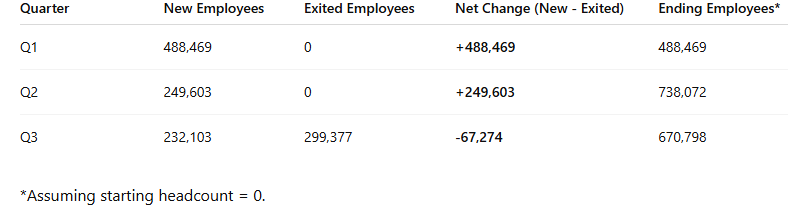
Source: NBS, 2024; Infoprations Analysis, 2025

In the first quarter of 2024, Nigeria experienced a remarkable wave of job creation. Almost 490,000 new jobs were added, reflecting either government-led employment drives, seasonal agricultural demand, or private sector expansions. The second quarter sustained this trend, though at a slower pace, with about 250,000 additional jobs. Taken together, the first half of 2024 gave the impression of positive momentum, suggesting that the economy was beginning to absorb some of the millions of Nigerians entering the workforce every year.

This growth should not be understated. Nigeria faces one of the fastest-growing populations in the world, and each year over four million young people join the labour force. The creation of over 700,000 jobs in just six months was a significant achievement. It signalled resilience in sectors such as agriculture, services, and possibly parts of manufacturing, despite the macroeconomic challenges of inflation, foreign exchange volatility, and infrastructure gaps. For many, the data from the first two quarters provided a sense of cautious optimism that Nigeria could expand opportunities in the face of global and domestic pressures.

The Turning Point in the Third Quarter

By the third quarter, however, the picture shifted dramatically. Job creation fell further to about 232,000, while job losses surged to nearly 300,000. This resulted in a net decline of more than 67,000 jobs during the quarter. For the first time in 2024, the labour market contracted, reflecting deeper structural weaknesses in the economy.

Several factors likely contributed to this reversal. Inflation remained elevated, particularly food inflation. High costs of living reduce consumer demand and put pressure on businesses to cut costs. The depreciation of the naira also raised import costs and disrupted supply chains, particularly for manufacturers reliant on imported inputs. Rising energy prices added another layer of difficulty for small and medium enterprises, many of which operate with already thin margins. In more formal sectors such as banking, oil and gas, and technology, cost-cutting measures and retrenchments have also been reported.

This quarter’s outcome reveals how fragile the labour market gains have been. Without a steady macroeconomic foundation, job creation becomes highly vulnerable to shocks and policy inconsistencies.

The Broader Structural Challenge

While the net job gain across the first three quarters of 2024 stands at about 670,000, this falls short of what Nigeria needs to keep pace with its rapidly expanding workforce. Even in a year of relatively strong job creation, millions of Nigerians remain unemployed or underemployed. Many of the jobs created are concentrated in the informal sector or in seasonal agricultural activities, which often lack stability, social protections, and the ability to generate sustainable income.

This disconnect between headline job numbers and real livelihood improvements highlights a deeper structural problem. Nigeria’s economic growth has not consistently translated into quality employment opportunities. The mismatch between skills and available jobs, weak industrialisation, and underinvestment in sectors that drive productivity all limit the ability of the economy to create stable, high-paying jobs. Unless these issues are addressed, periodic spikes in job creation will not be enough to solve the underlying employment crisis.

Building a More Resilient Labour Market

To transform these patterns, Nigeria needs a deliberate strategy that links economic growth with sustainable job creation. Policymakers must focus on stabilising the macroeconomic environment by tackling inflation, improving foreign exchange liquidity, and reducing energy costs. Investment in infrastructure, particularly reliable electricity, would allow businesses to expand with more confidence.

Equally important is the need to strengthen the connection between education, training, and the evolving needs of the economy. As global industries shift toward technology and green energy, Nigeria must prepare its workforce with relevant skills to remain competitive. Supporting entrepreneurship and small businesses, which already account for a large share of employment, will also be critical.

For the private sector, the challenge is to identify opportunities in adversity. Companies that innovate around local sourcing, renewable energy, and digital services can create not only profit but also significant employment. Partnerships between government and businesses can accelerate this process, while international investors should see Nigeria’s young and energetic workforce as a long-term opportunity once structural reforms take root.

Blaxel – AI Cloud Infrastructure for AI Agents | Tekedia Capital

0

Call it the AWS of AI agents and the finest cloud infrastructure for AI agents. Blaxel, a Tekedia Capital portfolio startup, is ready to host your AI agentic mission. Begin here blaxel.ai.

At Tekedia Capital, we make friends with the world’s finest founders who are building category-redefining technologies in five continents.

Nigeria’s Central Bank Directs Banks And Fintechs to Enforce PoS Terminals Geo-Tagging to Curb Fraud

0

The Central Bank of Nigeria (CBN) has issued a new directive requiring all financial institutions and licensed payment operators to comply with international payment messaging standards and introduce mandatory geo-tagging for Point-of-Sale (PoS) terminals.

According to the circular signed by Dr. Rakiya O. Yusuf, Director of the Payments System Supervision Department, the move aligns Nigeria’s payment infrastructure with global best practices while strengthening transparency and security across the financial system.

The CBN emphasized that all payment transaction messages, whether domestic or international, must adopt the ISO 20022 format in accordance with both its own and SWIFT’s global specifications. This standard requires the accurate inclusion of key data such as payer and payee identifiers, merchant and agent details, and transaction metadata.

All institutions in the payment ecosystem, including Deposit Money Banks, Microfinance Banks, Mobile Money Operators, and Switching Companies, are expected to complete migration and achieve full compliance by October 31, 2025.

Mandatory Geo-Tagging of Terminals

In addition, the CBN directed that all existing and newly deployed PoS terminals must come with native geolocation capabilities, specifically Double-Frequency GPS receivers, to ensure reliable location tracking. Operators must register terminals with a Payment Terminal Service Aggregator (PTSA) and capture precise latitude and longitude coordinates for every merchant or agent location.

The circular further states that PoS applications must integrate the National Central Switch Geolocation SDK, with Android OS v10 set as the minimum requirement. Terminals must capture and transmit geolocation data at the start of each transaction, which will serve as a mandatory reporting field.

Merchant activities are restricted to within a 10-meter geofence from their registered business location. All existing terminals must be geo-tagged within 60 days of the circular, while new terminals must be geo-tagged before certification and activation. Terminals not routed through a PTSA will not be allowed to operate.

CBN will commence compliance checks from October 20, 2025. The central bank stressed that these measures are part of efforts to modernize Nigeria’s payment ecosystem, curb fraud, improve regulatory oversight, and ensure interoperability with international financial systems.

This new directive by the CBN comes amid rising concerns over cloned terminals and ghost agents operating outside regulatory oversight. Since the introduction of PoS terminals in 2013, it has become the go-to for cash for many Nigerians. This has seen the PoS network in the country surge in recent years, with over 1.5 million agents nationwide.

As of March 2025, there were 8.36 million registered PoS terminals, with 5.90 million active/deployed. Transactions hit a record N10.51 trillion in Q1 2025, a 301.67% increase from Q1 2024. However, this growth has come with risks, as Agents often unknowingly serve as access points for fraud and criminal activity.

Fraudsters have continued to exploit PoS terminals through various methods, often targeting the trust-based interaction between customers and operators or weaknesses in the technology itself. The rapid growth of PoS terminals has outpaced regulatory and security measures. Many terminals are operated by unlicensed agents, making it easier for fraudsters to infiltrate the system.

Efforts to Combat PoS Fraud

Nigeria’s financial authorities and fintechs have been taking steps to address PoS fraud.

In January 2024, the Nigerian Electronic Fraud Forum (NeFF), in collaboration with AMMBAN and NIBSS, announced a fraud-flagging feature for PoS terminals, set to launch by Q1 2024. This feature requires KYC details for certain transactions and aims to identify suspicious activities. However, some PoS operators were unaware of the initiative, indicating communication gaps.

Also, the CBN and Corporate Affairs Commission (CAC) mandated that all 1.9 million PoS agents register their businesses by September 5, 2024, to enhance accountability and reduce unlicensed operators.

Looking Ahead

PoS terminal fraud in Nigeria is a significant challenge driven by the rapid growth of electronic payments, lax oversight, and technological vulnerabilities.

While fraud cases are rising, financial losses have decreased, suggesting some improvement in detection and prevention. Initiatives like geo-tagging, fraud-flagging features, and stricter KYC requirements show promise to curb surging fraud cases.