DD
MM
YYYY

PAGES

DD
MM
YYYY

spot_img

PAGES

Home Blog Page 6388

IMF Excludes Nigeria

4

The International Monetary Fund (IMF) has announced debt relief for 25 nations around the world to help them cushion the effects of coronavirus pandemic. The executive board of the monetary body approves the immediate debt relief for these countries in the wake of the COVID-19 outbreak that has brought the world’s economy to its knee, and exposed vulnerable countries, especially in Africa, to alarming economic hardship.

Ms. Kristalina Georgieva, Managing Director of the IMF, said the provision is for the poorest among its member countries, and part of its Catastrophe Containment and Relief Trust (CCRT) response for poor countries affected by the pandemic.

“Today, I am pleased to say that our Executive Board approved immediate debt service relief to 25 of the IMF’s member countries under the IMF’s revamped Catastrophe Containment and Relief Trust (CCRT) as part of the Fund’s response to help address the impact of the COVID-19 pandemic.

“This provides grants to our poorest and most vulnerable members to cover their IMF debt obligations for an initial phase over the next six months and will help them channel more of their scarce financial resources toward vital emergency medical and other relief efforts.

“The CCRT can currently provide about US$500 million in grant-based debt service relief, including the recent US$185 million pledge by the UK, and US$100 million provided by Japan as immediate resources. Others, including China and the Netherlands, are also stepping forward with important contributions. I urge other donors to help us replenish the Trust’s resources and boost further our ability to provide additional debt service relief for a full two years to our poorest member countries,” she said.

The countries in line to benefit from the debt service relief include 20 African nations. They are as follows: Afghanistan, Benin, Burkina Faso, Central African Republic, Chad, Comoros, Congo, D.R, The Gambia, Guinea, Guinea-Bissau, Haiti, Liberia, Madagascar, Malawi, Mali, Mozambique, Nepal, Niger, Rwanda, Sao Tome and Principe, Sierra Leone, Solomon Islands, Tajikistan, Togo and Yemen.

It came as a surprise that Nigeria was excluded in the list as it is battling to contain a daily increasing number of the coronavirus cases. It could be recalled that Nigeria’s former finance minister Ngozi Okonjo-Iweala and former president, Olusegun Obasanjo, had moved the quest for debt relief for poor African countries.

The duo called on the G20 nations to waive 2020’s debt repayment for poor countries, including $44 billion expected from African countries. In the letter addressed to the G20 members, Obasanjo and Iweala asked the international community to remember how the world survived the economic crunch of 2008-2010, and apply the same technique now.

“In 2008-2010, the immediate economic crisis could be surmounted when the economic fault line-under-capitalization of the global banking system was tackled. Now however, the economic emergency will not be resolved until the health emergency is effectively addressed: the health emergency will not end simply by conquering the disease in one country, but by ensuring recovery from COVID-19 in all countries,” the letter reads partly.

Nigeria is the country with most poor people in the world, a major criterion for debt relief. Therefore, the West African country’s exemption from CCRT amnesty has instigated curiosity.

Many believe it is due to habitual practice of borrowing by the Nigerian government. Since November 2019 till now, the federal government of Nigeria has made several attempts to make external borrowing, especially from the IMF and the World Bank. There was the $29.96 billion notorious loan request in November, and the $22.7 billion that was suspended in March due to opposition, and $6.9 billion it planned to borrow from multilaterals lenders earlier in the month of April.

Each of these attempts to borrow has attracted wide condemnation. Dissenting voices had called it “reckless and unjustifiable.”

The former Vice President Atiku Abubakar berated the government’s last attempt to borrow from foreign governments. He asked the Nigerian government to look inward to solve its problems as every country around the world has the same worry to contend with right now.

“As it stands today, the world is too preoccupied with its challenges to prioritize Africa, and so we have to prioritize ourselves. The issue of Nigeria wanting to borrow $6.9 billion at this time shows the almost delusory state of our government. No one has that type of money to throw about.

“Why is it that the Nigerian government is always quick to want to borrow at every instance? It shows a lazy mindset and an inability to take those sacrifices necessary to get the economy into shape. Worse still, it proves that we do not, as of yet, have the ability to think outside the box for genuine solutions.

“We cannot be looking to borrow huge sums at the same time our officials are taking delivery of foreign made luxury cars. We cannot be considered a serious country when we refuse to cut down on profligacy and instead seek outside help to fund our inefficiencies,” Atiku said.

Many believe that it’s time Nigeria begins to cut down on loans, reduce wastage and lax on judicious use of scarce funds. It is also believed that the government needs to generate ideas to diversify the economy.
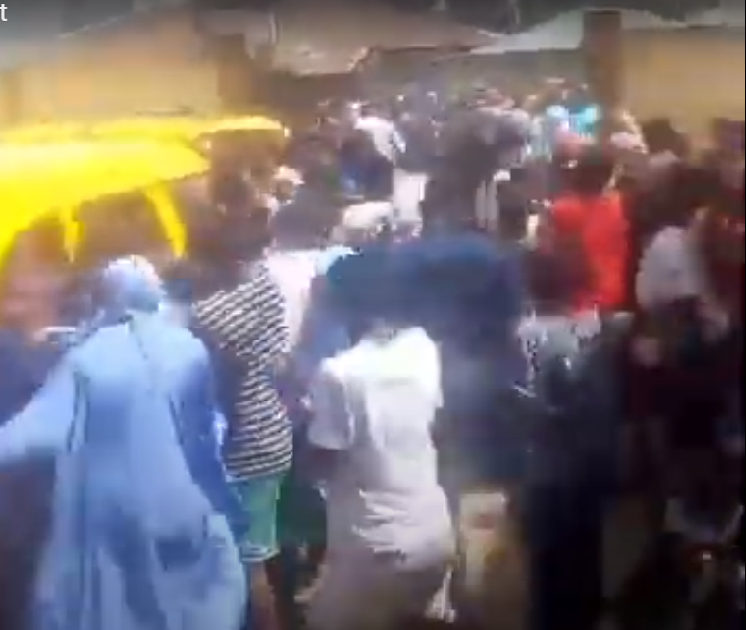
The Nigeria’s Bread Scramble [Video]

1

The biggest irony: you lock down a nation because of coronavirus, implementing social distancing. Then, because of hunger, all protocols are broken as people fight for bread. Of course, the government is working – some contractors contracted to transfer cash to the poor in some states have been sacked for delay. 

The federal government says it has terminated two contracts for cash transfers to Nigerians in four states.

The project was called off after a breach of agreement by the affected contractors, Sadiya Farouq, Minister of Humanitarian Affairs, Disaster Management and Social Development, said in a statement Tuesday.

The “payment service providers” were contracted by the federal government to make payments to vulnerable persons in Bayelsa, Akwa Ibom, Abia and Zamfara States.

“The termination is with the procurement process launched using World Bank procurement guidelines to ensure that payments commence in the affected states on or before April 28, 2020,” the statement signed by Salisu Dambatta, the minister’s spokesperson.

The minister said the federal government cannot accept delays in the current payment round of N20,000 to beneficiaries in poor and vulnerable households under any excuses in the four states or any other states of the federation

I do not envy those contractors because if you ask me to find the poor in Nigeria, I am not even sure there is a standard quantifiable  mechanism to do that. Yes, if you think you are transferring cash via any bank to the poor in Nigeria, you are wasting your time. Poor people in Nigeria do not have bank accounts! Of course, you can transfer via air, sea, party leader, … [add your magic].

You have less than 40 million unique bank accounts in a nation with at least 80 million adults. Magic transfer, none has ever reached my village since 1999! This video, on click, shows the state of things: scramble for bread.

https://youtu.be/IFDoaur3264


TrustBanc Daily Stock Market Scorecard, 14th April 2020

0

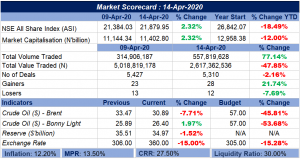
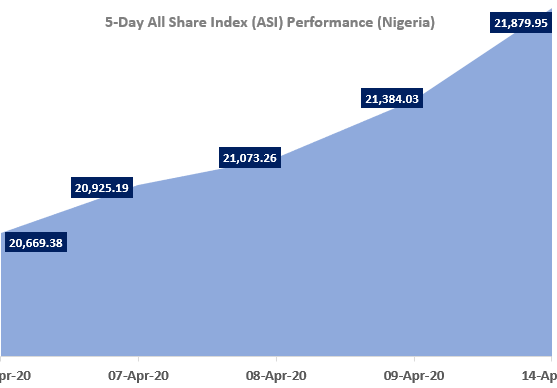
Since close of trade on 6th April 2020, the market has now gained over 5.80% in four consecutive trade days and recovered over N630 billion for Investors, the last time the market enjoyed this streak was January 2020.

The All-Share Index (ASI) appreciated by 
2.32% today to abate the year-to-date loss of the Market to 18.49%.

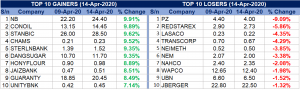
Market Breadth: The breadth of the market remained strong today as the Bulls maintained their hold on the market for the fifth day running, 28 stocks appreciated as against 12 that depreciated. NB and CONOIL led the gainers’ chart, while PZ and REDSTAREX led the losers chart. See the list of top gainers or losers below:

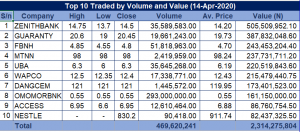
Market Turnover: ZENITH and GTB led the most traded stocks chart in volume and value. See top 10 traded stocks below:

Have a good evening.


Innovation Lessons from 12 Companies

0
The 12 firms

Next week, we will be examining these companies, focusing on the innovation lessons we can learn from them. The broad theme dwells on the state of the tech nation, and the emerging opportunities which are coming up. Our goal is to discover the leverageable factors which are cushioning the scalable advantages in the firms – and in the process, we can learn, and apply in our firms. 

You can join the second edition of Tekedia Mini-MBA here.

Tekedia Academic Programs

Nigeria in a Dilemma

0

Nigeria is in a state of dilemma. She is currently in a position that placed her between the devil and the deep blue sea. Any direction she takes now spells disaster for her. So she needs to choose the lesser evil; though none of the options seems less disastrous.

The moment it became obvious that restriction of movement order will be enacted to minimize and contain the spread of COVID-19, people became afraid. People knew that the lockdown was the best option but they couldn’t imagine what their lives would be like during the period. They hoped against all odds that the order wouldn’t be put in place. But alas, they were disappointed to find out that there is no running away from a lockdown.

Then people were only afraid of not being able to find daily meals. Those that survive on daily income were the most concerned. The people that could afford to stock up necessary supplies in their houses did so while those that couldn’t, trusted on providence to provide for them. That was the state of the nation when state and federal governments began issuing lockdown orders and started placing security personnel in place to enforce them. Then, the only worries of every average Nigerian was hunger. Today, the worries have surpassed fear of starvation.

The COVID-19 induced lockdown has woken up a lot of sleeping demons. These, in addition to hunger, include inflation, extortion, bullying and armed robbery.

  1. Inflation: The 30th of March, 2020 is a day that marked the peak of inflation in many parts of Nigeria. The prices of goods in the market escalated beyond imagination. For no reason whatsoever, traders increased the prices of essential goods such as food stuffs and toiletries. They knew that people must buy things they will use during the lockdown and decided to use that day to extort buyers of their hard earned money. This hike in prices continued into the lockdown. Right now, the reasons traders give for the price hike is that the lockdown made it difficult and expensive to “import” food stuffs from their producing states.
  2. Extortion: Officers of the Nigerian Police Force, as usual, are using this period to make money. In fact, the traders claimed that policemen are part of the reasons why food stuffs are expensive nowadays. It is said that police mounted roadblocks days before the lockdown commenced and started from that period to extort motorists that want to “cross the border”. Speculation has it that lockdown only works for those that don’t have money to settle the police. However, it is quite unfair that members of NPF should disturb the movement of foodstuffs despite knowing that lockdown should not affect flow of food. Extorting from motorists, especially from traders that bought food ingredients to sell is wrong and should therefore be checked.
  3. Bullying: Several disheartening videos of members of the NPF and the NA bullying people they met on the road have emerged. Some health workers and other people in essential services have narrated their ordeals in the hands of security agents who manhandled them when they, the workers, were on their way to work. These security agents did not bother to verify these people’s given reasons for leaving their homes but rather decided to abuse the power given to them. There are also cases of sick people going to hospitals that were forced to go back home by these security agents. Most of us must have heard of the Warri incident, where a civilian and a soldier lost their lives all in the name of maintaining lockdown order. These attitudes are threats to the maintenance of the lockdown policy.
  4. Robbery: Several cases of harassment, intimidation, extortion, robbery and shoplifting filtered into the news on Saturday, 11th April, 2020. An eye witness of the Abule Egba robbery took to Twitter to narrate how a group of young boys took to the street in broad daylight, shot sporadically, harassed and stole from residents and broke into shops. These people had their field day and later left undisturbed. Some people have linked these robbers to miscreants operating in those areas while some others linked them to people pushed over the edges by lockdown-related hunger. No one can categorically state what caused these young men to go into such an occupation, but what we all are sure of is that in a matter of time, such an act will spread to other parts of the country unless something is done to hold it at bay.

The dilemma Nigeria is facing now is whether the lockdown order should be lifted or if it should be sustained. Lifting the restriction means that COVID-19 will become epidemic in the country and claim as many lives as it could before it becomes contained. But maintaining the restriction means that hunger, inflation, intimidation, extortion, robbery, and many other social vices may go berserk. Put differently, Nigerian government is faced between losing the citizens to death by COVID-19 and losing them to death by the lockdown demons.

The only hope Nigeria has is that it can control the second option while the first one is out of anybody’s control until a vaccine is found. This is just to let the concerned authorities know that they still have a lot of things to do so that the lockdown will not become a nightmare.