

Good People, we have added the following sectors under Sector Innovation and Focus for the second edition of Tekedia Mini-MBA: Logistics, Ecommerce, Fintech, EdTech, Agtech and HealthTech. Only Founders or CEOs of related startups would facilitate them. Meanwhile, an MIT expert on supply chain management will handle a session on Effective Supply Chain Management. Our updated courses and faculty are available here.
The Apple’s Press Release
Why is Facebook investing on connectivity in Africa and Latin America? Why is Google putting resources to expand mobile internet in Africa and beyond? Answer: every IP is an IP even though you can segment the value derivable by regions. So, if you put $100 million to provide affordable internet to people, increasing your number of users, Wall Street could boost your stock by $1 billion. It is the same playbook that is used in retail: give away $10 million through promos on the last few days of the quarter, reporting increase on same store percentages, and wait for your stock to add extra $100 million on market cap. As they always say, there is no free lunch in most parts of this world.
So, that brings me to the first Press Release from Apple signed by an Apple staff, telling Africans that it has launched new services. In short, Apple is telling us to help it tell the good people of Cameroon, Côte d’Ivoire, Democratic Republic of the Congo, Gabon, Libya, Morocco, Rwanda, Zambia, etc that its services are available in their nations.
Apple® announced that starting today, even more customers around the world can enjoy many of Apple’s most popular Services. The App Store®, Apple Arcade™, Apple Music®, Apple Podcasts® and iCloud® are now available in 20 more countries, and Apple Music is available in 52 additional countries.
“We’re delighted to bring many of Apple’s most beloved Services to users in more countries than ever before,” said Oliver Schusser, Apple’s vice president of Apple Music and International Content. “We hope our customers can discover their new favorite apps, games, music and podcasts as we continue to celebrate the world’s best creators, artists and developers.”
[…]
The App Store, Apple Arcade, Apple Music, Apple Podcasts and iCloud are now available in the following countries and regions:
- Africa: Cameroon, Côte d’Ivoire, Democratic Republic of the Congo, Gabon, Libya, Morocco, Rwanda and Zambia.
[…]
Apple Music is also expanding to the following countries and regions:
- Africa: Algeria, Angola, Benin, Chad, Liberia, Madagascar, Malawi, Mali, Mauritania, Mozambique, Namibia, Republic of the Congo, Senegal, Seychelles, Sierra Leone, Tanzania and Tunisia.
This is the first time I am reading a direct press release from Apple which specifically mentioned African countries. It should not come as a surprise: Apple needs numbers because it has upgraded its strategy of selling proprietary hardware packaged with exclusive software, to one that focuses more on services. So, Apple needs numbers – anywhere those can come. Because without numbers, partnerships with retailers, vendors, etc staff. That explains why that $300 iPhone will come within two years. If Apple sees good traction from here, it can make an affordable phone to serve the market. Everything will change, post-covid-19.
The full press release below.
Apple Services Now Available in More Countries Around the World
The App Store®, Apple Arcade™, Apple Music®, Apple Podcasts® and iCloud® are now available in 20 more countries, and Apple Music is available in 52 additional countries
CUPERTINO, California, April 21, 2020/ — Apple® (www.Apple.com) announced that starting today, even more customers around the world can enjoy many of Apple’s most popular Services. The App Store®, Apple Arcade™, Apple Music®, Apple Podcasts® and iCloud® are now available in 20 more countries, and Apple Music is available in 52 additional countries.
“We’re delighted to bring many of Apple’s most beloved Services to users in more countries than ever before,” said Oliver Schusser, Apple’s vice president of Apple Music and International Content. “We hope our customers can discover their new favorite apps, games, music and podcasts as we continue to celebrate the world’s best creators, artists and developers.”
The App Store, Apple Arcade, Apple Music, Apple Podcasts and iCloud are now available in the following countries and regions:
Africa: Cameroon, Côte d’Ivoire, Democratic Republic of the Congo, Gabon, Libya, Morocco, Rwanda and Zambia.
Asia-Pacific: Maldives and Myanmar.
Europe: Bosnia and Herzegovina, Georgia, Kosovo, Montenegro and Serbia.
Middle East: Afghanistan (excluding Apple Music) and Iraq.
Oceania: Nauru (excluding Apple Music), Tonga and Vanuatu.
Apple Music is also expanding to the following countries and regions:
Africa: Algeria, Angola, Benin, Chad, Liberia, Madagascar, Malawi, Mali, Mauritania, Mozambique, Namibia, Republic of the Congo, Senegal, Seychelles, Sierra Leone, Tanzania and Tunisia.
Asia-Pacific: Bhutan.
Europe: Croatia, Iceland and North Macedonia.
Latin America and the Caribbean: the Bahamas, Guyana, Jamaica, Montserrat, St. Lucia, St. Vincent and the Grenadines, Suriname, Turks and Caicos and Uruguay.
Middle East: Kuwait, Qatar and Yemen.
Oceania: Solomon Islands.
The App Store, now in 175 countries and regions, is the world’s safest and most vibrant app marketplace, with over half a billion people visiting each week. It is the best place for users to discover new apps and allows developers of all sizes to distribute their apps to customers around the world. The App Store features many ways for developers to build their businesses, and since it launched in 2008, developers have been creating innovative apps that influence culture and change lives.
Apple Arcade is a groundbreaking game subscription service within the App Store, offering users unlimited access to the entire catalog of more than 100 exclusive games, all playable across iPhone®, iPad®, iPod touch®, Mac® and Apple TV®. Apple Arcade is adding new games and expansions every month from some of the world’s most visionary game developers.
Apple Music is the most complete music experience, now available in 167 countries and regions and offering more than 60 million songs. With world-class music experts and tastemakers curating thousands of playlists and daily selections, and the renowned global radio station Beats 1, Apple Music is the best music service for iPhone, iPad, Apple Watch®, Apple TV, Mac, HomePod® and CarPlay®, and is also available on Android and and other devices.
New Apple Music subscribers in the 52 additional countries can enjoy a six-month free trial of the service, with locally curated playlists including Africa Now, Afrobeats Hits, Ghana Bounce and more. In addition, users have access to world-class music experts, tastemakers, and artist-led programs from globally celebrated creators including Virgil Abloh, Billie Eilish, Elton John, Pharrell, and more.
Apple Podcasts is the best place to browse and listen to the world’s largest catalog of podcasts, now featuring over 1 million shows in more than 100 languages and 175 countries and regions.
iCloud is an essential service that keeps users’ personal content safe, up to date, and available across all their Apple devices, allowing them to store a lifetime of photos, keep important documents at their fingertips, and share and collaborate with ease. iCloud backs up iPhone, iPad and iPod touch automatically and includes Find My to help locate and secure missing devices. With Family Sharing, up to six family members can share access to Apple Services, including Apple TV+, Apple Arcade, Apple Music, iCloud storage, as well as individual music, movie, TV, book and app purchases. Available in 175 countries and regions, iCloud comes with 5GB of free storage and offers affordable 50GB, 200GB and 2TB plans.
For a full list of Apple Media Services availability around the world, please visit Apple Support (https://apple.co/34SAX9d).
Apple revolutionized personal technology with the introduction of the Macintosh in 1984. Today, Apple leads the world in innovation with iPhone, iPad, Mac, Apple Watch and Apple TV. Apple’s five software platforms — iOS, iPadOS, macOS, watchOS and tvOS — provide seamless experiences across all Apple devices and empower people with breakthrough services including the App Store, Apple Music, Apple Pay and iCloud. Apple’s more than 100,000 employees are dedicated to making the best products on earth, and to leaving the world better than we found it.
Brian Bumbery
Apple
Economy, Finance, Business News Headlines & Insights: 21st April 2020
Stock Market Update:
Nigeria’s equity market is currently down by 1.19%. FTSE (UK) – down by 1.77%, DAX (Germany) – down by 2.73%, CAC 40 (France) – down by 2.52% and Nikkei 25 (Japan) – down by 1.97%.
Click on the link https://bit.ly/2XrvIf9 to open a stockbroking/share purchase account and trade within 24 hours.
Oil Market Update:
The negative closing price of WTI futures price yesterday can be interpreted to mean sellers desperately paying buyers to take US crude from them. As an example, WTI is currently trading at -$6.3, it means suppliers of oil have to give $6.3 to buyers willing to take one barrel of their oil.
Why will a seller pay a buyer to take a product away? In this case of oil-storage trade, the sellers want to avoid storage costs.
In a WTI futures contract, the buyers of WTI oil are required to take physical delivery of their oil at a location called Cushing, Oklahoma in the United States. Sadly, the storage capacity of that location had been exhausted as a result of oil glut and destruction of demand by COVID-19, and buyers don’t want to take delivery of oil without a place to store it before getting a final buyer. Sellers were therefore compelled to pay buyers an incentive, the reason for the negative closing price of WTI on 20th April.
Aside from the real activities of Buyers and Sellers, Oil as a commodity is heavily traded on exchanges.
The closing price of the WTI yesterday was more of a function of the commodities trading market than underlying fundamentals, more about the activities of pure Investors than the reality on the ground. You will be right to call it panic.
WTI futures expired yesterday, meaning that pure Investors had to sell May’s contract and purchase June to avoid having to make good on their purchase and also avoid storage costs, because there was no storage capacity available in Cushing, Oklahoma.
The main takeaway here is that this challenge is peculiar to the US and the price of WTI is expected to make a comeback in no time.
As for Brent, the unprecedented crash in WTI will not crash Brent prices as Brent contracts will expire at the end of the month.
Nigeria’s Bonny Light futures prices will not be affected too, for now.
Current prices: WTI -$6.3, Brent $21.57, Bonny Light $20.88
Money Market Update:
Nigeria’s annual inflation rate rose for the seventh consecutive months to 12.26 per cent in March, the highest in 23 months from 12.2 per cent in February. The Nigeria Bureau of Statistics (NBS) disclosed this today in its Consumer Price Index Report for March 2020. Read more
At the current rate of inflation, you need returns that will take you closer to growing your wealth in real terms, we can provide that.
Our money market fund is still open and yield is currently over 11.5%, reach out to our team to grow your cash. We are digital, we are working from home, we are online and we are active. You can also do deposits with us at a starting rate of 10%.
Click to subscribe to our money market fund https://trustbancasset.com/moneymarket/
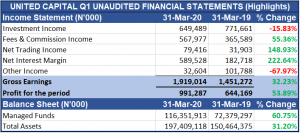
Earnings Flash: United Capital grow earnings by 32.23% and PAT by 53.89%, see highlights in the image below.
 Headlines:
BREAKING: 38 New Cases Of COVID-19 Confirmed By The NCDC
Thirty-eight new cases of #COVID19 have been recorded; says the Nigeria Centre for Disease Control (NCDC). This brings the total number of cases confirmed to 665. According to the NCDC, 23 cases were discovered in Kano, 5 in Gombe, 3 in Kaduna, 2 in Borno, 2 in Abia, 1 in FCT, 1 in Sokoto and 1 in Ekiti. Read more
Latest on the spread of the coronavirus around the world
Reported cases of the coronavirus have crossed 2.46 million globally and 169,863 people have died, according to a Reuters tally as of 0200 GMT on Tuesday, with U.S. President Donald Trump saying he will suspend all immigration into the country. Read more
Nigeria’s Airports Will Remain Shut For Two More Weeks – Aviation Minister
Airports in Nigeria will not be reopened on April 23rd as earlier scheduled. Instead, they will remain shut for two more weeks, a statement from the Ministry of Aviation said on Monday. “As a result of the extension on lockdown by Mr President, it is no longer possible for us to open our airspace and airports for normal operations by the 23rd April 2020,” the Minister of Aviation, Hadi Sirika, was quoted as saying in a statement by the Director of Public Affairs in the ministry, James Odaudu. Read more
Brent crude crashes to $25, US oil falls below $1
The international oil benchmark, Brent crude, fell to $26 per barrel on Monday, as the demand collapse triggered by the COVID-19 pandemic has caused a massive oversupply in the global oil markets. The lockdowns imposed in many of the world’s major economies have sent crude demand tumbling. US oil prices crashed below $0 per barrel on Monday, hitting the lowest level since the contract launched in 1983, on warnings that storage could fill up within weeks, according to Financial Times. Read more
COVID-19: Insurers set to pay N3m on deceased doctor
Nigerian insurers have said they are ready to pay N3m to the first medical casualty who died while taking care of a COVID-19 patient in fulfilment of their promise to provide free cover for medical personnel. Some underwriters disclosed this to our correspondent after a 51-year-old medical doctor died recently of COVID-19, which he contracted from a patient he had treated. The doctor died at the Lagos University Teaching Hospital after he was rushed to the facility. Read more
Corporate Disclosures:
UAC of Nigeria Plc – Dividend Information for 2019 AFS
A Dividend of 10 kobo per ordinary share, subject to appropriate withholding tax and approval will be paid to shareholders whose names appear in the Register of Members as at the close of business on the Monday 18th May 2020. Read more
Sunu Assurances Nigeria Plc – Notice of Board Meeting and Closed Period for 2020 Q1 Accounts
Notice is hereby given that a virtual meeting of the board of directors of SUNU Assurance Nigeria Plc (the company) would hold on Thursday, May 7 2020 at 10.00 am to consider and approve the first quarter 2020 unaudited financial statement. Read more
Oil Price Crash: What Are Nigeria’s Economic Alternatives?
Crude oil price slumped below $0 per barrel on Monday, turning the oil market to negative and killing every hope that has been entertained by oil producing countries since the production cut agreement of OPEC members a week ago. The oil output cut wasn’t enough to save the industry from the catastrophe enveloping it now as a result of closed tarmacs, offices and industries. COVID-19 is winning from all angles and there is little hope to hang on right now.
The development has presented the world with a dicey economic hurdle that will take more than total elimination of coronavirus to scale. But for some countries like Nigeria, who 90% of its Gross Domestic Product (GDP) stems from oil, it’s more than a dicey hurdle.
“The oil world has seen many shocks over the years, but none has hit the industry with quite the ferocity we are witnessing today,” IEA said in an article published on its website early in the month. “The impacts will be felt throughout oil’s global supply chains and ripple into other parts of the energy sector.”
Though the Nigerian Bonny Light is still wobbling around $10, while the US WTI Futures has plunged -$54 for the first time in history, it’s not something to count on. Apart from Saudi Arabia, Iraq, Iran and Kuwait, whose production cost falls around and below $10, others have high production cost and have been selling at huge loss. Nigeria, with a production cost of $30 per a barrel has been paying people to buy its oil since the price plummeted below $35.
So it’s no longer a question of when there will be a rebound in the oil market, it’s a question of what the alternative to the Nigerian oil will be. With a mountain of infrastructural responsibility, especially in the health sector, begging for attention, Nigeria is on for a rough ride that will either make or mar her.
Though there is belief that the expiration of the May contract that took effect on Tuesday contributed to the price crash, as the forward curve has not crashed, the contract of June remains at $22 per barrel. But that is as good as nothing, and it only points to the dangers ahead.
Energy expert Alex Gilbert said there is hope that the commodity will stay with the forward curve, but there is also the possibility that the worst will happen.
“This is a terrible sign of what’s to come. It’s entirely possible that we see sub-$10/barrel spot prices all of May. Negative pricing for spot and futures are also possible for most US barrels,” he said.
The bleak future the situation presents brings back some memories that would have saved the situation for Nigeria.
In 2013, crude oil had a peak price of $100.95 its best since 2008. The surge in oil price then increased Nigeria’s revenue generation and put extra cash in the government’s purse. The only challenge lied on appropriation of funds and saving for the rainy days.
The Excess Crude Account (ECA) was created for only one purpose; to save for the times of distress, days like these when oil producers will be paying people to buy from them just so they can clear their stockpile, but it didn’t happen.
In the memo that she narrated her ordeal with governors as the Finance Minister, Ngozi Okonjo-Iweala told how the ECA funds were disbursed to governors for political appeasement, subjugating the objective and jeopardizing all efforts put in place by former president Olusegun Obasanjo, to sustain the excess crude account and save enough for the incoming storm.
“The institution of the Oil Price-based Fiscal Rule (OPFR) and the attendant creation of the Excess Crude Account are regarded as two of the greatest benefits of the macroeconomics reforms,” the memo said.
But the OPFR failed to yield results for one reason alone, the governors lacked the discipline to save and wanted all the money spent as it came. And since there was no law backing the ECA up, the governors stood on the constitution and squandered the wealth.
“The ECA was controversial. The state governors argued that it was unconstitutional because it prevented the sharing of all revenues among the three ties of government, as mandated by the constitution,” the memo added.
It was a fierce battle between the federal government and states. The combined fists of the governors, backed by the constitution, eventually won years later, when Goodluck Jonathan became president and bowed to the pressure.
The ECA was raided and plundered in no time, and the governors who were not thinking beyond their tenure had their full to the detriment of the future. Years later when the National Sovereign Investment Authority (NSIA), a sovereign wealth fund was created, it’s to support a saving culture backed by law. But it’s too late, the glorious old days of booming oil prices had become things of nostalgia, and the need for what was wasted was increasing as oil price kept dwindling.
It’s April 2020, and the Excess Crude Account is depleted to $71.81 million. With the oil market in turmoil, Nigeria is expected to look for another source of revenue generation to sustain the economy and its exploding population.
The former Minister of Education, Dr. Obiageli Ezekwesili said the situation has presented an opportunity for a total economic reset.
“If you are Nigerian, don’t say, “Praise the Lord! Hallelujah,” and then go and relax. Not a time for complacency. It is not all uhuru on this commodity that has defined our country. We need a total reset of our economic growth and development strategy away from oil,” she said.
While many agree with her that Nigeria’s need for economic diversification is long overdue, the concern lies on what the choices are and how they can be attained in this critical time.
What makes the situation uglier than it appears is that there is no other sector with such a huge revenue generation ability to sustain Nigeria’s economy. The agriculture sector that should have served the purpose is still an infant, not tall enough for the giant to rest on its shoulder.
Though Ezekwesili offered an answer to the question saying; “I want education and human capital to be the new oil for Nigeria,” Nigeria’s immediate needs can’t wait for that long.
The $163bn Invoice to China as Compensation for Covid-19 Pandemic in Germany

On Friday 18, former World Bank Vice President Dr. Obiageli Ezekwesili shared her article published on the Washington Post, where she made the case for China to forgive Africa of its debt as compensation for the ravages of coronavirus on the continent. The logic behind the case is based on the assertion that the pandemic has set Africa 10 years back by eliminating all the economic progress it has made within the period.
It was more to the voices calling to hold China accountable for the economic consequences of COVID-19, which almost every country in the world has had a bite of.
China has been at the center stage of the outbreak that originated in the city Wuhan late last year, and spread like wildfire across continents and countries with devastating impacts. It appears that the controversy is about to take a new dimension. Among many conspiracy theories that have trailed the outbreak is the suspicion that it may have been created in a Chinese lab.
On Saturday, the U.S. President Donald Trump warned that China would face consequences if the suspicion is true, though China has vehemently refuted the claim.
“It could have been stopped in China before it started and it wasn’t, and the whole world is suffering because of it,” Trump told reporters. “If it was a mistake, a mistake is a mistake. But if they were knowingly responsible, then there should be consequences.”
The United States like every other country has watched its economy plunged helplessly, businesses shutting down and people getting thrown out of work.
It is in this vein that the call to hold China to account is being consolidated and the volume is getting on the increase as many more countries join.
The UK and France have been co-advocates of “holding China responsible” for the outbreak of coronavirus – The main reason being the perceived dishonesty of China in handling matters relating to the virus. The UK has joined the U.S. intelligence officials in investigating if the virus originated from a Wuhan lab, setting off a new wave of anger from Western nations.
A story published by DailyMail said Wuhan Institute of Virology was conducting a coronavirus experiment on bats with a $3.7 million U.S. grant, according to documents obtained by the English tabloid. The mammals were captured 1,000 miles away in Yunnan and sequencing of the COVID-19 genome has traced it to bats found in Yunnan caves. It is believed that an accident may have happened exposing the scientists working in the lab {that has now become the center of investigation}, to the virus when they were sprayed by the blood of the animal containing the virus.
The whole world gradually believes that China has something to hide in all these and should be made to pay. The birth of the hashtag #ChinaLiedAndPeopleDied on Twitter reinforces the narrative that there is more that the South Asian country is not telling the rest of the world.
As the hashtag trend last week Friday, China upped the figure of cases in Wuhan, including the diseased by 50%, suggesting that the impact of the virus must have been downplayed through government’s cover ups.
Ryan Fournier, the founder and co-chairman of Turning Point Action said China must be held accountable.
“Unfortunately we will probably never really know how many perished in China. They will continue to lie about this, and blame the United States. We must hold them accountable,” he said.
In her piece, Ezekwesili said that China acted irresponsibly and it collapsed not only the economies of African nations, but also that of the rest of the world. And for that reason, she should be held accountable.
“In short, what Africa must first be accorded in this particular crisis are damages and liability compensation from China – the rich and powerful country that reportedly failed to transparently and effectively manage this global catastrophe,” she said.
While other nations are still talking, contemplating on how to approach the “China must pay” mantra, Germany has sent an invoice. Germany’s largest newspaper tabloid Bild, had last week drawn up an itemized invoice of €149 billion under the title, “China owe us”, as expected compensation from China. They can use an invoice maker & receipt generator for that. Lol.
The tabloid made the calculation based on the economic losses incurred by Germany as a result of the COVID-19 pandemic. The charges include €27 billion tourism revenue, €7.2 billion euros for the German film industry, a million an hour for German airline Lufthansa and €50 billion for German small businesses.
The invoice was drawn based on the calculation of €1,784 per person if Germany’s GDP falls by 4.2%.
In response, China says the invoice is xenophobic and stirs nationalism. It is expected that many more countries will follow suit in no time.