COVID-19 pandemic continues to force many changes in governments around the world. Social and economic changes altering the status quo have remarkably been part of everyday doings of governance across governments. Some of these changes are long overdue, others are bitter pills needed to quell the surge of the pandemic.
In Nigeria, the Nigerian National Petroleum Commission (NNPC) has announced an end to the fuel subsidy regime, a fight that has lasted for years without end. Fuel subsidy gulped millions of dollars in public funds yearly; creating infrastructure decay as such funds would have been directed toward much needed facilities.
While it is believed to be a way to alleviate economic hardship in Nigeria, as many businesses and households depend daily on fuel to power electricity, it is also believed to be a cartel, a major source of illicit funds among politicians and petroleum marketers in the country.
In 2019 alone, Nigerian government spent N780 billion on oil subsidy, an enormous sum sizable enough to revamp the health sector or other infrastructural projects lying in decay.
Nevertheless, calls by concerned individuals and organizations to remove the subsidy had sounded on deaf ears. The World Bank and the International Monetary Fund (IMF), repeatedly urged the Nigerian government to yield to the clamor to remove fuel subsidy totally, but it was as good as the rest.
So it came as a surprise when theNNPC announced on monday that fuel subsidy is no longer a part of government’s business from now going forward. Though in response to the plummeting oil prices, the government has reduced petrol pump price to N125, and subsequently, N123, the free fall of oil price brought the inevitable to bear. The impact of Coronavirus brought oil prices down below $20, basically removing the subsidy without further debate.
Not long after, President Muhammadu Buhari approved the temporary employment of 774,000 people who will engage in sweeping of streets, markets and clearing of gutters for a period of three months. This is part of the Special Work Programme (SWP), announced by the federal government back in February, but has been elaborated to accommodate more states and workers in the country.
According to the announcement made by the federal government on Tuesday, the SWP will require no certificate or skills from applicants.
“The SWP beneficiaries have been engaged to carry out clearing, cleaning of streets, markets, schools, drains etc. and also maintenance of rural feeder roads. No skills or formal education are required for the SWP programme,” government’s statement said
The pilot states according to the announcement are: Edo, Ebonyi, Ekiti, Adamawa, Kwara, Katsina and Jigawa. And the scheme is targeted at unemployed Nigerians, and will kick off during the dry season in rural areas.
But the recent update by the special adviser to the president on media, Tolu Ogunlesi disclosed that the scheme has been extended to every state in Nigeria.
“President Buhari has now approved that this programme be extended to all 36 states and the FCT from October to December 2020. It will result in the employment of 774,000 Nigerians, (1,000 per a LGA) Funding will come from the new COVID-19 Crisis Intervention Fund,” the statement said.
Though the job is billed to last for three months, it will offer many people the chance they never had for long. Moreover, the sudden expansion of the programme to 36 states of the federation is as a result of donations in support of COVID-19 intervention programme.
As the impact of coronavirus rattles the government to wake from its leniency, forcing changes advocated for long to take effect, many Nigerians are expressing optimism that the wind of change will blow toward another critical area – restructuring.
The need to practice true federalism has been on the table of debate for some time now. In 2014, former president Goodluck Jonathan heeded the call for a national conference called Confab. The objective was to reach a consensus on how to move the nation forward from ideas shared by representatives of every region in the country.
In the end, the most talked about ‘way forward’ is regionalism or true federalism. Jonathan lost his reelection bid, and his chance to implement the reports of the Confab.
Ever since then, there have been talks to restructure Nigeria and allow each state to develop with its resources while paying taxes to the federal government.
The possibility of restructuring has appeared impossible until now, but it seems, with the oil revenue in jeopardy, many believed that a broke federal government would have no choice than to let each state generate its own revenue.
The global jailer is symbolized in the Coronavirus. The pandemic takes all and leaves no one. The disease globally tagged the novel virus is no respecter of any indices – colour, age, geographical boundaries or even economic status. There are a variety of prisons into which it clad people. For some, the sentence is isolation. For others, quarantine is their punishment. And some have even gone to the great beyond. Their crime has always been a contact with the virus. The latest victim is Funke Akindele-Bello. She was caught violating the law of lockdown and the law had come down heavily on the Nollywood star and her husband. The focus of this piece is to examine the pros and cons of the whole scenario and piece together important lessons for celebrities, brands and other organizations that might want to benefit from celeb popularity to promote either their brands or a social cause.
Celebrity Endorsement/Role Modelling: the accrued benefits, the risks involved
Celebrities are people who enjoy specific public recognition by a large number of certain groups of people. They have some characteristic attributes like attractiveness, extraordinary lifestyle or special skills that are not commonly observed. They could be individuals or characters who are known to a large portion of the general population primarily because of the publicity associated with their lives. There are very good examples in football, music, movies and other genres of entertainment. With the kind of public attention they attract to themselves, celebrities are considered a major force in society who could influence and control behaviour. For this characteristic, they are usually the best bet to endorse a brand or role model certain behaviour in society.
Celebrity endorsement is a kind of contract that exists between a celebrity and a brand to promote products of such brand. If the contract involves encouraging a particular behaviour for change, then we have role modelling. Simply put, when a celebrity endorses a brand or is portrayed as using the brand, such celebrity has become a celebrity endorser. On the other hand, when a star models a behaviour towards encouraging their followers, fans and admirers to also engage in such behaviour, then we have role models. Celebrity endorsement happens when the main motive is commercial while the role modelling focuses on social behaviour and change. However, there is a thin line between the two. Sometimes, the line could be as clear as the morning sky. And sometimes in between. For example, when a company engages a celebrity to endorse its products, this has some direct effect on the company’s bottomline. On the other hand, when such a company contracts a celebrity to role model certain behaviour, say COVID 19 preventive measures, then it is pursuing a social cause expected to have implication on its social standing and portraying such company as a socially responsible organization.
Every company that signs up celebs in endorsement deals does that on the TEARS basis. Broken down, this translates into the following variables. Trustworthiness entails honesty, integrity and believability of an endorser. Expertise refers to the level of perceived celebrity expertise. Attractiveness captures physical look, personality, properties, attractive lifestyle. Respect refers to the quality of being admired or esteemed due to the endorser’s overall accomplishments. While similarity represents the extent to which an endorser matches the target audience on characteristics related to the endorsement relationship. This in marketing terms is celebrity/product fit.
What then are the benefits of celebrity endorsement and role modelling? There are a number of benefits attached to the deployment of endorsement and role modelling.Research has revealed that endorsement contributes to bottom line objectives of the companies who use them. Not only that, it enables clear messaging amidst media clutter. Fans and followers would like to see their loved stars and their attention would be got through that. Then, endorsement aids recall and recognition of the brand or product. Most importantly, endorsement has been found to be effective for consumer behaviour and purchase intention. It is even found that it could change behaviour.
Despite the benefits of celebrity endorsement, there are risks associated with the practice. A number of demerits of celebrity endorsement have been identified. One, celebrities risk fame fluctuation which seems to be a common feature that dog celebrities worldwide. So, when a celebrity endorser’s fame fluctuates, it has a backlash on the brand promoted. The misbehaviour aspect accommodates negating the essence of the product or behaviour they are paid to model. Also, there is a tendency for people to question the credibility of a celebrity endorsed brand because they perceive the celebrity endorser has been paid. In the same vein, celebrities do multiple endorsements thereby creating confusion.
Funke Akindele-Bello in the Celebrity Endorsement/Role Modelling Loop
Funke Akindele-Bello is a celebrity by all standards. She is a Nollywood star who is married to another musician, AbdulRasheed Bello, popularly known as JJ Skilzz. She is known for movies that have wide following on national television. Movies such as Jenifa, Jenifa’s Diary and its other series made Funke Akindele-Bello a darling to her fans. With a combination of 11.4 million followers on Twitter and Instagram respectively, she is one of the most sought after Nollywood actresses in Nigeria and beyond. She has multiple awards to her credits.
She has a high TEARS rating. Her trustworthiness, expertise, attractiveness, respect and similarity has made her in the past to be involved with Lagos state government campaigning for a cleaner Lagos. Her TEARS rating might also have influenced her relationship with Dettol as a brand. Having been signed on as the face of the brand on April 16, 2019 at a colourful event tagged “the Clean Naija Initiative Official Launch in Lagos.
She modelled the COVID 19 protective messaging spread on satellite television and social media on behalf of Dettol. However, one of the risks of celebrity endorsement came to play when she organized a birthday bash for her hubby. JJC Skillz uploaded the photos on social media and all hell was let loose. Nigerians were on her neck because she contradicted the essence of her campaign on television. Both the brand she represents and the National Centre for Disease Control have denied her involvement with them on the fight against COVID 19. She was charged to court and convicted as she pleaded guilty.
The entire scenario would make a good case study for marketing communication professionals and researchers. Brands only want the positive feedback on celebrities that represent them. One of the greatest risks of investing in celebrities is the tendency to court scandals and misbehave. Brands would always want to leverage on successful celebrities to generate positive brand association and impact on bottom line objectives. Rising stars are enjoined to pay attention to their fame and reputation so that brands could stay with them for long. A moment of indiscretion led Funke Akindele Bello into trouble. After serving out her terms of two weeks’ community service, the fight to get herself unhooked as an ex-convict begins. She still has the opportunity to appeal the judgement or even seek Lagos state pardon. However, in years to come, the Internet of Things would keep her days in both the court of public opinion and court of law fresh in the public sphere.
The thoughts in this piece emerged from the interview conducted with Abdullah Oladipo, Project Team Lead at Green Facilities. Before joining Green Facilities, Abdullah has previously worked with Savvy Capire Partners Limited. At the Green Facilities, he currently leads team managing soft and critical facilities at Egbin Power Plant located in Ikorodu, Lagos State.
Tekedia: Already, Nigeria and her people, including businesses are a facing potential threat to economic growth after exiting recession a few years ago. What is your take on Coronavirus Outbreak in line with economy and industries performance so far?
Abdullah: COVID-19 has affected the entire world, most businesses are suffocating, factories are shut down, hence it makes demands to be more than supply. Human being is a natural social being is now asked to keep social distance. The effect of the pandemic is enormous. Therefore, I am afraid if this go on for another 6 months, the world might experience another great global recession. We do business with people and not animals, and the slogan of the world now is social distancing.
Tekedia: Facilities Management industry is one of the emerging industries. With the lockdown of Lagos, Abuja, Ogun and some parts of the country. How would you describe the future of the industry considering the fact that a significant part of the first quarter has been impacted by the virus?
Abdullah: Yes, the significant part of Q1 has been impacted by the COVID-19, funny enough, it’s only had little effect on FM. Most essential company still works online; wastes are still generated and life keeps running. FM is all about people. Therefore, wherever the people go, Facilities Management follows, some company adopts different strategies in managing their facilities and assets. Some locked down the company and its maintenance team to ensure business continuity. Some operate virtually, when issues arise, they mobilize to the location and fix the issues. This tells us the importance of big data, IoTs, and CAFM in the business operations of the FM. Any company that has deployed those 3, will work seamlessly during this period with high returns on investment. They will also be efficient and meets whatever Key Performance Indicators the clients might give them. This is the time to really look into that, and turns all buildings to smart ones.
Tekedia: You are managing a facility that has a lot of people and critical and soft facilities. Can you tell us the strategies and tactics you are deploying for continuous maintenance of the facilities and deliver the needed value?
Abdullah: There is state lock down, which affects people’s movement and enjoys social distancing. FM is half way on site and half way off site. Therefore, we need to have some of our team onsite. We locked them now for all essential services such as management of Power Plant and facilities at hospital. They will operate and live within the facility for the entire period of lock down. Also, for important sub contractors. We can bring them in to fix issues if it’s very important and very urgent. They go directly to the place of work, execute the work then move them out immediately.
Tekedia: Is it imperative for the players in the industry to reengineer their solutions delivery processes and standards in the face of disruption that has affected operational activities?
Abdullah: Of course, this is key, Post covid-19 would change a lot of things. This is the time companies should start looking at real technology integration. Like the use of robots instead of men or women as technicians, use of drown for inspection instead of physical inspection and use of IoT and sensor for energy management will change the dynamic of the business.
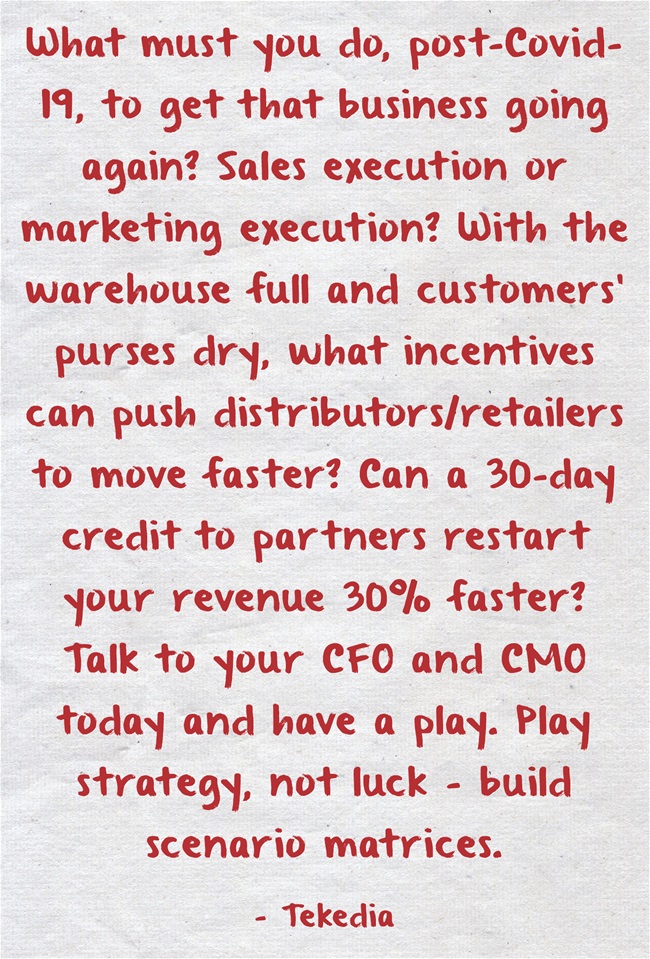
What must you do, post-Covid-19, to get that business going again? Sales execution or marketing execution? With the warehouse full and customers’ purses dry, what incentives can push distributors/retailers to move faster? Can a 30-day credit to partners restart your revenue 30% faster? Talk to your CFO (chief financial officer) and CMO (chief marketing officer) today and have a play. Play strategy, not luck – build scenario matrices.
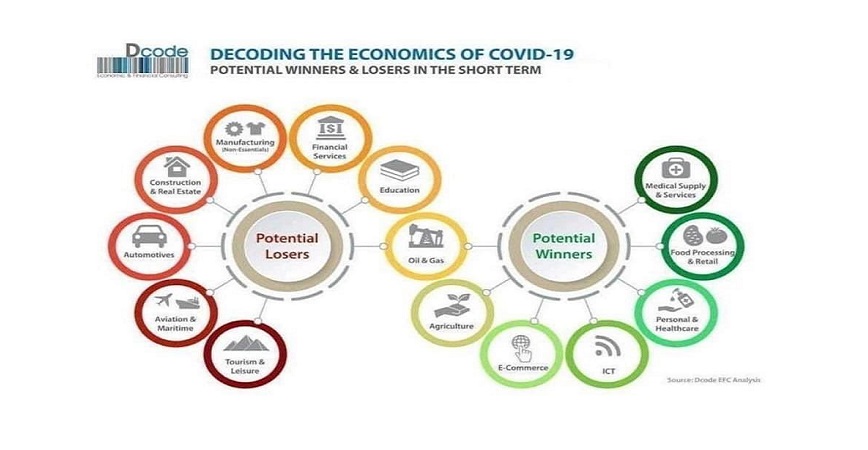
Understand where your sector is on this figure, and what your company needs to do, as you plan ahead to restart your company once the lockdown is over. Develop your plan, and do not rely on luck. If you are in leisure and tourism, talk to your Chief Financial Officer on what a 30% discount can do to the business. Because purses are emptying and priorities have been reshaped, you need to offer something big to bring the customers back. If you are in the green zone, think on how you can keep the market share Covid-19 has just given you. #Plan4Restart
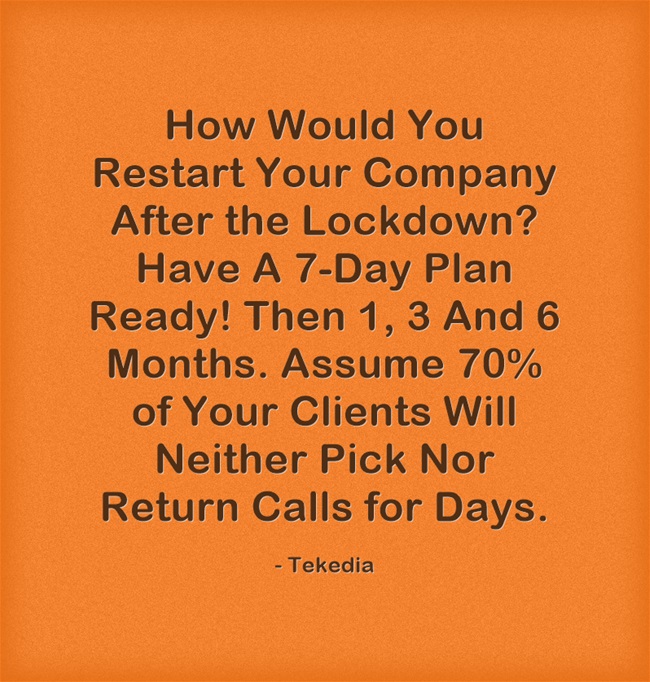
How Would You Restart Your Company After the Lockdown? Have A 7-Day Plan Ready! Then 1, 3 and 6 Months. Assume 70% of Your Clients Will Neither Pick Nor Return Calls for Days.
The global Covid-19 pandemic has within the past few weeks proved to be a disruptive element more than anyone could have imagined. From football stadiums to work places, almost everything is now shut down save for those providing essential services. The government started from the reduction of gatherings to not more than 50, but now, that number has been reduced to 10 in some states while some other states have been placed under a total lockdown. But, with much surprise or maybe not, Nigerians have been disobeying these measures despite being told the serious effects the virus could have and how contagious it is. So, the questions really are: are Nigerians just simply unreasonably disobedient? Or perhaps there are justified reasons to be suspicious and distrustful?
In the early days of the virus break-out in Nigeria, concerned citizens, public health advocates, and the government hammered on the need to stay at home and stay extremely safe. But, no one ever really listened. Mosques and churches still opened for business as usual, as many of them either dismissed the reality of the virus or they placed their faith over the porosity of the virus. Another reason on the part of an average citizen was that the virus is a ploy for the government to siphon funds. The problem here exactly is that many people genuinely believe so. From the inception of the virus, there have been several claims that it is a conspiracy theory to loot public funds. For instance, a middle aged respondent told reporters with Legit.ng that Nigeria’s weather is so harsh for Coronavirus to survive… there is no trace for the so-called confirmed cases…it is an opportunity to steal our money. Similarly, Nigerian investigative journalist Damilola Banjo stated that Nigerians at the grassroots, where the majority live, think coronavirus is a ruse or even a ploy by the government to steal more money. In fact, a recent survey by NOI polls suggests that 26% of Nigerians believe they are immune to coronavirus. This is a worrying percentage. With all this, it then becomes understandable why many people take the virus with a pinch of salt.
Despite the assurances by the government on their readiness to tackle the virus, Nigerians continue to remain doubtful. But, given the Nigerian context, these doubts – even though potentially dangerous – are not unfounded. The doubts were firstly fuelled by the government’s sluggish and shady behaviour towards the virus. Isolation centres were not set up as early as necessary. For instance, in Abuja, there weren’t testing centres earlier on and even the one available, as sadly noted by the Senate President, Ahmad Lawan, was in a sorry state. These unnecessary delays in taking preventive steps easily spurred doubts on the sincerity of the government in tackling the virus.
On the 19th March, 2020, a Punch Newspaper reporter, Ralph Ede, reported the death of a seventy year old woman who was quarantined in a state facility, but died a day after being discharged. Although the woman tested negative to Covid-19, her family members established their utmost displeasure at the absolutely horrible state of the medical facility and the treatment she received. This is, however, no big news. Nigeria is a country where only the rich can risk having terminal illnesses and genuinely nurse hopes of survival. In such a country, the reality of the common man is very terrifying. Public healthcare is in a bad shape in Nigeria and the average man has all the incentives to doubt the government. For instance, in his undercover investigation titled Cancer is the Disease and Nigeria’s Health System is the Killer, Fisayo Soyombo noted how the lack of functioning radiotherapy machines across federal hospitals in Nigeria is impeding the treatment of cancer patients and aiding its spread from one parts of the body to another, thereby leaving many of these patients stranded in their treatment and at the mercy of the killer disease. This – and similar public healthcare calamities – is the day-to-day reality when there wasn’t a pandemic. How much more now?
Years after years of unfulfilled electoral promises, insensitive governance, high level of corruption, and unsustainable policies, Nigerians have invariably gotten to that point where individual responsibility – the placement of self-interest above collective responsibility – is all that matters. And it’s terrifying when a people have degenerated to this level, because it becomes difficult to know when the government is being genuine and when it’s just business as usual. Given the nature of Nigerians, since government has proved irresponsible over the years, the automatic default is God. It is why when the Coronavirus broke out, many Nigerians were found saying things such as “it is not my portion”, “I am covered by the blood of Jesus”. It is why preachers could leverage that instance to propel their sermons at the expense of the stay-at-home policy.
In a widely circulated video across social media platforms, we witnessed Pastor Innocent Kingsley, the General Overseer of Bible Believing Mission, dismissing Covid-19 by stating: “that thing cannot survive in Nigeria. What do you mean by coronavirus when there is corrosive anointing” Today, Nigeria officially has over 200 cases of coronavirus with fears that the numbers may actually be way higher than that. Similarly, reacting to government’s directive on the closure of all gatherings, Bishop Oyedepo asserted that shutting down churches would be like shutting down hospitals. This intersection of religion, science, and politics has also been a conflicting area enabling disobedience of citizens towards policies. There was a similar trail of events during the outbreak of Ebola and this won’t be the last.
Policy implementation is perhaps the major area that suffers the backlash of public distrust. That’s when you realize majority of the populace have no regard for the government. Clearly, entertaining doubts on the reality of the Covid-19 pandemic can be a leeway to a severe humanitarian disaster. However, even while not appropriately justifiable, the experience of Nigerians with the government is enough enabler of disobedience. Two of the foremost promises of this administration were to fight corruption and to tackle terrorism. This same government has been an agent of witch-hunt with the corruption radar specifically on persons of the opposition, rather than fighting corruption wholesomely. Similarly, some 6 months after resuming office in 2015, President Buhari declared that BokoHaram had been “technically defeated”. However today, with several bomb blasts, killings, abductions, and video evidences, it is very clear that this Bokoharam sect is otherwise growing in numbers and capacity
As such, to ensure nothing impedes their daily survival, the average Nigerian – such as market-women, taxi drivers and petty traders – is quick to dismiss the reality of Covid-19. Even if these people genuinely believe in the existence of Covid-19, the next problem they are faced with is how to not stay hungry while staying at home. Again, the Nigerian government has not demonstrated efforts in this regard. So, if an average Nigerian – who lives under a dollar per day and who survives based on what he or she makes daily – is to stay at home, how does hunger not kill them while doing so? This question is largely left unanswered and, with no definite governmental relief fund in sight, the stay-at-home policy is bound to face serious obstacles.
Case in point is a middle aged man in a video interview by LegitNG (below). In his words: how can I stay at home unless they (government) provide something for us… America gives money to their citizens during this period. That is a government that cares for the citizens. Nigerian government doesn’t care for her citizens. Similarly is the viral video of a middle aged woman, lamenting that just within two days of lockdown, her pot of soup already got stolen: we cannot continue like this, she said.
Realities like this pose challenges to the stay-at-home policy, because giving the status of the virus, no one can say for how long the pandemic will last. So, for a government that does not have a track-record of caring about its citizen, where is the safe space for the common man. If nothing happens in time, these people will, out of resort, revert back to their markets and hope the holy-spirit protects them since the government can’t. And no, this will not be the first time public distrust will occasion policy gaps.
In 2011, during the Jonathan administration, the government made a move to remove the expensive petrol subsidy program. To this end, the government explained that the subsidy program had been used to siphon about 6.8 billion naira meant for importing petroleum products. Further analysis estimated that the removal of subsidy would reduce the cost incurred by government, as 1.3 trillion naira was allegedly being spent on petrol subsidies. However, regardless of all this analysis and alternative measures sought by the government, citizens and trade unions still protested the elimination of the subsidy program – an action which largely stemmed from the distrust level in the country. A similar case happened in 2016 when the National Electricity Regulatory Commission sought to increase electricity tariffs. Despite the explanation by the Minister of Power that this step is needed to incentivise investment in the power sector for better power supply, citizens still met this action with total resistance.
So, are Nigerians just naturally belligerent? That doesn’t seem to be the case. Rather, the case is that our trust level in the government has degenerated to nothingness. No one wants to trust that the government is trying to take a citizen-oriented step, especially if it will affect the citizens’ current way of life. Years of governmental failure have conditioned Nigerians to be suspicious of the government. This is not exaggerated, it’s the reality. A Pew Research Centre poll in 2016 revealed that Nigerians do not consider the political and economic system to be fair. And why would they? Is the political and economic system actually fair?
The Nigeria government commands a very low level of trust from her citizens and this is not an appealing reality. While the status of Covid-19 is terrifying, it has somewhat further helped us to see how wide the trust gap between the leaders and the people is. In the early days of the pandemic, concerned persons and public health advocates clamoured for the government to shut her borders to foreigners or, at the very least, ensure an immediate quarantine of travellers. None of this was done as early as required. Had it been recent travellers had been quarantined, the Covid-19 could have been contained in Nigeria before we started worrying about the spread. This initial absence of a sense of urgency is worrying and more worrying is the fact that it has almost always been like that with Nigeria.
This problem of distrust didn’t start today and can’t be brought to an end suddenly. It’s going to take deliberate efforts and intentional good governance. But, while this pandemic lasts, the government needs to do more. Truth be told, they have done some things well such as clarifications on who can be tested and provision of information on isolation centres. However, more levels of transparency are needed. There are still cases where powers that be are covering up positive Covid-19 patients. Also, the general public needs unbridled information about the capacity gaps Nigeria is facing in tackling this problem. The government should also work on making relief funds available to those who are deeply affected by this new work reality – those whose daily incomes are largely what they live on. This should also be properly monitored to avoid cases where these funds do not reach the target people. We should also have regular updates on how the money donated by several donors is being spent. These are few of the things that can be done to alleviate this situation.
One thing the Ebola experience showed us was that a high level of community trust in authorities helps in the fight against any pandemic. If trust was not lost in a day, it cannot be regained in a day. But, while this pandemic persists, the government has to do more in guaranteeing a more successful implementation of policies. The strength of a policy, just like a chain, lies on the strength of the links. In this instant, the people are the link. And a quality synergy of the two is how we can beat Covid-19.