DD
MM
YYYY

PAGES

DD
MM
YYYY

spot_img

PAGES

Home Blog Page 6400

COVID-19: The Nigeria’s N50 Billion Targeted Facility For Small Businesses

3

As every country in the world affected by the coronavirus pandemic push to save its economy by doling out grants for businesses and households, Nigeria appears to be following suit.

The most critical of it all has been sustenance as many states are embarking on lockdown and restriction of movement to quell the spread of the virus.

As part of its Social Intervention Program, the federal government of Nigeria, through the Central Bank of Nigeria (CBN), announced last month that it is giving N50 billion Targeted Credit Facility to households and businesses affected by the pandemic. The arrangement is to be facilitated through CBN’s agency, the Nigerian Incentive-based Risk Sharing System for Agricultural Lending (NIRSAL) Microfinance Bank.

In a surprising turn, the NIRSAL Microfinance Bank is demanding N10,000 fee from small business owners as prerequisite for accessing the intervention loan, according to Sahara reporters.

According to circular shared earlier by the Apex Bank, businesses eligible for the loan scheme include hospitality, health (pharmaceuticals and medical supplies), agricultural value chain activities, airline service providers, manufacturing and value addition, trading.

One other condition to access the loan is that businesses must provide evidence that they have been adversely affected by the pandemic. A statement published in NIRSAL’s website earlier in March said that there must an evidence of downturn of business activities as a result of COVID-19, for enterprises seeking to obtain loan from the Targeted Credit Facility.

The alleged request for N10,000 access fee has cast doubt on the genuineness of the scheme even though the CBN has refuted it.

The outbreak of coronavirus has wreaked unprecedented havoc on businesses around the world, and Nigeria is not immune to its devastating impacts. Every business is counting losses, and every enterprise has such a claim to make. From the oil industry to the financial sector to entertainment to transport and sports, there are undeniable effects of the virus on every business as deserted streets show.

NIRSAL said it’s charging N10,000 as application processing fee, and compared to intervention programs rolled out by other countries, it is more like a revenue generating scheme, since every business that accessed the fund would repay it with interest.

The maximum amount to be accessed is N25 million and households can access N3 million with an interest rate of 5% per annum and the maximum period is one year.

Some other countries in Africa are also rolling out sustainability measures as the scourge bites harder. The Central Bank of Kenya (CBK), in March advised commercial banks to provide relief to borrowers. In Egypt, the central bank announced a huge 300 basis point cut as the country is working to limit the economic pains stemming from the virus.

African countries are focused mainly on health infrastructure as the negligence of their health sector has exposed many to vulnerability of the disease. A few however, are making provisions for businesses and the economy as a whole.

However, economists believe that Nigeria’s N50 billion Credit Facility fund is quite insignificant to the economic intervention needed. Nigeria and South Africa are the African continent’s largest economies and have been hardly hit by economic turmoil. South Africa is technically in recession while the downturn in the oil market puts Nigeria in line.

Experts believe that without stronger economic measures in the continent, there will be more trouble. Stephen Karingi, the director of the trade division at the UN’s Economic Commission for Africa, told VOA in March, that Africa’s economy will be devastated.

“As things stand now, the 3.2 percent growth has actually been insignificant when it comes to meeting these SDG goals. That’s the point we want to make. In other words, we are going to see an increase in the number of people who are actually poor or below the poverty,” he said.

Nigeria as a net oil exporter has suffered gross loss as the price of the commodity plummet in the wake of coronavirus. Economists said there would be severe impact in coming months as the disruption in supply chains across the globe gets on the increase.

Vera Songwe, secretary general of the United Nations Economic Commission for Africa, said Nigeria is going to feel the impact according to the performance of the oil market.

“If you’re a country like Nigeria, which is a net oil exporter – one, we’re demanding less oil from you, but secondly the amount of oil that we’re demanding from you has dropped {in price}. We’ve estimated that Nigeria could lose almost $19 billion if the trend continues and that’s a big shock to Nigeria’s economy, which was already growing at quite a low rate of 2.8 percent,” Songwe said.

Though OPEC reached a deal to cut oil production so as to increase demand, it will be a long call as the global supply chains remain largely closed.

Nigerian option to sustain its economy will depend on SMEs and all non-oil sector business as borrowing will not easily happen now. The situation places emphasis on the need to sustain small businesses. Economists have called on the Nigerian government to increase the Targeted Credit Facility fund and help as many businesses as possible in order to curtail the looming mass layoffs that will follow the liquidation of businesses.


Updated: The Central Bank of Nigeria had denied of any fee collection for the loan application.

“The attention of CBN has again been drawn to false reports on the social media circles, that loan seekers and owners of small scale businesses who apply for loans provided to cushion the effects of COVID-19 are required to pay a certain amount as application processing fees.CBN urges members of the public to disregard any message requiring them to pay any amount to process their applications.

“Members of the public, particularly, households and owners of small scale businesses are therefore advised to disregard any message requiring them to pay any amount to process their applications.

“Prospective applicants are advised to approach NIRSAL Micro Finance Bank or the CBN branch nearest to them for clarification on the procedure for accessing any of the bank’s related loans.

“Any observed irregularities should be reported to the Consumer Protection department of the CBN via cpd@cbn.gov.ng or call 07002255226”


IMF Excludes Nigeria

4

The International Monetary Fund (IMF) has announced debt relief for 25 nations around the world to help them cushion the effects of coronavirus pandemic. The executive board of the monetary body approves the immediate debt relief for these countries in the wake of the COVID-19 outbreak that has brought the world’s economy to its knee, and exposed vulnerable countries, especially in Africa, to alarming economic hardship.

Ms. Kristalina Georgieva, Managing Director of the IMF, said the provision is for the poorest among its member countries, and part of its Catastrophe Containment and Relief Trust (CCRT) response for poor countries affected by the pandemic.

“Today, I am pleased to say that our Executive Board approved immediate debt service relief to 25 of the IMF’s member countries under the IMF’s revamped Catastrophe Containment and Relief Trust (CCRT) as part of the Fund’s response to help address the impact of the COVID-19 pandemic.

“This provides grants to our poorest and most vulnerable members to cover their IMF debt obligations for an initial phase over the next six months and will help them channel more of their scarce financial resources toward vital emergency medical and other relief efforts.

“The CCRT can currently provide about US$500 million in grant-based debt service relief, including the recent US$185 million pledge by the UK, and US$100 million provided by Japan as immediate resources. Others, including China and the Netherlands, are also stepping forward with important contributions. I urge other donors to help us replenish the Trust’s resources and boost further our ability to provide additional debt service relief for a full two years to our poorest member countries,” she said.

The countries in line to benefit from the debt service relief include 20 African nations. They are as follows: Afghanistan, Benin, Burkina Faso, Central African Republic, Chad, Comoros, Congo, D.R, The Gambia, Guinea, Guinea-Bissau, Haiti, Liberia, Madagascar, Malawi, Mali, Mozambique, Nepal, Niger, Rwanda, Sao Tome and Principe, Sierra Leone, Solomon Islands, Tajikistan, Togo and Yemen.

It came as a surprise that Nigeria was excluded in the list as it is battling to contain a daily increasing number of the coronavirus cases. It could be recalled that Nigeria’s former finance minister Ngozi Okonjo-Iweala and former president, Olusegun Obasanjo, had moved the quest for debt relief for poor African countries.

The duo called on the G20 nations to waive 2020’s debt repayment for poor countries, including $44 billion expected from African countries. In the letter addressed to the G20 members, Obasanjo and Iweala asked the international community to remember how the world survived the economic crunch of 2008-2010, and apply the same technique now.

“In 2008-2010, the immediate economic crisis could be surmounted when the economic fault line-under-capitalization of the global banking system was tackled. Now however, the economic emergency will not be resolved until the health emergency is effectively addressed: the health emergency will not end simply by conquering the disease in one country, but by ensuring recovery from COVID-19 in all countries,” the letter reads partly.

Nigeria is the country with most poor people in the world, a major criterion for debt relief. Therefore, the West African country’s exemption from CCRT amnesty has instigated curiosity.

Many believe it is due to habitual practice of borrowing by the Nigerian government. Since November 2019 till now, the federal government of Nigeria has made several attempts to make external borrowing, especially from the IMF and the World Bank. There was the $29.96 billion notorious loan request in November, and the $22.7 billion that was suspended in March due to opposition, and $6.9 billion it planned to borrow from multilaterals lenders earlier in the month of April.

Each of these attempts to borrow has attracted wide condemnation. Dissenting voices had called it “reckless and unjustifiable.”

The former Vice President Atiku Abubakar berated the government’s last attempt to borrow from foreign governments. He asked the Nigerian government to look inward to solve its problems as every country around the world has the same worry to contend with right now.

“As it stands today, the world is too preoccupied with its challenges to prioritize Africa, and so we have to prioritize ourselves. The issue of Nigeria wanting to borrow $6.9 billion at this time shows the almost delusory state of our government. No one has that type of money to throw about.

“Why is it that the Nigerian government is always quick to want to borrow at every instance? It shows a lazy mindset and an inability to take those sacrifices necessary to get the economy into shape. Worse still, it proves that we do not, as of yet, have the ability to think outside the box for genuine solutions.

“We cannot be looking to borrow huge sums at the same time our officials are taking delivery of foreign made luxury cars. We cannot be considered a serious country when we refuse to cut down on profligacy and instead seek outside help to fund our inefficiencies,” Atiku said.

Many believe that it’s time Nigeria begins to cut down on loans, reduce wastage and lax on judicious use of scarce funds. It is also believed that the government needs to generate ideas to diversify the economy.

The Nigeria’s Bread Scramble [Video]

1

The biggest irony: you lock down a nation because of coronavirus, implementing social distancing. Then, because of hunger, all protocols are broken as people fight for bread. Of course, the government is working – some contractors contracted to transfer cash to the poor in some states have been sacked for delay. 

The federal government says it has terminated two contracts for cash transfers to Nigerians in four states.

The project was called off after a breach of agreement by the affected contractors, Sadiya Farouq, Minister of Humanitarian Affairs, Disaster Management and Social Development, said in a statement Tuesday.

The “payment service providers” were contracted by the federal government to make payments to vulnerable persons in Bayelsa, Akwa Ibom, Abia and Zamfara States.

“The termination is with the procurement process launched using World Bank procurement guidelines to ensure that payments commence in the affected states on or before April 28, 2020,” the statement signed by Salisu Dambatta, the minister’s spokesperson.

The minister said the federal government cannot accept delays in the current payment round of N20,000 to beneficiaries in poor and vulnerable households under any excuses in the four states or any other states of the federation

I do not envy those contractors because if you ask me to find the poor in Nigeria, I am not even sure there is a standard quantifiable  mechanism to do that. Yes, if you think you are transferring cash via any bank to the poor in Nigeria, you are wasting your time. Poor people in Nigeria do not have bank accounts! Of course, you can transfer via air, sea, party leader, … [add your magic].

You have less than 40 million unique bank accounts in a nation with at least 80 million adults. Magic transfer, none has ever reached my village since 1999! This video, on click, shows the state of things: scramble for bread.

https://youtu.be/IFDoaur3264


TrustBanc Daily Stock Market Scorecard, 14th April 2020

0

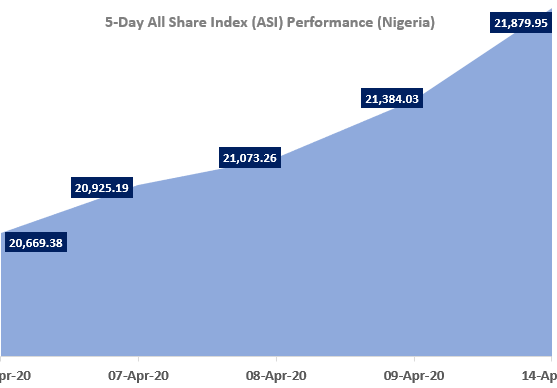
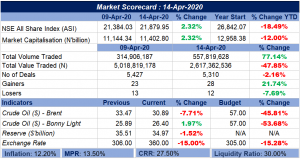
Since close of trade on 6th April 2020, the market has now gained over 5.80% in four consecutive trade days and recovered over N630 billion for Investors, the last time the market enjoyed this streak was January 2020.

The All-Share Index (ASI) appreciated by 
2.32% today to abate the year-to-date loss of the Market to 18.49%.

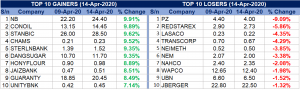
Market Breadth: The breadth of the market remained strong today as the Bulls maintained their hold on the market for the fifth day running, 28 stocks appreciated as against 12 that depreciated. NB and CONOIL led the gainers’ chart, while PZ and REDSTAREX led the losers chart. See the list of top gainers or losers below:

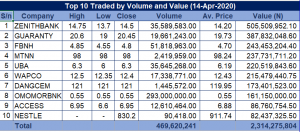
Market Turnover: ZENITH and GTB led the most traded stocks chart in volume and value. See top 10 traded stocks below:

Have a good evening.


Innovation Lessons from 12 Companies

0
The 12 firms

Next week, we will be examining these companies, focusing on the innovation lessons we can learn from them. The broad theme dwells on the state of the tech nation, and the emerging opportunities which are coming up. Our goal is to discover the leverageable factors which are cushioning the scalable advantages in the firms – and in the process, we can learn, and apply in our firms. 

You can join the second edition of Tekedia Mini-MBA here.

Tekedia Academic Programs