Thank you Botswana. We signed the first alumni association of a university into our Tekedia mini-MBA under the Advanced Management Program. Through this program, the alumni members will co-share and co-learn through a dedicated digital board under our facilitation. From Monday, we will begin a process of creating focused and customized contents on five core areas the alumni leadership has identified: logistics, fintech, education, healthcare and agriculture. This program will run for four months just like the generic mini-MBA.
Other Programs – GMP and AMP
Besides Tekedia mini-MBA, we have GMP and AMP. I will repeat Tekedia mini-MBA to help in explaining these programs structured for organizations.
Tekedia mini-MBA: Sector- and firm-agnostic open program comprising videos, flash cases, contents, pulses, challenge assignments, labs, written materials, webinars, etc delivered online. Options for grading labs available.
Tekedia General Management Program (Tekedia GMP): The same as Tekedia mini-MBA but customized for a specific organization with flash cases, contents, pulses, challenge assignments, labs, etc developed around the firm and its sector. Challenge assignments and labs not graded.
Tekedia Advanced Management Program (Tekedia AMP). GMP with Challenge assignments and Labs graded.
The Tekedia Mini-MBA has been amazingly successful with hundreds enrolled. On the strength of the impacts, many companies and groups have made requests for specific customized programs, to enable them share and learn at deeper levels, on private boards, with cases, contents, pulses, etc focused around their businesses and sectors. Your team will discuss and stimulate new ideas on this private dedicated board for your company, under the guidance of our faculty. We offer the following to dedicated learning communities: Tekedia General Management Program (Tekedia GMP) and Tekedia Advanced Management Program (Tekedia AMP) across the following sectors.
Manufacturing (all areas like beauty care, FMCG, agro-processing, construction, agriculture, etc )
Energy (oil, gas, renewable, utilities, etc)
Services (consulting, ecommerce, tourism, retail, healthcare, education, media &entertainment, etc)
Telecom (telcos, ISPs, network operators, etc)
Public Sector (government, agencies, ministries and departments of governments)
Start-ups (sector agnostic, focusing on the mechanics of building category-king start-ups)
GMP vs AMP
GMP: Challenge and Lab assignments will NOT be graded by our team. Contact for cost.
AMP: Challenge and Lab assignments will be graded by our team. Contact for cost.
Both programs are on-demand which means there is no scheduled start time; we are ready once a client is ready to start.
There is no maximum number of people that can be enrolled from a firm.
The structure follows the generic Tekedia Mini-MBA except that sessions, cases, pulses, etc are all focused around the specific company and its sector. It will be online, and fully on a secure dedicated digital board only your staff will have access for the innovation process. It will last 4 months with contents archived and recorded. There would be scheduled webinars but no physical contacts.
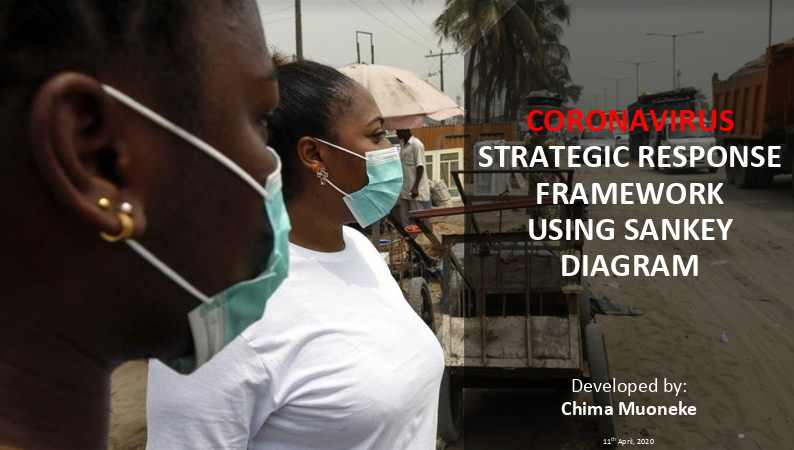
As an energy analyst and strategy enthusiast, I believe in numbers because they don’t lie. And most often, I use the Sankey diagram to illustrate energy flows in my analysis to identify where most energy-saving effort is needed. The same strategy can be used to combat Coronavirus across the world.
In this document, I have used the Sankey diagram to illustrate various strategic response frameworks to combating the Coronavirus. The diagrams show 3 levels of response frameworks. Level 1 requires the least funding and increases as the strategic response level increases to 3.
The key to success at any level is heavily dependent on the availability of data to track progress from baselines
The World Health Organization (WHO) has told us that It would take time before any vaccine for the virus would be ready. Currently, the most effective response framework is level 3. And the longer we stay at levels 1 and 2, the more the global impact on economies
Remember, no one is safe until everyone is safe
This strategic response framework can be adopted by all the countries of the world to conducting their analysis and tracking progress in the fight against Coronavirus.
As the number of coronavirus cases keeps rising in Nigeria, the most affected states see more reason to stay at home and observe the lockdown initiative of the federal and state governments. The Federal Capital Territory (FCT), Lagos and Ogun States are at the center stage of the lockdown, due to the number of cases the states have recorded so far.
As at Thursday, there have been 288 cases and seven deaths in Nigeria, with Lagos having the highest number (158) and the FCT 54. These alarming numbers are emphasizing the need to keep social distance and see the lockdown order as a preventive measure.
However, people’s reaction to the stay-at-home order has been discouraging. A situation many believe is as a result of the rumors and conspiracy theories flying around. Many in Nigeria still believe that coronavirus is a hoax or that they have zero chances of being infected. In an opinion poll conducted by Vanguard on the reality of coronavirus on Facebook, about 40 percent of responders said it doesn’t exist.
Such belief is seen by the way people are breaking the social distance rule, especially in Lagos.
On Saturday, actressFunke Akindele Bello and her husband, Abdulrasheed Bello got caught in the act of disobedience of the social distance and it landed them in trouble. The Lagos State has limited social gatherings to 25 people only, a number believed to be not big enough to enable the spread of the virus. Mr. and Mrs. Bello had made a birthday that involved far more than that number of people, including popular music artist, Naira Marley.
Well, the law took its cause, and the couple was found guilty of social disobedience. What surprised many is the overwhelming number of fans who turned up in solidarity to the celebrities in court.
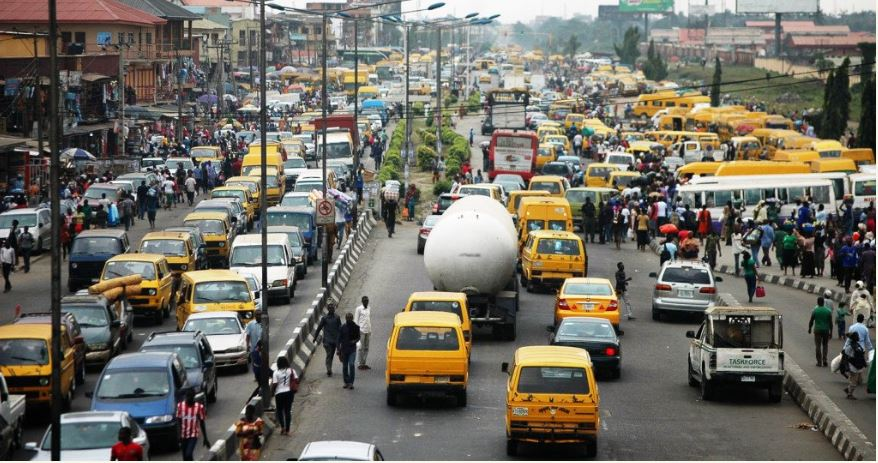
Early this week, heavy traffic jam was reported in Lekki-Epe expressway Lagos, amidst the lockdown order. The effrontery to break the rule appears to have stemmed from the lenience of authorities to enforce it. From the onset, the Lagos State Commissioner of Police (CP) Hakeem Odumosu had warned enforcement officers not to go hard on people moving around, and toallow petty businesses to continue. The relaxation of the enforcement seems to have triggered an avalanche of movement across Lagos State. But that is changing as law enforcement has commenced clampdown on the violators. Yet, Agege is running wild!
Tension started in the area over the weekend following attacks by suspected cultists who went from street-to-street robbing and raping innocent residents.
The attacks in Agege were spillover of last week’s assault on residents and traders at Abule Egba, Alagbado, Meiran, Alakuko, Ijoko and Sango, among others by armed gangs numbering over 200, that has left at least four people feared killed.
Pockets of robbery incidents were alleged to have taken place simultaneously at Olusanya Adenire, Pen Cinema, Oniwaya, Orile-Agege, Dopemu and Agbotikuyo on Sunday, as the hoodlums armed with guns, bottles and cutlasses dispossessed their victims of cash, food and other valuables
Over 78 persons were arrested and over 600 vehicles impounded as the governments intensified efforts to quell the spread of coronavirus. Among them are those who converged on major roads for sports activities.
The statement issued by Lagos State Police Command spokesman, Bala Elkana on Wednesday, disclosed that the suspects were charged to court where they were punished accordingly.
“The suspects were arrested for playing football on major streets and having group exercise in large numbers, thereby neglecting the principles of social distancing. The suspects were arraigned in Chief Magistrate Court Yaba on a one-count charge of violating the social distancing directives of Lagos State Government contrary to Regulation 8(1)(a) &(b) and 17(1) (i) of Lagos State Infectious Disease (Emergency Prevention) regulation 2020, an offense punishable under Section 58 Public Health Law Cap P16 laws of Lagos State, 2015.”
The statement added that “73 of the suspects pleaded guilty to the charge while three pleaded not guilty. The court ordered that all the suspects should be kept in government isolation centers for 14 days and thereafter serve one-month community service. The three suspects who pleaded not guilty will after observing the 14 days isolation, be brought to court for trial.”
On Thursday, police arrested 202 persons for the same offense. Elkana said “The suspects were arrested playing football on major streets and having group exercise in large numbers, which negates the principles of social distancing.”
The suspects were charged to court and fined N10,000 each after they pleaded guilty to violating the stay-at-home order. They were also sentenced to 14 days of community service.
It is hoped that the recent enforcement of the social distance rule in the states will help to force adamant people to stay at home. Though it is believed that apart from those gathering for sports activities and merrymaking, others have beenforced out of their homes by hunger.
The palliatives of the governments have been described as ridicule and mockery of families who depend on their daily income to feed. It appears that many more people are going to get arrested if the lockdown goes beyond two weeks. Of course, we must ensure that the Agege thuggery does not scale across the nation.
The Igbo people are an ethnic group native to the present-day south-central and southeastern Nigeria. They have tasted bad leadership by their own people and non-Igbos, they have also been devastated by the effect of the Civil War. Thus, the decay in the Igbo governance is nothing too positive to write about. With a booming new population facing up to meet the past of their ancestors, what is the future of the Igbo leadership system for the younger generations, given that the past and present has failed woefully?
In this article I explore unbiased, as to why the new generation of Igbos are taking it upon themselves to rebuild their zones and how they are actually going about that.
An Overview of the Igbos
The Igbo people are an ethnic group native to the present-day south-central and southeastern Nigeria. There has been much speculation about the origins of the Igbo people, as it is unknown how exactly the group came to form.
Igbos are well known for their variety of soups, made from locally grown vegetables, fruits and seeds. The most popular Igbo soups are Oha, Nsala, Akwu, Okazi and Ofe owerri. The Igbo people have a traditional religious belief that there is one creator, called ‘Chineke’ or ‘Chukwu’.
The Igbo people are descended from Eri, a divine figure who, according to Igbo folklore, was sent from heaven to begin civilization. Another account presents Eri as one of the sons of Gad (as mentioned in the book of Genesis in the Bible) who traveled down to establish the present-day Igbol and. In Nigeria, Igbos inhabit an area referred to as Igbo land, which is divided into two sections along the lower River Niger. They live in most or all parts of five states: Abia, Anambra, Ebonyi, Enugu and Imo, as well as minor parts of Delta, Rivers and Benue states. Small Igbo communities are also found in parts of Cameroon and Equatorial Guinea. The Culture Trip (May 22, 2018).
The Degrading Journey
A lot of people will say that the Igbos have a fair journey, but that is not really the truth. Why? The degrading journey of the Igbo people began after the civil war. Remember that it’s been 50 years since Nigeria’s brutal civil war calling for the secession of Biafra started. By the time it ended in 1970 over one million people had perished.
To make the matters worse, it was purported that at the start of the civil war, Igbos withdrew their funds from Nigerian banks and converted it to the Biafran currency. After the war, bank accounts owned by Biafrans were seized and a Nigerian panel resolved to give every Igbo person with an account only 20 pounds.
After the surrender of Biafra, some Igbos who had fled the conflict returned to their properties but were unable to claim them back from new occupants. This became law in the Abandoned Properties Act (28 September 1979). It was purported that at the start of the civil war, Igbos withdrew their funds from Nigerian banks and converted it to the Biafran currency. After the war, bank accounts owned by Biafrans were seized and a Nigerian panel resolved to give every Igbo person with an account only 20 pounds. Today, Federal projects in Biafra were also greatly reduced compared to other parts of Nigeria. In an Inter-society study it was found that Nigerian security forces also extorted approximately $100 million per year from illegal roadblocks and other methods fromIgbo land, a cultural sub-region of Biafra in what is now southern Nigeria.Wikipedia (2014).
Regardless of the post war trauma, the leadership of the Igbo people is nothing too good to write about. Although distinguished men such asSam Mbakwe, who was an Igbo politician and Governor of Imo State, southern Nigeria from 1 October 1979 until 31 December 1983. The Sam Mbakwe International Cargo Airport, located in Owerri, the state capital, was renamed after him. In 1981, Sam Mbakwe set up Imo State University. Dr. Sam Mbakwe performed credibly as a Governor and someone else who took over his legacy is the person of distinguished Dr.Peter Obi.
Peter Gregory Obi is a Nigerian politician and businessman who was the vice presidential candidate in the 2019 Nigerian general election under the Peoples Democratic Party. He was also a one time Governor of Anambra State, and he performed remarkably well. He has been an advocate of good governance and has called to reduce the cost of governance.
Asides, there have been good governors who have tried their best, however these two humans are remarkable in bringing the dividends of the government to the people. So I have taken you on a road map of history, the question is what is the next generation doing to make sure there’s no repeat of bad governance in Ala Igbo?
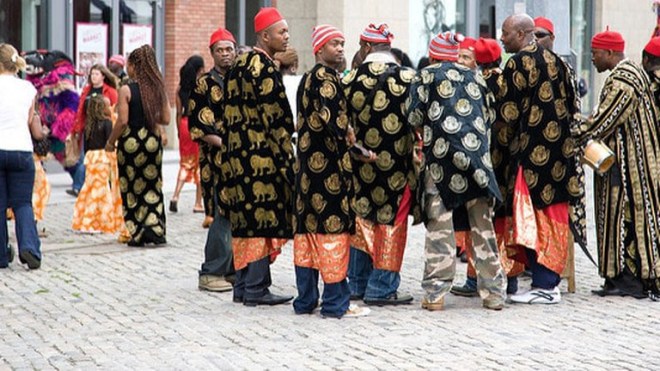
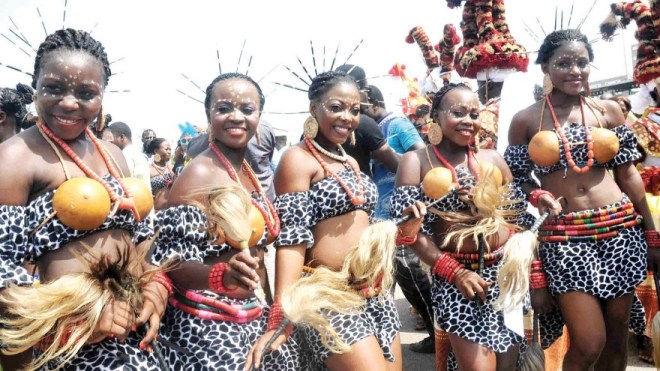
Beautiful Igbo Women in traditional dancing attires, courtesy of Ikenga Chronicles
The Millennial’s Grab The Bull’s Horn
For those of you who follow me onTwitter, you must have seen my tweets where I call out bad governance in the Igbo Land. Well, if you have not kindly followed me onTwitter. The reality that an educated Igbo man will leave ala Igbo and head to Lagos and other places to get a decent job is not a good development as I would always say. Can’t we have those things and facilities in Lagos brought to the Igbo land for the benefit of our convenience and prodigy? That’s a question all must reflect on, because it’s getting more risky as other ethnic groups show their triblism towards the Igbo people.
To this light, the Alaigbo Development and Accountability Initiative (ADAI), an NGO was born. This a nonprofit organization that promotes development and good governance in Igbo communities (Ala Igbo) across Nigeria. Talking about grabbing the bull by the horn, there numerous members of the Igbo community championing this cause. I have known some of them via Twitter. So who are these heroes and heroines?
Juliet Kego, has been leading the vocal narrative for positive change in the Ala Igbo development. Still don’t know who she is? Check her out onTwitter. Well, she’s’ a Wife, Mother, Poetess-Story-teller, Weaver of the Spoken-Written-Sung Words, Leadership Trainer, Financial Literacy Coach, Life Connoisseur, Entrepreneur, Social Enterprise Catalyst, Belly-Dancer, Advocate for Women & Girls, Student of the Sensual Arts, World Traveler and a citizen.
Another person leading the change narrative isIfechideere. She’s on Twitter too so check her out. In fact, she is a historian and her countless threads on various historic facts has helped me push out some great content about the Igbo narrative too. Ifechideere has been logical and outspoken towards the plight of the Igbo people too. She also leads the Ala Igbo Initiative program.
Noble Igwe is also leading the narrative too. The chairman of 360nobs is a full fledged Igbo man and passionate to change the narrative too. Though, you might not know he’s fully pushing the Ala Igbo Initiative, he’s a dedicated husband and business man and he and everyone else only hopes for a developed Igbo land.
Where do we go from Here?
Well, you and I are not really going anywhere (we die here). Ala Igbo is our’s and as they say: “North, West, East and South; no place like Home.” After journeying with me through history, you’d best believe that the only place you can call home is a place where you are safe and a place where positive development strives.
In all, you can support the Ala Igbo Initiative project by checking the official websitehere. You can also see the outcome of the previous survey they had prior to the official project launchhere.
Mr. Dare Adeoye is a Management and Development Consultant. He recenlty spoke on the reported dwindling trust level between citizens and government. He examined this issue from a global perspective amidst other issues. Here are the excerpts
Tell us about yourself
I am Dare Adeoye, a Management and Development Consultant based in Osogbo, Osun State.
Globally, there seems to be an increasing level of distrust in governments by citizens. What do you think could have caused this?
Yes of course. There has been sort of distrust between citizens and their political representatives. Generally, I believe government should be an all inclusive thing. But the leaders, especially of the contemporary time are seeing it in a different perspective. They are seeing leadership as a discreet business that should not be revealed to the governed. This, to citizens, means that the government has something to hide. Even when eventually the government decides to address the citizens on any burning issue, it may be belated. Added to this is the mindset of the citizens that nothing reasonable is expected from the government since they are particularly detached from the governed.
Many people have said liberal democracy is a scam especially in Sub Saharan Africa including Nigeria. Do you agree with this?
Yes of course. Democracy is not an African thing. We practice a monarchical system of government in Africa, which tends toward totalitarianism and autocracy. This suits an average African. In the African society, rulers rule without limit, opposition or dissenting voice. Rulers don’t willingly surrender their titles after ruling for a while or a stipulated time. They die on the throne. Democracy here is a fusion of the two and it has not been too helpful. That is why some schools of thought believe democracy is a scam.
Recently, especially at the ongoing COVID 19 pandemic, people tend to pitch tents with fake reports concerning the government. What are the underlying factors giving life to this?
The underlying factors for the thriving of fake news are nothing unconnected with the silence from the government. If there is uninterrupted and timely information flow from the government, I believe any other news from any source won’t thrive. Absence of information flow from the government and the zeal to be constantly fed with goings on will always give rise to fake news. It is in lieu of what people want to hear.
Experts have said there would be a lot of changes in the post COVID 19 era, what are the lessons you think Nigeria should learn from this disaster?
Some of the lessons Nigerians should learn from the pandemic include preparedness for epidemic outbreak and for the citizens. There is also a need for effective and timely information management. Putting round pegs in round holes, that is, making use of our experienced professional medical practitioners to head the Presidential Task Force on COVID-19 rather than a lawyer heading the team. Probably, we also an improved health care service delivery. I’m not too convinced this will be completely affected being what we are. Maybe a more efficient record keeping and data management on Nigerians.Voting for a younger, well equipped, knowledgeable and more proactive president in the next election will save us from the retinue of embarrassments the present leader has caused us. Reduction in over reliance on health excursion whereby a person who tested positive and has no case file in Nigeria, had his case file transferred from a medical facility abroad.
Do you foresee Nigerian leaders reflecting these changes after the pandemic?
I am not a prophet of doom but I doubt if they will change just like the proverbial leopard who hardly changes its spots.