DD
MM
YYYY

PAGES

DD
MM
YYYY

spot_img

PAGES

Home Blog Page 6439

Coronavirus: What You Read About the Virus Determines How You Prevent Its Spread

0

The fight against COVID-19 isn’t just a fight against the pandemic, it has been described as an infodemic war; with several anxiety triggering, fear inciting, and scary information being circulated.

Despite over 80,000 recoveries being recorded globally, there is more focus on the deaths, and the patients health practitioners are unable to save. There is little information about medical testing, China closing its last COVID-19 hospitals, and global recoveries.

At Know COVID-19 Nigeria, we will be giving up to date verified data, and information relating to the pandemic. We will be doing this through summary texts, infographics, live statistics being updated as soon as they are confirmed by the NCDC, WHO, and other relevant organisations.

This will also include a platform for people to report suspected cases, connect to emergency hotlines in their States, locate testing centres, and safety tips.

COVID-19 is neither feminist nor sexist. It does not discriminate based on gender, race, political affiliation, and ideologies. To fight this pandemic and the underlying infodemic, we need all hands to be on deck. Let’s just keep our hands to ourselves, and use it for sharing (verified) information, as we will be bringing them to your couch through your devices.

If you want up-to-date information about COVID-19 without fear of fake or panic news, visit our platform https://knowcovid19.now.sh/  You’ll find safety tips, number of cases, recoveries, and relevant updates relating to the #COVID19 pandemic.

The platform was created by a group of young Nigerians to help reduce the spread of panic surrounding COVID-19, by sharing only verified information, like drug testing, recoveries, and the exact number of cases. You can also find contact numbers  of different states in Nigeria included, for your convenience.

This is not a sponsored activity; we are only concerned about the safety of Nigerians, and will appreciate your support through RTs, sharing of our infographics, and overall support. Let’s reduce the infodemic in the pandemic.

The Atiku Abubakar’s N300,000,000,000 Challenge

10

Former Vice President Atiku Abubakar wants the Nigerian government to distribute N10,000 (about $25) to about 30 million Nigerian households as a way of reducing the burdens which coronavirus has brought to the good people of Nigeria: “At an approximate 30 million households or thereabouts, the government should devise modalities to distribute N10,000 as a supplement for foodstuff to each household, among other palliative measures, with no one left behind”. Notice that the former VP does not know how many households as he used “approximate” and “thereabouts”; that is the first sign of trouble on this proposal.

The second problem is the money; N300 billion is a lot of money in Nigeria now. But assume a miracle happens and President Buhari receives a credit alert on behalf of Nigeria, the biggest hurdle would be how to distribute it. Where do you start? The United States which must have inspired Mr Abubakar has accurate data of Americans through the social security administration and tax system. Nigeria has none.

This proposal is a tough one and I do not see how it could work.I understand that the government has been sending stipends to some citizens. But do not bank on it; the initiative was mainly to mobilize citizens for elections. If you are keeping records, the initiative has scaled back since we completed the elections.

Anyone that tells you that the government has the capacity to send one naira to Nigerian households, effectively, examine him or her for malaria symptoms. We do not know how many households in Nigeria. We do not know where they are. We do not know who can receive the money on behalf of the households before you start family mini-wars. We do not know what we can’t know, making this proposal largely “the more you look, the less you see”.

Read his full statement

As the coronavirus pandemic ravages the world, I applaud the various Nigerian state governments who have proactively taken measures, such as issuing stay at home orders, and shutting down non-essential markets and other places of mass gatherings, while also giving guidelines for social distancing.

However, we must accept the fact that much of the Nigerian public have a subsistence existence. A large percentage of our people do not have the financial capacity to withstand long periods of self-isolation and even lockdown.

It is, therefore, incumbent on the Federal and state governments to provide palliatives to the Nigerian people to enable them to survive, even as they abide by these necessary measures put in place for their safety.

At an approximate 30 million households or thereabouts, the government should devise modalities to distribute N10,000 as a supplement for foodstuff to each household, among other palliative measures, with no one left behind.

It is thus time for the National Assembly to reconvene in an emergency session, perhaps by teleconference (in line with the demands of social distancing), to legislate a Stimulus Package Act that will cater for all Nigerian citizens.

I also call on all Mobile Telephony Companies in Nigeria to urgently develop mobile money platforms so that the government can reach the unbanked with financial assistance. I also urge these telecommunications firms to offer each of the 100 million mobile phone lines in Nigeria free credit of at least ?1500 per mobile line, so that Nigerians who show symptoms, or those who just want information, can call the nearest available health facility, or even an ambulance service, as the case may be.

I commend all individuals and corporate organisations who have one way or the other provided some form of relief for the Nigerian people. In essence, this is what makes Nigeria great, when we help each other at such crisis times as this, irrespective of any differences. I further call on more corporations and individuals with capacity, to assist the public in these trying times.

To this end, Priam Group pledges N50 million on my behalf as my humble contribution to a relief Fund that will form part of the stimulus package.

TrustBanc Daily Stock Market Scorecard, 25th March 2020

0

Today, expectations of the passage of a $2 trillion economic rescue package for the US sent waves of bullish sentiments across global markets. For a normal crisis, this package is huge enough to eliminate any threat of a recession. Sadly, COVID-19 is not a normal pandemic.

In a similar vein, Nigeria’s House of Representatives passed the Emergency Economic Stimulus Bill 2020, which, among other things, aims at providing temporary relief to companies and individuals from the economic consequences of the COVID-19 pandemic.

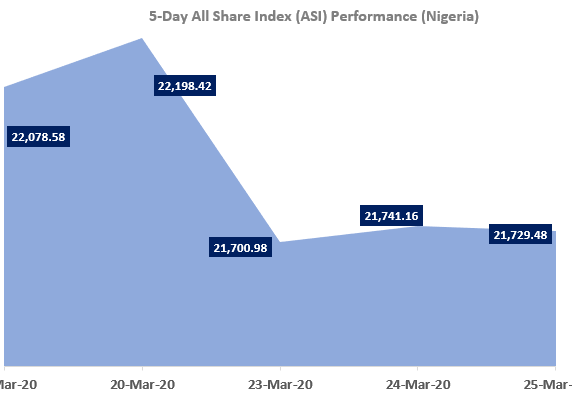
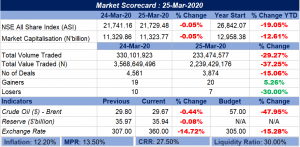
The All Share-Index (ASI) greeted these developments with a marginal decline of -0.05% to expand
the Year-to-Date (YTD) loss of the Market to -19.05%.

Other global indices:

  • FTSE 100 (UK) – up by 4.45%
  • Dax (Germany) – up by 1.79%
  • CAC 40 (France) – up by 4.47%
  • Nikkei 225 (Japan) – up by 8.04%
  • S & P 500 (US) – up by 1.15%

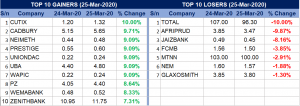
Market Breadth: Despite the bearish return of the ASI, market breadth registered a positive sentiment to produce 20 gainers compared to 7 losers led by TOTAL. NEIMETH on the gainers chart continues to attract the interest of investors since the CBN announced 100 billion intervention in healthcare loans to pharmaceutical companies. See the list of top gainers and losers below:

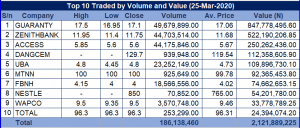
Market Turnover: GTB and ZENITH led the turnover chart as market activities declined by 29.27% in volume and 37.25% in value. Top ten trades are summarised below.

Have a great evening.


In The Midst Of The Storm, How Can CBN Impact Your Business, Company And Wealth?

0
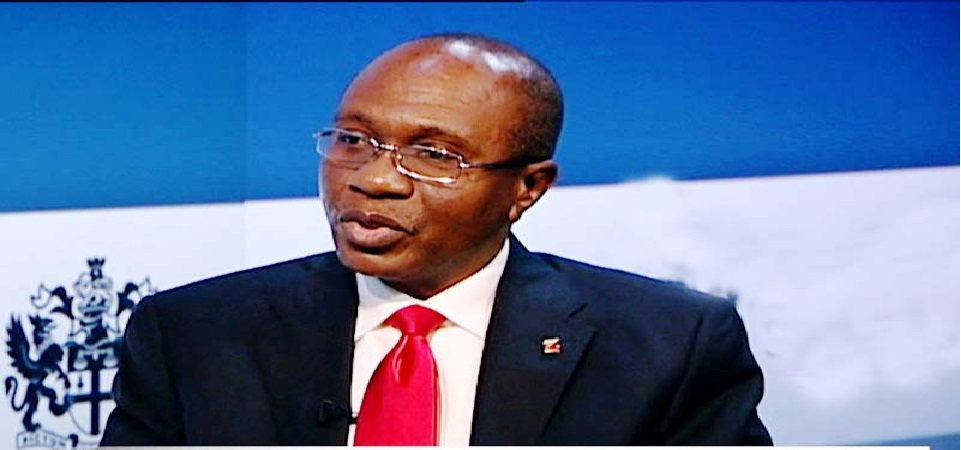
CBN Governorn, Godwin Emefiele

The Monetary Policy Committee (MPC) met on the 23rd and 24th March 2020, amidst heightened uncertainty in the global macroeconomic environment arising from major disruptions associated with the outbreak of the Coronavirus Disease (COVID-19) and the oil price war between Saudi Arabia and Russia.

As you may know, the MPC (a committee within the CBN) is responsible for formulating monetary and credit policies, attainment of price stability and support the economic policies of the Federal Government. The MPC also monitors internal and external economic conditions in formulating monetary policy directions.

In the light of current internal and external economic realities, please find below highlights of the latest monetary policy communique from the MPC and other policy insights that may affect your business in the days and months ahead as this crisis gathers momentum locally.

Background:

The committee noted the N3.5 trillion worth combined policy measures put in place as a stimulus to ameliorate the pains arising from the COVID-19 health and economic crisis. The measures include:

  1. Extension of the moratorium on CBN intervention facilities effective 1st of March, 2020. A significant move by the Bank to ease pressure on loan repayments.
  2. Reduction of interest rate on all CBN intervention facilities from 9% to 5% over the next one year.
  3. Creation of a N50 billion targeted credit facility for households and SMEs that have been particularly hit by COVID-19 pandemic.
  4. N100 billion intervention in healthcare loans to pharmaceutical companies, healthcare practitioners intending to build new hospitals and health facilities or expand existing ones to first-class health centres
  5. Regulatory forbearance to Banks to restructure terms of facilities in affected sectors
  6. Strengthening the LDR policy, which is encouraging significant extra lending from Banks.
  7. Activation of the N1.5 trillion InfraCo Project for building critical infrastructure
  8. N1 trillion in loans to boost local manufacturing, production across critical sectors and import substitution

The committee also noted the following:

  1. Uptick in inflation from 12.13% to 12.20% for the 6th consecutive month, driven by shocks to food prices as well as persistent infrastructural challenges.
  2. Growth in aggregate credit by N2.35 trillion since the inception of the LDR policy, reflecting the potency of the LDR policy
  3. Dismal performance of the equities market as the All-Share Index and market capitalization dipped by 19% and 12.57% respectively between 31st December 2019 and 24th March 2020.
  4. Continued resilience of the banking system due to the decline in NPLs while expressing confidence in the regulatory regime.

Outlook

  1. Increased deterioration in the financial market condition.
  2. Disruption to the global supply chain as a result of the COVID-19 pandemic.
  3. Decline in oil prices and non-oil receipts which will lead to a further decline in reserves.
  4. Subdued growth in 2020.

The Committee noted that these can be mitigated by:

  1. The effective response of the monetary and fiscal authorities.
  2. Recalibration of the 2020 budget.
  3. Sustained CBN interventions in selected sectors.
  4. Deliberate policies to diversify the economy.

Committee’s considerations

  1. COVID-19 pandemic resulting in further health and economic crisis.
  2. Decline in oil price and supply glut in the nearest future.
  3. Emergence of exchange rate pressure.
  4. Downward revision of the 2020 budget by N1.5trillion and oil price benchmark to $30/barrel.

Committee’s decisions

At the end of deliberations, the Committee was faced with three options – whether to tighten, hold or loosen.

Tightening will result in reduced inflation rate and support reserve accretion however, it will reduce money supply, credit creation, increase cost of credit and have an adverse effect on growth which has already been weakened by the pandemic.

On loosening, the committee felt that this decision will boost money supply but will not necessarily increase credit creation. It will have an adverse effect on inflation and also lead to exchange rate pressures as money supply rises.

In view of the aforementioned, the Committee decided by a unanimous vote to:

  1. Retain the policy rate at 13.50%
  2. Retain the asymmetric corridor of +200/-500 basis points around the MPR
  3. Retain the CRR at 27.5%
  4. Retain the Liquidity Ratio at 30%

This decision will offer pathways to appraise the effects of the CRR and LDR policy while also allowing the pandemic to wear off before determining the next course of action.

Other News Headlines:

COVID-19: Massive economic crises loom, says CBN
The Monetary Policy Committee of the Central Bank of Nigeria on Tuesday said the outbreak of the coronavirus pandemic would lead to massive economic crisis capable of throwing many countries into recession. The committee said the COVID-19 pandemic would not only result in health crises, but also massive economic crises that would force even leading industrialised countries into recession. Read more
COVID-19: Staying safe with cash-less banking
For years, Nigeria’s push towards a cashless economy was greeted with mixed feelings, but eight years after the Central Bank of Nigeria (CBN) rolled out the scheme, many people have come to realise that the gains outweigh the pains. With the ongoing COVID-19 pandemic, digital payment remains one of the ways to stay safe, with banks encouraging their customers to go cash-less. Read more
FG threatens businesses involved in arbitrary price hike
The Federal Competition and Consumer Protection Commission on Tuesday threatened to prosecute businesses involved in unfair competition practices through unnecessary increase in prices of their products. The commission said the warning became imperative following unnecessary price hike by sellers of basic health products as a result of the natural apprehension by consumers due to the spread of the coronavirus pandemic. Read more
COVID-19: Reps propose duty waivers, new tax regime
In a record time, the House of Representatives has passed the Emergency Economic Stimulus Bill, 2020, which, among other things, aims at providing temporary relief to companies and individuals from the economic consequences of the COVID-19 pandemic. The bill especially seeks to maintain the general financial wellbeing of Nigerians pending the eradication of the pandemic and return to economic stability. Read more
Stocks – Europe Continues Higher Amid Fresh U.S. Stimulus Hopes
European stock markets are set to open positively Wednesday, continuing Tuesday’s sharp ride higher, on the expectation that U.S. policymakers will finally deliver a massive rescue package to bolster the country’s beleaguered economy. Read more
Asia rides Wall Street surge as investors place hopes on U.S. stimulus
Asian shares extended their rally on Wednesday in the wake of Wall Street’s massive rebound as the U.S. Congress appeared closer to passing a $2 trillion stimulus package to mitigate the economic blow from the coronavirus pandemic. On Tuesday, MSCI’s gauge of stocks across the globe (MIWD00000PUS) rallied 8.39%, the largest single-day gain since the wild swings seen during the height of the global financial crisis in October 2008. It rose another 0.8% in Asia on Wednesday. Read more
Oil Prices Jump on Surprise Crude Draw
The American Petroleum Institute (API) estimated on Tuesday a crude oil inventory draw of 1.247 million barrels for the week ending March 21, capturing the period before over half of all Americans went into lockdown mode this week—a development that will surely curb the appetite for oil. Oil prices were trading up on Tuesday afternoon prior to the API’s data release on new hopes that a stimulus package would be passed and that the oil price war will come to an end with the US intervening. Read more

Amazing Testimonies On Our Programs

0

As we open the 2nd edition of Tekedia Mini-MBA on April 1, I am really happy to share this testimony left here on LinkedIn by Nyebuchi. This second edition is coming with better features and a major strategic partnership to ensure learning is live-tested. Classes will begin June 22, 2020 for four months.

Join hundreds of participants from 14 countries for a new excursion of learning.

Registration for 2nd Edition of Tekedia Mini-MBA Begins April 1