DD
MM
YYYY

PAGES

DD
MM
YYYY

spot_img

PAGES

Home Blog Page 6452

1.1 – Facilitating and Impeding Conditions

0

1.1.0   Introduction

As explained in the introduction, there are issues preventing entrepreneurial journey and positive reasons for engaging in it. The focus of this section is to let you understand these issues and reasons from the perspective of the participants of the study I explained previously.

1.1.1    Muslims’ Status and Welfare

Participants opined that Muslims are yet to see Mosque or Society beyond worshipping. They believed that in any mosque or organisation, welfare of the members should also be prioritised. To them, the Ummah are better off when their spiritual, health and wealth creation are integrated. This will go in a long way to reduce poverty among the Ummah. Maryam O., one the respondents, observed that “Not all religious organizations really care about the welfare of their members.” She added that members and organisations should stop discrimination which is associated with most welfare programmes. Rasheed T.O. pointed out that Muslim philanthropists need to help in the area of Ummah’s welfare. “Some are having cash in bank without utilising it for anything.”

1.1.2   Absence of Entrepreneurship Unit

Lack of unit dedicated to entrepreneurship in Islamic organisations was seen as the main factor for having insufficient Muslim entrepreneurs. The absence was linked to the prevalent poverty among the Ummah. According to Rasheed T.O., having the unit will help to eliminate poverty already associated with Muslims. Supporting Rasheed T.O.’s view, Maryam O. said: “If they keep uplifting religion and no entrepreneurship, the religion uplifting might not even be effective.”

Having established that there is no entrepreneurship unit in most organisations, this facilitator asked about who should start it. Should it be left to the Islamic leaders and clerics or should individual Muslim partake in its creation? Some believed that clerics should set the unit up while some were of the view that it should not be the responsibility of the clerics or leaders alone, members also have significant roles to play. Maryam O said: “If they are not ready to do it, I think we don’t need to wait for them.” To Salahudeen A., clerics are not versed in entrepreneurship development or too conservative. Mustapha I. expatiated further that, “We have to form an umbrella that will carry the flag of Islamic view on business and entrepreneurial skill development such as Dawah train to all Islamic organisations, giving them some modality that can help the future of Muslim youths.”

Despite the participants’ positions on the entrepreneurship unit, some were able to identify some organisations that are encouraging business creation. Amaddiyah and Nasfat were prominently mentioned. Amaddiyah in particular was said to have started production of Garri. Elated Rasheedat I. said: “Alhamdulillah I think we need to also start something genuinely in respective of our location.”

1.1.3   Ideological Differences and Business Orientation

From the participants’ views, business ideas are not being discussed with members at organisational level due to ideological differences and lack of business orientation. According to them, ‘Aqeedah (ideology) and Islamic views of many Muslims do not allow business interaction. Mustapha I. specifically cited levels of interpersonal relationship, overzealous of some successful business owners, religious and entrepreneurial misconceptions.

Likewise, majority of Muslims have little or no knowledge about business. The insufficient orientation eventually surfaced during the discussion when a participant said organisations do not empower their members, which he mistakenly took for entrepreneurship, when he identified Nasfat as the only organisation empowering its members. Kuku Qazeem, however, said: “Basically, Nasfat gives and builds members on empowerment programme which has stipulated period.”  Facilitator later pointed out that there is a huge difference between entrepreneurship and empowerment. According to him, governments and politicians have actually failed in this regard. They focus on empowerment, giving ephemeral incentives to citizens rather than creating enabling environment for enterprises to thrive.

1.1.4   Internal and External Loci of Control make Business Creation Easier

Participants observed that they need to explore their personal traits very well for them to create a successful business. Apart from this, majority believed that Allah’s intervention is equally needed. At the internal level which was seen as personal, participants noted that strong determination, scalability and success spirit are highly needed. Rasheedat I. put it thus: “If you start with your business and you are very serious about it, from there others will emulate and also start something good. This shows that you are contributing positively to the Ummah.” She added that it is not necessary that members start big. “Start small and have a big mindset towards the business. From the smallest beginning, you grow big,” she pointed out. Rukayat A., in her contribution says: “With God all things are possible. No business is without a failure but your determination to bounce back can lead you to success.”

1.1.5   Personal Determination and Structured Organisation

Strong determination also reflected in the participants’ views when they were asked to highlight and discuss key requirements they need to kick-start their business. They submitted that determination is equally necessary at organisation level. Rasheedat I. opined that in any organisation where focus and strong determination are lacking, business creation would be difficult. According to her, there should be synergy between personal and organisation’s determination to ensure entrepreneurial pursuit of the members. Mutiu Iyanda emphasised that the Ummah needs well-structured and focused organisations towards entrepreneural development. Yusrah A. put it differently when she said, “We shouldn’t expect miracle to happen.” Yusrah A. added that material needs cannot ensure business creation. Patience to grow it also matters.

Participants also felt that in some organisations, there is favouritism when it comes to helping members. Ganiyah A. described this as an obstacle turning away some members’ requests. Facilitator however cautioned that it is not possible for members of an organisation to be rejected. What could happen is to reject non-members because it would not be an ideal thing to prioritise non-members above the registered members. The view was corroborated by Ganiyah A. who said, “Truly most religious organizations won’t favour a non-member over a member.”

1.1.6   Taking New Directions

Participants revealed that they have taken new directions in their life when situations demand it. The new directions, however, cut across living and business. Some participants have had cause of relocating to another environment for convenience.  Ganiyah A. said: “At some point in time, I had to change environment.”  Rasheedat I. reiterated that changing environment also contributes to an entrepreneur’s growth. Abdul Hakeem A. highlighted how he changed his business direction within agriculture sector many times with the intention of unearthing new opportunities.  “I had to venture into livestock business at some point in time. But doesn’t work out. Then change direction for aquaculture,” Abdul Hakeem A. succinctly hinted. Facilitator, however, stressed that entrepreneur must know everything about something, and something about everything. According to him, this becomes imperative towards achieving sustainable growth of any business.

Beyond taking new directions in living and business activities, majority of the participants equally believed that when seeking knowledge, taking new direction also becomes handy, especially when the desired results are not attained. “I have to change my direction from my younger brethren’s experience on entrepreneur skills. He introduced me to online marketing as I am used to physical customers’ relationship alone, but I have to shift direction to the use of online values which really makes different in the business,” Mustapha I. pointed out. Mustapha believed that knowledge is power. Complementing Mustapha I’s position, Rasheedat said: “As an entrepreneur if you try a particular thing and that thing did not come out well you can change your direction may be by relocating or make a survey about what people in that particular environment lack and start working on that may be by making order for it or just do something so that you can be able to improve on your sale.

1.1.7   New Routes Inspire Creativity and Innovation

In the second discussion of the issue, participants’ deliberation shows that taking news routes could enhance an entrepreneur’s creativity and ability to innovate new products or services. Changing his previous ways of doing agribusiness helped Abdul Hakeem A. to have a greater number of particular species he has been using before but bringing low output. “I was able to get other breeds and use different method to nurse them before transferring them into the pond,” Abdul Hakeem A. said. To Mustapha I., taking new routes assisted him in rebranding his inherited conventional business model to a more modern technology of the time. Despite taking the new routes when situations warranted them by most of the participants, facilitator discovered that experiences that pushed many towards taking new routes were not documented for future reference, particularly in making decisive decisions. Abdulhakeem A. who has changed ways of doing his agribusiness many times emphasised that he only had the past in his memory not in written form, which facilitator described as orality. “You need written. Failure to do it will not help to use process tracing to identify future challenges and for the coming employees to learn from the past,” Facilitator stressed.

1.1.8   Consequences of Taking and not Taking New Routes

Taking new routes has positive and negative implications. Some participants who have taken new routes have learnt from their decisions and even created uncontested market space. They, however, contended that consistency matters sometimes. New routes should not be taken always. Doing it should be prioritised when difficult situation arises. Nana-Hawa D. said: “It is not in all situations that you should change to another direction when faced with an obstacle. Consistency works sometimes too.“You don’t need to change direction if your strategies are working. However, if you continue using same strategies and succeeding, remember others are studying you. So, you can’t hold on to particular strategies for long. Life and business are dynamic.”Ganiyah A. said: “Consistency work yes but change your approach in getting that thing you so desire. I believe that is what the facilitator is trying to tell us. Our president is a good example. I think he changed his party at some point.”

1.1.9   Trying New Foods stimulate New Business Creation, Product Development and Marketing Activities

Almost all the participants have eaten foods produced in another ethnic group or part of the country. The experiences are striking. Some ate the foods because there was no alternative or their local foods were not produced in the new environments they found themselves. “I went to Port-Harcourt I ate Igbo food which looks like dokunnu,” Kuku Qazeem said. Supporting his experience, Rasheedat I. narrated, “If you go to North, a food is called Madidi. It also looks like dokunnu but it is not.” Facilitator, however, said trying new foods will make participants curious about the way the foods were produced,      which could reveal lapses in the production process. “If it affects you it will really make you curious to find out how they prepared them. Maybe there is an issue in the process leading to production.” He added that it could also be an avenue for new business creation whenever participants return to their permanent locations especially when the market is available. This view was supported by Rasheedat I. who said trying new foods matter because the ways they were produced could be replicated in own locality and leading to good results.

On getting marketing ideas from trying new foods, facilitator pointed out that it could help in gaining right strategies for converting a person into paying customer. “Try new foods and even learn how to prepare it if you are a female it is a great tactic in wooing customers,” he sermonised the participants.  “Besides, trying [sic] new foods also represent your readiness to know more, get knowledge. Above all, know something about everything, everything about something.”


Back to Table of Contents
1.2 – Potential Risks and Possible Mitigation Strategies

0

1.2.1   Financial Risk Taking

Participants have taken financial risk by venturing into small businesses. According to Rukayat A., she had sold used clothes before with N20,000, making profit initially, but later nose-dived when customers started owing her. Most of the customers are neighbours, making collection of the debt difficult. Yusrah A. said she only experienced low profit margin.

1.2.2   Knowledge Risk Taking

Seeking entrepreneurial knowledge or information was also seen as a potential risk. To Maryam O., it is a risk that must be taken if someone really wants to do business because knowledge is knowledge. Rasheedat I. said: “I have taken several risks on online business, but I don’t think I gain anything from it. Still, I don’t relent in seeking more knowledge.” Facilitator, however, noted that seeking knowledge becomes a risk when the source is wrong or the learner misapplies what he or she has been taught.

1.2.3   Relationship Risk Taking

Engaging with humans in the course of delivering or getting values was also seen as a risk. This was noted as relationship risk by the participants. It emerged that co-partners could be a risk in business, especially in managing process. Customers are also categorised under this risk. This is premised on the fact that an entrepreneur needs to interact or engage with the customers. Yusrah A. and Rasheedat I. expatiated this within the context of competition and getting good patronage from customers. Yusrah A. said: “Sometimes when the competition is tense, people will patronise you because of your personality and what you do differently.” Rasheedat adds: “Just be loyal in whatsoever you are doing, because when people see the loyalty in you and your business, the sky is your starting point.” Relationship with the labour is also seen as risk. Personnel become a significant threat to any business when they are not efficient or having ulterior motives towards the business.

1.2.4   Compliance and Operational Risk-Taking

Failure to follow authorities’ rules and regulations on business establishment, mostly products development and its commercialisation, was considered as compliance risk which every entrepreneur must deal with. Kuku Qazeem viewed that whenever it happens that he has gone beyond established rules, he would rather abandon the product or business rather than continue the process, a position which was countered by Marufat I. According to her, she would ask the concerned authority reasons for stopping her rather than accept the defeat initially. “I will ask the authority their reason behind it.  If it is a genuine reason, then I quit. Or I go for another plan. That’s why it’s good to have plan B.” Put it differently, Rasheedat I. noted that, “When it comes to consumables there is a way.  You can start it before you call NAFDAC or any other organization to access you.  At least people will know you and your goods before the government.” Location of business is considered as operational risk. Before business could get the right footing, participants maintained that the place where it would be situated also needs consideration.

1.2.5   Overcoming the Risks

Patience, strong determination and God’s support were seen as techniques for overcoming the identified risks which was corroborated by the facilitator. I added that there are four ways of dealing with or managing each risk. The risks could be accepted, transferred, reduced or eliminated. In other words, like other entrepreneurs, Muslim entrepreneurs must have Accept Risk Strategy, Transfer Risk Strategy, Reduce Risk Strategy, Eliminate Risk Strategy and Spiritual Strategy.


Back to Table of Contents

Introduction – Islam, Muslims and the Rest of the World

1

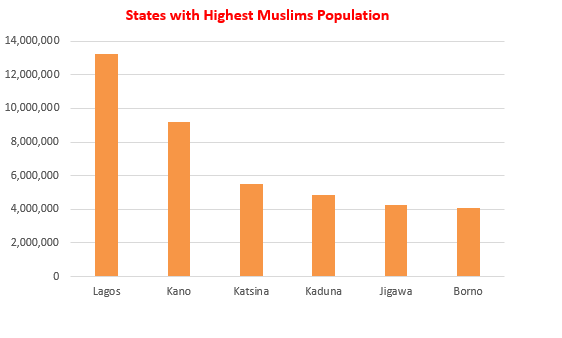
Several accounts have indicated that Islam is the world’s second largest religion. It is a religion being practised almost everywhere in the universe. Available statistics shows that the religion has over one billion adherents, representing 23% of the global population. This percent is expected to reach 26.4% or 2.3 billion of the world’s population by 2030[1]. Another account indicates that this religion would grow twice as fast as the rest of the world’s population by 2050. This has largely been credited to youthfulness of its population and high fertility rates[2]. The number of Muslims who live in South Asia and Asia Pacific is expected to reach 1.3 billion by the year 2030. The four countries boasting the largest Muslim population are Indonesia (200 million), Pakistan (174 million), India (161 million) and Bangladesh (145 million). Nigeria is not an exemption. She has a significant number of Muslims spread across the south-west and north regions[3].

Source: Naij, 2017

Numerous accounts from the books of the religion establish that Islam represents peace and total submission to God’s will. This is an indication that every follower is expected to abide by the rules and norms guiding practising or participating in activities towards becoming a submissive follower. Islam forbids begging when there are no cogent reasons for it. Islam teaches that man and women should work and earn as laid down by the Holy Book (Qur’aan) and Hadith (the sayings and teachings of Prophet Muhammad SAW).  In Qur’aan 62 verse 10, Allah says, “And when the prayer is ended, then disperse in the land and seek of Allah’s favour, and remember Allah much, that you may succeed.” Also, He asserts in Suuratul Mulk (Qur’aan 67:15), “It is He who has made the earth subservient to you, so walk in the paths of it and eat of His provision, and to Him will be the resurrection.”  In fact, when Prophet Muhammad (Peace Be Upon Him) was asked what type of earning was best, he replied: “A man’s work with his hands and every (lawful) business transaction” (Al-Tirmidhi).

From the Quranic verses and the Prophet’s saying above, it is obvious that Muslims are enjoined to venture into entrepreneurship and generate halaal (lawful) income that would meet their financial obligations and contribute to the falaah (well-being) of the Muslim ummah (nation) in this life and hereafter. It is not surprising if we conclude that the religion shapes entrepreneurship at micro, meso and macro levels of Muslim’s life and the society he or she lives in. At every stage of engaging in entrepreneurial activity, Islam encourages actors to be just towards one another and society at large. While it encourages opportunity pursuit and risk-taking, it forbids initiating and executing innovations (associated with business creation and management) that go against Islamic principles. For instance, Islam frowns at selling substandard products and services, and requesting outrageous prices from buyers or clients.

Away from the fundamentals of doing entrepreneurship, one can argue that the involvement in creating halal business and offering halal products or services cannot be in vain, considering the significant number of Muslim consumers worldwide as discussed earlier. Globally, the Muslim market was described as “third one-billion” by Miles Young, the CEO of Ogilvy & Mather Worldwide in his keynote address at the 2010’s Oxford Forum because of the availability of over one billion Muslim consumers and the rise of Muslim middle class across the Muslim geographies and beyond. According to a report by Dinar Standard, Muslim consumers spent approximately $1.8 trillion on food and lifestyle in 2014 alone and the numbers are expected to increase to approximately $2.6 trillion by the year 2020. The current global assets of Islamic banks exceed $1.3 million and are expected to be more than triple by 2020[4].

From all indications, as presented and discussed previously, there is no excuse for Muslims not to involve in entrepreneurship. But, as exemplified by the group of Muslims who participated in a study that facilitates the writing of this book, it is obvious that there are challenges impeding Muslims from taking the entrepreneurial journey as encouraged by the Holy Book and Prophet Muhammad (Peace Be Upon Him). I also learnt that they have some factors helping them to believe in taking the journey. Insights from the study reveal that Muslims, like adherents of other religions in Nigeria, are finding it difficult to discover sustainable opportunities and exploring them to their advantage.  Based on the insights, I make a case for Enterprising Muslims (EM). By EM, I expect individual Muslim and Islamic organisations to draw from the principles regarding attitude towards business, experiences and risks taking, and Islamic organisations or movements’ roles in entrepreneurial growth in their localities and Nigeria in particular.

[1]Pew Research Forum (2015)

[2]Green, E., (2015) Islam Could Become the World’s Largest Religion After 2070 Available on https://www.theatlantic.com/international/archive/2015/04/islam-could-become-the-worlds-largest-religion-after-2070/389210/

[3] Naij (2017) Muslims Population in Nigeria

[4]Sheikh, A., (2017) The Growth of The Muslim Economy and Its Worth Available on https://www.huffpost.com/entry/the-growth-of-the-muslim-economy_b_9571458 April 2, 2017


Back to Table of Contents

Enterprising Muslims

1

Preamble

Several accounts have indicated that Islam is the world’s second largest religion. It is a religion being practised almost everywhere in the universe. Available statistics shows that the religion has over one billion adherents, representing 23% of the global population. This percent is expected to reach 26.4% or 2.3 billion of the world’s population by 2030. When Prophet Muhammad (Peace Be Upon Him) was asked what type of earning was best, he replied: “A man’s work with his hands and every (lawful) business transaction” (Al-Tirmidhi). In this book, I examine entrepreneurship within the Muslim global community, and Nigeria in particular.

From all indications, there is no excuse for Muslims not to involve in entrepreneurship. But, as exemplified by the group of Muslims who participated in a study that facilitates the writing of this book, it is obvious that there are challenges impeding Muslims from taking the entrepreneurial journey as encouraged by the Holy Book and Prophet Muhammad (Peace Be Upon Him). I also learnt that they have some factors helping them to believe in taking the journey. Insights from the study reveal that Muslims, like adherents of other religions in Nigeria, are finding it difficult to discover sustainable opportunities and exploring them to their advantage.  Based on the insights, I make a case for Enterprising Muslims (EM). By EM, I expect individual Muslim and Islamic organisations to draw from the principles regarding attitude towards business, experiences and risks taking, and Islamic organisations or movements’ roles in entrepreneurial growth in their localities and Nigeria in particular.

Table of Contents

Coronavirus: Nigerians need to cooperate with government to calm the tide of the disease

1

It is no longer news that the Coronavirus has moved from its index case which came into the country late February to 27 as at Sunday 22, March , 2020. Governments at all levels have taken drastic actions to curb the spread. Since Friday 20, 2020, almost all the states of the federation have closed down schools across the country. Public and religious gatherings of above 50 attendees have been banned nationwide. Some corporate organizations have also asked their employees to work remotely from home. The federal government had earlier shut the major international airports in Lagos and Abuja. As at the time of writing this piece, Nigeria could be said to have been under partial lockdown. This was unavoidable as the confirmed cases has been said to be 27. Thus, Media campaigns are heavy especially those that preach social distancing and other preventive hygienic measures.

Despite the government efforts at curtailing the spread of the virus, there are more imminent dangers of the disease spreading if more actions are not taken by both the government and the citizenry. As at Saturday 21, March, 2020, Nigerians were seen attending previously fixed private ceremonies which had in attendance more than 50 attendees. Not only that, some religious organisations also held programmes of large numbers. In fact, a pastor of a church was reportedly arrested in Osogbo for conducting church service which had members of congregation that were above the stipulated number. In Abuja, a particular popular church was also said to have insisted that its Sunday service would go ahead.

There are concerns that many worship centres open for service this Sunday defying the government directive. This disregard for the rule of law is more dangerous as it gives the virus the chance to penetrate and wreck more havoc. Global concerns of the virus spreading to Africa were high before it eventually came in. Stakeholders expressed their fears of the virus spreading in countries with failing health infrastructures. If the spread became extremely high, the health facilities could be overrun and more fatalities could be recorded. The novel virus had made nonsense of countries with developed healthcare facilities. Just on Saturday, Italy was said to have recorded 769 deaths from the COVID 19.

Earlier on Friday, The People’s Democratic Party had held a south west unification rally in Ibadan. The rally which held at a time government was taking serious efforts to combat the spread of the disease had come under heavy criticism. There were serious condemnation of the action of the party at a time state governments were considering closing schools.

In its reaction, the ruling  All Progressive Congress  through its Oyo State Chapter had chided the Governor Seyi Makinde-led government for  daring to expose the state to such crowd at the time the general concern was public gathering. The party said “Few indices of the enormity of the pandemic will suffice here, for the populace to appreciate the gravity of maladministration going on in Oyo under the government of Makinde. China has 81,048 reported cases with 3,204 deaths, France has 4,480 reported cases with 91 deaths, Italy has 21,157 reported cases with 1,441 deaths, United Kingdom has 1,140 reported cases with 21 deaths, and United States of America have 2,952 reported cases with 57 deaths.” It further noted “likewise it was reported to have made great inroad to Africa with Algeria, Cote d’Ivoire, Egypt, South Africa and even Nigeria recording eight cases and most worrisome was a positive COVID-19 patient found to have being in Oyo for two weeks, only to be discovered in another state”.

Having come under heavy criticism, the governor, Mr. Seyi Makinde, accepted responsibility and apologized. In a statement made available on his social media handles, the governor regretted any lapse in judgement. He said “I have received your complaints about the rally that was held yesterday, and I feel obligated to state in clear terms that we acted based on the information we had at the time. In retrospect, it should not have happened and I take responsibility for that lapse in judgement.”

Moving forward, the following suggestions should be followed by government. One, citizens should be encouraged to blow the whistle against those who are flouting government order. Phone lines of government officials responsible for ensuring total compliance should be made available to the citizens. Two, if the partial lockdown is not going to be effective, let the government  go full blown. If need be, let there be a curfew. Three, every Nigerian must see themselves as critical stakeholders and should be concerned on the effect of an unmanageable spread. May the country and the world be healed!