DD
MM
YYYY

PAGES

DD
MM
YYYY

spot_img

PAGES

Home Blog Page 6466

Global Recession Looms Over Coronavirus

0

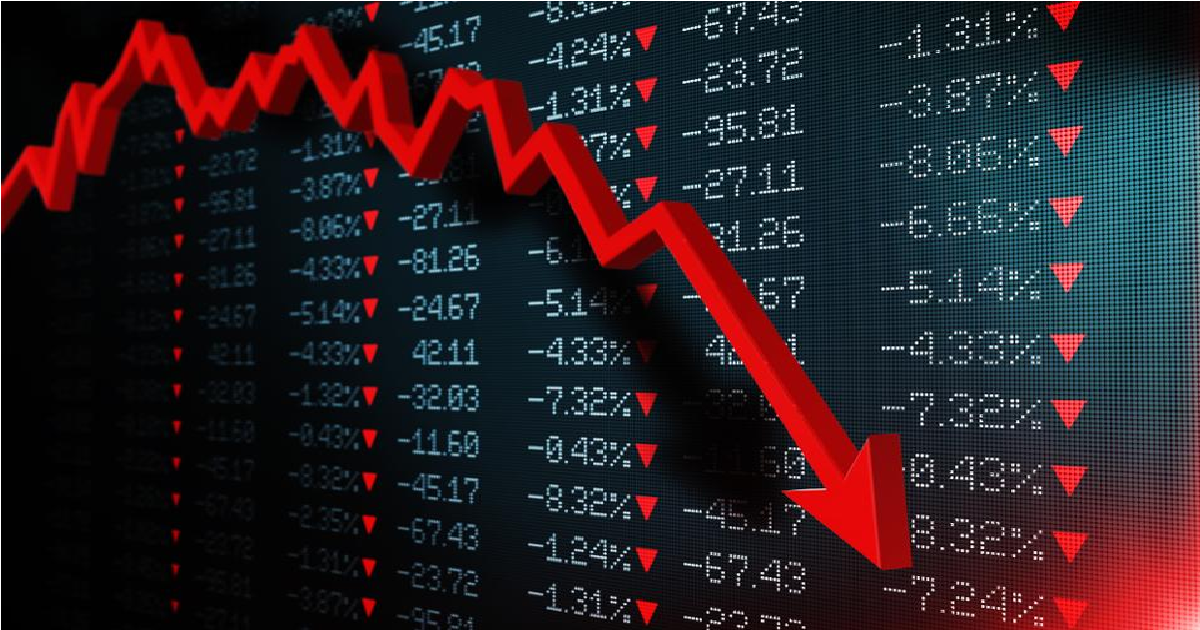
Stocks continue to nosedive as the world struggles to halt the spread of coronavirus. On Thursday, the U.S. markets witnessed yet another drop that took the markets’ index to a historic fall.

The Dow has been on free fall since the outbreak of COVID-19 in the United States, and took a further leap downward on Thursday as president Trump and the Federal Reserve failed to proffer a solution to the rapid dwindling of stocks as a result of the coronavirus outbreak.

The Dow Jones Industrial Average closed 2,352.60 points lower, or 9.99%, at 21,200.62. That’s the market worst fall in 34 years. The S&P 500 plunged 9.5% to 2,480.64 to join Dow in bear market. Nasdaq showed no difference, closing 9.4% lower at 7,201.80, all replicating the 1987 crash that took over 22% value off the markets.

The remarkable turns the falls are taking is pointing to a possible collapse of the markets, which will usher in a global recession. Bloomberg noted that roughly $17 trillion has been erased from the stock market in 52 days. The pace is five times faster when compared with the 2007/2008 financial crisis that took 262 days for a similar amount to be wiped off.

Asian markets were on a rough ride as the global stock markets crash took a swipe on Singapore, putting an end to the defiance that has yielded a years-long bull run. Coronavirus came with a devastating wind that practically destroyed the hiding places and left investors exposed.

Japan doesn’t have a better story; Nikkei went down as far as 10%, falling freely to its worst since the 2008 financial crisis. Across the Asian pacific, the markets yawn with despair, leaving investors to wrestle effortlessly to savage what they can.

The Dow futures went down about 3% in Asia, taking along the S&P and 500 futures.

Australia’s benchmark went down about 8%, marking its worst performance in recent times and may drift further in coming weeks. Australia has injected $5.5 billion into the financial sector.

Hong Kong’s Hang Seng index dropped 5% while China’s Shanghai composite fell 3%.

Europe took further hit after Donald announced a travel ban for European countries, crippling the already wobbling aviation sector. The UK’s main index fail by 10% on Thursday, it’s worst since 1987. Though there was insignificant positivity in some markets in the Euro-zone, the overall performance of stocks beams with disappointment and uncertain future.

In commodities, the oil market has been on the loose and has been falling freely since OPEC members disagreed on production cuts that could have helped to stabilize price. Brent went further down 50 cents or 1.5%, at $32.74 a barrel after it fell more than 7% on Thursday. The U.S. crude went down 1.6% at $30.99 per barrel on Thursday.

Gold, usually a safe harbor in times of global economic trouble failed to secure its island from the plummeting economic influence. It fell 4% to $1.563.42 an ounce in 48 hours.

The commodity downturns signify troubles for African countries. The plummeting prices are stoking inflation and increasing chances of recession in a very short time.

South Africa’s stock market witnessed a plunging shock that sent vibration through the spines of leading industries in the market. Johannesburg Stock Exchange (JSE)  fell by more than 10% for the first time in 23 years.

Telecommunication giants, MTN Group, Vodacom and Telkom took dwindling turns in the stock market.

MTN plunged 13.9% to R54.39 ($3.36) per share, Vodacom fail 5.3% to R104.14 ($6.43) while Telkom slumped 7.4% to R23.39 ($1.44).

Nigeria is finding it hard to sell its oil in the face of low cost that has gone below its budget benchmark. The Nigerian National Petroleum Corporation (NNPC) is wary of a bleak future if coronavirus is not contained soon.

“Due to the Coronavirus pandemic, Nigeria has about 50 cargoes of crude oil that have not found landing. This implies that there are no off-takers for them for now due to drop in demand. Today, I can share with you that there are over 12 stranded LNG cargoes in the market globally. It has never happened before,” Mallam Mele Kyari, NNPC GMD said.

The naira fell against the dollar to sell at N420/$1 at black market as a result of the fall in oil prices. Though it was attributed to speculation by Bureau de Change operators that the Central Bank of Nigeria is about devaluing the naira, exchange rate is still fluctuating around N375/$1 even after the intervention of the Apex bank.

The US stocks showed signs of recovery on Friday after Trump announced measures to tackle coronavirus, the markets leaped to significant gains to close the day in remarkably the best way since October 2008. But despite the gains, Wall Street ended the week with losses.

The S&P 500 went up 5.8%, while Dow was 5.7%, or 1,220 points, and the Nasdaq Composite was 5.4%. However, the stability of the growth is not guaranteed and the market will likely take another fall at any negative news about the government’s efforts to quell the outbreak.

The markets’ troubles have been attributed to panic stemming from the government’s inability to announce measures to fight the outbreak.

“Government bureaucracy simply has not kept pace with the nature of the outbreak and market expectations,” said Tai Hui, Chief Asia Market strategist, J.P. Morgan Asset Management. “We need to see the number of new infections stabilize… we also need to see fiscal and no monetary policy support implantation.”

The New York Federal Reserve pumped in $500 billion and added $1 trillion on Friday in a bid to keep borrowing costs from rising. Other countries around the world are taking financial measures to keep their economy stable, including injecting funds into sensitive sectors of the economy.

However, the measures are so far yielding little results to resuscitate the global economy, mainly because COVID-19 is still spreading and will require significant containment to get the markets back on their feet again.

Vetifly Opens Booking in Nigeria, Offers 30% Bonus: Fly Over Traffic and Insecurity with Helicopter

0

From April 2020, you will be able to book helicopter rides on Vetifly, starting in Lagos, and soon covering other cities in Nigeria including Ibadan, Abuja, Kaduna, etc.

If you go ahead to create your account now and top-up your wallet, we would extend a limited ONE-TIME BONUS (vetifly.com/signup) offer to you. You get a one-time 30% BONUS for every dollar you deposit in your wallet, up to a maximum of $300.

To access this bonus, please follow the instructions below:

  1. Create your Vetifly account via vetifly.com/signup.
  2. Top up your wallet on your newly created account immediately with $100 or more, using your preferred choice of payment. Naira cards are also accepted. Your wallet balance will always display in US dollars.
  3. Within 24 hours of your deposit, your wallet would be credited with 30% of the amount you deposited in your wallet as a ONE-TIME BONUS to use towards booking on the Vetifly app from April 2020.
  4. To sign back into your account anytime, go to vetifly.com/login, enter your email ID and password and proceed.

P.S: Please note that this offer is time-bound and subject to availability. In this case “fortune favours the first”.

The money you deposit in your wallet remains yours and may be withdrawn at any time. You may initiate a withdrawal process by emailing us at support@vetifly.com. Bonus balance is not eligible for withdrawal.

Take advantage of this offer and the amazing opportunity to fund your first trips with us. Act now by clicking this link: vetifly.com/signup

Sit tight, and get ready to Vetifly across Nigeria. In the coming weeks, we will send you a link to download the Vetifly app from the App Store and Google Play. You will need to use the same login details you are creating now to book, using funds from your wallet.

We look forward to welcoming you onboard on one of our early routes, after launch, very soon.

From your friends @Vetifly

Why The Exclusion Of South East From Nigeria’s $22.7bn Loan Is Not Healthy

1

During a lecture on government a couple of years back, my professor dropped this line “… Government determines who gets what… “.

Regardless of the fact that, that practice can easily be observed in the acts of political leaders, and the fact that the man was a respected scholar, I couldn’t bring myself to subscribe to that line of thought. I resented it for the reason that it was very easy to just look at the reality that is  obvious and append ” … And whose interest end up being ignored…” to the man’s description. Doing so, the whole idea will read ” … Government determines who gets what … and whose interest end up being ignored “. That is the big problem.

The problem that such a practice creates isn’t just that those who ‘get’ are happy and those who are out-rightly ‘ignored’ are sad, angry, and resentful. Giving to one and out-rightly ignoring another expands the boundaries of inequality. It fuels restiveness. It rubs a society of the important opportunity that tapping into the talents of all its citizens affords. It fans the embers of disunity.  Are those not sufficiently disturbing problems? Should it not matter to a society not to be hell bent on creating multiple challenges for itself but to work hard in the direction of exploring its full potential in a sensible fair manner? As far as reason goes, the manner in which the $22.7 bn loan was allocated suggests something very bizarre.

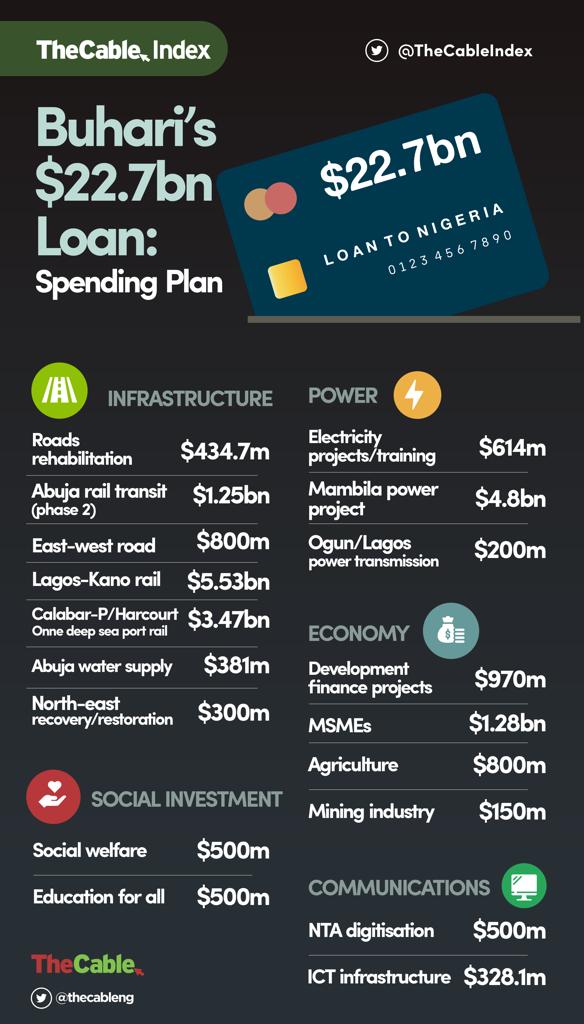
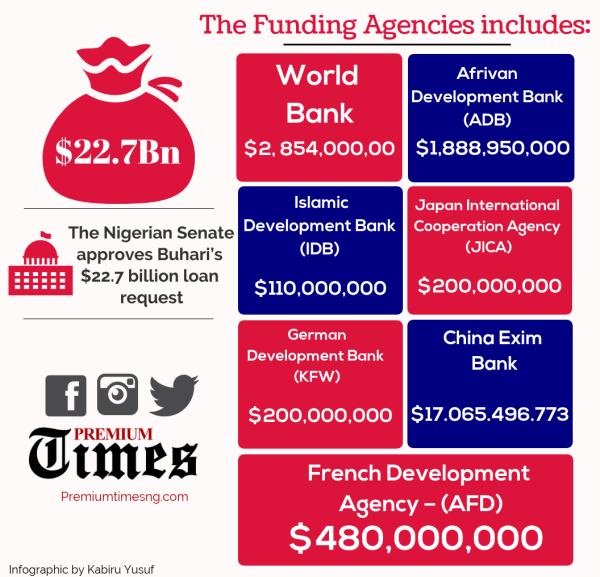
The table below shows the distribution of a 22.7 billion dollars loan to the various geopolitical zones of Nigeria.

Nigeria’s $22.7b Loan: Projects/Services By Political Zones.

1) South West:     $200,000,000.00

2) South South:    $4,270,000,000.00

3) South East:     $0.00

4) North West:    $6,372,000,000.00

5) North East:     $300,000,000.00

6) North Central:   $6,531,000,000.00

General:              $5,853,900,000.00

Source: Tekedia Network

A look at the above table should give anyone who cares the feeling “what does it all mean?” The answer to that question, no matter how fanciful it may be, won’t help the nation in the long term. That’s, if anyone cares  about long term.

It’s a clear fact that the world has undergone remarkable transformation over the past few decades. A transformation that is energized by greater acceptance of other people in spite of obvious differences, and by the drive towards freer societies, as well as by the enhancement of opportunity for all men,  women and children.

Just a couple of decades ago, Africa was at the receiving end of the worst form of exploitation that can be imagined. And throughout the rest of the world, discrimination made it so difficult for people of different races to support one another and work together to achieve the greater good doing so brings.

Given the sharp improvement in the world today compared to the sadder realities of the recent past, there’s a very straight forward lesson that can be easily learned.

Those who are hell bent on exploiting others in unfair ways, eventually keep themselves blinded to the opportunities that collaborating with those they exploit, on fair terms, could offer them to achieve greater milestones than is possible through unfair exploitation.

Just to clarify this point, I’m curious  as to why a relatively younger America became more powerful than its older colonizer. Doesn’t it seem reasonable to think that while the then unsustainable policy of ” Grab and grab all that can be grabbed ” of the European powers, placed on them a huge limitation, the willingness of America to support and expand opportunities for all it’s citizens helped it stay ahead?

It is hoped, in solidarity to Nigeria and to the call of senators from South East, for a review, that we don’t solely insist that government must be a tool for granting privileges and opportunities in such a way that, in a country of six regions, the interest of the people, of a particular region is ignored. Unless anyone who subscribes to the practice of otherwise feels that, it will be possible to bullet-proof the country from the dangerous depressions that marginalization  causes to a nation and its people.

The possibility of a greater and better Nigeria lies in prioritization of support for every citizen of Nigeria, regardless of their ethnic or political affiliation, to have the opportunity  to achieve a better, healthier life. It lies in not only making life better for the people of some regions, but in pursuing policies that fight for the wellbeing of every man, woman and child of all the regions in the country.

Nothing much will be gained by a country that works hard to keep its people angry, poor, underdeveloped and resentful. Because whatever practice that doesn’t uplift a nation ultimate retards its progress.

Week 6 Session is Live – Capital Markets,  Investing and Fundraising

0

Week 6 of Tekedia Mini-MBA – Capital Markets,  Investing and Fundraising is live in the Digital Board. A total of 8 videos covering capital markets, investing and fundraising.  All supported with a Written Material using Warren Buffett’s investing philosophy and many other constructs of modern investing. Bonds, debts, stocks, equities, etc are all covered along with a selection of active venture capitalists in Africa at the moment. Bringing it home, our capital markets expert, Azeez Lawal, used Aliko Dangote and Tony Elumelu, illustrating how they have built business empires via the capital markets. A lesson on Dufil Prima, the makers of Indomie, and how it has used capital markets to finance growth is a moment in class.

Meanwhile, on May 4, 2020, we will release a special series titled Winning in Business as earlier announced. Unlike our typical session which includes written materials, the series would be delivered via videos. To make it look like a time-limited meatspace delivery, the series will be available for 24 hours only. On the date noted, a link will become active on the Digital Board for Tekedia Mini-MBA members to access. Here are the topics:

  • Session 1 – Readiness for The Frictions of Nations
  • Session 2 – The SIX to Unlock Values in Markets
  • Session 3 – The Two Critical Playbooks
  • Session 4 –  Mechanics of growth & Investment Options
  • Session 5 – Finding the Edges and Market Opportunities
  • Deep Conversations – Answers to Big Questions

I wish you all a profitable week ahead.