DD
MM
YYYY

PAGES

DD
MM
YYYY

spot_img

PAGES

Home Blog Page 6474

The Magic of TikTok’s Intimidating Growth

0

The social media app TikTok continues to exert influence over an increasing number of people. Sensor Tower reported that the social video app has surpassed 1.5 billion downloads in the app stores, giving it a huge audience amidst fierce competition.

In 2018, TikTok was the fourth most downloaded non-gaming app in the world,with a record 655.8 million unique installs. In 2019, it added more than 614 million downloads, 6 percent more than it had at the same point last year.it’s growth speed has been spontaneous and intimidating, mocking other social media apps like Facebook that has constantly tried to push the Chinese investment aside.

The short video app has been a thorn in the flesh of Facebook from when the idea became widely appealing to young people. Instagram has failed to stay ahead in the short video business, giving Mark Zuckerberg a cause for concern that resulted in the attempt to clone  TikTok. While Facebook is leading the download battle through other members of its family, TikTok has been doing the solo push to the top.

According to Analytics site Sensor Tower, TikTok crossed the 1 billion downloads back in February 2019. It took a space of less than nine months for the app to add 500 million to make the 1 billion mark, and about six months to add further 600 million downloads.

Its popularity has been heightened by three major countries – the US, India and China. India has been recently, the center of its proliferation, and has accounted for more than 31% of its downloads. China on the other hand, has become its second biggest market with over 11.5% downloads, while the US is responsible for over 8.2%.

Within three years, the video app has moved up to top ten in the rank of social media platforms, taking the seventh place ahead of YouTube and Twitter that have been around for much longer.

TikToks’s biggest threat has been the US’ Government’s interest in its activities on the excuse of national security concerns. TikTok was acquired by ByteDance, a Beijing-based technology in 2016, but had been on the radar of surveillance by the US authorities ever since then. However, that has not stopped it from pulling a surprise growth that has kept Facebook paranoid.

But it is apparent that the US government’s inquisition is stymieing the app’s growth in the United States, where a large number of Generation Z demographic have found a deep connection with the video features, and are dropping other video apps for it. Moreover, the appeal is catching interest from other countries and TikTok is poised to take advantage of that and extend its services to these countries. According to Global Web Index, 41 percent of TikTok users are aged between 16 and 24.

TikTok is available in more than 155 countries, and in 75 languages including 15 local Indian tongues. A push it is making to win more people around the world to make up for the seeming US apathy that has kept its growth in North America on check, though the number of US adult users of the app has been consistently on the rise since 2018. The number of US adults on TikTok doubled from 7.2 million in September 2018, to 14.3 million in just six months. Exponentially, the number grew 5.5 times, offering hope of further increase in the future.

The recent growth in its adult usage in the US has been attributed to Jimmy Fallon’s show that encourages audience to participate in different challenges created by the TikTok App. The interesting challenge has spurred a lot of interest and caused many people to download the App.

While video sharing has become a thriving social media business that has kept companies like YouTube, Instagram and Snapchat online for years now, TikTok seems to have found a new perspective that gives users a different taste from what other platforms have to offer.

TikTok is mainly designed for content creation, giving every user an opportunity not only to share contents but become creators of contents. The ease of creating one’s own content has become the force behind the drive.

However, TikTok’s success is drawing a lot of competition from video App startups such as Facebook’s Lasso and Chinese Douyin that is currently leading in China. Lasso is currently available in the US, Mexico and Colombia, but Facebook is reportedly planning to launch it in India to counter TikTok’s influence and expand Lasso’s reach.
Group Frowns as Osun Sells Teaching Service Recruitment Form

0

The Positive Agenda Nigeria has expressed its displeasure over the ongoing teaching service recruitment in Osun State. According to the group, it is not ideal for Osun State government under the leadership of Governor Gboyega Oyetola through assigned government’s ministry and agency to ask applicants for payment of N3,000 before they could be recruited into the State Teaching Service.

In a press release signed by one of the conveners of the organisation, Rasheed Adebiyi, PAN says “its attention has been drawn to the attempts of the Osun State Government to recruit teachers to fill in vacancies that exist in the teaching service commission of the state. It was also learnt that the recruitment is in line with the government’s recent reversal of the education policy hitherto put in place by the immediate past administration in the state.”

“While the organization has commended the attempt to recruit new teachers into the employ of the state, it has found grossly exploitative and highly unacceptable an application fee attached to the recruitment exercise. We found it unthinkable that candidates, who are indigenes of Osun are expected to pay a sum of N3,000 to the coffers of the state government before they could be allowed to submit their applications for employment into the public service of the state.

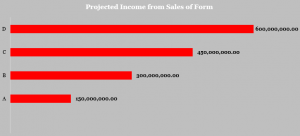
“Our scenario analysis has shown that Osun State government is likely to recoup millions of naira if 50,000 (Scenario A), 100,000 (Scenario B), 150,000 (Scenario C) and 200,000 (Scenario D) forms are sold to the prospective applicants. This analysis was carried out in line with the previous media reports that indicated thousands of applicants applied for previous government job vacancies in the State.

Source: Positive Agenda Nigeria Analysis, 2020

“The Positive Agenda Nigeria, as a good and open governance civil society organization considers this action from the All Progressives Congress led government as an exploitation of the huge number of unemployed youths. This implies that those who are brilliant and capable but who do not have the means are automatically exempted. For the avoidance of doubt, asking the candidates, many of whom would have their monies lost as the available slots are not even up to N3,000, is callous. It shows the insensitivity on the part of government to have wanted the jobless youth to pay to apply.”

The group, which recently released a civic engagement report that spurred the government officials to initiate Apero, a traditional civic engagement programme held recently, asks “what would happen to the monies paid by the candidates whose applications are not eventually considered?”

The group urges the government to stop the extortion in the name of application fees being charged by the ministry of education. “This action if allowed to continue would be a dent on the recent improvement of the governor’s engagement with the people. By doing this, we believe the government through Governor Gboyega Oyetola would leave up to the expectation of the citizens who expect good governance at all times.”

Tekedia Mini-MBA Monthly Update

6

(Please email me – email can be found below – if you want us to inform you when the next batch registration begins)

Dear Community Member,

Greetings! This is the monthly update for Tekedia mini-MBA community. I am using it to provide feedback on some issues and suggestions members have shared.

  1. Broad Feedback: Generally, the comments on our program are positive. Nonetheless, we understand the monetary challenges some face on watching videos. That is the main reason why we have the Written Materials to reduce the need for excessive videos.
  2. Tekedia Innovation Summit: Many members requested they would like a physical connection besides this virtual one. Accordingly, we plan to host a summit in Q4 2020 in Lagos. That summit will also be webcasted. Expect more details in subsequent updates. But note: this summit will not cost members anything more.
  3. Co-Innovation Idea Circle: Some members want to have a section to share product and service ideas or what they are building, via video and documents, and get feedback from the community. Our team is updating our platform to accommodate that for the next batch of this program.
  4. Funding Club: We have mobilized small money to run innovation competition for members, tapping into #3 above. Depending on the votes in the community and other factors, some ideas will receive small funding for minor stakes. We do believe that Tekedia should not just teach innovation but must also stimulate innovators to do great things. This will be part of the next batch.
  5. Courseware: We received the feedback to add programs on advertising, media, and business law in the next batch. Also, we have worked out a way to ensure that Challenge assignments and Labs are being graded. Two institutions, one Africa-based and another U.S.-based, have offered to support this process.
  6. Partner Marketplace: Some companies have reached out to us, seeking opportunities to offer free products and services to the community. These services could include web hosting, product samples, books, business legal services, etc. We are working on a process on how best to integrate this without impacting learning. If interested as a partner, contact me. 
  7. Company specific programs: GMP (General Management Program) and AMP (Advanced Management Program) are Tekedia mini-MBA customized for specific companies and their sectors. This was an immediate feedback from firms. The firms have dedicated boards for their entire staff (no limit) to discuss and innovate. We create contents using the firms and their industries to stimulate conversations. Email me for a brochure.
  8. Innovation Book: During the Summit, we will unveil a book – Innovation for Growth: Techniques for Building Category-King Companies

Remember, every Monday at 12 noon Lagos time, contents for new weeks are posted here – https://www.tekedia.com/dboard/ . All updates are also done on the weekly board as we try to reduce emails as much as possible. 

Our goal is to make this program the best innovation program in Africa. And experiences from this inaugural batch will make the next one better. Please feel free to send questions: those with business canvas questions, send them, we have capacity now to provide guidance to everyone.

From all of us at Tekedia Institute, we truly value the opportunity to co-create,  co-share and co-learn with you.

Regards,

Tekedia Institute

tekedia@fasmicro.com

Future of Work: 6 Must Have Skills for Researchers of the Future

0

The future of work is changing. Whatever anyone engages in, there are new skills that need to be applied. When human resources experts talk about the future of work, Artificial Intelligence and Machine Learning usually dominate their thoughts. What this means is that an average human being is expected to be smarter and work more intelligently.

Being a university teacher is one of the most arduous tasks anyone can take up in the world. An average lecturer is also a researcher. He is expected to publish or perish. In a bid to advance far in the course of being a university teacher, the mantra is you either publish or perish. But now, the thinking is moving away from publishing alone. How a researcher does make impact in the society and address their empirical work to solve societal problems? Every university teacher understands their commitment is to three core areas – teaching, research and community service. So, how does one advance the course of knowledge and still be impactful? This is the main question the write up focuses on. The essence is to talk about those skills that the researcher of the future must possess. Thus, this is a review of an article generated for the purpose of calling the attention of the fourth industrial era researchers to those needed skills.

#Research Communication and Public Engagement. This is a necessary skill for every researcher who seeks audience beyond the academic circle. It is the ability or skill that enables a researcher to explain the outcomes of research to the layman audience without the academic jargons. If the essence of research is to solve societal problems, then research communication is a key skill that must be warehoused so that those on whose behalf studies are carried out appreciate and understand their importance. When next you are publishing a research article, think of the way to also communicate to the public and engage members of the public on it.

#Research Collaboration beyond the Academia. For the researcher of the future, collaboration is the keyword. Dubbed Town and Gown collaboration, it is meant to imply the extension of research beyond the network of the academics alone. Researches that are relevant to businesses and industry, government, non-governmental organizations, policy makers and other stakeholders require collaboration.  So, as a researcher of the future, you are expected to create a network of collaborators beyond the four walls of the ivory towers. There are several ways to do this – seek external advice from them; interview them as part of your research; see how your research fits in with their product development or engage them through career events.

#Use of Digital Tools. Any researcher of this era should understand that many of the hitherto research processes done manually have now become digital. From data collection to analysis, there are open source and free software used to carry them out. Not only that, for wider dissemination and far reaching impact, a researcher of the future learns how to use the social media, academic blogs and even YouTube to call public attention to their latest scientific investigations. There are a number of other digital tools that are very useful.

#Open Research Practices. This is the latest trend in academic research. As opposed to a close research culture where researchers publish the outcomes of their research in subscription based journals where access is premised on the payment of certain amount, there is a focus on open research now where researches are shared openly and publicly. The open research practices come in different ways. It could be publishing in open access journals, sharing research outcomes on social media or even making the data collected available on designated repository. In whatever way, the aim is to be open and make research information available to those who need them.    

#Media Relations Skills. A researcher of the future does not only know how to carry out valid research, they must understand the intricacies of communicating it with the public. One of the ways to do this is through relating with the media. This in PR terms is called media relations. This will involve writing press releases or statements and sharing such with the press. It may also include calling a press conference to disseminate the findings of your study. There are mainstream and online media outfits. The researcher of the future must learn how to relate with the media to publicize their findings.

#Popular Article Writing. These are different from the usual scientific article which could only make meaning to the people in the academia. It involves interpreting outcomes of research in a way that is understandable to the general public. It is a craft of using data to generate articles and it involves some skills. Writing popular article makes a researcher known in the field. It also makes a researcher a thought leader in both the academia and the industry. A researcher who has the ability to do this has successfully mastered the art of being a researcher that is impactful beyond in the two worlds.


Economic Development, Foreign Direct Investment, and the Rule of Law in Nigeria

9

Nigeria is in a development crisis. The indices of national development suggest that the country is a barrel of disaster waiting to explode. With 69% of the population living below the poverty line, huge infrastructure deficit, ailing health sector and a failed public education system; the country is in dire need of an appropriate web of interventions. Indeed, recent efforts are yielding results – evidenced in the country’s improvement in the ease of doing business ranking. However, the country’s unenviable 158th position in the Human Development Index ranking, reveals that a lot still needs to be done. 

One of the important elements for development in Nigeria is the attraction and retention of Foreign Direct Investment (FDI). FDI is one of the most important contributors to economic growth. It augments domestic capital; creates jobs; enhances efficiency through the transfer of technology and expertise and stimulates the growth of domestic firms. In fact, on the 4th of February 2020, the President justified the country’s new Visa policy by emphasizing its potential to attract FDI into the country. Strategies like this and tax incentives reflect Nigeria’s standard approach to the attraction of FDI. However, the country seems to be missing an important factor – The Rule of Law

The Rule of Law – The missing link

Essentially, the supremacy of the law in any society, the indicators of the Rule of Law, according to the World Justice Project are Constraints on Government Powers, Absence of Corruption, Open Government, Fundamental Rights, Order & Security, Regulatory Enforcement, Civil Justice and Criminal Justice. The Rule of Law connotes equality before the law, legal certainty, avoidance of arbitrariness, and procedural and legal transparency. 

In the 2017/2018 Global Investment Competitiveness Report, Political stability and a business-friendly regulatory environment were identified as the most important in investors’ decision making.  In this report’s survey, 81 per cent of investors rate country legal protections as important or critically important in their investment decisions. This reveals a major gap in Nigeria’s development strategy and approach to FDI. In Nigeria, the availability of legal protection, guaranteed by a respected judicial mechanism is constantly undermined by the actions and words of the government and its agencies. Investors seek both strong legal protections and predictability and efficiency in implementing laws and regulations. Over 90 per cent of investors rate various types of legal protections, including the ability to transfer currency in and out of the country as well as legal protections against expropriation, against breach of contract, and against nontransparent or arbitrary government conduct as critical. All investors, regardless of sector, source country, or FDI motivation, find these guarantees of greatest value. These policies are bigger deal-breakers than investment incentives, preferential trade agreements, and bilateral investment treaties. Essentially, the presence or otherwise of the Rule of Law in a country is a deal-breaker for investors. 

In Nigeria, the Rule of Law is all but absent, and ironically, the same government supposedly pursuing development objectives, consistently undermines the Rule of Law. As chronicled by the Punch Newspaper in September 2019, President Buhari has consistently disobeyed court orders. Mr Femi Falana SAN emphasized that there are about 50 cases where court orders have been disregarded by government agencies in Nigeria. In fact, President Muhammadu Buhari, exhibiting some economic naivety while addressing the general conference of the Nigerian Bar Association stated that the Rule of Law must be subject to the country’s security and interest. This confusion or ignorance on the relevance of the Rule of Law in National Development in government circles needs to be corrected. There is an apparent need to emphasize that the Rule of Law is, in fact, a pre-requisite for National Development and consequently, National Security.  The relevance of the Rule of Law to Development is so trite that as far back as the eighteenth century, Adam Smith in his work – The Wealth of Nations emphasized that “Commerce and manufactures can seldom flourish long in any state which does not enjoy a regular administration of justice, in which the people do not feel themselves secure in the possession of their property, in which the faith of contracts is not supported by law, and in which the authority of the state is not supposed to be regularly employed in enforcing the payment of debts from all those who are able to pay. Commerce and manufactures, in short, can seldom flourish in any state in which there is not a certain degree of confidence in the justice of government”.

In 2012, The United Nations General Assembly adopted a resolution noting that the Rule of Law and development are strongly interrelated and mutually reinforcing and that the advancement of the rule of law at the national level is essential for sustained and inclusive economic growth, sustainable development, the eradication of poverty and hunger. 

Two major billion-dollar arbitral awards currently hang over Nigeria due to the arbitrariness of government conduct and disregard of contracts. In 2003, the Nigerian Ministry of Power awarded a Build, Operate and Transfer (BOT) contract of the Mambilla hydropower project to Sunrise Power and Transmission Company Limited (SPTCL). Three years later, the same project was awarded to a group of Chinese companies. In November 2012, a general project execution agreement (GPEA) was signed with SPTCL; while in 2017, the same ministry signed another engineering, procurement and construction (EPC) contract with Sinohhydro Corporation of China and the initial Chinese companies to form a joint venture for the execution of the project — excluding SPTCL. SPTCL claims to have spent millions of dollars on financial and legal consultants in a bid to secure financing for the project and it has dragged the federal government and its Chinese partners before the International Chamber of Commerce (ICC) in Paris, France, over an alleged breach of contract; an action which could lead to a 2.3 billion dollar award against Nigeria. 

The second potential multi-billion dollar liability flows out of a similar set of facts characterized by a disregard for the Rule of Law. The P&ID case is one with several twists and turns as surreal as a movie plot. The undisputed facts, however, reveal that Nigeria flagrantly defaulted in its obligation under the contract to build a gas supply pipeline to a P&ID facility. Consequently, P&ID, which claims to have spent about $40 million on the project instituted arbitration proceedings against the country. This proceeding, sprinkled with the usual government disregard for institutions, has snowballed into a 9.6 billion dollars arbitral award against Nigeria. 

Unsurprisingly, Nigeria currently ranks 106 in the 126 countries ranked in the Rule of Law index – evidence of regulatory bottlenecks, elusive justice and apparent disregard for existing frameworks for legal protection. This status represents risks to potential investors which continental trade agreements, new visa regimes and tax incentives cannot erase. Investors are simply averse to climates where contracts are not respected by the government and civil modes of redress in the event of disputes are disregarded by the same government. 

The Panacea 

Essentially, the Rule of law is necessary to create the conditions for private sector-led growth, job creation, and attracting foreign investment. Five of the eleven indicators used by the World Bank in its annual Doing Business report are related to the strength of legal institutions because, without strong, impartial legal institutions and respect for the rule of law, private sector actors – local and foreign, cannot make the investments needed to grow economies and create employment opportunities. Consequently, for sustainable development in Nigeria, the Rule of Law and the Independence of the Judiciary have to be strictly pursued, not simply as governance ends in themselves; but as key items in the development toolkit.