DD
MM
YYYY

PAGES

DD
MM
YYYY

spot_img

PAGES

Home Blog Page 6485

The Measures and Correlates of the 60 Years Crises in the Nigerian Banking Sector: Is Bailout a Sustainable Strategy?

0

In every decade, the Nigerian banking sector does not experience less than two crises. According to experts, banking crisis evolves when two conditions emerge.  The first condition is the significant signs of financial distress in the banking system such as bank runs, losses and liquidations must evolve. The second condition has been premised within the banking policy intervention measures in response to significant losses in the banking system.

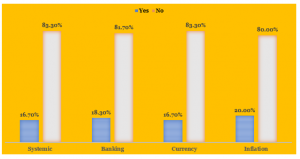
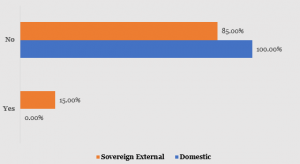
Our analyst is interested in understanding these conditions further with special attention to the Nigeria’s data on crises in the banking industry from 1954 to 2014. During the period, existing data show that country experienced 11 systemic crises followed by 10 currency crises in addition 9 sovereign external debt defaults and 12 inflation crises, which could be described as a mixture of ups and downs for the economy. For instance, systemic crisis started from 1987 to 1994. It resurfaced between 2004 and 2005.

Exhibit 1: Category of Crisis between 1954 and 2014
Source: World Bank, 2014; Infoprations Analysis, 2020

Exhibit 2: Debt Default between 1954 and 2014
Source: World Bank, 2014; Infoprations Analysis, 2020

What Effect Do Exchange Rates Have on Nigeria’s Inflation Rates in 30 Years?

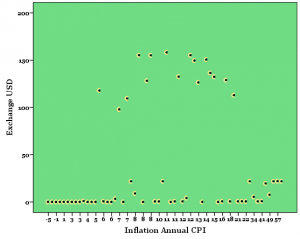
On a specific note, our analyst explored the impact of the exchange rate of US dollars on inflation annual (Consumer Price Index) rates in 30 years (out of the 60 years covered in the analysis), which in turn caused banking crises during the period. Analysis reveals -5.3% connection for the exchange rate and CPI. We also found that 0.3% of the fluctuation in the exchange rate could be understood from the CPI [see Exhibit 3].

These results align with the experts’ position that “When the exchange rate of its currency falls against multiple other currencies and the country imports goods from all these countries, the combined effect leads to economy-wide inflation in the country, even if its partner countries don’t raise their prices.” Going forward, our analysis suggests 21.8% increase in CPI for 2020 if the current exchange rate continues without adequate measures to checkmate it. Our analysis specifically indicates that one dollar increase in the exchange of Naira to Dollar would lead to a 21.8% increase in Inflation Annual CPI [see Exhibit 4].

Exhibit 3: Link between Exchange USD and Inflation Annual (Consumer Price Index) in 30 years
Source: World Bank, 2014; Infoprations Analysis, 2020

Bailout Sustainability and the Need for Stable Exchange Rates

Exhibit 4: Exchange USD per Year
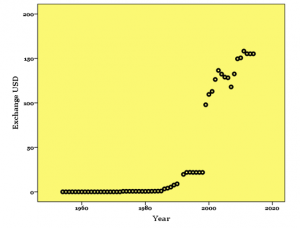
Source: World Bank, 2014; Infoprations Analysis, 2020

According to our checks, during the period, government officials and experts agreed and disagreed on the rationales for bailout funds given to some banks. They also had divergent views on the policy interventions of the Central Bank of Nigeria and other regulatory authorities. In 2009, Lamido Sanusi, former governor of the CBN hinted that N620 billion was injected into the troubled banks due to non-performing and unsecured loans of the banks which led to tight credit in the economy. Checks have also shown that “Nigeria’s all-share index fell 2.5%, with financial stocks the heaviest losers after a 400 billion-naira ($2.6 billion) bailout of five banks knocked investor confidence in the sector.”

Having seen the gravity of unsecured loans and the cost of bailout on the government, in 2018 the Nigerian government through the Special Presidential Panel for the Recovery of Public Property announced its commitment to recover the $7 billion bailout fund granted to embattled commercial banks between 2006 and 2008 by the Federal Government. A year later, the Federal Government reinforced the need for the banks to revisit the risk management strategy because the use of huge bailout funds may not be sustainable in the financial system.

According to Professor Yemi Osibanjo, the Vice President, “First is the number of institutions, and implicit and explicit tools in our safety system and their sustainability. Perhaps the most significant challenge to the financial system that we have experienced so far was that bank crisis of 2009. “Going by the manner of resolution, it appears that the preferred option was the establishment of Asset Management Corporation of Nigeria – an option that cost something in the order of N5tn. Since then we have also seen the use of a mixture of bailouts and bridge banks.

“The problem, of course, is that the most reliable studies show that overly generous financial safety nets or system have generally tended to increase bank risks and systemic fragility. “My respectful view is that there must be some rethinking of the short and long- term implications of the use of these tools and their sustainability in the coming years. A reference was made in the past that we may not even have that option of the AMCON-type bailout given the sheer amount of money that will be involved.”

Beyond looking at the possibility of readdressing the bailout approach to rescue troubled banks, concerned stakeholders also need to devise the right policy interventions that would solve the exchange rate fluctuation in 2020 and coming years.  This is imperative as the World Bank’s Global Economic Prospects report says,  “There have been four waves of debt accumulation in the last 50 years. The latest wave, which started in 2010, has seen the largest, fastest, and most broad-based increase in debt among the four. While current low levels of interest rates mitigate some of the risks associated with high debt, previous waves of broad-based debt accumulation ended with widespread financial crises. Policy options to reduce the likelihood of crises and lessen their impact should they materialize include building resilient monetary and fiscal frameworks, instituting robust supervisory and regulatory regimes, and following transparent debt management practices.”
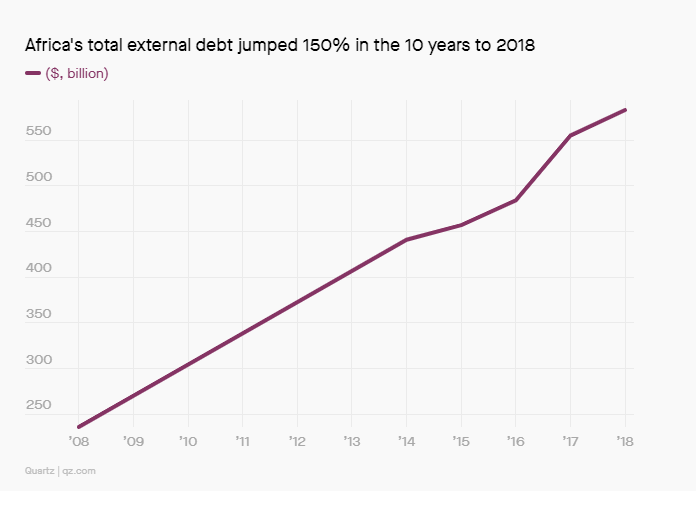

The World Bank’s BIG Concern on Africa

1

I wrote a few days ago that the World Bank should allow the African Development Bank the freedom to run its playbook.

The African Development Bank (AfDB) which I hope empties its vault to help develop Africa rebuts World Bank whose president dropped those unfortunate lines: you have a tendency to lend too quickly and in the process, add to the continent’s debt problems. The World Bank president is wrong and he should be told that: AfDB is not adding to any problem.

Africa needs to incur debts over the next two decades to have any chance of advancement because its tax credits are so small to organically fund developments.  Largely, the problem is not the debt BUT what the politicians do with the borrowed money. World Bank should focus on that second part, helping to ensure there is an improved governance.

We appreciate the World Bank; it wrote a cheque of US $20.2 billion for Africa in 2018. But that is nothing and at that rate, nothing will happen. Dangote raised close to $15 billion only for his empire a few years earlier. Time has come for respect and I expect the World Bank president to show that: AfDB is as important as the World Bank on this mission of developing Africa, and should be respected as it runs its own playbook!

But that does not mean Africa should not be concerned about the debt we are packing from China. I personally do not have much issues with AfDB, but I do have concerns when it comes to China. Yet, that does not mean that the World Bank should be the police. The reason we have China in African capitals is largely due to decades-long failures of IMF and World Bank, along with the African leaders, to fix the continent.

So when the World Bank president writes, “One of the practical problems we’re dealing with right now is some of the new lenders, the non-Paris Club lenders—and so I guess when we say that, people should sometimes read China into that.. They’ve escalated their lending, which is good in a way. We want more lending into developing countries.  But…oftentimes their contracts have a nondisclosure clause that prohibits the World Bank or private sector from seeing what the terms of the contract are,” you will feel the pains arising from the disintermediation China is causing. But China did not get into Africa uninvited: the West created the vacuum which China is mining!

Both institutions [Word Bank and IMF] are also worried about the impact of China which, while still not the largest lender, has become a hugely influential source of capital in African countries that have few options due to their weak economic balance sheet. This is particularly true because China offers a convenient package of funding and execution through its state-owned enterprises for much-needed infrastructure projects across the continent. The problem, said World Bank president David Malpass, is the lack of transparency.

“One of the practical problems we’re dealing with right now is some of the new lenders, the non-Paris Club lenders—and so I guess when we say that, people should sometimes read China into that,” said Malpass. “They’ve escalated their lending, which is good in a way. We want more lending into developing countries.  But…oftentimes their contracts have a nondisclosure clause that prohibits the World Bank or private sector from seeing what the terms of the contract are.”

The World Bank will not have any luck here  as the politicians prefer the Chinese playbook, as less transparency breeds the spirit of corruption, which many of them hold multiple captain-ships. My only recommendation to the World Bank is thus: boost your private sector investment in Africa via IFC, your private investment arm, to $200 billion risk capital. If you do that over ten years, China may not have valuable things to fund. But if you stay around the current $20 billion yearly number, nothing will change. China gives cash and projects, most times, the World Bank gives lines of credits; African politicians prefer cash!

Source: Quartz

Carbon launches entrepreneurship fund to champion African startups

0

Carbon has set up a $100,000 Pan-African fund to address the lack of funding and support holding back budding tech entrepreneurs on the continent.

Carbon’s mission is to empower opportunity globally through frictionless finance. that empowers individuals and businesses with access to credit, simple payments solutions, high-yield investment opportunities and easy-to-use tools for personal financial management. We are a global company of over 100 employees with operations in Nigeria, England and Kenya.

Carbon’s Disrupt fund, the first of its kind by an African fintech startup, will invest up to $10,000 per startup (for 5 percent equity) and give access to Carbon’s API, allowing investees to leverage Carbon’s growing customer base and innovative technology platform, to get to market faster. Acknowledging that its success is dependent on the growth of the tech ecosystem, Carbon expects the initiative to spark more collaboration and further investment that should drive growth across the ecosystem. It’s not all altruistic, unfortunately!

Carbon is now accepting applications from companies with operations in Uganda, Kenya, Nigeria, Ghana, Cote d’Ivoire and Egypt. Startups looking to apply for the fund must have a functioning product, post revenue and looking to operate in multiple countries. The fund has a wide investment mandate but target sectors include insurance, health, education which have not seen as much investment as the fintech space.

More than 50 percent of startup funding on the continent in 2019 went to fintech firms1, despite the abundance of opportunities that exist in other sectors. Carbon’s Disrupt fund has been developed to tackle this head on, making it easier for entrepreneurs across all sectors to access the funds and support they need to establish their solutions and achieve their business objectives. The fund will also provide mentorship, access to Carbon’s customers and payment platform, as well as office space in Carbon’s Lagos offices.

According to Chijioke Dozie, CEO and co-founder of Carbon, “Common investor wisdom is to stay in your market and dominate. This assumes that you are expanding on your own but we believe that by collaborating and partnering deliberately, Carbon and other tech companies can scale faster and build more enduring platforms.  There are many excellent companies across the continent looking for the kind of scale Nigeria offers and we are excited to partner with them to provide the support and financial investment they need. We are equally excited to expand beyond Nigeria and Kenya by working with a new generation of innovators across the continent and sharing our experience to tackle common obstacles to growth”

Ngozi Dozie, co-founder of Carbon, added “The investing environment for early stage startups has improved in recent years. However, a key issue for most startups that has not been addressed is the cost of customer acquisition. A lot of money is spent on acquiring customers, mainly via social media, when a more collaborative approach among tech companies could be more efficient. Our fund will enable this collaboration, allowing others to market to our customer base and vice versa – a win-win for everyone. As the saying goes, ‘if you want to go fast, go alone.  If you want to go far, go together’”.

Since launching in 2016, Carbon has amassed 2.1 million users. The company disbursed more than $63.7 million in loans in 2019 and processed more than $140 million in transactions. In December 2019, the company announced its expansion into the Kenyan market, as well as its Carbon for Business platform which provides startups, small and medium-sized enterprises (SMEs) and FinTechs with access to uncollateralized credit, secure online payments, reliable funds transfer and fast KYC (know your customer) compliance obligations.

Interested entrepreneurs can apply to access the fund via https://getcarbon.co/disrupt-fund.

Source: press release

Dangers of Academic Ghost-Writing

1

While growing up, I read mystery novels that told stories about ghost-writers and ghost-writing. Then, I thought ghost-writing was all about writers shadowing important people so they could chronicle important events in their lives. All I knew about ghost-writing centred around writing true stories on people’s lives.

Later, I found out that ghost-writing isn’t just about writing stories on people; it is all about writing things that wouldn’t fetch you any credit, except the money you will be paid. I learnt this when I started writing speeches and addresses for my bosses. That was when I realised that presidents and CEOs don’t have to write their speeches. All they needed to do was to hire ghost-writes and then edit what was written.

But today, ghost-writing is taking another dimension. People still hire others to write their stories and speeches as well as textbooks and novels, which is ok as far as I know. But the one that is gradually taking over the ghost-writing business is what I call “academic ghost-writing”.

Understanding Academic Ghost-Writing

Remember, ghost-writing involves writing piece of works for others and taking no credit for them. A ghost-writer is what he is – a ghost. He’s invisible in all ramifications. He writes what was contracted to him as if he was the client. When the work is done, the client’s name is published as the author. And the ghost-writer, who is the actual author, vanishes into oblivion. Most clients do not even allow their ghost-writers to keep copies of their works. Some don’t allow these ghost-writers to present their works as samples of their creation. These clients assume authorship and seal up any portal that will link those works to their ghost-writers.

This is ok and acceptable in the world of creative writing for so many reasons, such as want of time, expertise and resources. But when students and academics hire ghost-writers to write their academic articles, assignments and projects, then ghost-writing becomes ruinous.

I know people may jump to conclusions by stating that this situation is peculiar to Nigeria, but I am here to make it known that this is a global thing. Yes, we see and hear of students paying other students to write their assignments, tests and exams for them; and we know some projects and thesis were ghost-written; but I know that these attitudes were frowned at and discouraged by academics. In fact, some project supervisors, who suspect their supervisees of hiring ghost-writers, ask that students continue to re-phrase, re-cast and restructure their works until they are sure the work is original. These students may see them as mean but it is all for their own good.

However, things are getting digital these days, so that today it is easier to hire ghost-writers from different parts of the world. This is made possible as a result of internet platforms that bring together academics and students solely for this purpose. These platforms usually advertise openings for academic writers, research writers, researchers and so on. Those that seek for ghost-writers that will carry out location-bound research only hire people that live within that location. Some look for only people in specific fields of learning. Others pick academics based on their highest qualifications and quality and quantity of publications. These platforms can be found in every remote work advertising websites.

Kindly understand that academic ghost-writing is not the same thing as seeking out researchers, who will supply their clients with data which will be used in research. It is also not the same thing with looking for editors, who will point out loopholes in their clients’ works. Academic ghost-writing here is a situation whereby an academic or a student pays someone else, in whatever form it may, to carry out studies and research, structure them, outline the paper and then write them. After which the client will assume full authorship for a paper the content of which he didn’t know how it was arrived at.

Dangers of Academic Ghost-writing

I know many people benefit from these transactions but I believe this may have negative effects in the long run if it is not curtailed. I’ll try as much as I can to state the side effects of hiring ghost-writers for academic works.

  1. Plagiarism

This is the commonest problem associated with academic ghost-writing. Plagiarism will be almost impossible in situations where the writer tells stories of someone’s life or writes speeches for specific occasions (except in the few embarrassing instances we witnessed in Nigeria). But in academic works, plagiarism is high. This could be linked to the fact that academics accept and write papers on areas of their specialty. And when they are to write on the same subject matter for two or more different persons, they will be tempted to simply twist some words and phrases and then push out the works.

Cases such as this have been witnessed in academic project defences, where two or more students wrote almost the same content but with modified project topics, or where students copied an existing project verbatim. In most cases, investigations reveal that the affected students used the same ghost-writers. Well, they pay the price by having their works cancelled.

  1. Half-Baked Graduates

This stands to be debated because I know a lot of people argue that it’s not a must that students need to write their assignments and projects before they become good in their fields. In as much as I know that empirical study can show this as true, it is still worthy to note that one of the things expected of a student is to be able to outline his assignments and then write them analytically. If a student finds it hard to study a phenomenon, read up past works on it and analyse his findings, then I don’t see that student graduating as a professional.

  1. Recycling Information

As I always tell my students that when one thousand students are given the same assignment, the lecturer expects to see one thousand new ideas. But in a situation where the one thousand students decide to use ten ghost-writers, only ten ideas will be projected.

This is more noticeable in the cases of dissertations, where topics that have been in existence for donkey years were written over and over again and the same results are given. The effect of these is that we have so many hands that would have helped to solve the world’s problems, but because these hands entrusted this responsibility to just a few people, the same old solutions are used to solve new problems.

  1. Unprofessionalism

This is more pertinent in the case of academics hiring ghost-writers to conduct research and write their academic papers. As a lecturer, I have been approached by several colleagues, who wish to pay so I could include their names in any paper I wanted to publish. These people are only interested in getting their next promotions and never bothered about professionalism nor knowledge acquisition. By the end of the day, we have so many top academics, who have little knowledge of their fields because they have not bothered about conducting research and publishing them.

Don’t get me wrong. I’m not kicking against people seeking help from academics across the globe in doing their assignments and other academic publications. My take here is that the whole work shouldn’t be left to ghost-writers to perform. The essence of academic works is to acquire further knowledge, which will be lost if academic ghost-writing is allowed to get out of hand.

Focusing On What Matters

0

Over the years, the singular issue that confronts most young people is “how do I get out of the meanness of the circumstances of my birth to achieve greater milestone, greater happiness, more contribution to humanity, fulfilment.”

If we’re sincere to ourselves, we’ll agree that this is the central reality that underpin our daily efforts as youths.

I do believe that we as young  individuals can really do something to make life worth living and fulfilling, not just only for ourselves, but also for those around us.  And I believe that there are no quick fixes to building a solid foundation that supports our progressive advance in life and works.

The surest way through which we can improve our lots, if we’re serious about the milestone we seek to attain in our lifetime, is to develop undying appetite for the following:

  • • Consistent Discovering of our knowledge and skill gaps, that needs filling, as we move along;
  • • Persistent learning, through books, other publications, seminars, from colleagues, mentors, great leaders and role models… to close those gaps;
  • • Undying commitment to actually taking reasonable actions.

It’s important to remind ourselves  that not every deed  we do  along the way, that may produce the target we’d hoped to attain by doing those deeds. But every step we take certainly take us a little away from our challenges. And every step we take can help us to see what we can do next.

However, If we know so much and we don’t border to apply them, there will be just no way to actually figure out what works. It’s through ‘doing’ that we get to know what does or doesn’t work. It’s through actions that we get to grow.

If it’s taking years to figure out how you can get past your present life dilemma, you must remember that it actually takes a lifetime to get past the cares of life.

Thanks to Ms. Hyacinth who said “… A four year degree earned after seven years, is still a degree…”

This should make us focus on solving our problems instead of counting how long it’s taking to get done, the things that make our lives better.

The priority should be, at first, to start. As we grow, we’ll have the need, and necessarily take steps, to becoming more efficient at what we do.

I’m a young man. I live in the reality of the challenges of youths. I believe in the potentials of youths.