DD
MM
YYYY

PAGES

DD
MM
YYYY

spot_img

PAGES

Home Blog Page 6496

Why Great Products Fail – How Startup Founders Are Missing It

0

At this stage in my life, I am sick and tired of people coming up to me to tell me how great a product they are building. I’m not trying to demean their efforts, I believe they might improve if they want to, but let me address you.

Two years ago, I met Mugumya Junior to discuss my startup idea with him and all I talked about was how awesome my product was. His simple question was how it would bring money and I thought I knew how it would bring money.

The product is nice, it is interesting and it solves a problem.

WRONG!!!! VERY WRONG!!!!

Look here, if you are starting out as an entrepreneur and you’re building a product, I’m here to tell you that solving a problem is not what determines the success of a product, nor is it how great the product is.

It is simply the ability of the product to sell itself and make its own money. A product doesn’t necessarily have to be great to make profits neither does it really need to solve a problem. It just needs to be structured to make money from people.

I have not discarded the fact that solving a problem could be the way it would make its money. If that is the way it would make its money, then it’s all good.

Collecting money from people is one of the hardest things to do. You can either manipulate them or convince them to part with their money. But it gets more difficult when it’s not you but your products doing the work. So when you come to me to discuss with me on how your product is great, i really want to see how it will bring in money on a short and long term.

This itself requires a different skill. It’s a complex skill really because you’re combining product building skills with sales at the same time.

When we talk about products not solving a problem, I will give three good examples

Condom: What problem does Condom really solve? Prevention from unwanted pregnancy or diseases right? The real question is that is Condom really really safe to use? 100% or even 99%. People don’t use condoms because it is safe but because they are told it’s safe.

Luckily for them, they haven’t contacted any disease and even if they do, they will still go use condom not because they care if it is or not but because they have been told it is.

Cigarettes: Despite the fact that people are aware that cigarettes are harmful to their health, they still take it. They consume so much in a day because they believe it gives them energy or strength which it does actually.

A poor man will keep taking cigarettes because he is addicted to it not because it is really solving a problem for him. That’s the point. Your product must be able to get people not want to refuse bringing out their money to pay for it.

Tertiary education: While it’s very evident that we are in a skill economy, and that it’s possible to survive without a degree, people cannot help but still pay a huge amount of money to obtain one and that’s because of uncertainty and fear of the future.

They are not paying because it is solving a problem for them but because they hope so they are left at the mercy of the threat of not becoming successful in their minds. Is there a problem being solved exactly? Nope!!

You can create a problem through your content structure, your sales channel, your story telling, your product structure and solve it yet charge people for it.

But it’s not easy. This is the right way however to think when building products and thinking of scaling.

Remember, i didn’t discard the idea of solving a problem. I had to lay all these facts to convince you that solving a problem may not be the right way to scale in business. Perhaps solving 100 problems embedded in each other may be the right way.

But who would go through that long process (although I did but it took a hell of a time) to work on that when by focusing on the structures to put in place to make people give you their money can be implemented.

A recent research by me shows that people invest their money with crypto traders either because they want their money to double their money which they don’t care how the miracle happens or because of the fear of future catastrophe which may make them financially damaged.

If you want to build a product in this line, these two alone will make your product great but it still doesn’t guarantee its success to making profits.

The word product is generally used to refer to products or services; whatever your company does to make a profit.

I had an interesting conversation with a friend two days ago and he really wanted me to explain why I said you can create a good product, solve a problem, yet not make profit as a company.

In business, lots of Entrepreneurs focus on value creation, which is the start. However, I have discovered that value creation is not directly proportional to revenue generation. I find it to be true.

I’ve got some good examples…

However, before that, I have also realized that a businessman can make profits without value creation. So this proves furthermore that it’s not directly proportional. Some illustrations:

Example #1. Cigarettes: People who are addicted to cigarettes return daily to buy it even though they know they would die or may die or get terminal illnesses.

They return to it because of the stimulant, nicotine. Nicotine really is not a value creation for the people in particular.

Perhaps, let me define value creation because it has two different meanings based on its application

  • Value creation can be the value you offer people they pay for which they’d pay for. That’s the general one we know. More like solving a problem and people pay for the solution.
  • Value creation could be anything you do as a company to bring out money from people’s purses.

On the cigarette issue, the stimulant that causes addiction doesn’t solve any problem to people. So it’s not a value creation as regard no 1… It makes them feel good?

Well yeah, but it makes them addicted. We can say it falls under no 2 which is what you do as a business to get people to pay you value or not.

So people keep smoking because cigarette has nicotine that gives them a happy feeling even though it’s really of no benefit to them. This just means the cigarette itself is a value creation to make money not basics to solve a problem.

Example #2: University degree: People pay for their children to get into universities because of HOPE. Hope that my son or daughter would get a job. I mean that’s what our parents had in mind when they sent us to school.

Let’s x-ray this…

In a family of 5, four are graduates, no jobs or underpaid. The last child is about to get into the university, the parents wouldn’t mind and would be considered not sending the last child to school because the rest are unemployed. Why?

They’re paying not because the degree is a guarantee to jobs but because they HOPE it is. Studying in school with the hope that you’d get a job is different from the guarantee that you’d get a job once you have a degree. They are two different realities.

The guarantee that you’d get a job falls under no 1 of value creation. That is, you’re paying for a service because of the value it offers you. While the HOPE falls under no 2, the university is not really solving a problem but making people believe they are which is they give you a degree with the HOPE that you’d get a job.

That’s why school keeps making more money. It sells Hope which is a value creation for its own self.

While building digital products or putting processes in place or structures, it is one thing to completely solve people’s problems, it is another thing to make them pay.

Now, your selling point which is what you expect them to pay on may not be on the problem you solve .

Of course, you have solved the problem but these people either cannot afford it or don’t care or love something else.

How do you convince them to pay for something they feel should be free?

Now that’s profit thinking not value creation (no 1 point) thinking because you must introduce some new structures in place to make them part with their money without them giving a thought about it.

It may or may not be a new value creation (problem solving perspective) but an income generation perspective.

I’ve discovered that most people who build products or create services solve the real problems but don’t make profits because they did not figure out what will make people part with their money

Whether it’s to lie, tell a story, manipulate, hallucinate, put some processes.

You just need to know what to put in place or pull to make your customers pay you. Sadly, it’s not as easy as anyone may think.

It requires carefully understanding the customer, their behavior, psychology, the world trend, and a lot of other factors.


The Importance of Belonging to a Social Group

0

“Two is company; three is crowd.” That was the regular advice given to us in secondary school to discourage us from forming and joining cliques. But the narrative changed as we entered the university. Then it became, “Tell me your friends and I will tell you who you are.” With this, we were encouraged to identify with a group, albeit a good one.

After we graduated from university, we found out that “you need connection to make it in this country.” And that “connection” must be someone who knows you and can vouch for you. But then, it was difficult for a lot of us to find the right “connection” because all the people we know and are close to are family members. And when you don’t have someone in your family to pull you up, well, you know the rest.

I sat back some days ago to reminisce on the necessity of belonging to social groups and realized that most of us have lost the opportunity of having a close relationship with non-family members because we were instilled with fear of belonging to any clique, which we were told will mar our future. Some people have become loners because they couldn’t get themselves to make friends they’ll hang out with. They do things alone claiming that “lions hunt alone.” I may not be a lion anyway but I know from wildlife films that lions that hunt alone don’t always get their kills.

Man is a social animal and should, therefore, live and exist within a group. The problem we are facing these days is that a lot of posts on social media makes it look like you don’t need others to succeed. This ideology is already tearing a lot of families apart because a member can wake up and decide he doesn’t need the other members of the family. He will leave to build his Utopia only to be hit by the bitterness of a lonely life. But this article isn’t focused on family as a social group, but on the type of social group known as ‘clique’.

He stays that way even in old age which is why Tarrant County residents look for senior living communities in Arlington where they can spend their golden years with people they have a lot in common with.

The Oxford Advanced Learner’s Dictionary, 9th edition, defines “clique” as “a small group of people who spend their time together and do not allow others to join them.” This dictionary portrays clique in the negative light. It made it sound like clique is synonymous to gang (in the negative sense). And if you don’t know better, you might think the dictionary is referring to clique as a cult.

But, clique from all I know, is a group of friends that always cluster together when they find themselves within a larger group, say office and school environment. The members of a clique are so close that they know the whereabouts of one another. If A and B belong to the same clique, all you needed to do when looking for A is to ask B for A’s whereabouts.

But the problem I know most people are afraid of when the subject of cliques comes up is the influence the members of the group will have on one another. This is why there is a need to start early to teach the younger ones how to identify good and bad groups. To that I’ll suggest the following:

  1. Don’t be in a hurry to associate. A clique may look appealing from the outside but may really be damaging to its members. So I’ll say, take time to study the clique that caught your attention. Don’t allow flashy things to attract you. Ensure the clique has what you needed before you start associating.
  2. Don’t join cliques that create wrong impressions. No matter how you might see it, once a particular clique is not accepted, be it in the workplace or in the community, belonging to it will dent your image. People will question your integrity and will treat you as they treat other members of that clique.
  3. Don’t join a clique with a visible leader. Remember, cliques are groups of peers; they are teams; they are equal. Yes, everybody has roles to play within a group and it is impossible not to have a nucleus within a group, but it should be noted that in cliques that influence members positively, there is no one taking up the position of the leader. Once a clique has someone that controls how things are run in it, it is not worth associating with. As far as I can tell, members of such a clique will lose their voices and freedom because the leader will be their “brain” and “voice”.
  4. Join cliques with successful members. How you measure success is up to you. But if that clique you’ve been contemplating joining is filled with people that move down when others are moving up, please stay alone; it is better that way.
  5. Don’t join cliques with conflicting ideologies. I know we are supposed to learn everyday, and that we need to, sometimes, unlearn to learn, you still need to be weary when contemplating joining a clique that has an ideology that conflicts with yours. If you must, be sure their ideology will have a positive impact on you.

The Importance of Belonging to a Clique

It’s possible some people are looking down their noses and asking what they need cliques for. These people may be surprised if they find out that they themselves belong to cliques. For instance, if you are one of those that spend the major part of the week in the office and have made friends there, you may notice that there is this group of people you can’t wait to meet when you get to work, and they are the ones you prefer sitting with during lunch. These people are likely members of your office clique.

If you don’t belong to a clique, be it in the office or elsewhere, here are some of the reasons why you should start considering identifying with one:

  1. Influence: Of course every group you belong to is bound to influence you one way or the other. This is the same thing with cliques. If you belong to a clique where all the members complain a lot, you will find yourself doing that too. But if you belong to the one where the members focus on finding ways to move to the top, you will find yourself working your way up. Like I always say, associate with people that will influence you positively.
  2. Grapevine: In offices, if you belong to cliques that have members that know “what’s up”, you will get information on everything happening within the office. You’ll get gossip that may not be of any good to you, as well as information about things that will be of benefit to you. Remember, those ‘oga on top’ don’t always release every piece of information that may help you build your career in the office. Your group member/s may just be the person you need.
  3. Fallback: Clique members have ways of helping one another. If they are close enough, they see themselves as “brothers or sisters that got each other’s back”. They rally round their members in times of difficulties. For instance, they can help a trusted member with money when he’s in need; and they may decide to engage in “isusu” to make it easier for them to sponsor projects.
  4. “Connection”: No matter how we see it, we all need connections to climb the ladder of success faster. Someone needs to push or pull us up. Whichever way it goes, it is still someone that trusted us that will do that for us. It happens most times that clique members do this for their members. You might need a favour, say referral or positive review, and the person that may connect you to the right persons will be someone in your clique. This is one good reason why it is never good to walk alone.
  5. Mentoring: This is the reason to belong to the clique of successful people. They will offer you free advice and guidance on how to handle situations. This is better if a member of your clique is a superior in your office, someone in the same profession as you or someone in a business you have an interest in. The major thing with people like this is that they don’t mentor people with negative mindsets and those that look for ways to rip them off. Put differently, if you find yourself accepted into a clique with this calibre of people, be ready to learn from them and not ask for financial assistance or “connection” (lol).

No matter how it is looked at, we all need people to lean on when the need comes. No man is an island. Identify with a group today so its members can help to pull or push you up that ladder. You don’t need to do the work all alone.

Basic Things To Consider Before Buying Any Laptop

0

You want to buy a laptop for yourself, your child, your boss and you don’t know anything about laptop? Worry no longer. This article is for you. Follow me as I walk you down the basics of important system specifications. Let me clearly state that the question of which laptop to buy doesn’t have a ‘this’ or ‘that’ answer. There are several things to consider, which I have attempted to explain in this article. You will have to consider all of them to make the best decision.

Specifications covered by this article include

  1. Size of budget
  2. Purpose of usage
  3. CPU Processor
  4. RAM size
  5. Storage capacity
  6. Physical size of laptop
  7. Screen size and type
  8. Keyboard quality 
  9. Battery life and USB Port

SIZE OF BUDGET

Except your plan is to steal or you are lucky enough to have a buoyant benefactor that simply wants you to make a choice else the size of your budget is the first thing you should consider. How much are you willing and able to spend? ‘Better soup na money no be news’ . For a brand new average laptop you need around N130,000.00 – N170,000.00. For a standard high spec laptop you need around N180,000.00 – N800,000.00. Anything less than N130k I will advice you go for foreign used which is a topic for another day. 

PURPOSE OF USAGE

In some cases, the purpose of usage is the most important thing to consider before buying any laptop. Before I became a software developer, I had an Asus mini laptop with 4G RAM and Intel Celeron Processor was serving me very well but could not meet my programming needs. I had  to buy another laptop. A Core i5 processor with 8G RAM. So the purpose of usage is very important. 

Every other laptop can perform basic tasks like desktop publishing, web browsing, playing of music etc but only high specs laptop can comfortably handle tasks that are associated with programming, gaming or graphics design. So What exactly do you want to be using your laptop for? 

CPU PROCESSOR

A Laptop is an electronic machine that can receive, process and output data. How effective it can deliver these tasks depends on its CPU processor. The better the processor, the more effective. I will recommend Intel processors over AMD except for purposes of quality r graphics display. 

Generally speaking I will advise you past any of Intel’s Core-based CPUs when buying a new laptop. Think Core i3, Core i5, and Core i7. An Intel Core Processor offers the best performance when it comes to multitasking and multimedia tasks. The higher the Core the better the performance. 

Note that with a Core i7-based system, heat coming through the base of the laptop can be a cause for concern, especially if you plan to actually use the laptop on your lap a lot of the time. If you are a pure game lover and loves to watch HD & Full HD Videos on your laptop then I will advise you to buy a laptop with Graphics Processing Unit. (GPU) It will take care of all the graphics processing tasks

RAM SIZE

More RAM allows for more applications to be run at the same time, and for more data to be quickly accessible by the system at any one time, which comes in handy for tasks such as editing photos or video content. But generally 4G Ram can serve very well for conventional tasks however, if you want to use your laptops for graphic designer, programmer, or photo/video editor I will recommend minimum of 8G RAM. RAM can be added even after you must have purchased the laptop.

STORAGE CAPACITY 

Storage capacity, Hard Disk, Hard Disk Space or Read Only Memory (ROM) all mean the same thing. This is where your files are stored (application files). All your music, movies etc are stored in your Hard drive. When it comes to Hard Drive. You always upgrade it to your convenient size even after you must have bought the laptop.

It is important you know the difference between Hard Disk Drive (HDD) and Solid State Drive (SSD). Both have their advantages and disadvantages. HDD load files slower compared to SSD. HDD also produce noticeable heat and noise. SSD on the other hand, offers a lot more speed, runs silently, and can be installed in a form factor that doesn’t add too much to the weight and bulk of a laptop. Almost all MacBooks come with SSD. Most OEMs have embraced SSD storage as the standard for laptops. 

While SSD is recommended it comes with higher budget and smaller space. So simply go for HDD if you want get larger space and at the same time spend less. You can equally buy an external drive to support the internal one.

PHYSICAL SIZE OF LAPTOP

Size isn’t like the RAM or ROM of a laptop, you can’t upgrade it later. You’re locked into whatever you select up-front, so choose wisely. If portability is your priority, you’ll want to go for a smaller sized Windows laptop. They tend to be thinner and lighter than their larger counterparts. Look for laptops that have a screen that is either 12.5-inches or 13.3-inches in size, and a weight between 1kg and 1.5kgs. 

SCREEN SIZE AND TYPE

Talking about screen, you first have to consider whether you want your laptop to have a touch screen or not. These days, touch screens are very common and they can make some tasks easier than others. Unfortunately, they can also add glossiness to the display which is sometimes undesirable. Glossy screens lead to reflections, which are a definite negative if you’re gaming, watching content or editing images and video content. For these reasons, you might want to consider a laptop that doesn’t have a touch screen. Next up, be sure to look at the resolution on any laptop you’re thinking of buying. A 1920×1080-pixel resolution (Full HD) should be considered if you want plenty of space to line up windows and keep things in view. Photographers and videographers will also want to privilege laptops that offer better color accuracy and support wider color gamut and HDR standards over those that don’t.

KEYBOARD QUALITY 

You want a keyboard that has a comfortable layout with full-sized keys and some space around the arrow keys. The keys should have adequate travel on the down stroke and snappy responsiveness when you let them go. A keyboard with backlit is an added advantage, you can type with an easier view on the keys in dimly lit environments but it also leads to higher power consumption.

BATTERY LIFE

In Nigeria, you cannot overemphasize the importance of battery life. The manufacturers rated battery life cannot be trusted because there are simply too many variables that affect battery life. There is the screen brightness, the screen resolution, the number of applications you have running in the background plus whether or not you actively remain connected to Wi-Fi networks or Bluetooth devices. The operating system a laptop runs on can also play a major role in determining battery life. A good practice here is to look at the rating of the battery in Watt-hours (Wh) or milliamp-hours (mAh). The larger these figures are, the longer the battery can last. 

USB PORT (USB 3.0)

Ideally, you should look for a laptop that has at least a couple of these USB 3.0 ports. In addition to the baseline utility you get from USB ports (which allow you to plug in an external hard or SSD drive and backup your data or use conventional mouse or a fancy keyboard with your laptop), USB 3.0 is about ten times faster than USB 2.0. This means that data transfers over USB 3.0 take significantly less time. Many modern peripherals also tend to deliver the best performance on or require USB 3.0 to function at all. 

SUMMARY

These are the basic things to consider before buying any laptop. Like are earlier stated. You need to weigh and balance all of them to come up with what is best for you. Other little considerations like brands don’t really matter much, so you can choose among any of the popular brands like Macbook, Windows, Dell, HP, Acer, Asus, Lenovo, Toshiba Razer, MSI, Samsung, Iball, Chromebook etc. For DVD/BLU-RAY drives, few laptops come with optical drives, because all software and movies are downloadable, However, if you really need to read/write discs and your laptop of choice doesn’t come with a built-in DVD drive, you can always buy an external one that connects via USB. 

Goodluck.

Get the Best Data Science Training and Position yourself for New Opportunities this Decade

0

Analytics, Data Science, Machine Learning & AI are new skills that will form the job landscape in 2022, according to the World Economic Forum Future of Job Report 2018. Acquiring these skills, requires solid foundational learning of theory, practice & use cases. 

Data Science Nigeria is the pioneer Data Science and Artificial Intelligence training and empowerment non-profit, that has trained thousands of students, through free AI training programmes, bootcamps, campus AI+ programmes, business professionals’ trainings and corporate trainings with robust hands-on consulting capacity. Our strength in training is a testament to our vision, which is to build a world-class Artificial Intelligence (AI) knowledge, research and innovation ecosystem that delivers high-impact transformational research, business use applications, AI-first start-ups, support employability, and social good use cases.

Our training model is a perfect blend of theoretical data science knowledge, practical industry use cases and delivered by facilitators who practice Data Science at the highest level of business & academia. 

All our trainings are designed to capture beginners to expert level competencies, with industry recognized certificates awarded to all participants at the end of our classes, including training support for international data science certifications by Microsoft or BigML 

In addition, we also provide custom trainings for industry-specific data enthusiasts, who wish to apply data science concepts to various fields, for example, HR, Marketing, Banking, Sales, Telecoms, etc. 

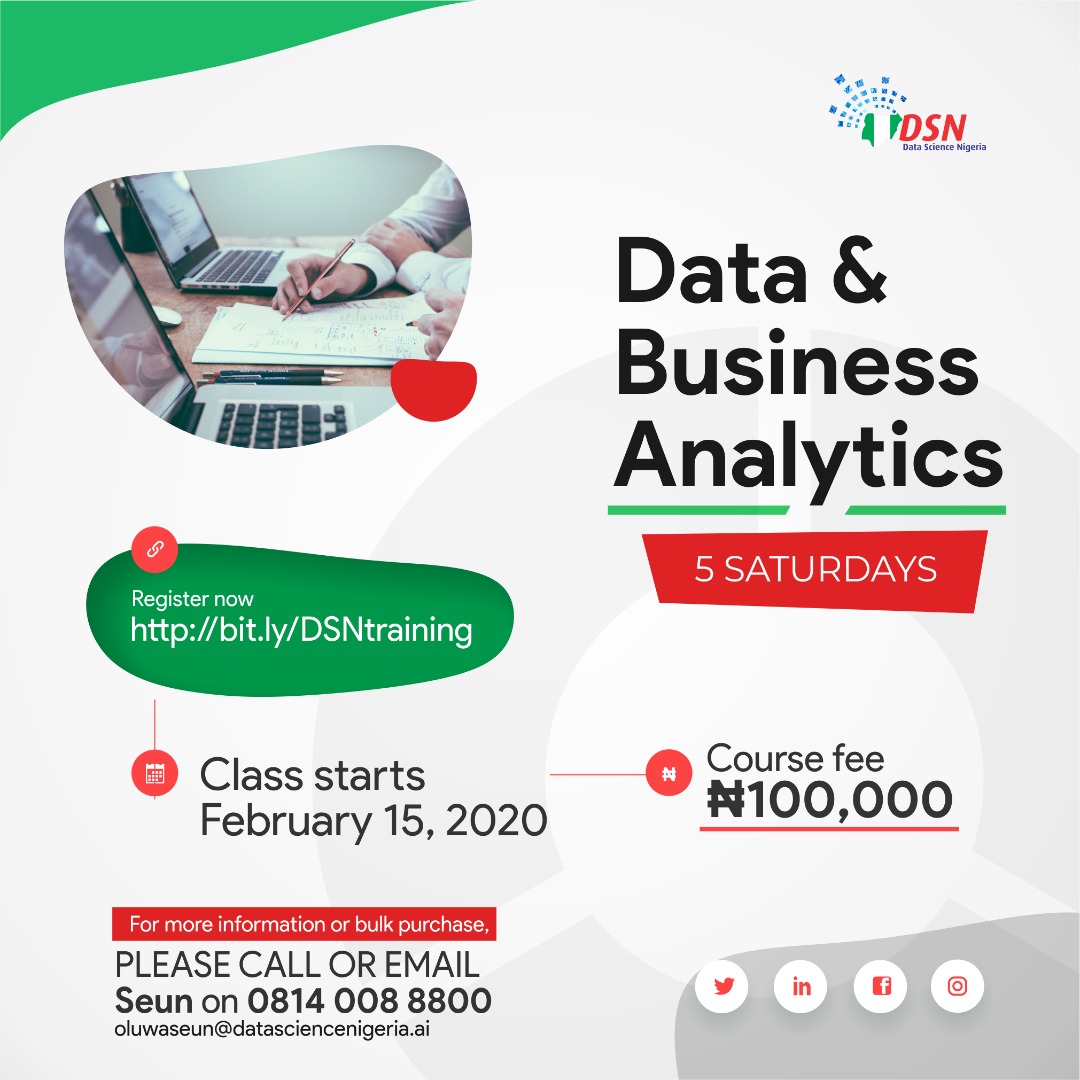
Don’t wait anymore, join our upcoming Introductory Data/Business Analytics Class starting 15th Feb and will go on for 5 Saturdays. Time is 9am to 12noon.

Please see below link to view all our scheduled training courses in 2020 www.datasciencenigeria.org/trainings/ 

To register for any of our trainings, please follow the link www.bit.ly/DSNtraining 

or  

call or email Seun on 08140088800/oluwaseun@datasciencenigeria.ai for more information.


African startups raised US$2.02B equity funds in 2019 – Partech Africa

0

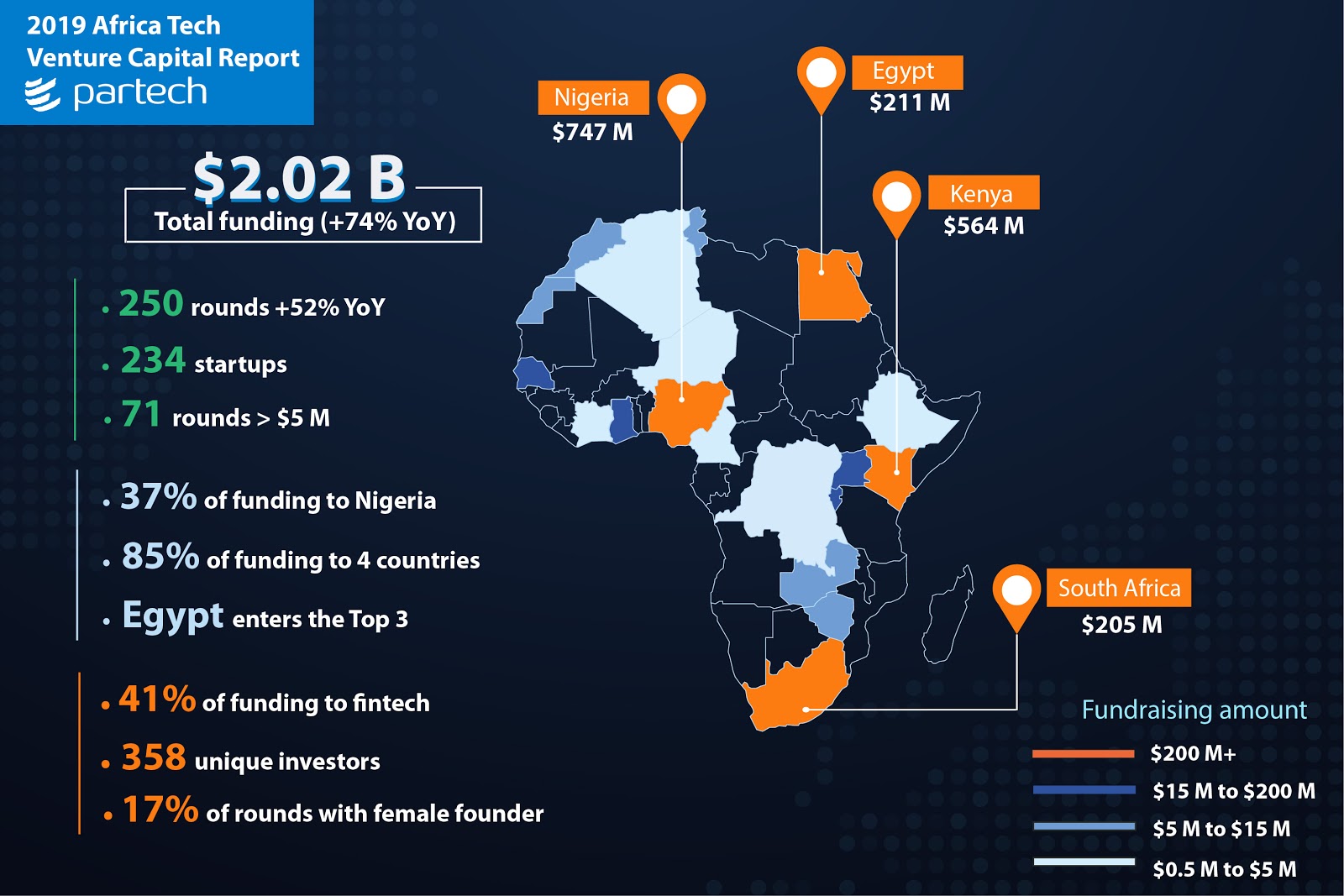
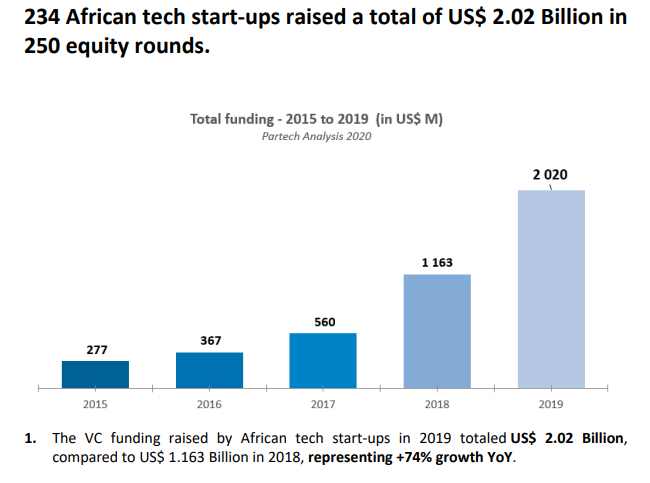
African startups raised US$2.02B equity funds in 2019 according to Partech Africa.

2018 saw US$1.163B raised in private equity, a figure that both Cyril Collon and Tidjane Dème anticipated to be reached after a further two years. Exceeding expectations even further, in 2019 that number increased significantly, with US$2.02B in equity being raised through 250 rounds, representing a 74%YoY growth.

The Partech Africa report tracked 250 rounds raised by 234 start-ups compared to 164 rounds by 146 start-ups the year before, representing +52% growth YoY in deal count. It should also be noted that the early stage rounds of Seed and Series A investments were extremely dense, a fact that demonstrates investors’ confidence in taking early bets in Africa.

You can download the full report here.