When I conceived the idea to provide a platform to co-learn and co-share, I was confident that the best learning would come from the community. The faculty would simply stimulate a conversation and the professionals would do what they do daily. With dozens of comments in our Discussion Board, that seems to be it. We have four months to go.
Yet, the impact from the community is already evident. A comment on the Board: “With less than a week in class I am very happy with the decision to join the Tekedia community. I am working on two different (Start up) Business Models. The videos and comments are shaping the ideas and models in a way that I am proud of. I am sure the end result will be a combination of efforts by the great insights from this community. Keeping fingers crossed as I continue with the development. Thank you Prof and the entire community.”
More so, from feedback, we are releasing the companies we have chosen for Week 2 Flash Cases ahead. I understand many want to study these companies well ahead to be ready for the materials. Next week, we will study Jevinik, OPay, MKopa Solar, Tinder, Airbnb and PhonePe in a session titled “The Grand Playbook of Business”.
You can still join us on this self-paced 4-month web programhere; everything is recorded and archived.
Source: Google Trends, 2020; Infoprations Analysis, 2020
In the last decade, the world has had various viruses to contend with. From SARS to Zika virus, monkeypox to Ebola virus and Lassa fever to coronavirus, businesses and individuals have recorded a number of losses in productivity and profitability. During the period, developing countries in Asia, Africa and Caribbean and Latin America had the largest share of the consequences of the viruses, according to various reports.
As at the time of writing this analysis, reports say coronavirus has infected more than 40,600 people globally. In velocity, variety and volume, data are being churned out from different organisations across the world about the impact the virus is having on people, businesses and countries with the projection that global Gross Domestic Product is most likely to dip in the first quarter of the new decade.
Exhibit 1: Confirmed Case, Death and Recovered by Region
Source: John Hopkins University, 2020; Infoprations Analysis, 2020
Analysing a 19-day data on the virus, we discovered that 10,759 deaths were recorded in countries and provinces or regions. There was a 99.2% connection between the confirmed cases and deaths recorded, while the confirmed cases resonated with the recovered victims by 95.2%. To the governments, healthcare professionals and families of the victims, these statistics are not encouraging in view of the speed at which the virus is spreading and killing the victims. According to them, current efforts on the containment of the virus need to be redoubled.
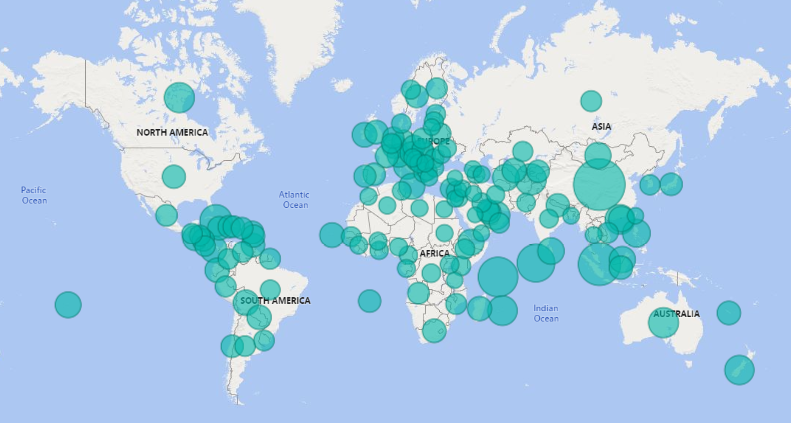
Looking at the data again, our analyst found that the difference between the confirmed cases and recovered people was not much. Analysis shows that confirmed cases was 220 on average, while it was 9 and 5 for recovered people and deaths respectively. As the data rollout in minutes, hours and days between January 22 and February 9, 2020, analysis reveals that people across the world sought knowledge about the virus and response efforts of the governments and health sector. Cumulative knowledge seeking threshold was 3,216. Out of this, Nigeria had 1,141 score.
Exhibit 2: Knowledge Seeking about the Virus by Region
Source: Google Trends, 2020; Infoprations Analysis, 2020
Strategic Lessons from the Wuhan City
Away from the staggering statistics, we need to walk through how China, through Wuhan, the hotbed of the virus, is teaching the world one of the right approaches to restrain deadly diseases. Wuhan is the city where the outbreak was first documented. Having seen the gravity of the havoc, the Chinese government swung into action with the construction of two specialised hospitals in the city using prefabricated materials to make the construction process quicker.
Apart from this, there are a number of design features such as the use of negative air pressure for the purpose of ensuring ventilated airflows into isolated wards, not out of the wards. These are some of the specific features of the two-story, 366,000 square foot Huoshenshan Hospital that will provide 700 to 1,000 beds and be managed by the Chinese military. The second hospital is Leishenshan. These hospitals are expected to assist the healthcare givers in coping with the suspected and confirmed cases.
Chinese government believes that construction of the hospitals is highly imperative to the reduction and eventual elimination of the ravaging virus. In this regard, innovative processes and technologies are not being used only, the government tapped emotions of the workers in the construction sector. A report says “workers were paid up to 1,200 yuan ($173) per day, triple their usual wages. At the site, there were at least 35 diggers, 10 bulldozers, and more than 100 people working on the facility.”
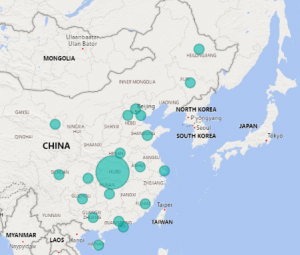
Exhibit 3: China’s Hot Provinces
Source: John Hopkins University, 2020; Infoprations Analysis, 2020
China has also proved to the world that it can enlist best construction companies for the building of infrastructure of national importance at this critical period. Beijing GeoEnviron Engineering & Technology (BGE), a pioneer in environmental remediation and provider of pollution control and waste treatment systems, and Oriental Yuhong Waterproof Technology, the largest waterproofing system provider in Asia, are among the companies contributing to the construction of the two hospitals.
The case of the virus has not been reported in Nigeria. However, with our understanding of the past and current approaches to the containment of global viruses by the Nigerian government, we present flash playbook, leveraging mined and analysed existing data. Our argument is that concerned stakeholders in the government need to learn the right strategies and practices from the countries that have had the highest share of the consequences of Ebola virus, monkeypox, SARS, Zika and the current one.
The Virus and Nigeria’s Preparedness
In performing its responsibility, the Nigeria Centre for Disease Control has issued a series of advisory statements to Nigerians on novel coronavirus between February 3 and 11, 2020. Information also has it that the Centre has supported 22 states for the establishment of emergency operations centres, in addition to the announcement of over N600m for the management of the possible outbreak nationwide by the government.
But, to Dr Chikwe Ihekweazu, a Nigerian expert at the University College London and a Senior Honorary Lecturer on Infectious Diseases, “Each state is better prepared to coordinate within and across their borders in the event of an outbreak.” In its message to member states, the World Health Organisation believes that Nigeria is one of the countries in Africa prone to the contraction of the virus. Hence, the need for the prioritisation of Lagos, Kano, Cross River, Akwa Ibom, Rivers, Enugu, Delta and Bayelsa states.
In spite of mapping these states as the key areas for the Nigerian government at the Federal and State level, our checks show that Lagos state remains the only state showing significant interest in preparedness and response strategy. It has opened an emergency centre at Mainland Hospital in collaboration with NCDC and Lagos University Teaching Hospital to identify the virus through the Biosecurity facility situated at the hospital. The opening was not a quick one. Series of reports indicate that the state government swung into action after the officials of the Britannia Hospital in Lekki refuted claims of a suspect case of nCov in its facility.
Efficacy of the Preparedness and the Place of FM Companies
From academics to industry experts, there are concerns on the delivery of no-casualty containment through the existing infrastructure and people. Those who expressed their views along this line have cited the Ebola virus case in which a Nigerian medical doctor and other healthcare practitioners died while attending to a Liberian who contracted the virus in his country before entering Lagos Airport. Those who belong to the second school of thought on the virus have exclusively cited Nigerian government’s inability to announce restriction of people to China and other affected countries as is done by most countries in the world. Reference has been made to the fact that there are 160 Chinese firms in Nigeria with about 40,000 to 60,000 nationals living in the country. With the frequent visit to their country, public affairs analysts believe the government should have considered travel restriction as parts of its preparedness and response strategy.
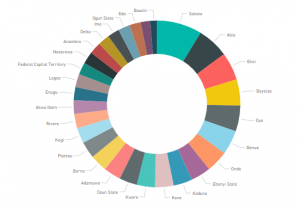
While introducing this piece, we made reference to the fact that the world is seeking information about the virus. Situating this within the Nigerian context, we discovered that the extent of seeking the needed information about the virus by individuals and businesses in the key areas mapped by the WHO was low. On a surprising note, information about the virus from Sokoto, Abia, Ekiti, Bayelsa and Oyo was higher than in Lagos, Kano, Cross River, Akwa Ibom, Rivers, Enugu and Delta states, the states that are susceptible to the virus according to WHO.
Exhibit 4: Knowledge Seeking about the Virus by Nigerian State
Source: Google Trends, 2020; Infoprations Analysis, 2020
A Flash Scenario
If Lagos were Hubei, a province in China and the hotbed of Coronavirus between January 22 and February 9, 2020, where 27,100 cases were confirmed 27,100, deaths 780 were recorded and 1,480 people recovered, it would be hard to contain the spread of the virus [see Exhibit 5]. As the Exhibit shows, it is evident that it was difficult for the concerned stakeholders to reduce the contracting speed of the virus in the first 5 days of the period. Before meaningful results could be recorded, it took the actors 9 days. Assuming it took Nigerian government and Lagos state government the same days, the impact would be high on people and businesses considering the infrastructure deficit and proactive strategy earlier discussed.
Exhibit 5: If Lagos were Hubei, the hotbed of the Virus between January 1 and February 9, 2020
Source: John Hopkins University, 2020; Infoprations Analysis, 2020
Understanding the Flash Playbook
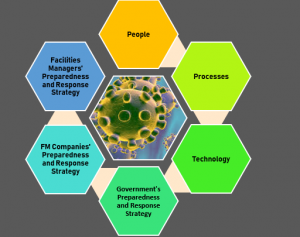
Now, the obvious truth is that fighting infectious disease outbreaks requires a coordinated approach with a strong continuous commitment to emergency preparedness and business continuity planning. In line with these and previous insights, we came up with a Flash Playbook for the concerned stakeholders. According to our model, containing infectious disease outbreaks is a matter of enlisting the right stakeholders from the public and private sectors. We have identified that facilities management and healthcare industries have strategic roles to play in restraining global viral diseases. The two industries are the lifeblood of every business. Every day, workers commute, work and interact within critical facilities such as water and sanitary facilities in public places. Management and maintenance of these facilities among others, are the sole responsibility of healthcare workers and facilities managers. Therefore, it is necessary to glean from the existing insights in addition to internal data and develop what we called Flash Playbook.
In the Exhibit 6, we explored the playbook further with the specific reference to the place of FM industry. At meso, micro and macro levels, there should be a coordinated preparedness and response strategy. Government is expected to lead the formulation of the strategy at the macro level, while FM companies and FM managers should ensure the development and execution of the strategy at the micro and meso levels respectively.
For instance, governments through its ministries, departments and agencies should liaise with the FM companies on the right approaches for management and maintenance of critical facilities. Facilities managers are also expected to devise specific strategies and tactics from the PRS [Preparedness and Response Strategy] developed by their companies for the real time management and maintenance of public and private sectors clients’ critical facilities using the right people, processes and appropriate technologies.
Job seekers should start reading like a salesperson. If you want a job, do something different. Deborah Dumbiri shared her work experience and how she will tackle her next role. Many job seekers can learn from this approach. Meanwhile, she got a job after granting this interview.
Can you introduce yourself to the audience?
My name is Deborah Dumbiri. I am a graduate of Business Management and Economics. I graduated in 2014 with a GPA of 3.9. Then I had an MSc degree in 2016, both degrees from the University of Fort Hare, South Africa. I have a few years of working experience as an HR and admin assistant, customer service and as a facilitator/corporate trainer. I am a very confident and smart lady who is ready to learn. I am also a student member of CIPM.
That’s interesting. I didn’t know that you had your education in South Africa. Can you share your academic experience compared to the Nigerian educational system?
The South African system of education is quite different from Nigeria, even though I didn’t go to school in Nigeria, but with the few things I have heard, I can tell.
South Africa uses a 7-5-3-1 system that is: 7 years in primary, 5 in secondary 3 for ist degree and 1 for an honours degree. This is one thing that stands out as different apart from the way the citizens are encouraged to go to school by giving cash incentives.
Thanks for sharing. Did you stay back after your graduation?
Yes, I started my career thereby facilitating in a college where corporate training is conducted. That’s where I gathered my experience in training and facilitating. Even though my parents are still there, I just felt like coming back
Oh really! Why did you choose to return to Nigeria?
I don’t like the place…they don’t really like foreigners. That’s why I really preferred to come back home and then if I want to travel, I will choose a better country.
I have no idea, but, it’s okay. So how has it been like to live in Nigeria?
Good. I was born here and I had my secondary education here…so it is fine.
Where do you work currently?
Nowhere. I stopped working in October last year.
That means you are currently on a job hunting?
Yes..
What position(s) do you think you will fit into perfectly in any organization?
Human Resource and Administrative role.
Have you ever worked in that role in any company?
Yes. That was where I worked in my last company. HR and Administrative assistant.
What will your potential employer enjoy from your service?
My professionalism, integrity, ability to build and work well in a team and my presentation skills.
What problems are you going to solve for any company that hires you?
If hired as an HR personnel or assistant, I will look into the issue of monitoring and evaluation of staff. I see that loophole in Nigeria companies. It is a big issue because staff that are not well monitored can not do well or even have a basis of evaluation or promotion or increment whichever the case.
Can you share a scenario where you solved a problem like that at your previous place of work?
I haven’t really solved any but I have given practical ideas to my superior about how each staff member should have a proper job description, then make sure hands are busy daily working on their job description.
Also, there should be a weekly report. From there, we can tell who is lacking. Do some random walk around to know what every staff member is doing.
At the end of 6 months, do a 2-page performance evaluation. Give some incentives to the best performing staff. This in turn will build the morale of others and make them sit up. That was in place before I left.
Okay. Why do you think you should be hired over all other job applicants?
My wealth of experience working in different sectors and with different people made me stand out to be the best amongst others. My presentation and ability to use Ms office well. Also my ability to work with little or no supervision and my professional approach to work.
What company are you looking forward to working with soon?
Any company, private or public.
Thank you for your time, Deborah. I wish you a blissful career ahead.
Thank you, Chinedu. I appreciate what you do for the world.
Indomie Noodles continues to close the flanks from any level of competition. We are learning that it is working with Tala, a U.S. fintech, to offercredit to enable people buy its products. Do not take this strategy for granted: if the minimum wage in Nigeria for federal workers puts them at about $2.80 per day wages, expect the national average to be around $2 per day. With that, even a 50-cents (N180 naira) single pack Indomie noodles could be expensive to most people. To deal with that, Indomie wants to offer a credit package that ensures that no other person gets into the lives of its customers. It can do this by financing micro-entrepreneurs who then become agents to market Indomie noodles. Of course, end users can be “micro-entrepreneurs”; it only requires volume to qualify.
Tolaram Group, the Singapore-based manufacturer of Indomie, Nigeria’s most popular noodle brand, is planning to tap opportunities in the lending space in Nigeria and the rest of Africa with the launch of Tala on the continent, according to a source very close to the matter. Tala is a US-based fintech company that offers uncollaterised loans.
In theIndomie Noodles Strategy, I have written how this company has used Sun Tzu strategy as articulated in the Art of War to close all flanks, making it hard for Dangote Noodles to find opening in the noodles business; Dangote Group later sold the business to the makers of Indomie. This credit offering is something along that line: I have closed all flanks in operations through a vertically integrated operations, and I want to ensure that my customers revolve around me, and I will give them credit to buy my products. That is a 360-degree closure.
The discussion continues in our Tekedia mini-MBA where we are studying the business of Indomie Noodles as one of our six weekly flash cases (you can register and join today).
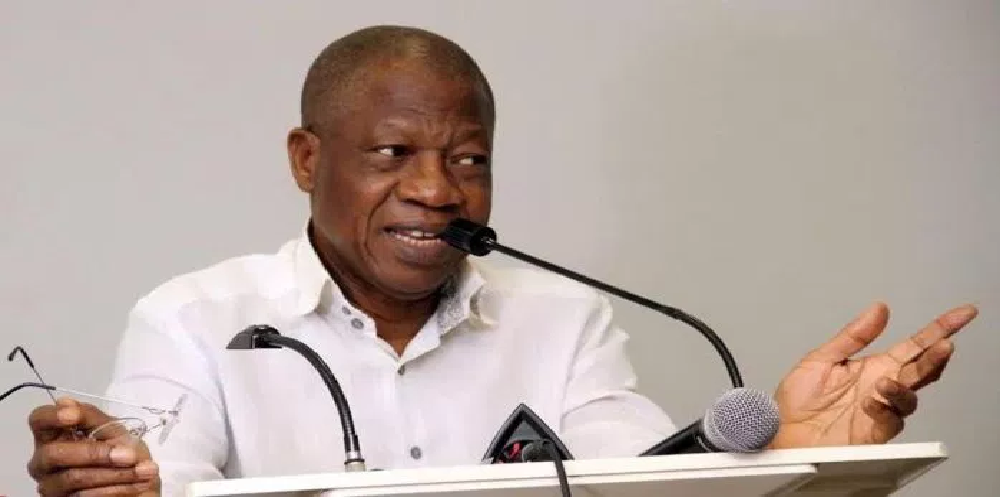
At the floor of the National Assembly, stood the Minister of Information, Alhaji Lai Mohammed, he was defending the $500 million loan request for the digitization of Nigerian Television Authority (NTA). In his defense, the Minister said that the $500 million (N180bn) is needed to digitally transform NTA to be at par with the likes of CNN. The $500 million is part of the$29.96 billion loan request made by President Muhammadu Buhari.
Lai Mohammed told the Senate that the loan, if approved, will be used to upgrade Nigeria’s national Television to attain certain satellite signals that will improve its broadcast capabilities to fit the digital age. He said there is a lot in the Nigerian creative industry to show the world, but due to analog broadcasting system, the creative industry is hidden from those who need to see it.
The Minister added that the creative industry employs no fewer than one million young persons directly and indirectly.
“If this this project is approved, there will be more visibility for our people in the music, fashion and film industry.
“In 2014, we made $23 million from music alone and about $53 million in 2019 and we are looking forward to making $83 million in 2025. You can imagine the kind of growth we will have if only we digitize all the NTA stations in the country,” he said.
The Minister added that the aim of the digitization is to provide jobs and generate revenue for the government. He noted that the creative industry contributes 1.492 to Nigeria’s GDP.
“Apart from agriculture, which is the largest employer of labor in Nigeria, especially the youths, the next largest employer of labor is the creative industry.
“The International telecommunication Union (ITU) in 2006 gave June 17, 2015 as deadline for all members of the organization to migrate from analogue to digital. Regrettably, we were unable to meet the deadline alongside most countries in sub-Sahara Africa, the deadline was moved to 2017, which was not reliable and today the target is June 2020,” he added.
He said Nigeria cannot afford to lose out on this last chance to go digital as it would impact negatively on the country’s ability to educate and entertain its people. Moreover, it will make it difficult for Nigeria to harness talents in the creative industry in a way that will result in employment. The Minister said if the loan is approved, $245 million will go into the establishment of media and culture industry center, while digitization of NTA stations and construction of integrated television services will cost $11 million.
While it’s true that the digitization of the NTA has lingered for so long, the question that has bothered many Nigerians lies on the $500 million loan request.
In 2011, the ministry of information announced the constitution of NTA and Nigerian Broadcasting Commission into a committee to work out the cost of digitizing the 109 NTA stations network. The stations were assigned each to a senatorial district. The cost of its implementation was estimated at $100 million (N15 billion). But that wasn’t all the cost. There was $7 million cost of platform provision per location for the 109 stations that would be handled by NTA and StarTimes network.
The committee recommended that the cost be spread over 5 years period, between 2011/2015 at N3 billion per annum as Federal Government counterpart funding schedule. None of it happened.
In 2015, NTA said it required $15 million to complete its digitization programme and N6 billion for total restructuring across Nigeria. Then, there was a mid-year deadline to be met and funding was a challenge. The Nigerian national television had secured a partnership with StarTimes, a Chinese telecommunication company operating in Nigeria and offered to provide the techniques for the digital migration. As it has been in previous cases, the fund was not provided.
Nigeria was lagging behind; the International Telecommunication Union’s deadline for 2015 was evidently not going to be met. Nigeria and many other African countries fell to it. However, the digitization of NTA remains a challenge the Nigerian Government needs to take on, but her unwillingness to provide the needed fund for the project was the bigger challenge.
It’s 2020, and the clamor for digitization is once again in the air. But this time, Nigerians are not buying it. The objection of Nigerians appears to stem from utmost priorities. At a time when the country is swimming in debt, and infrastructural deficit is high on basic human needs, the quest for NTA digitization is seen as a white elephant task. Moreover, people believe there is no moral justification of borrowing $500 million to embark on digital transformation of TV stations that will not put food on the table of the common man.
A Twitter user, Morris Monye tweeted: “Lai Mohammed should fear God. Haba! $500 million (N180bn) can build 10 world-class cancer hospitals. It can create at least 25, 000 SMEs that will improve the lives of at least 5m families. Why does he need a loan of $500 million (N180 bn) to digitize NTA. What concerns you and I with NTA”?
How the cost of digitization has quadrupled in five years is another cause for concern to many. At a time when there is a hollow trust between the people and the government, every intention of the government becomes questionable.