DD
MM
YYYY

PAGES

DD
MM
YYYY

spot_img

PAGES

Home Blog Page 6508

Excellent Apps to Learn More About Renewable Energy

0

Introduction

Our planet is not exactly in the best condition. The effects of pollution and global warming are beginning to be felt everywhere. The ice caps are melting, the sea levels are rising, fires are destroying large chunks of ancient forests, and many animal species are disappearing before our very eyes. Scientists have confirmed, time and again, that a good deal of this is due to human meddling in the delicate balance of the ecosystem. Much damage has been done and we need to reverse the clock as soon as possible.

Attend courses online if your knowledge is slim

Luckily, all is not lost. We still have time to save our planet. The more people get involved, the more likely we are going to make it through the storm. If you would like to join, the first step is to learn as much about the change you can create as possible. Sustainable energy is an option that is available to many yet not enough people are taking advantage of it. In order to implement it into your life, you can attend courses in renewable energy (either in person or over the internet) and learn how you can improve the state of the environment. It won’t even take up too much of your time. I attended an online course that barely took 20 minutes a day from my schedule.

Learn how to use solar energy to avoid high electricity bills

Contrary to what many believe, sustainable energy can also be cheaper. You don’t have to spend 1000s of dollars to help the environment. Quite the contrary. Solar technology, for example, can enable you to harvest the power of the Sun in order to heat, cool and run your home. Investing in such a system can pay off within a matter of two years. Taking a solar energy course will help you learn the basics and understand how you can best take advantage of the empty spaces on your roof to create a cost-effective and eco-friendly source of power. You can save money, save the planet, as well as create a sense of independence we all crave.

Find work in the energy industry to help prevent further problems

The more you learn about renewable energy, the more you are likely to realize that every little bit of help counts. If you’re really passionate about saving the Earth, perhaps you may even want to get a job in the energy industry. While not the easiest one to get into, it is worth the effort as you will be able to create a positive change for everyone. Doing your research first is crucial. While looking to learn more about sustainable energy, I found this selection of apps that have proven quite useful.

Apps to Learn about Renewable Energy

The battle for the survival of our planet is ongoing. The more people join, the more likely it will be a success. The future of many is at stake.

Conclusion

Our planet is in jeopardy – there is no doubt about it. Human influence has disrupted the balance and we have to work hard to bring things back to normal as much as we possibly can. Renewable energy is a push in the right direction. Still, many of us don’t know much about it. Taking an online course could help you better understand the advantages of it. You can learn how you can employ solar power or even get a job in the energy industry to transform the system from within. The time to act is now.

Flutterwave Raises $35 million

1

He is eminently a visionary. He understood that before any commerce could flourish online in Africa, payment must be working. I have admired him from afar. Then, one day, a big bank flew me from U.S. to give a keynote speech in a program. I spoke and delivered a business sermon on banking, fintech, innovation and competition. Then, he took the podium. I was about going to meet some executive directors from the bank. As I walked out, I heard words like “partnership, cooperation, synergies”. I quickly ran to the big people, and excused myself to return to the talk.

There, I saw a wise man who deviated from the typical – “crush, disrupt, annihilate” – the banks. It was a great mind knowing that for fintechs to thrive in Africa for a long time, banks have to be empowered due to the current ordinances we have. When you come peacefully, you make friends and good things happen. He has built a category-king company on the ideals of those words, linking Alibaba’s Alipay, Worldpay, etc.

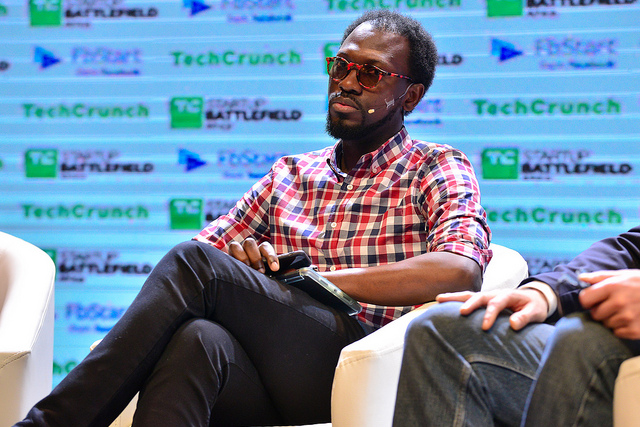
GB, Olugbenga Agboola, is the CEO of Flutterwave – Nigeria’s leading fintech.  I know it is the leading because my team added it this week for our mini MBA program: they usually build matrix before making their selections. For the fact they picked Flutterwave, it is the king in that sector. 

Flutterwave belongs to my paytech+ category: payment technology companies which build domain expertise across many sectors, with the payment services acting like an operating system in the relationships. Yes, they serve schools, churches, businesses, governments, etc, helping those entities improve their primary businesses. Think of Silicon Valley Bank in U.S: “ … “the U.S. bank’s entry, which was encouraged by Danish companies and investors, is seen as filling a kind of multifaceted funding-lending-consulting-networking-cheerleading gap that traditional local banks have a hard time closing.”

Now the big news – Flutterwave has raised $35 million series B funds. That is huge for an indigenous African company. 

San Francisco and Lagos-based fintech startup Flutterwave has raised a $35 million Series B round and announced a partnership with Worldpay FIS for payments in Africa.

With the funding, Flutterwave  will invest in technology and business development to grow market share in existing operating countries, CEO Olugbenga Agboola — aka GB — told TechCrunch.

The company will also expand capabilities to offer more services around its payment products.

[…]

In 2019, Flutterwave processed 107 million transactions worth $5.4 billion, according to company data.

{…[

The new round makes Flutterwave the payment provider for Worldpay  in Africa.

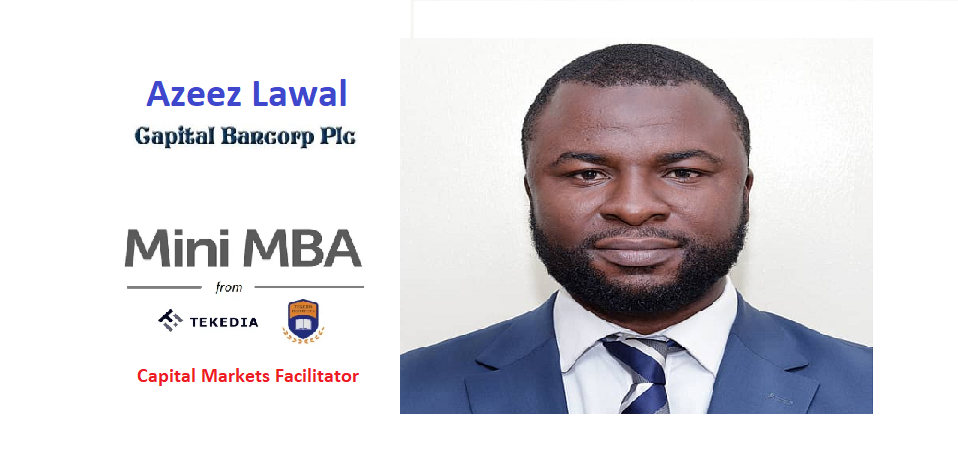
Azeez Lawal – Capital Bancorp Plc – Facilitator, Tekedia Mini-MBA

0

He is a dean of the capital markets, leading Capital Markets & Research Department at Capital Bancorp Plc, one of Africa’s leading financial advisory firms. His writings are insightful, and supremely fresh, with piercing perspectives only those that serve as high priests on the altars of market mechanism can deliver. On this social community service, the Tekedia mini-MBA (click to learn more), Azeez Lawal will lead a session on Capital Markets, Investing & Fundraising. On Tekedia, his weekly articles are now shared more than all works there, including mine. We think we have the best – and I want you to join him, from Feb 10. Click and REGISTER here.


https://www.tekedia.com/mini-mba/

Organizing an Issue-Driven Youth Development Programme: Lessons for Youth Development Advocates

0

As a youth development advocate, I have always aligned with the school of thought that believes that youth development programmes should be built around issues affecting them and solutions proffered around that as well. So, commencing a six-month youth development programme for youths drawn from different parts of  Osun state. This piece is about the lessons learnt in the process of conceiving and organizing the first month of the five months. Tag along.

#Data Driven Approach.We are in 2020 and activities organised around development work should be data driven. It is data that would indicate the enormity of the problems and how to handle them. A specific example of this in my recent experience on the issues of entrepreneurship among youths in Osun. My observation was that those young entrepreneurs in the state do not have the right information on accessing funding. It tallies with the statistics earlier quoted in one of my previous articles. To be on top of any issue, there is a need to know the numbers very well.

#Social Capital. It is described as the goodwill gathered over the time by a person from others who have had a cause to trust such individuals. This makes people to key into whatever the person with the credible social capital brings. This reflected in my attempt to put the first meet up together. From the facilitators to the venue used and even the chairs and refreshment, people were willing to  donate to the cause. Integrity and clear intentions are ingredients of a robust social capital. To get the facilitators and other donors for the Skillup, social capital was at work.

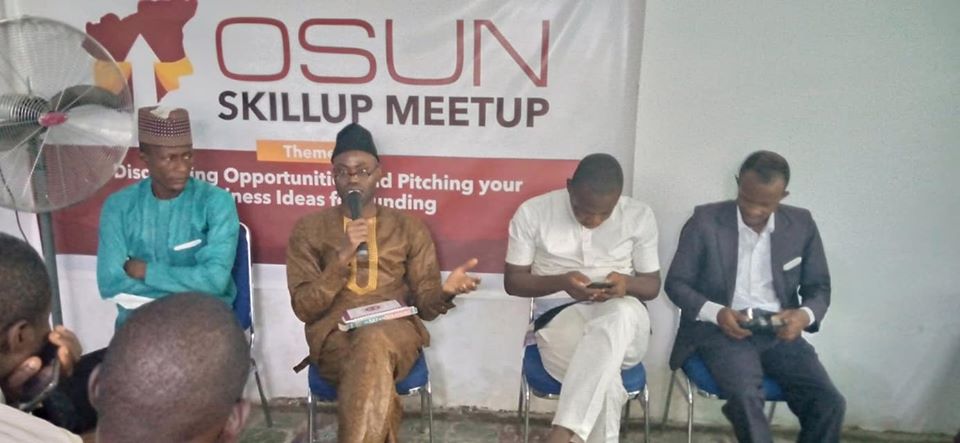
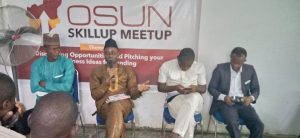
Panelists at the Panel Session

#Team Spirit. For every development worker, working in teams is a special asset. For youth development advocates, the need to build a team cannot be over emphasized. For the Osun MeetUp SkillUp, it was indeed a team work. Young men and women who saw the benefits were willing to volunteer. The convener was equally open to such mechanism. Resources maximization was utilized to the fullest. A good example was in the selection of the participants. The convener and the two facilitators were involved in the selection process. We had 54 applicants and 30 was selected to take part.

#Networking. It is important to network. It is good to know those who are fully involved in the aspect of the development work you are involved in. It makes execution easier. It also assists in getting those who you need for your programme. For a programme to be run on crowd sourcing, you need the networks that give your work some credibility.

#Crowdsourcing. This term used to have a meaning that is very abstract to me. I once believed it could only be achieved online. But, in the course of organizing the SkillUp MeetUp, I have learnt we could have a hybrid of online and offline crowd sourcing. It could do wonders. People would get you recommendations. And you would get your needs in minimum time possible. There is absolutely nothing you could not crowd source.

I am sure as we progress on this six-month journey to create a sustainable path for young entrepreneurs in my state, there are still many more lessons to learn. We are certain that successes and failures would be recorded. But, we are already developing a mindset to leverage on both of them to come out stronger.

Luanda Leaks: The Corruption Behind the African Richest Woman’s Fortune

0

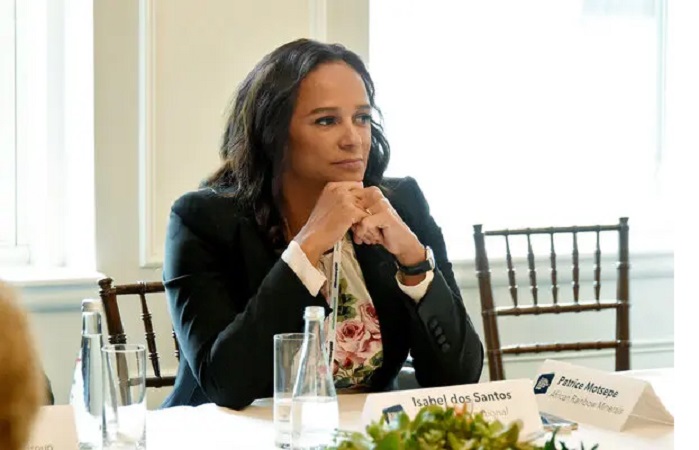
Her name is Isabel Dos Santos, the daughter of former Angolan president, she is the African richest woman, basking on $2.2bn fortune made through a conglomerate of businesses. This introduction is for a few who may have not heard of her.

Her journey to the status of “African richest woman” started toward the end of the Angolan civil war, when she returned from London where she had bagged a degree in electrical engineering and worked for two years at Coopers & Lybrand (PWC). She made her first business venture by acquiring a stake in Miami Beach Club, a struggling beach bar (Ilha de Luanda) in Angola, which eventually turned out to be a good investment and set Isabel on the path of other business that would crown her efforts with fortune. She was only in her mid-twenties.

Basking on the influence of her father, Jose Eduardo dos Santos, the former president of Angola, Isabel set out on a business adventure that would spread across many fields of investment – from eateries to oil.

When it appeared that the civil war was over, she started a transport business. And mobile phone technology caught her interest because of her dealing with communication for trucks. The consortium she was part of won the license in 1990 for a mobile phone telecommunication, which gave birth to Unitel, Angola’s biggest mobile phone provider. She would later acquire a 25% stake in Unitel from a high ranking government official.

Angola is the second largest oil producer in Africa with a lot of diamond to back up its natural resources. Isabel dos Santos ventured into oil, thanks to presidential decrees and her father’s influence that put her in charge of Sonagol in 2016. The country has enjoyed the booming oil prices from 2002 to 2008 that shot up its revenue from $3bn to $70bn in just six years. But then, it provided an opportunity for Isabel to secure her place in the secretive world of Angolan business elite.

She has subsequently amassed more wealth through so many other businesses. Isabel Dos Santos owns a large part of Angola’s cement, diamond and banking industry, and other stakes in a supermarket network, a satellite TV, brewery etc. her wealth was augmented when she married Sindika Dokolo, a Congolese businessman and an art collector, whose foundation is reputed to hold the largest collection of African art in the world.

Dokolo’s collections include sports cars, superyacht, a huge penthouse in Lisbon. The couple also own three homes in a single gated development in Kensington, there is also a 50 million euro luxury flat in the Petite Afrique building in Monte Carlo, and a magnificent villa in the Algarve.

The wealth under the control of Isabel and her husband cuts across two continents. Portugal holds a large amount of the couple’s assets. There is also an 800 million euro stake in Galp oil and gas Group, a large shareholding in Eurobic, a Portuguese commercial bank, stakes in some banks in Angola and Cape Verde and a stake in the Pay TV and broadband group Galp.

Dokolo and Isabel Dos Santos were basking in this glory believed to have stemmed from hard work when the majority of Angolans are living below $3 per day. Their problem started in 2016 when a senior MPLA official who replaced her father as president in 2017, after his 38 years rule, Joao Lourenco removed Isabel as the head of the state owned Sonangol, and launched anti-corruption investigation.

Other members of the Dos Santos family have been fingered in a series of corruption allegations made as a result of the findings of the anti-graft campaign. Welwitschia dos Santos, Isabel’s half-sister fled to the UK, saying she has been a target of the secret service. Her half-brother, Jose Filomeno dos Santos is on trial for corruption.

While the family is being investigated by the authorities in Angola, investigative journalism conducted by International Consortium of Investigative Journalists (ICIJ), has uncovered documents revealing how Africa’s richest woman amassed her wealth. The documents show that she and her husband enjoyed special privileges that allowed them to secure deals in illicit ways.

The ICIJ investigation that was conducted in collaboration with other 37 media organizations shed light on the shady deals carried out by Isabel and her husband that contributed to the impoverishment of the Angolan people. Andrew Feinstein, the head, Corruption Watch, says the leaked documents reveal how dos Santos exploited her country to her selfish gain.

“Every time she appears on the cover of some glossy magazine somewhere in the world, every time that she hosts one of her glamorous parties in the south of France, she is doing so by trampling on the aspirations of the citizens of Angola,” he said.

In Sonangol Oil, where she served briefly as chair, the leaked documents show that she approved a suspicious payment to a consultancy company in Dubai called Matter Business Solutions, at the tune of $50 million. Though she denied having any financial interest in the company, traces reveal that the company is run by her business manager and owned by a friend.

The document also showed that she had to pay only 15% of the price of her stake in Galp upfront, and the remaining $70 million was turned into a low-interest loan from Sonangol which she used to make the purchase. The terms of the deal means that it will take 11 years before the loan could be repaid.

The diamond deal wasn’t free from indictment too. Sindika Dokolo, signed a one-sided agreement in 2012 with the country’s state diamond company Sodiam. They were supposed to be 50-50 partners in a deal to buy a stake in the Swiss luxury jeweler De Grisogono, but that didn’t happen.

The deal was single handedly financed by Sodiam. According to the documents, 18 months after deal was brokered, the Angolan state diamond company had put $79 million into the partnership, while Dokolo invested only $4 million. And he was awarded 5 million euro for brokering the deal, that means the diamond deal was wholly funded by Sodiam and Dokolo was only a beneficiary partner. When BBC contacted Isabel, she declined to comment on the deal saying that she is not a shareholder of De Grisogono. But the leaked documents show that she is described as a shareholder by her financial advisers.

Not only that, the former president awarded raw diamond procurement right to Dokolo. Sources who know about the deal say the Angolan people lost about $1bn in deal because diamonds were sold at unbefitting costs. Not only that, the loan taken by Sodiam to finance the deal was borrowed from a bank where Isabel is the biggest shareholder. The state diamond company had to pay 9% interest and the loan was guaranteed by a presidential decree by the former president, Eduardo dos Santos, so it must be repaid so that Isabel’s bank doesn’t lose out. Bravo da Rosa, the new chief executive of Sodiam, told Panorama that deal was designed to enrich dos Santos, not the Angolan people. “In the end, when we have finished paying back this loan, Sodiam will have lost more than $200 million,” he said.

Isabel’s land deal with the government was also not free from corruption. The documents show that she had acquired a square kilometer of the prime beachfront land in the capital Luanda with the help of presidential decree signed by her father. The land was worth $96 million, but she had paid only 5% of the cost. The occupants of the land had to be resettled some 50 kilometers from the capital Luanda, and their businesses killed.

There is more to the story that suggests corruption in every of the venture that has contributed to Isabel dos Santos’ wealth. Though she denied it, saying “it’s a witch hunt” that she has worked her way up to the top using her business acumen, but the documents labeled The Luanda Leaks refute her claims.