DD
MM
YYYY

PAGES

DD
MM
YYYY

spot_img

PAGES

Home Blog Page 6528

2.0 – 5G Spectrum

0
Figure 2.1: Massive MIMO [7]

This chapter addresses the spectrum requirements anticipated for 5G networks. Spectrum is a scarce finite resource; there is however a growing demand for spectrum due to the hungry data demand of consumers who want to be able to download videos in seconds, instantly connect with friends and families from various parts of the globe, share viral videos and favourite moments with one another, hashtag a political concern or even issues at work and finalize business deals remotely.

The success of 5G applications highlighted in the previous chapter is heavily dependent on the Governments and regulators support of a timely release of affordable spectrum. Within the Industry, there are several developments geared at providing spectrum and increasing the efficiency of the existing spectrum for 5G applications, termed spectral aggregation. This chapter therefore introduces the reader to the spectral aggregation methods developed for the 5G network.

2.1 Spectrum Re-farming

In order to make spectrum available, traditionally old bands are cleared of incumbents [8]. Spectrum Re-farming involves the re-assignment of frequencies previously assigned for older generations like 2G and 3G and subsequent use for 5G. This is particularly true in countries like the US and East Asia where there are no 2G services available anymore [9]. This is a cheaper and cost effective way of acquiring spectrum.

Furthermore, the digital switchover also contributed towards freeing up some spectrum; infact the 700MHz band was cleared of incumbents to provide some bandwidth for 5G. Besides 700MHz, some other bands will be re-farmed for 5G [10].

2.2 Spectrum Sharing

Spectrum sharing, as the name implies, involves sharing spectrum among various bands.

2.2.1 Spectrum Sharing – Unlicensed bands

Unlicensed spectrum (e.g. 2.4GHz) can support offloading from licensed bands. This is very important because 5G would involve a combination of different technologies like Long Term Evolution (LTE)/WiFi etc.

However, Quality of Service (QoS) cannot be guaranteed when using unlicensed spectrum; therefore spectrum sharing (with unlicensed bands) needs to be well planned and carefully integrated with licensed bands [8].

2.2.2 Spectrum Sharing – Under-utilized bands

Bands that are under-utilised in time or geography can also be utilised for 5G services e.g. TV white spaces in the US. This has led to specialized spectrum sharing techniques like Authorized Share Access (ASA) where the ASA spectrum holder only has access to the spectrum when it is not utilized by the incumbent [8]

Furthermore, certain Organisations like GSMA are pushing for regulators to encourage voluntary spectrum sharing agreements among operators or verticals, where possible [10].

2.3 New Spectrum from mm wave band

Traditionally, frequency bands used for cellular systems were within the sub-3GHz [8]. However, the need for an increased spectrum for 5G services means that the higher frequencies (30-300GHz), termed mm wave, are now been considered for use in 5G.

These frequencies were traditionally being used for satellites and radar applications. And these frequencies are able to provide a large amount of bandwidth. As the higher the frequency, the more data that can be transmitted. The huge bandwidth/data capability of the mm wave frequencies is of utmost importance to 5G applications.

But these frequencies have different propagation characteristics and thus present numerous challenges such as large path loss, shorter transmission range, signal blocking/absorption by objects, low transmission capability etc. [8]

In order to combat these propagation challenges, base stations can be situated closer to the users (which reduces the loss) and makes a good case for citing various small cells indoors. However, an issue that could arise with citing base stations closer to the public is that it may increase the publics’ concern and worry about the impact of electromagnetic radiation on their health.

At these higher frequencies, the antennas are small due to the small wavelength dimensions (from the name mm-wave); hence the signals propagate very short distances, which is an issue for signal reception [8]. Hence to maximize the signal reception, a large number of small antennas are combined within the transmitter and receiver to provide for spatial and multiplexing gain using a technique called Massive Multiple Input Multiple Output (MIMO).

Massive MIMO simply implies that the number of antennas is far greater than the number of data streams and requires hundreds/thousands of antennas, as shown below in Fig. 2.1 below [7].

Figure 2.1: Massive MIMO (sources:, Researchgate, [7])
Furthermore, adaptive beam-forming can also be used to target the radiation towards or away from the user, thereby reducing the interference, as depicted below in Fig. 2.2 below [7,8].

Figure 2.2: Adaptive Beamforming [26]

2.4 Dynamic Spectrum Management

Previously, spectrum assignment was static and regulators simply monitor that the spectrum assigned is being utilized for the right purpose. Research has shown this is inefficient and there are better ways to maximize the scarce spectrum resource. For example, dynamic spectrum allocation (e.g.  Nominet Dynamic Spectrum Management) allows for the allocation of spectrum in real time using a geo-location database by checking for the usage, location of user and the demand [11]. This increases the efficiency of the spectrum.

2.5 Spectrum Harmonization

From the foregoing, it is clear that 5G would rely on spectrum from the low band, mid band to the high band. For this reason, a new air interface, called 5G New Radio (NR), has been developed to support these wide range of bands, as depicted below in Fig. 2.3. The 5G NR will be discussed further in the next chapter. Fig. 2.3 shows that LTE works within the sub 6GHz whereas 5G NR would operate over a wide range of bands.

Figure 2.3: Spectrum Band for LTE and 5G NR [21
The effective use of frequencies in different bands is critical to the success of 5G services and therefore places huge emphasis on spectrum harmonization as the key to minimising cross border interference, facilitating international roaming agreements and reducing the cost of mobile devices [10].

2.6 Summary

It is clear from this chapter that the spectrum needed for 5G would be realized in different bands: Sub-1GHz for widespread coverage and Internet of Things (IoT) services, 1-6GHz for coverage and capacity and mm wave band for higher capacity; hence spectrum harmonization will vital in delivering the huge promises anticipated from 5G applications [10].

Furthermore, it has been noted that spectrum pricing in developing countries, are on average more than three times higher than in developed countries, after taken into considering the income levels within the country, in order to maximise revenues. This therefore leads to slower broadband services and worse coverage. These costs are often transferred to the consumers which therefore widens the digital gap. In order to accelerate the adoption of 5G services, regulators are advised to set affordable spectrum prices based on the market forces [10, 13].
Back to Table of Contents.

1.0 – Introduction

0
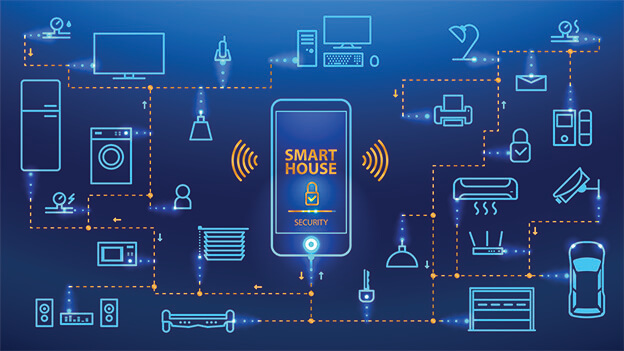
Figure 1.6: Smart Home [25]

This chapter will introduce the reader to 5G cellular generation network, cover its widespread applications within different industries (verticals) and highlight some ethical impact of 5G and emerging technologies on society.

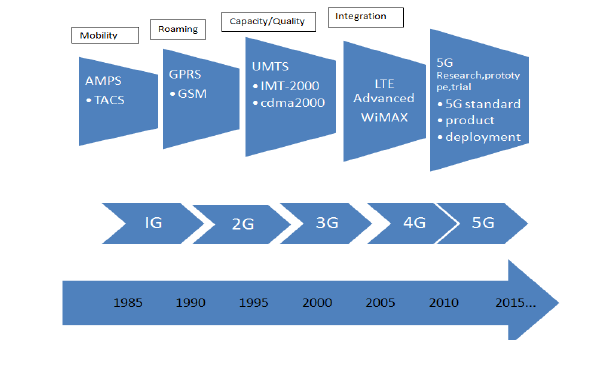
5G refers to the Fifth Generation Cellular Network. Every ten years, there is always a shift from previous generation onto a newer generation, as depicted in Fig. 1.1 below.

Figure 1.1: Evolution of Cellular Network (sources: ResearchGate, [7])
In 1991, the development of GSM made voice calls to become reliable and cheaper and encouraged the widespread adoption of SMS and MMS. 1n 2001, 3G ushered in an era of data services and allowed workers access to emails from any location and this increased work productivity. 1n 2010, 4G led to the development of mobile internet and video based applications which triggered the development of many sectors like online shopping, e-banking etc [1]. 2020 is not going to be different as it promises an era of high speed connectivity, ubiquitous coverage, massive data and low latency, all thanks to 5G.

1.1 What is 5G?

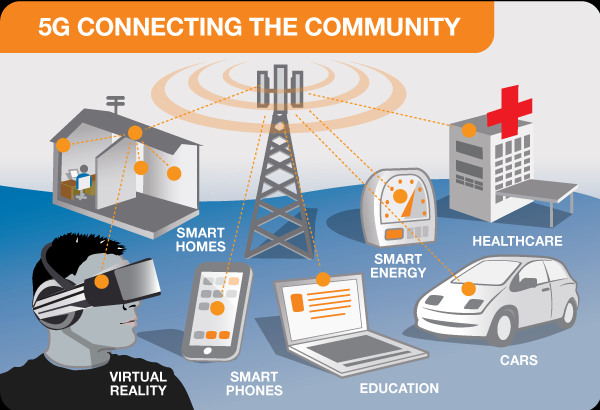
Figure 1.2: Widespread Applications of 5G within the society (sources: EMFE, [21])
5G represents a shift from consumer technologies to industrial technologies as it promises to lead to the development of a highly automated and intelligent environment which would revolutionise many industries and every part of the society as shown above in Fig. 1.2.

It is a newer generation which presents different opportunities to different stakeholders depending on where your interests lie. To an equipment vendor like Ericsson, 5G represents a market opportunity to drum up the sales of infrastructures like small cells etc. To an academic, 5G would provide an opportunity to solve complex research problems within the Communications Industry.

To a car manufacturer, 5G simply represents the opportunity to make revenues from new offerings like connected cars. To a regulator, 5G would lead to the opportunity to make increased profits from new spectrum release and lots of debate on band issues etc. To telcos, it may represent a way to increase revenue, consider new offerings (verticals) and address the increased competition from over the top (OTTs) applications like WhatsApp etc.

For the technology media, it’s an opportunity to increase subscription audience and perhaps pitch the development and deployment of 5G as a race between countries or operators.

The International Telecommunication Union (ITU) has classified 5G in terms of three use-cases presented below:

  1. Enhanced Mobile Broadband: It is simply an extension of 4G and promises a speed of 10/20Gbps for either your uplink/downlink. In literal terms, as a user, you should be able to download an HD film in seconds [7].
  2. Ultra-Reliable and Low latency: Here, a stringent requirement of less than a milli-sec of delay is anticipated for applications like autonomous driving and remote surgery e.g. imagine a robot performing a surgery operation during an emergency, a delay could have damning consequence [7]
  3. Machine to Machine type Communications: allow for IoT based applications, 10^6 devices per km^2 e.g. smart metering, smart city, smart agriculture etc. [7]

1.2 Applications of 5G

5G will be a major technology in growing industrial digitization applications. For example,

Figure 1.3 Autonomous Car [22]
  • Transportation System: Autonomous cars will revolutionise transportation (see Fig. 1.3 below) which would reduce commute time, allow passengers to concentrate on other tasks and reduce accident due to human error [2].
  • Smart Cities: Highly Efficient Transport Systems would therefore lead to the development of smart cities where for example, connected sensors can help in determining the water level of a city and predict when and whether a city will be flooded or otherwise [3]. Connected sensors can also help direct passengers to the nearest parking spaces with available facilities [4].
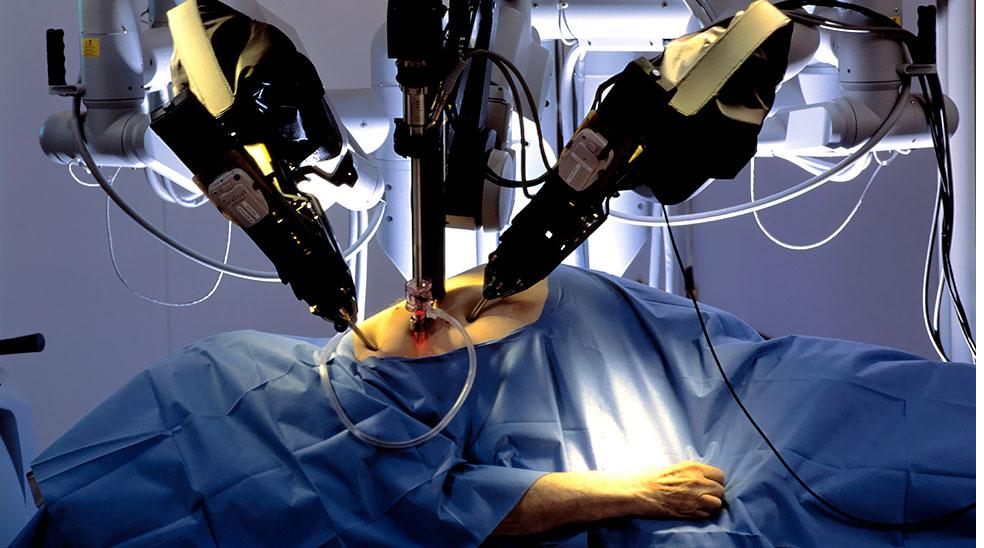
  • Health Care: Internet of skills alongside remote surgery can help to improve health care in developing as well as developed countries. For instance, a surgeon in remote Africa can perform complex surgical procedures through video access to the best surgeon in the world. Robots can be made to perform precise and complex surgical operations thereby reducing the death rate from human error, as depicted in Fig. 1.4 below. 5G will also aid the remote monitoring of patients who need mobility assistance or are residing far away from hospitals or clinics. Drones can also be used to deliver drugs in remote places in developing countries e.g. this is already happening in Malawi, Ghana etc. [5].
Figure 1.4: Robots performing Surgery [23]
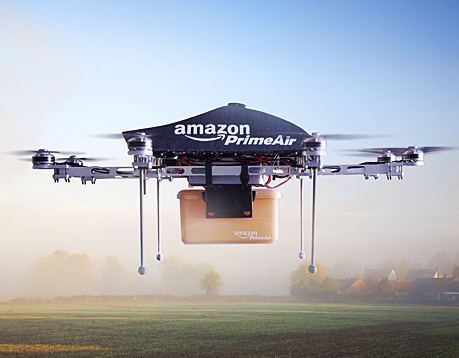
  • Package Delivery: Amazon is already testing the use of drones to deliver its packages in the US, as depicted in Fig. 1.5 below. This is particularly useful in rural or remote areas, where it takes a significant amount of time for packages to arrive using the current system.


Figure 1.5: Drone delivering an Amazon package [24]

  • Industry 4.0: The use of robots, automated machines and sensors etc. would lead to Industry 4.0 which would bring about the development of highly automated and efficient factories and industries. Machines in factories can therefore be programmed to order for maintenance support and spare parts through the use of automated sensors.
  • Smart Agriculture: Food production can be increased through smart agricultural initiatives like the use of sensors to predict the right level of water and fertilizer to apply to different parts of the farm [6].

Livestock management can be enhanced through the use of connected sensors monitoring the welfare of the animals. Robots can be employed to harvest and perform farming operations. Farmers and Buyers can be connected through Artificial Intelligent System, thereby reducing food wastage. Weather conditions can also be predicted for agricultural processes using Big Data [5].

Figure 1.6: Smart Home (Radware, [25])
  • Smart Home: Homes can be made smarter through smart energy and other smart homes applications, for example, one can programme a refrigerator to order groceries online when exhausted, see Fig. 1.6 above. Smart energy can help in reducing the energy consumption within the home.
  • Future of Work: Labour force need not be restricted to a geographic location through smart educational initiatives and internet of skills.
  • Fintech: Mobile money and other electronic bank transactions would make bank transactions faster which would make life easier.
  • E-commerce: Consumers are able to purchase products and services from any geographic location as we are already witnessing.
  • Education: Robots can serve as educational Instructors and has huge implications for developing countries where there is a shortage of such professionals [5]. 

1.3 Ethical Implication of 5G

It is very clear from the foregoing that 5G, alongside other emerging technologies, would lead to a disruption in all parts of the Society. For example, certain jobs will no longer be available as robots will replace humans. This will of course engage ethical questions like:

  1. Should robots have the same rights as humans?
  2. Should robots be taxed for every job they replace?
  3. If robots can think and have emotions, what would then make us human?
  4. How do we ensure that there are no security breaches in our digitally interconnected world?
  5. How do we ensure that data theft and privacy concerns are respected in the wake of fake news, terrorism, profiling of individuals?
  6. How do we protect the society from the use of autonomous weapons?
  7. Will these technologies widen or reduce the existing inequalities within the world?
  8. Will these technologies reduce or increase the gender bias or the digital divide within the world?

These and more questions need to be addressed so that the benefits of these technologies can be maximized whilst minimizing the risks [5].


Back to Table of Contents.

Nigeria Strikes DStv, Inventing Communism in Sports Broadcast Rules

4

Nigeria is a very fascinating country. We make rules that take us backwards in order to please our emotions that we are helping our people. But check deeper, those rules are meaningless. The latest is that Nigeria does not want exclusivity on new sports broadcast rights. Simply, if you have the rights to broadcast European football games, you are required by law to re-license to local TV companies.

It makes perfect sense since everyone has been looking for how to deal with MultiChoice’s DStv with its “high fees”. Why not force the company to allow NTA (Nigerian Television Authority) to broadcast the games, on free airwaves, for largely nothing: “This regulation removes exclusivity and mandates the sharing of all content upon the payment of commercially viable fees.” The “viable fees” is laughable because the budget of NTA will not get closer to help DStv cover its fees to the European football leagues.

Here is the fact: for decades, Nigerians were not watching European games live. The reason was not that those games were not played. What happened was no one was ready to pay for the rights to broadcast them. Then, amalgam of firms emerged, and we began to watch the games. HiTv did well, but the European leagues jacked up the fees, and then it could not renew [as clarified below, it was the bidding process that inflated price, not necessarily EFL, English Premier League]. DStv stepped forward, with tons of money from its then alpha-parent company, Naspers – Africa’s largest on market cap – and paid the new amount. To compensate for the high fees, DStv raised fees on customers; a common sense business move.

Prof…a few points I would like to make. Firstly, the EPL never ‘jacked up the price of the right’ which forced HiTV to lose them. EPL rights are acquired through a bidding process and are sold to the highest bidder – there is no set asking fee. The fact is that it was HiTV themselves who ‘jacked up the price by making outrageous bids to prise the EPL rights away from SuperSport. It was a badly thought out strategy – overspending on rights before you’d built up a substantial paying customer base to support those costs. Before HiTV came along, SuperSport were paying just over $20 million a season for the EPL rights. HiTV won the rights with a bid of around $70 million. With the business already failing badly, HiTV tried to go for broke when the renewal of the rights came up 2 and half years later with an outrageous bid of $140 million!! Of course, they won again, but the whole thing collapsed a few days later when their funders declined to give them the bank guarantees required by the EPL to confirm the agreement. So the rights were then offered back to SuperSport.

Our government thinking is that DStv will pay the fees, and then re-license to local firms. That is possible provided the local firms can pay for it to cover its costs. I personally doubt that would happen. It is easier to cover the costs via subscribers than via local TV stations. To make that happen, exclusivity becomes critical. If NTA pays only 30% of DStv European costs, as re-licensing rights, and broadcasts all the games free, no one will sign up to DStv to help it cover the remaining 70%.

The Wrong Thinking

We keep thinking that DStv is the problem. Yes, partly, for its relative high margin, as reported in its financials. But the biggest challenge is that sports broadcast rights have been going up for years: “The cost of English Premier League broadcast rights has risen almost 8% to 9.2 billion pounds ($12 billion) for the next three seasons”. If you make it a direct correlation, it simply means that DStv should be increasing costs by 8% over the next few years. (That is not necessary since some of the rights are old).

The Main Issue

If MultiChoice does not increase rates, it has no business in Africa. It is irrelevant if the price in Nigeria is higher than what it prices in Ghana. It has made it clear that running a business in Nigeria is higher because it runs generators and hires private guards unlike in other economies where those are readily provided by governments.

The key reason why MultiChoice is increasing the price is thus: it is losing its best subscribers and to cover and service the loans it took to pay for the TV rights which have made it the best Pay-TV product in Africa, it needs to ask existing customers to pay more, and because TV rights are always going higher it has to budget more for the next cycle of licensing.

The statistic depicts the revenue from the Premier League television broadcasting rights from 1992 to 2019. From 2013 to 2016 the Premier League generated over 3 billion pounds in revenue from its marketing of TV broadcasting rights per year. (source: statista)

All Together

Largely, my point is that Nigeria is addressing a demand-supply relationship with rules that create distortions in the equilibrium point in ways that would destroy supply. As Samuel Nwite noted in this piece, there is a possibility that broadcasters would simply wait in Nigeria for the first company that would get the rights, and then ride on the rules to seek for re-license rights. Because no one would do that, the expectation is that Nigeria will return back to enjoying our local league games, with new kids growing to know players from Enyimba FC, Kano Pillars, etc. Provided Messi and Ronaldo would continue to be paid the annual budget of Abia state as salary, do not expect TV rights to go low. If that stays that way, never expect watching those games to be cheaper. Of course, if no one shows the games in Nigeria, the cost drops to zero for everyone!!

MultiChoice Nigeria (DStv, Gotv) Plans Ahead for Supreme Court Showdown on Price Hikes

The New Sports Broadcast Rules: The Point Nigerian Government Missed

0

The Federal Ministry of Information & Culture has announced a new directive prohibiting exclusivity of sporting rights in Nigeria. The new directive mandates media houses, broadcasters and all those who have exclusive licenses to sports contents to share such rights with others.

The Ministry of Information said the decision is in order to boost reach and also maximize utilization by all broadcasters of premium content. The statement signed by the Hon. Minister of Information, Alhaji, Lai Mohammed, said the new rule will compel broadcasters to utilize the content and services of Nigerian independent producers.

Lai Mohammed said the new rule is in line with already existing regulatory requirement that is designed to accommodate 70% local content, but is being exploited due to the loopholes in the exclusive rights of broadcasters.

“This regulation removes exclusivity and mandates the sharing of all content upon the payment of commercially viable fees,” the Minister said.

As part of the new regulations, the Ministry also directed media houses to ensure that producers of contents are paid promptly for ads and sponsored contents placed on all TV, radio, and broadcast platforms. They are also mandated to use their capacity to ensure that contents being broadcasted are localized to meet the 70% requirement.

The regulation also prevents broadcasters from using musical contents illegally, or not paying the right dues to the owners as stipulated by music rights or applicable licenses. The Nigeria Broadcasting Corporation (NBC) has been directed to enforce the rules which are to come into effect in January 2020. The Information Ministry believes that the new rules will result in growth and deliver value in the broadcast industry, and most of all, protect the interest of players in the field.

While the other rules in this announcement have been praised by Nigerians, many find a fault with the one stipulating sharing of exclusive rights, and that’s because sports broadcasts thrive on the purchase of such licenses and exclusivity.

For instance, in 2007, High Television (HiTV) launched its satellite broadcast services in Nigeria, which was sports dominated. Its contents were served at the cost of N3,500 ($27.73) monthly. It was a made-in Nigeria and the first television platform in Africa to deploy Hypercable, a terrestrial pay-per view TV decoder system.

HiTV services was widely embraced as long as it was serving the English Premier League, its future was promising until 2011 when the issue of TV right purchase came in the way, and it succumbed to a competitor with more financial power – the DSTV.

In mid-2010, HiTV lost its bid to secure the highly contested $115 million English premiership broadcasting right to DSTV. The multi-channel TV had previously secured the premiership deal, but the review of the viewership right upped the continuity price to $115 million. The Nigerian indigenous TV provided $40 million but could not provide guarantee that the balance would be ready in due time due to banks’ lack of commitment in funding the deal. The result was that the DSTV saw an opportunity to get back to English Premiership broadcast in Nigeria, and has never let up since then: A year after, HiTV went out of business.

Sports business literally thrives on competition; in and out of the field of play, the price always goes to the highest bidder, and TV rights are not exempt.

The new rule introduced by the Ministry of Information means that whoever secures a broadcast license for a tournament, league or any other sports event should be willing to share such rights with others at his own loss. It will not matter how much effort and money went into it, other media houses will only have to wait on the top gun, (in this case DSTV) to acquire licenses, then feast on it by the power of the Federal Ministry of Information and Culture.

The resultant consequence of this rule maybe the DSTV leaving Nigeria out of its countries of sports broadcast. And at a time when there is no competitor, it will be a bad business to the broadcast industry as no broadcast station would want to share its rights with others based on government’s directive. And that would amount to a bad business in a football country.

A Twitter user, Festus Green said the rule will likely force foreign owned broadcast stations operating in Nigeria to leave.

He tweeted: “Finally there would be zero sporting contents; no serious firm would secure exclusive broadcasting rights only to be forced to do give away to NTA and others in Nigeria. Once their license expires, they’d simply run away and leave us with deadbeat NTA.”

Former Lagos State Governorship aspirant, Babatunde Gbadamosi, added his voice to matter saying: “This is a communist policy, designed to reward the lazy.”

One thing certain to be achieved by this new rule of the Federal Government is the elimination of competition in its quest to quell monopoly. And since many media houses operating in the country are not functioning on public funds, they will look for countries where market forces determine prices, and where there is less government interference.

Experts say the rule is anti-business, especially at a time when the government is inviting investors to the country. Because investors will not pitch their tent in a market where the fundamental rules of competitiveness are not respected. Many opined that the government, if it wants to promote broadcast stations of Nigerian origin should provide funding for them to secure exclusive rights of contents.

Reactions of Nigerians on Electricity Tariff Increase by NERC

0

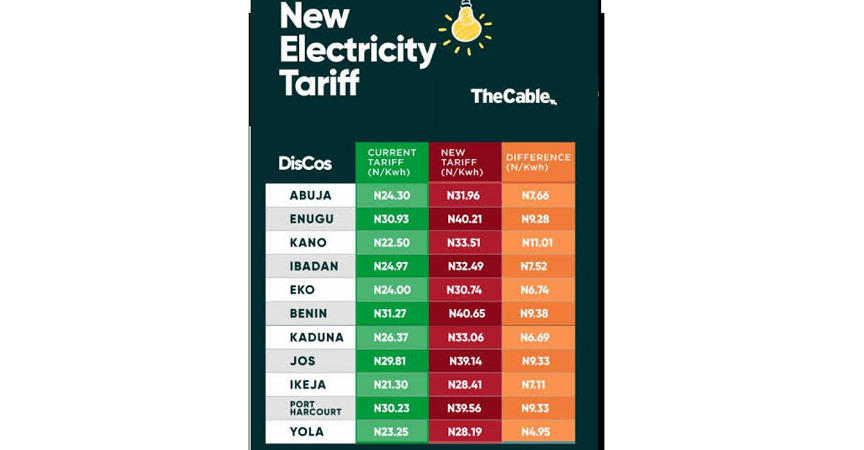
The news of the increase in electricity tariff approved by Nigerian Electricity Regulatory Commission (NERC) filtered in early this week. This news stated that from April 1, 2020, the 11 Electricity Distribution Companies (DisCos) in the country will review their electricity tariff upward.

According to NERC, this upward review, which was last done in 2015, was necessary as a result of four factors – inflation, exchange rate, US rate of inflation and gas prices. These were stated in the agency’s December 2019 Minor Review of Multi Year Tariff Order (“MYTO”) 2015 and Minimum Remittance Order for the Year 2020, which can be accessed from here.

This new increase shows that most tariff plans will increase by the addition of an extra N10 – N25 per unit, depending on the tariff plan and DisCo. However, going through the tables of new rates for different DisCos, I realised that electricity consumers under Enugu Electricity Distribution Company (EEDC) have been paying the new rate for some years now. It is obvious that what we are waiting for is the year 2021 tariff rates and not that of year 2020.

Anyway, the major reason for dropping this article is to lend a voice to many Nigerians, who have one or two things to say to NERC and the Nigerian DisCos.

It is pertinent to note that Nigerians don’t trust NERC and any of the DisCos to provide them with uninterrupted power supply. No Nigerian received the news of the tariff increase with relish. They all expressed their scepticism and suspicion towards the intention of the government agency. A lot of people pointed out the coincidence of the tariff increase and minimum wage implementation, wondering if the federal government is indirectly collecting its money back from the citizens. Then there are those that speculated that the government wants to overtax the citizens so that it will cover up its incompetency.

From the opinions and complaints of Nigerians towards the tariff increase, I noted that three distinct groups exist, all of which require the attention and consideration of NERC and Nigerian DisCos.

GROUP A

Those that belong to this group are the people that are willing to welcome the price hike so long as there is an improvement in power supply. Among these people are business owners that are tired of the high cost of running their businesses with generators. People in this group also complained of the noise and air pollution that comes from power generators. However, they are of the opinion that the only condition in which they will welcome the new electricity tariff is if they will enjoy 24-hour power supply. Failure of this means they will resort to generating their own power through solar, micro-hydro and wind power plants. In fact, a lot of people are considering these business options as I write now.

GROUP B

This group comprises of the people that insist that the tariff shouldn’t be increased for any reason. They hold that the current rate is even too high because a lot of people pay for what they didn’t get. Most of the people under this group are those that are still stuck with the Estimated Bill method and those who do not use electricity for any form of business. According to a person here, he’s billed #12,000 every month even though he couldn’t boast of 5 hours of power supply daily. He couldn’t then imagine what the new bill will cost if NERC is allowed to have its way.

There is something that NERC needs to note about this group. The members are bitter and they feel cheated. They believe that the DisCos in their areas are extorting them. A lot of them claimed to have applied for prepaid meter but have not gotten it because their DisCo benefits more from Estimated Bill method. To this group, increase in electricity tariff rate is a form of corruption.

GROUP C

I met this group in my village, Awkuzu, Oyi Local Government Area, Anambra State; and I believe they exist in every part of the country. When I told some people in my village that “NEPA” was about to increase their tariff rate, I got funny answers that ranged from, “For which light? The one we see or the one we don’t see?” to “They should carry their light; we are used to the darkness.”

This group no longer cares about power supply. They have settled to using generators in running their businesses and they know how to conserve fuel. When their phones’ batteries run down, they take them to business centres where they are fully charged at #50. At home, they use kerosene lamps and rechargeable torches to manage the darkness. Occasionally, when the need arises, they power up their generators do a little “oyinbo”. They heat up their food to keep it “fresh” and they keep their water in cool dark corners to keep it cool. In fact, these people have settled to a lifestyle that ensured that lack of electricity does not disrupt their activities. So when you tell them electricity tariff is about to be increased, they don’t care a bit.

If NERC has considered all factors and deem it fit for the tariff to be increased, no one can stop them. But there is a need to consider consumers’ satisfaction too. The first thing the agency should do is to compel all electricity distribution companies to issue out prepaid meters before April 1. That way, consumers can monitor and manage how they consume power. As for uninterrupted power supply, that is still something in our wish list; we will know when it is about to happen.

NERC and DisCos should also remember that Nigerians are considering alternative sources of power. If they fail to improve, one day they will wake up and find most of their customers are gone.