DD
MM
YYYY

PAGES

DD
MM
YYYY

spot_img

PAGES

Home Blog Page 6536

LinkedIn Hacks To Grow Your Business And Career This Year

0

LinkedIn has more than half a billion users you can connect with to discover career opportunities, expand your sales channel and even leverage to become a thought leader. In fact, there are several testimonies of how people  got their big breaks on the social network.

So, if you are active on LinkedIn, below are 3 ways you can use it to grow your career and business.

1. Get personal email of people you want to connect with

Imagine there is someone you need to discuss an opportunity with, but you do not have the contact. How will you go about it? With LinkedIn, you can search the profile of the person and send a connection request. When the person accepts the invite, LinkedIn makes it possible for you to get the email of your contacts. 

Why do I love the hack ? 

This is one of the best ways to get the primary contacts of anyone. Usually, when most people sign up to LinkedIn, they use their primary email account and some users even add their phone number or other means of contact.

You can even do this at scale by exporting the contacts of all your connections at once into an excel spreadsheet and start emailing them about my products and services. Here is a simple guide to download contacts on LinkedIn

2. Build your expert status as a thought leader.

Many people want to be recognized as an expert, the challenge is lack of platform. Today, platforms like LinkedIn makes it possible to amplify your expert opinions. Some of my favourite connections are influencers on LinkedIn.

Why I love this hack ?

You enjoy the privilege to be considered an expert in the area of your expertise. For example, Kayode Abbas is a LinkedIn expert who uses the platform to help B2B generate leads and help HR to connect with the right candidates.  By all standard, Prof Nduibisi Ekekwe is one of the leading LinkedIn experts. He even mentioned in a previous article how LinkedIn has become his lab.

If you are just starting out, you will gain exposure by writing very informed comments on articles written by experts in your space.

3. Advance your career and land your next job. 

I will share with you 5 unique ways you can use LinkedIn to advance your career and even land yourself a dream job.

  • Use LinkedIn’s recruiter feature to land your next job.This feature makes it super easy to setup your profile so employers know you are available for job (without revealing it to your current employer). You can access this feature from your dashboard view
  • Use LinkedIn to evaluate your career path and steps it will take to get there. I do this a lot. On LinkedIn, I might search for a job position. Like “digital business strategy”. I will use the filter to configure the results so I can get relevant profiles. Then, I view the profiles to check for academic records and previous roles the person held before “arriving” at their current position. Check out this article on how I use this knowledge to map my own career development plan.
  • Building connections with people in companies you want to work at. Identify top 5 companies you want to work at, search for it on LinkedIn and connect with some of the senior people working in those organizations (including HR). Then engage with them politely via direct messages to learn about their culture and job opportunities. 
  • Improve yourself with professional courses. Take courses on LinkedIn Learning (formerly Lynda.com) and other online learning platforms. When you complete such courses, add them to your LinkedIn profile to showcase your knowledge.
  • Ask colleagues and friends to write recommendations about you. Sometimes, these recommendations validate what you say about yourself and tend to act as recommendation about your previous works.

Now that you know how best to use LinkedIn to your advantage. Take steps to implement some of these in 2020. I will be glad to know how any of these hacks help you.

Wole Ogunlade is a business growth strategist. His experience included working with early-stage startups and ventures that have raised funding and exceeded more than $10 million monthly in revenues generated.
CAF Awards: Sadio Mane’, Asisat Oshoala, Crowned African Bests

0

In the eve of Tuesday January 7, playmakers, coaches, journalist and many who love the round leather game gathered for the 28th edition of CAF Awards 2019 in Egypt. The once in a year event is deigned to select the best among those who ply their trade in the football field, and that was done, honors were given to those to whom it’s due.

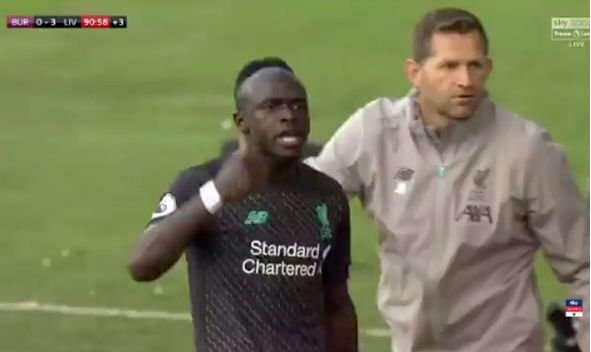
Sadio Mane’ of Liverpool has in the past season displayed the kind of playmaking that distinguished him from his contemporaries. The prodigy that earned him the fourth place in the Fifa ballon Do’r was not ignored by the Confederation of African Football, so that he was considered the best. He polled 477 votes ahead of his Liverpool teammate Mohamed Salah, 325 votes and Algeria’s Riyad Mahrez, 267 votes.

The Senegalese was instrumental to Liverpool’s epic come back against Barcelona, and their subsequent win of the Champions League.

Another character in the game whose activities in the game caught the eye of the football body is Nigerian Asisat Oshoala, who plies her trade with FC Barcelona’s female team. She was crown the best female football in Africa.

Oshoala was named African Women’s Player of the Year for the fourth time, equalling the record of her compatriot Perpetua Nkwocha.

She garnered 351 votes, 30 more than Cameroonian forward Ajara Nchout and Thembi Kgatlana, who had 247 votes.

Her prowess in the field of play was convincing enough that FC Barcelona didn’t find it hard deciding to keep her after her trial at Camp Noun. And she has been genial with the Nigerian female national team, the Super Falcons.

There are others too, who although they didn’t win the best footballers, came first in other different categories. Below is the list of the winners and nominees.

African Interclubs Player of the Year: Youcef Belaïli (Algeria & Esperance / Ahli Jeddah)

Nominees:

1. Anice Badri (Tunisia & Esperance)

2. Kodjo Fo Doh Laba (Togo & RS Berkane / Al Ain)

3. Taha Yassine Khenissi (Tunisia & Esperance)

4. Tarek Hamed (Egypt & Zamalek)

5. Youcef Belaïli (Algeria & Esperance / Ahli Jeddah)

African Youth Player of the Year: Achraf Hakimi (Morocco & Borussia Dortmund)

Nominees:

1. Achraf Hakimi (Morocco & Borussia Dortmund)

2. Krépin Diatta (Senegal & Club Brugge)

3. Moussa Djenepo (Mali & Southampton)

4. Samuel Chukwueze (Nigeria & Villarreal)

5. Victor Osimhen (Nigeria & Lille)

African Women’s National Team of the Year: Cameroon

Nominees:
1. Cameroon

2. Côte d’Ivoire

3. Nigeria

4. South Africa

5. Zambia

African Men’s National Team of the Year: Algeria

Nominees:
1. Algeria

2. Madagascar

3. Nigeria

4. Senegal

5. Tunisia

Best African Goal of the Year: Riyad Mahrez (Algeria)

FIFPro Africa’s Best 11:

Andre Onana; Serge Aurier, Joel Matip, Kalidou Koulibaly, Achraf Hakimi; Idrissa Gana Gueye, Riyad Mahrez, Hakim Ziyech; Mohamed Salah, Pierre Emerick Aubameyang, Sadio Mane*

African Women’s Coach of the Year: Desiree Ellis (South Africa)

Nominees:

1. Alain Djeumfa (Cameroon)

2. Bruce Mwape (Zambia)

3. Clementine Toure (Côte d’Ivoire)

4. Desiree Ellis (South Africa)

5. Thomas Dennerby (Nigeria)

Men African Coach of the Year: Djamel Belmadi (Algeria)

Nominees:

Aliou Cisse (Senegal – Senegal)

2. Christian Gross (Switzerland – Zamalek)

3. Djamel Belmadi (Algeria – Algeria)

4. Moïne Chaâbani (Tunisia – Esperance)

5. Nicolas Dupuis (France – Madagascar)

African Women’s Player of the Year: Asisat Oshoala

Nominees:

1. Ajara Nchout (Cameroon & Valerenga)

2. Asisat Oshoala (Nigeria & Barcelona)

3. Gabrielle Ouguene (Cameroon & CSKA Moscow)

4. Tabitha Chawinga (Malawi & Jiangsu Suning)

5. Thembi Kgatlana (South Africa & Beijing Phoenix FC)

Player of the Year: Sadio Mane (Senegal & Liverpool)

Nominees:

1. André Onana (Cameroon & Ajax)

2. Hakim Ziyech (Morocco & Ajax)

3. Ismail Bennacer (Algeria & AC Milan)

4. Kalidou Koulibaly (Senegal & Napoli)

5. Mohamed Salah (Egypt & Liverpool)

6. Odion Ighalo (Nigeria & Shanghai Shenhua)

7. Pierre-Emerick Aubameyang (Gabon & Arsenal)

8. Riyad Mahrez (Algeria & Manchester City)

9. Sadio Mane (Senegal & Liverpool)

10. Youcef Belaili (Algeria & Ahli Jeddah

The Senegalese international Mane’ was believed to deserve better than he got in the Fifa Ballon Do’r, that even Lionel Messi called his fourth position “an injustice.” Nevertheless, the night came to an end with Mane’ getting what he deserved for his contribution to the beautiful game. And he didn’t fail to show appreciation.

“It’s a great day for me and for my career. I would like to thank all of the Senegalese people who supported me during my journey.

“I’m feeling happy because they will be glad watching me winning this award, especially the people in my village,” Mane’ said.

Saudi Aramco Lost $200b Amidst Iran’s Tension

0

As President Trump and Ali Khamenei roll up their sleeves in a new tussle, the rippling effects span wide across Europe and the Middle East, sending signals that the stock markets are receiving in bad fate. The tension emanating from the killing of one of Iran’s most powerful generals, Qasem Soleimani has resulted in dwindling stock activities in the markets around the world.

Saudi Aramco has suffered its biggest loss since its record breaking IPO late last year. CNN Business reported that the stock dropped 2% ($200 billion) amid concerns of retaliation from Tehran. Saudi Arabia is a key American ally in the Middle East, and could be a victim of Iran’s reprisal attacks for the death of Soleimani. With its oil installations having been targets of attacks in the past, the paranoia of losing its oil infrastructure is not something the Middle East kingdom could dismiss. It has happened before and it may happen again.

The realities of the threat is notable in the activities of the oil market. Despite a 6% surge in crude oil prices since Thursday that got the price close to $70 per barrel, which should boost the earnings of Aramco, the company’s shares have dipped instead.

Since after its IPO, Saudi Aramco has been struggling to meet the expectations of its shareholders. On Monday, the company’s decline topped 10%, wiping more than $200 billion off its market value. That’s a lot to lose in a few weeks after Aramco debut the biggest IPO in history, and it has begun to give investors concern, especially at this time of Iran vs. America tension.

In 2012, Saudi Aramco suffered a major cyber attack, one of the worst in history. A total of 35 computers were destroyed and their information wiped off.

In September 2019, the company’s oil facility suffered a missile attack that reduced its production capability to a half. The U.S pointed at Iran though they denied the responsibility.

Iran has an undeniable prowess in cyber attacks. There have been some other cases where the country was fingered. For instance, the cyber attacks involving major American banks, JPMorgan Chase, Bank of America and Wells Fargo. These attacks left compromising marks on these institutions, with a lot of data compromised and customers denied access to their accounts.

It is more like a retaliatory pattern to any political event from the U.S against Iran. In a note shared by Evercore analysts, Ken Talanian and Kirk Materne, to investors, they noted that “Iran has a long history of politically motivated cyber attacks across the world. The attacks often follow closely to changes in U.S sanctions.”

The killing of Soleimani has become one of those events, and there is reasonable expectation of the usual response from Iran, and Saudi oil installations may be at the receiving end because of its relationship with the United States.

Oil prices are expected to spike due to these events that have limited production and most of all, supply of oil to Asia because of irregularities in the Strait of Hormuz, that have narrowed the passage of oil tankers to a few. But the psychological effects is having even tighter grip on the stock markets than the spiking price.

Analysts at Goldman Sachs indicated in a research note that the looming dangers are already reflected in crude oil prices, and to sustain them (prices) near current levels, a supply disruption would be needed.

“We therefore believe that price risks are skewed to the downside in coming weeks, with oil prices already trading above our fundamental fair value of $63 a barrel ahead of the recent events,” they said.

A supply disruption may likely come from any retaliatory action taken by Tehran against Saudi that cuts the production or supply of crude oil to any part of the world, especially Asia.

However, the drop in Saudi Aramco’s stock has shown that its performance doesn’t depend on the spike of oil price. Dubai based head of equity strategy at Tellimer investment bank, Hasnain Malik, said Saudi Aramco’s stock depends on continued support from local and regional investors.

“Fundamentally, Aramco is massively overvalued,” said the director of energy at Palissy Advisors, Anish Kapadia. So it will be a struggle for Aramco to live up to the value based on market forces.

Nigeria Capital Market in 2019, What Should We Expect In 2020?

4

In 2019, we wore the poverty capital of the world tag with hope and unflinching will, and we lived daily in an economy that was tamed by global economic headwinds, erratic economic policies, aggressive fiscal policies, unconventional regulatory directives and pronouncements.

In 2020, we do not expect the headwinds and ‘policy gymnastics’ of the previous year to disappear overnight but ‘we move’ with tact and experience, hoping the momentum garnered in the previous year will come in handy to ensure a more productive year.

Topic by topic, join us to review the key headlines that shaped the Capital Market in 2019 and share insights on lessons to grow your wealth in 2020.

The Equities Market (‘the Market”)

A Farmer rejoices when his crops blossom with green leaves, green is an indication of bounties/gains to come but when it’s red/brownish, he mourns in fear of heavy losses because his farm is most likely on fire or the crops are dying. In the equities Market, green and red carry the same message as the farm.

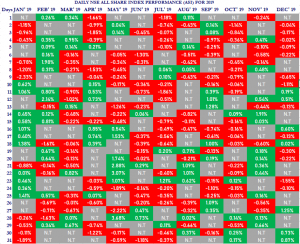
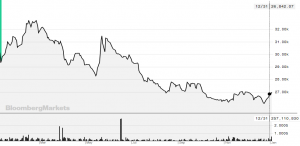
From the chart, the equities market opened for 246 days in 2019, stocks blossomed in green for 100 days, and for the most part – 146 days, the Market was on fire, ravaging most stocks and leaving Investors with heavy losses on their investments.

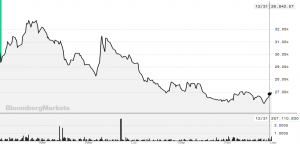
More technically, the equities market started 2019 on a high with an All Share Index (ASI) of 31,430.50 and peaked at 32,715.20 on 15th February 2019. In the course of the year, political, economic, and global turbulence drove the market up and down until it nosedived to close the year at 26,842.07.

ASI is a parameter used to measure how well a stock market is performing. You can view it as the daily ‘jamb score’ or ‘CGPA’ measuring the combined daily performance of all stocks in the equities market. The higher the score, the better the performance of the stock market. Comparing first day in 2019 score of 31,430.50 with a last-day score of 26,842.07, you will be right to conclude that the market performed poorly, suffering a decline of -14.60%.


Like the ASI, all other market performance indicators were in the red zone except market capitalization, which gained not necessarily because of better performance but because of the listing of new companies like MTN, Airtel etc.

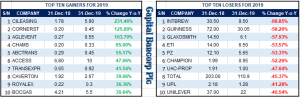
Here is the list of top gainers and losers for the year:

If you invested N500,000.00 in the shares of CI & LEASING on 31st December 2018, by now you will be on the millionaire’s list in your village at N1,657,303.37. Even if you had invested your funds equally between the top gainer and loser, you still would have been better off at N906,520.64, about 70% premium above inflation, that’s the beauty of the equities market.

What should we expect in 2020? We expect the market to enjoy some green moments in the early days of the year considering the excess supply of funds beyond the pipeline of attractive investments in the money market.

Eventually, the lethargy that we have come to know the market and players for will soon set in and burn the green moments. It will be difficult to fault the Market or blame the energy of Players since the Market is usually a reflection of the economy, you cannot have a sustained bullish market in a bearish economy with erratic policies, regulatory directives and pronouncements, along with global headwinds that we can only accept at best.

Be that as it may, there are always decent undervalued companies and penny stocks waiting to be hunted, waiting to be spotted, waiting for the next millionaire/billionaire. Imagine if you had bought penny stocks like CILEASING, CORNERSTONE, CHAMS etc in 2018 and play the waiting game? Patience is a virtue, right?

Double-digit Inflation Rate

Inflation! a subtle weapon of theft even more devious than tax at times. Like a burglar in thick darkness, inflation robs you of your wealth without you having a clue.

When the Government proposed an increase in VAT from 5% t0 7.5%, we all jumped into a royal rumble of comments and analysis. Check the records, the inflation rate was 8.2% in January 2015 and now 11.85%. Put simply, it is an additional VAT of 2.5% and what feels like an additional inflation tax of 3.65%.

While the effect of tax is clear and intuitive because we can actually feel the negative emotions of our cash moving to Government. In contrast, a higher rate of inflation does not generate an equivalent negative emotional reaction because it’s not intuitively felt.

Here is the implication of the current rate of inflation at 11.85%, if inflation were to stay at that rate for the next 12 months and you invest N100,000.00 in a fixed income security to earn 12% annually, after 12 months, your precious N100,000.00 will effectively worth N100,150.00 instead of N112,000.00, inflation just robbed you off N11,850.00.

Outlook for 2020: most certainly the next inflation figure will hit 12% and cross it in the coming months. Falling interest rates, potential VAT increase, Border closure along with the implementation of the new minimum wage, inflation won’t be declining soon.

The Lesson: To grow your wealth in 2020, the return on your investments and business ventures must give you some reasonable premium above the inflation rate.

Question: What can you invest in ‘to beat the thief called inflation rate’?

Treasury Bills and Crashing Yields

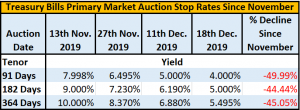
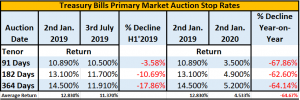
Treasury Bills used to be an answer to the question above, not anymore, it’s no more a Haven for Banks and Fund Managers. The tables below tell the story:

Outlook for 2020: it doesn’t appear the crash is stopping any moment, here is the result after the first auction in 2020;

At an average yield of 12.83% in January 2019, you will conveniently beat inflation. Fast forward one year after, at the current average yield of 4.533% and inflation rate at 11.85%, the return on treasury bills will come in negative at -6.541%, clearly, you cannot grow your wealth with T-bills.

External Reserves and Oil Prices

Nigeria continues to suffer from overreliance on crude exports to grow its external reserves. In the last six months, the reserves have declined by $6.46bn from $45bn in June 2019 to $38.6bn as of yearend 2019.

“At an investor meeting in London, Godwin Emefiele, governor of the Central Bank of Nigeria (CBN), told foreign investors that the apex bank would meet all foreign exchange demands so long as the nation’s external reserves are above $30 billion and the international prices of crude oil do not go below $45 per barrel” BusinessDay

If you own a company or have anything to do with strategy in any company, please print the statement above and paste it where you can see it on a regular basis, most importantly, factor it into your scenario modeling. At the current rate of depletion, circa $1 billion monthly, we may hit that alert point in September 2020.

In the coming months, the re-energized hostilities between Trump and Iran may just turn out to be the tailwind that will fuel the confidence of Investors in our external reserves and douse all speculations.

Despite the headwinds, the opportunities in the land are boundless, strategize, explore, execute brilliantly and be confident of a positive outcome.

Cheers to more wins in 2020.

Strategic Issues that will make or mar Amotekun’s Operations in South West Nigeria

0

The idea came at the time security of lives and properties was at its lowest ebb in the region. Stories of killing, wailing and loss rented the air and was almost making the southwest roads the next most dangerous after the Boko Haram ravaged the North Eastern Nigeria. Concerns by stakeholders was pointing towards the formation of a security network built on local intelligence involving the different security personnel of the Police, the Nigerian Army, the NSCDC, the Air Force and local militias.

This cry culminated in the joint meeting of the governors across the region in a summit tagged Southwest Security Summit held in Ibadan. And the name of the outfit was pronounced Amotekun. The headquarters is located at Gbongan ìn Osun State. And the outfit would be unveiled on Thursday January 9, 2020.Ordinary people and security experts have hailed the move by the governors of the Southwest to secure its road in a cooperative manner that portrays the potential of such approach if extended to other areas of her life. However, there are strategic issues that need to be looked into as Operation Amotekun comes on board in the security architecture of the region.

#Synergy between the Security Force and Local Militias. Days ahead of the inauguration, pointers are emerging as to the kind of relationship that would exist between the established forces and the local militia and vigilante groups in the region. For a region that has an abundance of local security groups such as OPC, Agbekoyas and others, it is important that the modus operandi of the outfit should be clearly spelt out. The roles of the different composition should be complementary. There should be a strong cohesion within the team. This is important in order not to jeopardize the purpose of the outfit. Already, there are insinuations that the different personnel of the existing security will not work with the local militias. This might not be a good omen for the new outfit.

#Corruption. Another major issue that would confront the smooth running of the operation is the corrupt tendency that exists within the major components that make up Amotekun. With existing efforts to curb the menace of criminal activities already compromised by extortion which happens on daily basis along the major routes.   People are wondering if such collection of illegal toll would not have negative effect on the operation. Turning such an important security operation to a commercialized venture might not be the best approach to retain confidence.

#Local Intelligence+Advanced Tech. The security outfit has to blend indigenous intelligence with advanced crime fighting tech. An analysis of kidnapping victims’ narration of their ordeal reveals that the perpetrators understand the terrain very well. So, it requires an equal  understanding on the part of those who are commissioned to secure the people. The use of drones and other modern crime detection and fighting tools should be deployed. This is not to discountenance the usefulness of the local intelligence. What would put an end or minimize the menace of these crimes is a combination of these two.

#Open Communication. Security of life and property as important as it is requires the cooperation of those to be secured. To have people buy in, the Amotekun outfit needs strategic communication. Such that would  be good enough to give people the needed confidence and at the same time not jeopardize the intent of the organization.  A well equipped internet enabled situation room is advised. The outfit needs to create a mechanism for feedback. This is necessary in the light of human right abuses by Nigerian security personnel.