DD
MM
YYYY

PAGES

DD
MM
YYYY

spot_img

PAGES

Home Blog Page 655

DBS Launches Tokenized Structured Notes on Ethereum Targeting Institutional Investors

6

Singapore’s largest bank, DBS, has launched tokenized structured notes on the Ethereum public blockchain, targeting accredited and institutional investors.

These notes, distributed through platforms like ADDX, DigiFT, and HydraX, are crypto-linked participation notes that pay cash returns when cryptocurrency prices rise while incorporating safeguards to limit losses during market downturns. By tokenizing the notes into $1,000 units—down from the traditional $100,000 minimum—DBS enhances liquidity and accessibility, making them more fungible and easier to trade.

The bank reported over $1 billion in trading volume for these instruments in the first half of 2025, with a 60% increase from Q1 to Q2. This move aligns with Singapore’s push to become a global hub for tokenized finance, supported by the Monetary Authority of Singapore’s Project Guardian and Global Layer One initiatives.

DBS plans to expand tokenization to equity- and credit-linked notes, reflecting growing institutional demand for digital assets. By lowering the minimum investment from $100,000 to $1,000, tokenization makes structured notes accessible to a broader range of accredited and institutional investors.

This could expand the investor pool, increase market participation, and drive demand for tokenized financial products in Singapore and beyond. Tokenized notes are more fungible and easier to trade on digital platforms like ADDX, DigiFT, and HydraX.

This improves liquidity compared to traditional structured notes, which often have limited secondary market trading, enabling faster and more efficient transactions. DBS’s initiative aligns with Singapore’s ambition to lead in digital asset innovation, supported by the Monetary Authority of Singapore’s (MAS) Project Guardian and Global Layer One.

This strengthens Singapore’s position as a global hub for tokenized finance, potentially attracting more fintech and blockchain firms.  The issuance of tokenized notes on the Ethereum blockchain signals growing institutional confidence in public blockchains for financial applications.

Portfolio Diversification and Risk Management

The crypto-linked participation notes offer returns tied to cryptocurrency price increases while incorporating safeguards to limit losses. This appeals to investors seeking exposure to digital assets with controlled risk, potentially diversifying portfolios in a volatile market.

The success of DBS’s tokenized notes could prompt regulators to further refine frameworks for digital assets, balancing innovation with investor protection. Singapore’s proactive regulatory approach may set a global standard for tokenized securities.

DBS’s plans to tokenize equity- and credit-linked notes suggest a broader shift toward tokenizing diverse asset classes. This could reshape capital markets, enabling fractional ownership and new investment opportunities across asset types.

Benefits of Tokenization

Tokenization divides high-value assets into smaller, affordable units (e.g., $1,000 vs. $100,000), lowering barriers to entry and enabling more investors to participate. Digital tokens are easily tradable on blockchain-based platforms, reducing friction and enhancing liquidity compared to traditional securities.

Blockchain’s immutable ledger ensures transparent, tamper-proof records of ownership and transactions, reducing counterparty risk and enhancing trust. Tokenization streamlines processes like issuance, settlement, and custody by leveraging smart contracts, reducing intermediaries and operational costs.

Tokenized assets can be traded on digital platforms accessible worldwide, expanding market reach and enabling 24/7 trading without geographic restrictions. Smart contracts embedded in tokenized assets enable automated features like dividend payments or risk safeguards, improving efficiency and customization.

DBS’s tokenized structured notes demonstrate how tokenization can transform traditional finance, offering scalability, efficiency, and inclusivity while positioning Singapore as a leader in the global digital asset landscape.


The EU’s Accelerated Digital Euro Reflects a Broader Global Race to Dominate the Digital Asset Space

0

The European Union is fast-tracking its digital euro project, driven by concerns over the competitiveness of the euro in the global digital economy, particularly following the U.S.’s passage of the GENIUS Act, which regulates the $288 billion stablecoin market.

The European Central Bank (ECB) and EU officials aim to modernize the financial system, enhance the euro’s global role, and ensure monetary sovereignty by reducing reliance on dollar-dominated stablecoins like USDT and USDC.

The ECB is exploring public blockchains like Ethereum and Solana for the digital euro’s infrastructure, a shift from earlier plans for a private, ECB-controlled system, to boost adoption, transparency, and cross-border utility. However, this raises privacy concerns due to the transparent nature of public blockchains, and some European banks worry it could disrupt their business models.

The preparation phase, ongoing since November 2023, includes finalizing the digital euro scheme rulebook and testing, with key decisions expected by October 2025 and a potential launch between 2026-2027, pending legislative approval. The digital euro would complement cash, ensuring a secure, central bank-backed digital payment option across the euro area.

The digital euro aims to reduce reliance on dollar-dominated stablecoins (e.g., USDT, USDC) and foreign payment systems, preserving the euro’s global influence. This counters the U.S.’s lead in digital finance, particularly after the GENIUS Act’s regulation of its $288 billion stablecoin market.

A digital euro could enhance the EU’s ability to control monetary policy in a digital economy, mitigating risks from private cryptocurrencies or foreign CBDCs (e.g., China’s digital yuan). A digital euro would enable faster, cheaper cross-border payments within the eurozone, competing with private fintech solutions like PayPal or blockchain-based platforms like Solana.

This could streamline transactions for consumers and businesses. Integration with public blockchains (e.g., Ethereum) could foster innovation, enabling smart contracts and decentralized finance (DeFi) applications, but it raises privacy and regulatory challenges due to blockchain transparency.

Banks fear a digital euro could disintermediate them by allowing consumers to hold digital wallets directly with the ECB, reducing deposits and lending capacity. The ECB is addressing this by capping individual holdings (e.g., €3,000-€4,000) to balance adoption and stability.

Competition from private stablecoins and DeFi platforms could further erode traditional banks’ market share unless they adapt by offering digital asset services. The EU’s push reflects a race to keep pace with the U.S., China, and others. China’s digital yuan is already in advanced pilots, while the U.S. leverages its stablecoin dominance.

Emerging economies (e.g., India, Brazil) are also developing CBDCs, intensifying competition to set global standards for digital currencies. Public blockchain adoption raises privacy risks, as transactions are traceable unless advanced cryptographic solutions are implemented. Balancing privacy with regulatory compliance is a key challenge.

Citizens may resist a digital euro if perceived as enabling government surveillance, especially compared to privacy-focused cryptocurrencies like Monero. A digital euro could enhance financial inclusion by providing a secure, accessible digital payment option, complementing cash. However, its success depends on user trust and seamless integration with existing payment systems.

Countries are racing to launch CBDCs to maintain economic influence. The EU’s digital euro competes with China’s digital yuan, which is already used in cross-border trials, and the U.S.’s stablecoin ecosystem. By 2025, over 100 countries are exploring CBDCs, with 39 in advanced stages, per the Atlantic Council.

A successful CBDC could attract international adoption, boosting a country’s currency in global trade and reducing dependence on others’ financial infrastructure. Central banks like the ECB are competing with private stablecoin issuers (e.g., Tether, Circle) and crypto platforms (e.g., Ethereum, Solana) that offer faster innovation and global reach.

Stablecoins already process billions in transactions monthly, challenging CBDCs to match their scalability and user base. The ECB’s shift toward public blockchains reflects pressure to adopt private-sector technologies to remain competitive, but it risks ceding control to decentralized networks.

Fintechs and crypto firms are driving competition by offering user-friendly, decentralized alternatives to CBDCs. For example, Solana processes thousands of transactions per second at low costs, outpacing traditional banking systems. Stablecoin providers are expanding into new markets, forcing central banks to accelerate CBDC development to avoid losing market share.

Competition extends to setting global standards for digital assets. The EU’s exploration of public blockchains aligns with open, interoperable systems, but conflicts with China’s closed, state-controlled digital yuan model. The outcome will shape cross-border payment compatibility.

Private blockchains and consortia (e.g., Ripple, Stellar) are vying to become the backbone for global digital transactions, pressuring the EU to ensure the digital euro is interoperable. Developing digital assets requires cutting-edge blockchain expertise, sparking competition for talent between governments, central banks, and tech firms.

The implications include enhanced monetary sovereignty, modernized payments, and challenges to traditional banking, but also risks of privacy concerns and market disruption. Competition is fueled by nation-states vying for currency dominance, central banks battling private sector innovation, and the push for interoperable standards.

Apple Explores Using Google’s Gemini for Siri, Highlighting Uneasy Rivalry and Reliance on Rivals in AI Push

0

Apple might use Gemini to power its revamped version of Siri, Bloomberg reports, in what could mark one of the company’s most unusual partnerships in recent years.

The companies are reportedly in the early stages of exploring a deal, with Google training a version of its Gemini model that can run directly on Apple’s servers. The move would place one of Apple’s most visible consumer products in the hands of a longtime competitor, underscoring both the pressure Apple faces to deliver in artificial intelligence and the difficulty it has encountered rolling out its own in-house system, Apple Intelligence.

The iPhone maker was previously reported to be considering similar partnerships with OpenAI and Anthropic. Internally, Apple is said to be developing two versions of the new Siri: one dubbed Linwood that runs on Apple’s proprietary models, and another codenamed Glenwood that leverages external technology. A final decision has not been made on which model Apple will ultimately adopt, but it is entirely possible the company will lean on its internal models instead of outsourcing.

For Apple, however, even publicly weighing the option of using Google’s Gemini shows how strained its AI rollout has become. While ceding such a crucial technology to a competitor seems decidedly un-Apple, it is a testament to the challenges the company has faced in bringing its new AI vision to life. Apple included the majority of its new AI features in iOS 18, but failed to ship the promised Siri update capable of drawing on personal data to take actions in apps. In March, Apple was forced to admit the update was delayed, with a new launch timeline now pushed to 2026.

The delay reportedly caused turmoil within Apple, with multiple AI projects being shifted between internal teams and management. That shuffle, coupled with growing investor pressure for Apple to deliver AI features that rival Google and Microsoft, has left the company seriously considering a third-party partnership.

As of the launch of Google’s Pixel 10, Gemini already offers a similar set of capabilities to those Apple originally promised with the new Siri — and could presumably deliver the same experience on iOS with some modifications. Running Gemini on Apple’s servers through its so-called Private Cloud Compute could also give Apple more control and an added layer of security, addressing concerns over user privacy.

Apple had also been planning to offer Gemini as an alternative to OpenAI’s ChatGPT inside Apple Intelligence, though that option has yet to ship. Should Apple integrate Gemini more deeply into Siri, it would follow a similar path to Samsung, whose Galaxy AI relies on a mix of in-house models and Google’s Gemini.

The development also revives attention to Apple’s long and uneasy history with Google — one of rivalry laced with reluctant cooperation. While the two companies compete fiercely in areas such as smartphones, operating systems, and now AI, Apple has relied on Google Search as the default engine on Safari for years, a partnership that is enormously lucrative for both sides but has attracted sharp antitrust scrutiny. The U.S. Department of Justice has argued that the deal entrenches Google’s dominance in search while leaving users with little real choice.

That uneasy balance — battling Google in hardware and software while leaning on it in search — is now poised to extend into the age of AI. Partnering with Google on Siri could invite criticism that Apple is once again depending on its chief competitor to power one of its flagship products. For Google, embedding Gemini in Apple’s ecosystem could dramatically expand its AI footprint, potentially reaching hundreds of millions of iPhone users worldwide.

The outcome remains uncertain, as Apple has yet to finalize its strategy. But the mere possibility of Siri running on Google’s Gemini is a striking sign of how much the AI race is forcing even the most independent tech giants into unexpected alliances.

Intel, Trump Administration Seal 10% Stake Investment Deal

0

Intel Corporation has announced an agreement with the Trump Administration to support the continued expansion of American technology and manufacturing leadership with 10% stake in the company.

Under the terms of the deal, the United States government will invest $8.9 billion in Intel common stock, underscoring Washington’s confidence in Intel to advance national priorities and bolster the domestic semiconductor supply chain at a time when the industry is seen as critical to both economic and national security.

The government’s equity stake will be funded by the remaining $5.7 billion in grants previously awarded, but not yet disbursed, to Intel under the U.S. CHIPS and Science Act, along with $3.2 billion awarded under the Pentagon’s Secure Enclave program. Intel reaffirmed its commitment to delivering trusted and secure semiconductors to the Department of Defense as part of that program.

The $8.9 billion investment builds on the $2.2 billion in CHIPS Act grants Intel has already received, bringing the government’s total support for the company to $11.1 billion.

“As the only semiconductor company that does leading-edge logic R&D and manufacturing in the U.S., Intel is deeply committed to ensuring the world’s most advanced technologies are American made,” said Lip-Bu Tan, CEO of Intel. “President Trump’s focus on U.S. chip manufacturing is driving historic investments in a vital industry that is integral to the country’s economic and national security. We are grateful for the confidence the President and the Administration have placed in Intel, and we look forward to working to advance U.S. technology and manufacturing leadership.”

Howard Lutnick, U.S. Secretary of Commerce, echoed the sentiment: “Intel is excited to welcome the United States of America as a shareholder, helping to create the most advanced chips in the world. As more companies look to invest in America, this administration remains committed to reinforcing our country’s dominance in artificial intelligence while strengthening our national security.”

Structure of the Deal

Under the agreement, the government will purchase 433.3 million primary shares of Intel common stock at $20.47 per share, equal to a 9.9 percent stake in the company. The purchase price represents a discount to Intel’s current market price, effectively giving U.S. taxpayers a value-based entry into Intel’s long-term success.

The government’s stake will be passive, with no board representation, governance, or information rights. Washington also agreed to align with Intel’s board of directors on shareholder votes, with limited exceptions.

In addition, the deal gives the government a five-year warrant to purchase up to an additional 5 percent of Intel shares at $20 apiece, though this warrant can only be exercised if Intel ever ceases to own at least 51 percent of its foundry business.

To support Intel’s investment stability, the existing claw-back and profit-sharing provisions tied to the earlier $2.2 billion CHIPS Act grant will be eliminated, ensuring permanency of capital as Intel pursues its U.S. expansion.

Historic U.S. Expansion

Intel has been aggressively investing in U.S.-based chipmaking. Over the past five years alone, it has poured $108 billion into capital investments and $79 billion into research and development, the majority of which were aimed at strengthening domestic manufacturing and process technology.

Currently, Intel is building out what it describes as its most ambitious U.S. expansion in decades — a more than $100 billion investment to expand fabrication facilities across the country. The centerpiece of this effort is its newest mega-fab in Arizona, which is expected to begin high-volume production later this year using the most advanced process technology available on U.S. soil.

Since taking over as CEO in March, Lip-Bu Tan has sought to reposition Intel as the standard-bearer of American chipmaking, moving quickly to strengthen finances, enforce disciplined execution, and restore a culture of engineering excellence. Today’s agreement with Washington is viewed as a key step in reinforcing Intel’s strategy.

The government’s decision to become Intel’s second-largest shareholder represents an unprecedented level of public-private partnership in the semiconductor industry. It reflects the administration’s broader effort to reduce reliance on Asian chipmakers like Taiwan Semiconductor Manufacturing Company (TSMC) and South Korea’s Samsung, which currently dominate global production of cutting-edge logic chips.

President Trump has made semiconductor manufacturing a centerpiece of his industrial strategy, pressing for “Made in America” leadership in advanced technologies like artificial intelligence, 5G, and defense systems. The Intel deal marks the most direct equity stake the U.S. government has taken in a major private tech company in decades, drawing comparisons to past interventions during critical national industries’ development, such as aerospace.

Intel, for its part, is signaling that it intends to be the cornerstone of this policy. “Strengthening the U.S. technology ecosystem is not just about Intel, it’s about securing the entire supply chain,” the company said, highlighting its partnerships with customers and technology firms aligned with the administration’s push for a resilient and secure semiconductor base.

Legality Questions and Backdrop

However, the acquisition of nearly 10 percent of Intel has already sparked questions about its legality. While the CHIPS and Science Act authorized grants, loans, and incentives for domestic semiconductor manufacturing, it did not explicitly authorize the federal government to acquire stock in private corporations.

“The CHIPS Act did not authorize the U.S. government to acquire stock in private corporations,” Rep. Thomas Massie said, adding to other warnings that the deal could set a precedent for federal overreach into private industry.

Some analysts have noted that this equity structure blurs the line between industrial policy and corporate ownership, raising constitutional questions about the separation of legislative authority and executive action.

Administration officials argue that the transaction is consistent with the intent of the CHIPS Act — to secure America’s semiconductor future — and say the equity purchase is simply a restructuring of previously allocated funds.

Little Pepe’s LILPEPE vs Shiba Inu’s SHIB: Comparing Which Ethereum Meme Coin Will Lead the Pack in 2025

0

Two Ethereum meme coins, Shiba Inu (SHIB) and Little Pepe (LILPEPE), are emerging as key players. SHIB, priced at $0.00001408, has seen a 24.32% price increase over the past 30 days.  Meanwhile, LILPEPE, in Stage 11 of its presale at $0.0020, has raised over $21 million, selling over 13.6 billion of its 26.5 billion allocated tokens. This comparison highlights LILPEPE’s explosive presale traction against SHIB’s steady recovery to determine which Ethereum meme coin could dominate in 2025.

Little Pepe (LILPEPE): The Meme Coin with Utility and Vision

Little Pepe (LILPEPE) is more than a viral token—it’s an Ethereum-based meme coin supported by its own Layer 2 blockchain, purpose-built for speed, security, and ultra-low fees. The project blends the viral culture of Pepe with blockchain innovation, positioning itself as a leader for meme coins, looking beyond hype into lasting infrastructure. Currently, LILPEPE is in Stage 11 of its presale, offering tokens at $0.0020. The momentum has been remarkable, with over $21 million already raised and more than 13.6 billion tokens sold.  Little Pepe’s LILPEPE operates with a controlled total supply of 100 billion tokens, carefully structured to balance growth and sustainability. The tokenomics are broken down as follows:

  • 5% Presale Allocation – 26.5 billion tokens dedicated to fueling early adoption.
  • 30% Chain Reserves – Ensuring the Layer 2 blockchain has the resources to thrive.
  • 5% Staking & Rewards – Incentivizing community members who contribute to liquidity and activity.
  • 10% Liquidity – Ensuring smooth trading experiences.
  • 10% DEX Allocation – Supporting decentralized exchange availability.
  • 10% Marketing – Driving awareness and continued adoption.
  • 0% Tax – Simplifying transactions for investors.

With over $21 million raised so far, LILPEPE’s presale is one of the hottest in the Ethereum meme coin market. Each stage of the presale has sold out rapidly, showcasing the eagerness of investors to get in before wider listings. At its current pace, Little Pepe could set records for presale funding in the meme coin sector. The team is also building community excitement through its massive giveaway. Ten lucky winners will each receive $77,000 worth of tokens, a bold move to reward early supporters while keeping momentum strong. LILPEPE is already listed on CoinMarketCap and has confirmed plans to debut on two top-tier centralized exchanges upon launch. Even more significantly, the team has announced that it will also list on the largest exchange in the industry, ensuring global visibility and liquidity for its token.

Shiba Inu (SHIB): A Strong but Volatile Contender

Shiba Inu (SHIB) remains a household name in the Ethereum meme coin category, currently trading around $0.00001295 after a 24.32% gain over the past month. A key driver of recent performance has been its aggressive token burns, with 1.04 billion SHIB permanently removed in Q2 2025—a 1527% increase compared to prior quarters. However, despite this progress, SHIB still faces challenges. Its circulating supply stands at a staggering 589.24 trillion, which heavily limits its potential for exponential price growth. Technical indicators also reveal volatility: while SHIB has broken out of a descending wedge, resistance at $0.00001341 remains strong, and a potential drop to $0.0000095 could occur if support fails at $0.00001279.

Little Pepe’s LILPEPE vs Shiba Inu’s SHIB Price Potential

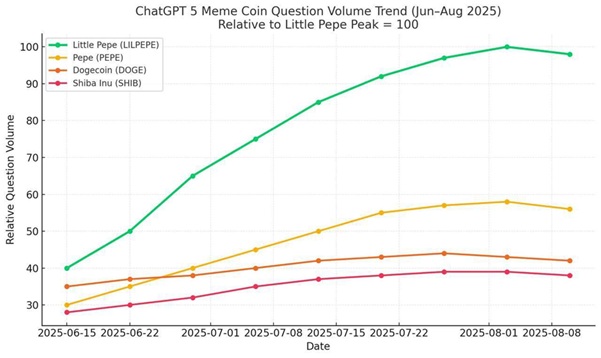
Analysts and early investors point to LILPEPE’s price trajectory as one of the most exciting aspects of the project. With a presale entry point at $0.0020, projections suggest that the token could rally up to $0.80, a 400x return, if its Layer 2 adoption and community growth stay on track.  Price projections for late 2025 suggest SHIB may reach $0.0000328, which represents gains but pales in comparison to the explosive upside of LILPEPE. This massive upside is one of the biggest differences in the Little Pepe’s LILPEPE vs Shiba Inu’s SHIB debate, as Little Pepe (LILPEPE) outranks top meme coins in the question volume trend from June – August, according to data from ChatGPT-5.

Conclusion

The debate of Little Pepe’s LILPEPE vs Shiba Inu’s SHIB highlights two very different stages of meme coin maturity. SHIB remains a strong, established token but faces limitations from its vast supply and volatile market conditions. LILPEPE, meanwhile, is at the dawn of its rise, with presale momentum, powerful tokenomics, and Layer 2 technology all pointing to outsized growth potential. With a possible 400x upside and global exchange listings lined up, Little Pepe’s LILPEPE looks poised to outshine SHIB and claim leadership in the Ethereum meme coin space by 2025.


For more information about Little Pepe (LILPEPE) visit the links below:

Website: https://littlepepe.com

Whitepaper: https://littlepepe.com/whitepaper.pdf

Telegram: https://t.me/littlepepetoken

Twitter/X: https://x.com/littlepepetoken