DD
MM
YYYY

PAGES

DD
MM
YYYY

spot_img

PAGES

Home Blog Page 6569

How KDI is Redesigning Advocacy for Youth Agenda in Osun State, Nigeria

0

In Osun, just like the rest of Nigeria, they suffer from economic disadvantage and unproductive engagements. The number is in their favour, yet their voices are never heard. It has been said that there is need for youth inclusion in government decision making process. However, the worst they get is being used in supporting partisans when elections knock on the door. They have the energy to campaign. They have the passion to convince. They have the power to struggle and sometimes engage in physical assault. But, whenever the elections are over, their grave situations still stare them in the face. Their potential waits for another four years to be tapped. This was the lot of the youth in Osun before the 2018 gubernatorial election. A non profit, Kimpact Development Initiative, had embarked on a good governance campaign tagged the Vote not Fight, a campaign  was meant to minimize violence during the governorship polls. The organization observed that the major perpetrators of violence are the youth. Still, their fortunes do not get improved either in terms of getting the highly prized dividends of democracy or even in participating in decision making process. And partisans only see them as instruments of mobilization at election time.

After the hugely successful campaign against electoral violence, KDI saw a gap. A wide one in that instance. If these youths were fully persuaded to shun violence at election time, how are they engaged after elections? If truly the idle hand is the workshop of the devil, the youths must be productively engaged. To stop the youths from being used by politicians during  elections, their pre election engagement and welfare matters. It is reasoned that to lure a productively engaged youth to political violence would be a herculean task.

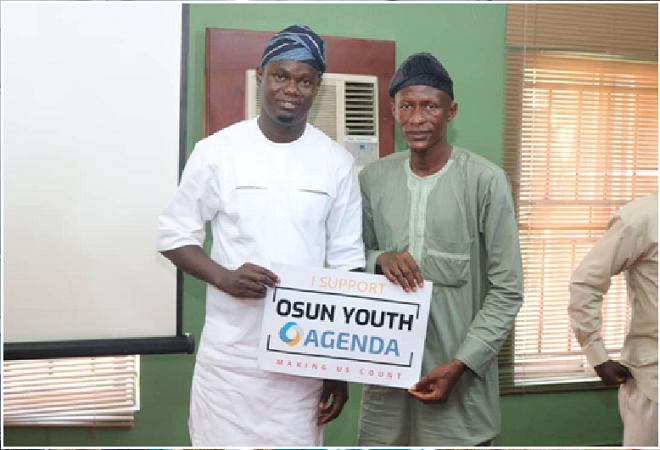
This prompted the organization to roll out a survey – Youth Priority Needs Survey (YPNS)- across the length and breadth of the state. The survey was meant to give the youth a voice in their own affairs and as well identify and validate the areas of their needs.  Employment and Wealth Creation; Improved Agriculture; Improved Health Facilities; Quality Education and Improved Infrastructure were the talking points. The outcome culminated in the tagline for the campaign – Osun Youth Agenda. With funding from donor agencies such as National Democratic Institute, United States Agency for International Development and United Kingdom Agency for International Development, KDI began a journey not only to clearly and smartly articulate the voice of the youths on their priority needs but also to make such needs policy driven. This was an onerous task because the aggregated voices of the youths on their needs must be heard by the stakeholders who must be moved to draw them into policy and budgetary frameworks for implementation. In this time and era of dwindling resources amidst rising government bills, it was imperative for the youth needs to align with existing government programmes.

As a member of the 8-man technical committee of experts on Osun Youth Agenda, I was part of the process of smartening the demands of the youths to make them policy driven and implementable. We had a 5-day brainstorming cum engagement session where the mapped needs were turned into workable and implementable points and policy demands. After serious deliberations, it was agreed that the state needs a youth policy as well as a youth development commission.  The commission would see to the integration and mainstreaming of youth aspirations and development needs into the policies and planning processes of the state at all levels. The commission would help in implementing the youth policy. Other policy points fashioned out include a rejuvenated youth targeted agricultural scheme, conversion of a popular market in Osogbo to a computer village, establishment of a well equipped youth business innovation hub as well as the review and rearrangement of Osun Youth Empowerment Scheme (OYES).

The demand for youth development commission is the umbrella demand of the Osun Youth Agenda. Unlike a ministry, the commission would be established by law, funded through funds and grants drawn from multiple sources such as government, the private sector and development partners. Models of Lagos State Employment Trust Fund, Kogi State Youth Development Commission, Akwa Ibom Youth Development Fund and Oyo State Agency for Youth Development were adopted, adapted and domesticated. It was observed that setting up a ministry is at the discretion of the governor. But, a commission established by law stands. It could not be tampered with except through the instrumentality of the law that establishes it.

There are a number of agricultural or farm settlements in selected zones in the state. Osogbo and Ago Owu are popular settlements. The Osun Youth Agenda advocated that the settlement should be made more youth friendly and conducive for young farmers.  In order to harvest the different young talents in the IT world in Osun, it was suggested that a computer village and an Innovation hub be established to enable young Osun IT-preneurs to flourish. There were equally recommendations concerning reviewing the existing Osun Youth Empowerment Scheme. It was recommended that the scheme be repackaged to encourage the participants to become entrepreneurs. This scheme should train the young participants in business development; give them seed funding and as well attached them to successful entrepreneurs for mentorship for a certain period of time.

KDI employed an intensive advocacy strategies and tactics. The technical committee members and the KDI team were involved in advocacy visits, stakeholder engagements, policy brief generation and policy dialogue. The campaign which started with a clear roadmap to the destination culminated in various visits to critical stakeholders and policy makers. The Policy Dialogue was the last of such interaction. The governor of the state was well represented by the Deputy Governor, Mr. Benedict Olugboyega Alabi. The Speaker of the State House of Assembly, Rt. Hon. Timothy Owoeye and the Chief Whip, Hon. Tunde Olatunji were at the dialogue too. The policy dialogue also had in attendance  high representations from concerned ministries including Ministries of Agriculture, Health and the then Empowerment and Youth Engagement. Commitments were secured from the attendees  and promises were made on the Osun Youth Agenda. Again, I led the team that collated and drafted the outcomes of the dialogue and as well coordinated the communiqué session.

It is seven months down the line when the technical committee first met with KDI for a strategy session on Osun Youth Agenda. The efforts have started to yield results. Few weeks after the policy dialogue in Osogbo, a ministry solely dedicated to youths and sports was created. A 40-year old was put in charge to run the affairs of the ministry. The bill seeking the establishment of the state youth development commission is on its way to the state legislature. The advocacy for the betterment of the affairs of the youth in Osun is yielding result. Special thanks to KDI. We should celebrate soon.
Lessons for Paytech Startups in Africa from Paypal Acquisition of Honey

0

PayPal is acquiring Honey Science Corporation, the startup that creates a deal-finding browser add-on and mobile app, for $4 billion with some components in cash. This acquisition, when it is completed, will be PayPal’s largest in its history, and will “give the payments giant a foothold earlier in the customer’s shopping journey. Instead of only competing on the checkout page against credit cards or Apple Pay, for example, PayPal will leap ahead to become a part of the deal discovery process, as well”, Techcrunch reports.

“What’s exciting is that we can take the functionality Honey now offers — which is product discovery, price tracking, offers and loyalty — and build that into the PayPal and Venmo experiences,” explains PayPal SVP of Global Consumer Products and Technology, and former Xoom CEO, John Kunze. “When Honey says they’re putting money in the pockets of their customers — that’s perfectly in line with what we want to do. We want to make digital commerce and financial services more affordable, easier to use, more fun and more accessible to people around the world,” he says.

Currently, Honey’s 17 million monthly active users take advantage of its suite of money-saving tools to track prices, get alerts, make lists, browse offers and participate in a rewards program called Honey Gold.

There is a huge lesson here for African paytech companies – you cannot just focus on competing for space in the checkout pages, you must become part of the “deal generation” if you want to thrive. The checkout page is getting crowded, and unless you have a pipeline, it may be tougher to scale your mission.  What OPay is doing where it generates transaction pipelines via its OBus, ORide and other services, is going to be part of this redesign. Of course, even if a paytech cannot acquire, it can seek partnerships, as the peril of checkout page competition is evident.

This Week In Nigeria Capital Market: Insights From Telcos, Falling Interest Rates, Inflation and GDP

2

This week’s series (Nov 18-22, 2019) features insights on listed Telcos (MTN & Airtel) and a possible debate on how you can plug-in into their growths. We looked at the falling yields on government securities and how that could affect the debt capital of your business. Also, we examined inflation and how it affects your investment and business decisions. We wrapped up with the growth in GDP as reported by the National Bureau of Statistics.

AIRTEL IS OUT TO DAMPEN THE SHINE OF MTN

The great-great-grandfather of Airtel, Econet birthed GSM services in Nigeria in 2001 and ruled the kingdom. Since then, several companies have taken the rein of Management to establish themselves as Heir to the Board, with little or no success. Econet-Vodacom-Vmobile-Celtel-Zain then Airtel came in, like a lion King, roaring to the telco thrown. Can Airtel ever rule the land again?

If you think it’s impossible for any Telco to take the reign from MTN, you may want to look at the growth trajectory of Airtel in the last 5 years.

Airtel has added 23.4 million customers in the last 5 years to record over 92% growth, compared to MTN’s 6.9 million and 11.8% growth in the same period. As of September 2019, Airtel had 48.9 million subscribers and MTN, 65.3 million subscribers.

How it concerns you: if you have to choose a business partner between Airtel and MTN, which will go for? The one that currently leads with numbers or the one with huge growth potentials and greater positive momentum?

Your solution: remember, this is Professor Ndubuisi Ekekwe’s MBA Class of wits, everyone is good enough, let’s have your take on the question? If you need more points to make your case, read on …

Mobile money will decide the future, it will decide the battle.

Nothing arrests our optimism in Africa these days more than the massive opportunities provided by mobile financial services (fintech), the conquerors of that ecosystem will rule the future. Unlike Kenya, in Nigeria, there are two opposite ends of the mobile money spectrum, “…You have a telco-led model and a bank-led model,” Iyinoluwa Aboyeji.

Unlike the Banks that serve just over 39 million bank accounts, the telcos have a potential clientele base that doubles the accounts the banks serve. Currently, MTN has the advantage over other telcos, aside from its clear lead in subscriber base, MTN is also the leading telco as far as fintech strategy is concerned. As a telco, you need two licenses to fully spread your fintech gospel, Super-Agent and Payment Service Bank (PSB) licences, both from CBN, MTN has one in the bag already.

On the 25th of July 2019, MTN’s subsidiary, Yello Digital Financial Services Limited (YDFS) obtained a super-agent licence from the Central Bank of Nigeria (CBN) which would enable it to build an agent network and accelerate the growth of its fintech business.

The commercial launch of the agent network (MoMo) was done on the 29th of August 2019 in Abuja, Nigeria. MTN reported in its 30th September financials that it had registered 66,000 super agents since the launch of its super-agent services in August, 2019, and grew fintech revenue by 21.7%.

Airtel has filed for Payment Service Bank (PSB) and Super-Agent Licenses with Central Bank of Nigeria (CBN) and will likely get one before year end, compared to MTN, that’s no biggy. What thrills me most is Airtel’s aggression even before receiving the licences, the following partnerships are in place already:

  • Mastercard Partnership: On 9 October 2019, Airtel announced a partnership with Mastercard which will give Airtel Money customers the ability to make online payments globally via a virtual Airtel Money Mastercard.
  • Ecobank Partnership: On 21 October 2019, the Company announced a partnership with Ecobank which will allow Airtel Money and Ecobank customers across Africa to improve their access to mobile financial services and carry out a variety of mobile transactions.
  • FINABLR partnership: On 22 October 2019, Airtel announced another partnership with Finablr which will enable Airtel Money customers to receive money directly to their phones, in their Airtel Money wallets, from more than 160 countries around the world.

On 14th November 2019, Airtel acquired additional spectrum to expand and strengthen its LTE services across the country.

Across its other African markets, Mobile money continues to be Airtel Africa’s fastest-growing business segment, delivering revenue growth of 46.5% in the first half-year, and slightly above 50% in Q2.

Exciting times ahead in the mobile money space, fintech war is looming.

Back to our earlier question, which telco will you partner with, MTN or Airtel?

Let’s dive into recent numbers:

Year-on-year (i.e comparing same period this year to last year) performance of MTN and Airtel based on their 30th September financial reports:

Financial Highlights (MTN):

  • Service revenue increased by 12.1%
  • Voice revenue by 10.1%
  • Data revenue rose by 34.9%

Operational Highlights (MTN):

  • Active data users grew by 8% to 22.3 million
  • Data traffic volume increased by over 68%
  • Data contributed 18% to service revenue (Q3’18:15%)
  • Voice remained the key contributor to service revenue at 73.5%

Financial Highlights (Airtel):

  • Revenue increased by 23.2%
  • Voice revenue grew by 13.1%
  • Data revenue was up by 75.7%

Operational Highlights (Airtel):

  • Data customer base increased by 20.8%
  • 4G data usage increased by almost 20 times
  • Data revenue now accounts for 31% revenue

The data war during the period under review was characterized by significant investments in 4G infrastructure and expansion.

  • 62% of Airtel’s sites are now 4G while it’s 35% in 64 cities for MTN.
  • Airtel grew its data customer base by 20.8% while MTN did 7.7%.
  • Data now accounts for 31% of Airtel’s revenue while it’s 18% for MTN.

The shares of Airtel is currently priced at 298.80 and MTNN at N120.00.

If you have built a business model that will leverage on the business of telcos, you should be cheerful because the goodies you see now is nothing compared to what’s coming.

Data, mobile money and everything that comes with it feel like a goldmine….

The question is: on which side will you be when exploring the Goldmine? Airtel or MTN?

YIELDS ON TREASURY BILLS AND BONDS ARE FALLING, INTEREST RATES ARE ON THEIR WAY DOWN TOO. Get your business plans ready, the banks and finance houses are coming to beg you for business.

Like an Emperor, the CBN Governor is stamping his foot on the monetary system with order-based monetary policies, whether we like it or not it’s working and growing businesses, at least for now.

At the last T-Bills Primary Market Auction (“PMA”) on 13th November 2019, the CBN successfully offered N125.2bn worth of instruments across 91, 182 and 364 Days tenor at respective stop rates of 7.998%, 9.00% and 10.00%, this is the lowest rates we have seen in 3 years.

On 20th November 2019, the following week, successful bids for FGN Bonds were allotted at the rate of 12.0000% for the 5-Year, 12.9300% for the 10-Year and 13.3900% for the 30-Year Bonds. Those rates indicate a significant decline from the rates at which the Bonds were issued at the October 2019 FGN Bond Auction.

Coupled with CBN LDR directives that have forced banks to increase their loan to customers, and at doing that must meet a minimum target of 65% by December 2019 (simply put, all banks must achieve a ‘B’ grade in their loan to customers). The combined cash that will be forked out by Banks in the process is estimated at over a trillion naira.

Smaller finance houses who have been supporting SMEs with decent rates and leaner loan requirements are now feeling the pressure of the excess loan money from banks, they are telling our clients to return our loans and come for theirs at cheaper rates. To retain our clients, we have been cutting rates too. Clearly, the supply of loans is now heavier than demand, basic economics tells you price will fall, the price here is interest rates!

Business Lesson: if you have a decent business plan and the banks have been chasing you away, this is the time to go back. If you already have a loan with a bank and you want more for business expansion, this is the time to go back. If your current loan with your bank is at 30%, this is the time to go back and negotiate the rates down to 25%.

If you need advisory on any of those lessons, feel free to reach out.

Finally, on this beautiful monetary policy regime, someone should remind the government that this can only work for long in the short-term, it cannot fix things permanently. You cannot use monetary policies to force growth when fiscal policies are not commensurate.

In perspective, imagine you got a cheap loan at 16%, that’s awesome right? But you still have to spend 4 hours is traffic and only 5 hours to stay on the generator in order to save cost, all because of the huge infrastructure gap, how much growth can you have in your business despite the cheap rates? We need aggressive fiscal policies to fix infrastructure, that’s where the real growth is.

In the meantime, enjoy the cheap rates and grow your business.

INFLATION IS ROBBING YOU, YOU NEED TO KNOW WHAT YOU ARE LOSING TO INFLATION TO GROW YOUR WEALTH IN REAL TERMS.

Earlier in the week, the National Bureau of Statistics (NBS) released inflation figures for the month of October 2019, inflation is now at 11.61%, the highest in 17 months.

Here is the implication, if inflation were to stay at 11.61% rate for the next 12 months and you invest N100,000.00 in fixed income security (or any other business) to earn 12% annually, after 12 months, your precious N100,000.00 will effectively worth N100,390.00.

Don’t mix it up, your bank or investment house will credit you with N112,000.00 after 12 months but effectively, that 112,000.00 is now worth N100,390.00. Inflation just robbed you off N11,610.00.

As you have seen above, any investment in T-bills at the moment will come back with zero real returns. This erosive impact of inflation on investments makes it particularly important to find ways to potentially boost the returns on your long-term savings and investments.

Lesson: whatever you are putting your money into must earn you some reasonable premium above the inflation rate.

GDP GROWTH RATE MINUS POPULATION GROWTH RATE EQUALS NO GROWTH…

On 21st November 2019, the National Bureau of Statistics (NBS) published GDP numbers for Q3’19. According to the periodic report, real GDP expanded by 2.28% year-on-year, better than what we have seen all year. It is expected that the current policies of the government, especially monetary, will keep growth rate at around the same 2%. This is still below the current population growth rate of 2.6%, effectively, no growth.

Apparently, government along with the CBN are doing everything to grow the economy, we saw the results again in improved GDP figures except that Nigerians too are doing everything to grow the number of their families.

In perspective, if you are promoted at work with a 25% increase in salary, then you go ahead to add another child that will increase the family running cost by 26%, have you really been promoted?

Here is where we draw the curtain on this week’s series.

Move Different with Helicopter Across Nigeria

0

This is Vetifly, a digital mobility company where any person can book for a helicopter, across routes in Nigeria and beyond, via smartphones, without brokers or agents. It works on aggregation construct which uses technology to reduce frictions between demand and supply.

Vetifly is an on-demand helicopter booking service. With Vetifly, you can book a lift on a helicopter in just seconds and reserve your seat on one of our scheduled flights. You may also charter one of our helicopters to meet your needs.

Few days ago, we unveiled our waitlist as we march to Q1 2020 public launch. Visit this link – www.movedifferent.ng  and complete our simple form to indicate your interest. No payment is required – we just want your contacts so that we will inform you when the app is ready for download. More so, from the waitlist, some will be winning free lifts from us as we open new routes.

More so, Nigerians in Diaspora or friends of Nigeria who visit Nigeria often, whether for personal reasons, for work or business, should also take advantage of the opportunity to join the Waitlist.

Visit this link – www.movedifferent.ng and complete the easy form.

Vetifly Team

The World of Records – Get Some Great Records In Your Resume!

1

There are things you cannot explain. Liverpool continues to win in the English Premiership. If they have not scored in the last 5 minutes in this season, they may be mid-table. But somehow, Liverpool keeps finding the nets, ripping the hearts of Manchester City fans. That Roberto Firmino‘s goal five minutes from regulation, shortly after Wilfried Zaha had brought Crystal Palace level is a goal for a team that could see the glory [I switched off when that happened, not a fan!]. Of course, the most amazing game today is really Man City winning over Chelsea.

Then, the Spurs winning over West Ham as the special one,  Jose Mourinho, returns. There is a business lesson there: people with prior great results continue to be recycled despite the abundance of new people looking for opportunities. You cannot make this up, as one CEO leaves one job for another job, and another CEO from another company fills it up. Jose has moved from FC Porto, Chelsea, Inter, Real Madrid, Chelsea, ManU, {vacation in my village}, and now is gifted another via Spurs. 

Why? He has the rings – Champions League which means he is validated, and no human can dispute his pedigree despite the effervescence of near-relegator with Chelsea a few seasons ago.

That is what happens in America football – the NFL. You cannot be retained as a  TV expert-analyst if you have never won the Superbowl, either as a coach or as a player. Without the rings, Jose would be expanding the size of his TV to watch the games in his house.

Records, Records build careers. Even when they begin to fade, the kingmakers always default to the man or woman with records. Get some great records in your resume!