DD
MM
YYYY

PAGES

DD
MM
YYYY

spot_img

PAGES

Home Blog Page 6571

The Fight for and Against the Nigeria’s Social Media Bill

0

The Federal Government of Nigeria has intensified its determination to control social media. Yesterday, the news came that the bill known as the Protection from Internet Falsehood and Manipulation Bill 2019 has scaled second reading in the National Assembly.

The sponsor of the bill, Senator Sani Musa, and those who stand by it claim it’s time such a regulation comes into play in Nigeria for the sake of national peace and security in the country.

Apart from the social media bill, there is also the Prohibition of Hate Speech Bill sponsored by Senator Sabi Abdullai. Each of these bills is seeking to control free speech and how Nigerians react to issues.

The Nigerian Senate has overwhelmingly stood in favor of the bill, apart from Chimaraoke Nnamani, the senator representing Enugu East; others have given various reasons why the bill must be passed.

In his speech against the bill, Nnamani said he condemns it in its entirety, citing the provision of freedom of speech in section 39 of the constitution of the Federal Republic of Nigeria. He said the bill is nothing more than an attempt to censor the media, reminded his colleagues that there are existing laws in Nigeria to tackle issues of cybercrime and false information. Quoting Fredrick Gustav Emil Martin Niemoller and as reference of repercussion the social media bill may bring upon those who ignorantly passed it, he said “this bill is pure censorship; it has no business in 2019 Nigeria. I therefore oppose and vigorously condemn the bill.”

However, his opposition and condemnation of the bill did nothing to deter the lawmakers from pushing the bill, now close to its third reading.

Among those who spoke in favor of the bill is Elisha Abbo, the senator representing Adamawa north, he said:

“The issue of fake news, if it’s not regulated, if it’s not caged, it is a cancer waiting to consume all of us… I’m supporting this bill holistically, I stand to say that this bill is good and if we cannot regulate the spread of falsehood, it will consume all of us tomorrow.”

The sentiment echoed here represents what everyone who supports the bill has been saying. It’s about curtailing the damages that falsehood and hate speech could cause on individuals and the country as a whole. President Buhari, addressing the concerns about government’s move to control the media in his Independence Day speech said:

“Whilst we uphold the constitutional rights of our people to freedom of expression and association, where the purported exercise of these rights infringes on the rights of other citizens or threatens to undermine our national security, we will take firm and decisive action.”

Nigerians have been a little unbothered in the beginning, until the contents of the proposed bill appeared online, and it brought outrage with it for reasons remarkable in other countries that have similar media control laws.

Part 3 (12) of the bill empowers enforcement agencies to shut down access to the internet and social media without recourse to the National assembly or a court.

The section reads: Law Enforcement Department may direct the NCC to order the internet access provider to take reasonable steps to disable access by end-users in Nigeria to the online location (called in this Clause an access blocking order), and NCC must give the internet access provider access blocking order (emphasis ours).

An internet service provider that refuses to obey the order on conviction by a court may be fined N10 million for each day the order is not obeyed.

A section of the bill prescribes a fine of N300, 000 or three year jail term or both for anyone found guilty of making statements that diminishes public confidence in the performance of any power of the government. That means, anyone criticizing a public office holder for not living up to expectation is liable to go to prison.

It is based on these highlighted sections of the bill and many others that dissent arose on Thursday against it. Critics believe it’s a calculated ploy in the guise of “curbing falsehood and hate speech” to muzzle the only medium that Nigerians have used to criticize the government and expose wrongs to the world.

The former Director General of BPSR, Dr. Joe Abba, joined other Nigerians who are registering their displeasure with the hashtags #SayNoToSocialMediaBill #SayNoToHateSpeechBill, to denounce the bill. He tweeted:

“I, Joe Abah, say no to Social Media Bill. It is a grievous infringement on the constitutional right to free speech. We must be able to speak our minds, even when we are wrong or mistaken, without fear of intimidation, harassment or incarceration by the State.”

The popular singer, Simi, didn’t hold back her voice, she tweeted: “This, Social Media Bill is very worrisome. We’re used to taking everything so lightly. I doubt most of us understand the implications of this if it gets passed. The things I’ve been reading are crazy. Freedom of speech is almost all the power we have left.”

One after another, Nigerians have been signing a petition initiated on Change.org against the Bill. Contact information of senators are being published on twitter, and everyone is urged to call his senator demanding they drop the bill.

Among the fears that have been expressed by the people is that Nigeria may end up like Congo, Cameroon, Iraq, Iran and every other country notorious of shutting down the internet whenever there is a protest by the people against the government.

Extend The Capabilities With Zenvus Imaging System

0

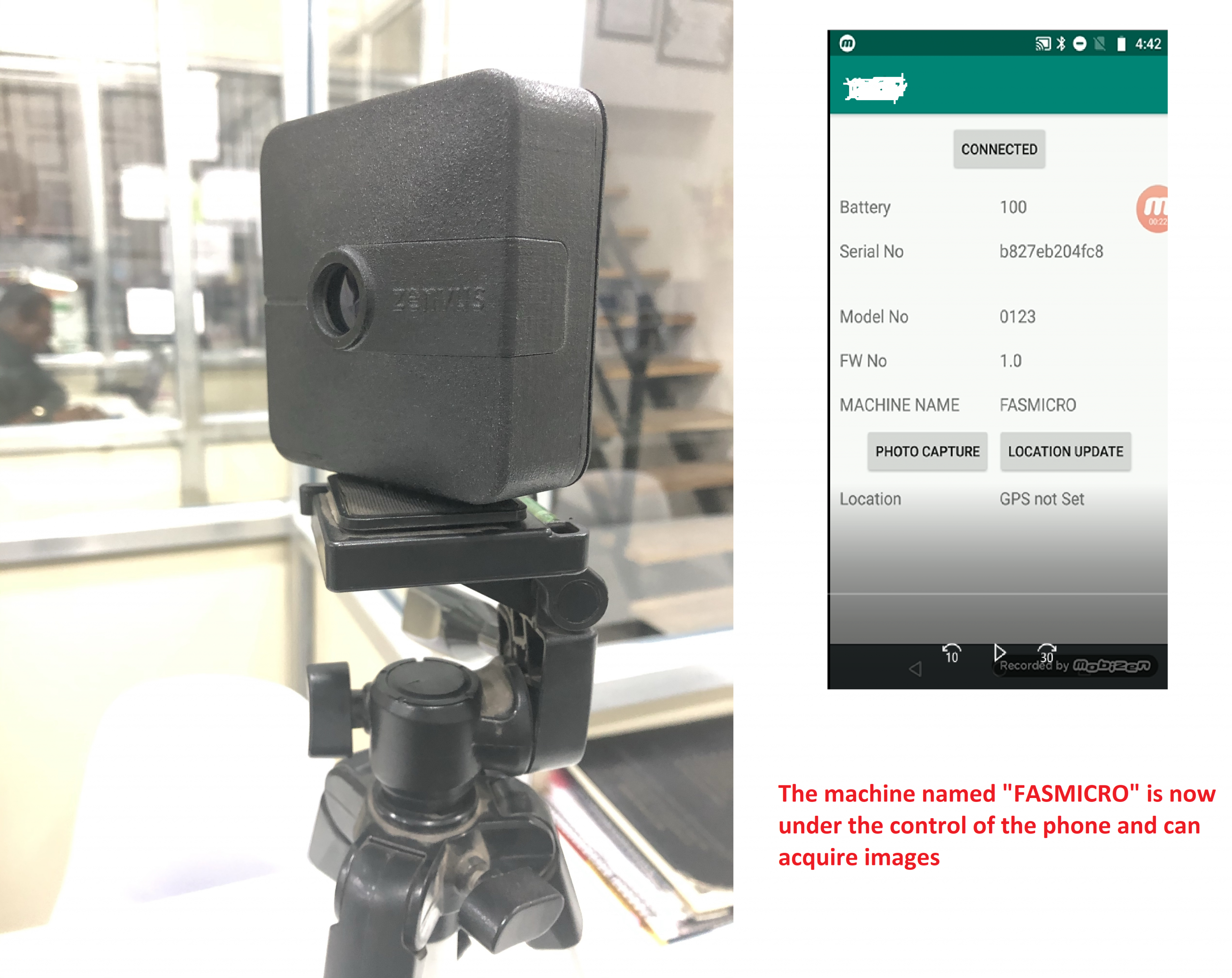
From Fasmicro’s Zenvus Lab – you want to extend your hands to capture an image. Think of the efforts to take a group photograph and every person wants to be in the photo with no one volunteering to do the shooting. (We have a similar friction for an industrial system but the problem being that the elevation is higher than the FOV (field of view) of the image taker.) We have a simple solution: have a Zenvus camera and install our proprietary app (not on Play store or IOS store).

The Zenvus camera will be positioned to do the image capturing. Each of you, all smiling, can then use your individual smartphones to take photos and magically everyone will be in the photos. There is a time setting that can give you time to hide the phones before Zenvus camera begins to take the photos.The images you acquire can be GIS tagged and converted into many image processing formats, enabling all kinds of things. Interestingly, we have not made the camera for “group taking photo” but an application it would be used depicts similar constructs where elevations of camera field of views are critical.

This does not need Internet to work as you can create a “local network” for all to work seamlessly.

Zenvus >> Intelligent Solutions


LinkedIn Summary

From Fasmicro’s Zenvus Lab – you want to extend your hands to capture an image. Think of the efforts to take a group photograph and every person wants to be in the photo with no one volunteering to do the shooting. (We have a similar friction for an industrial system but the problem being that the elevation is higher than the FOV of the image taker.) We have a simple solution: re-engineer the firmware in the Zenvus imaging system and extend the possibilities by making it such that everyone can time-take the picture with his/her personal phone, “taking” over the capturing camera. This does not need Internet to work as you can create a “local network” for all to work seamlessly.

The machine named “Fasmicro” is the engine built in the camera firmware to enable you to create a protocol that can help this image capture. We process the images in seven different formats delivering insights on what is being seen.

The Dangers of Learning Without a Well-Defined End-Goal

0

I’d like to switch gears to touch on a subject that’s near and dear to me: how to make learning more effective and meaningful. If I launched a poll to sample opinions regarding the relevance of each course you took in college, more than likely it’ll reveal a list of courses which were perfunctory at best or simply a blatant waste of your time. For courses that fall into this bucket, I’ve sampled the opinions of family and friends to understand why. Their reasons can be broadly summarized as:

The future relevance of the course content was not immediately apparent at the time. This adversely impacted the level of effort committed to it. 

This opinion piece focuses on why future relevance is key to effective learning today. Over the course of my decade-long practice as an engineer, I’ve often come across concepts that were totally opaque to me back in college. However, under different circumstances these seemingly impenetrable ideas turned out to be easier than expected. The new scenario often entailed: a clearly defined problem along with the desired end results, lofty expectations from management and a tight deadline to top it off. 

A good example of this for me is “Engineering Statistics”. I took this course in my 3rd year as an engineering student in Obafemi Awolowo University (OAU) Ile Ife. It was a mandatory course in statistics for all students of the faculty of technology. I barely understood a thing and got through by the skin of my teeth. My result: 40- E. I remember this clearly because it’s the worst mark I’ve ever received as a student. One mark lower and I would’ve had to retake the course.

I recall struggling through the drudgery of endless impromptu tests, homework and exams. I never saw the point of the concepts to my future career as an engineer. While there are a few other reasons to blame for my poor performance, I thought my professors (or lecturers like we called them back in Nigeria) were simply sadists who were hell-bent on ensuring my sojourn through OAU was as painful as possible. By the way, some of them actually were. But that’s the subject of a separate write-up.

Fast forward a few years, I’m working with Intel D1C as a Process Engineer. I’m shocked at how much statistics is required in manufacturing. My learning curriculum on day 1 included Stats courses that covered everything from sampling to hypothesis testing. The key difference here however was that I had clear manufacturing problems that needed solving. A good knowledge of “Engineering Statistics” would go a long way in arriving at the best solution without needless iterations of wasteful experiments. 

I confronted this behemoth head on and was shocked at how easily I was able to comprehend the concepts. Understanding the problem I was trying to solve gave me laser focus on key areas of the course curriculum. It also narrowed my questions to things that were relevant to the problem at hand. I was able to master concepts in weeks that took me months to flunk back in college.

If the purpose for the existence of companies is to solve problems, for which they get compensated, doesn’t it make sense to first the immerse problem-solvers in the issues and have them work back to a solution? Immersing workers in the full gamut of the problem facing any organization is key to its success. The challenges faced by companies tend to be complex and multifaceted. Only personnel who are aware of this possess the diversity of perspective to proffer effective solutions. 

This top-down approach to problem-solving weeds out over-simplification of complex issues and gives workers the oomph to hunt down a solution where one isn’t in clear view. As organizations grow the tendency to develop harmful work silos increases. This tendency means the vast majority of problem-solvers only possess a narrow perspective of the issues facing the organization. Complete immersion implies breaking these barriers by exposing engineers, for instance, to the financial or marketing angle of their problem to increase the chances of global success.

The most successful companies today are ones that are uncompromising in hiring the right talent and developing them for success. Effectively deploying such talent requires training that exposes them to the full complexity of the problems being faced. Only then will your hiring start to positively impact both your top and bottom lines.

Lessons learned from investing in Africa’s top businesses

0

Press Release

Africa’s startup ecosystem on the brink of massive growth

The growing number of startups securing major financial commitments, sets the stage for an entirely new era of growth in the African venture capital industry. This was the most discussed topic during the sixth edition of the Africa Early Stage Investor Summit #AESIS2019 held between 13-15 November in Cape Town, South Africa.

Growing interest from foreign investors – including an increasing number of Chinese investors – , startup valuations becoming too high, entrepreneurs increasingly looking to international markets and the question if local entrepreneurs are really benefiting from the influx of funding, were highlighted across a rapid series of panels, keynotes, fireside chats and roundtables across the three day event, that marks the 6th year VC4A and ABAN organize the Africa Early Stage Investor Summit.

Lessons learned from investing in the continent’s top businesses

Industry leaders challenged these topics while sharing insights and lessons learned from investing in the continent’s top businesses. At #AESIS2019, participants dove head-first into these and many more startup ecosystem topics with African powerhouses like Pieter de Villiers, Eghosa Omoigui, Keet van Zyl, Rebecca Enonchong, Ido Sum, Lauren Cochran, Tomi Davies, Marième Diop, Johann Choux, Paul Cook, Yassine Oussaifi,  Llew Claasen, Abu Bakr Cassim, Olivier Furdelle, Khaled Ismail, Ben White, David van Dijk and many others, leading the conversations.

The 2019 event comprised 3 days of rich content and networking activities including new components this year such as a full-day Fund Manager Training and curated speed-dating sessions between Limited Partners and General Partners. Both of which were oversubscribed. The first day of the Summit also included the first Annual General Meeting for the African Business Angels Network (ABAN) as efforts continue to spur angel investing across the continent and to unlock resources for starting companies at their earliest stages of development.

Co-organizers, ABAN and VC4A, welcomed 330 investors representing Africa’s early stage investing ecosystem. The Summit attracted the highest ever number of early stage African investors from 35 different countries representing 110+ investor organizations, funds, family foundations and business angel networks. The motivation? To bring together leading investors from Africa and beyond to network, exchange insights, create partnerships and make deals.

Key takeaways from the Summit include:

  • The number of women (co-)founders are on the rise at 18% in 2019
  • Africa’s startup ecosystem, as of 2018, is on par with Southeast Asia’s of 2014, with major increase in early-stage investing expected
  • Ecosystem actors need to stop looking to Silicon Valley and create own ecosystem model and path for growthAfrican startups create social impact but investing for profit remains leading driver for investor participation
  • Fund managers and investors need to play the long game to reap any returns while there is a need for more fund managers to enter the industry

Creating pipeline through VC4A’s Venture Showcase – Series A

#AESIS2019 wouldn’t be complete without co-organizer’s VC4A Venture Showcase that featured 12 vetted Series A-ready companies (https://bit.ly/2D4nfTB) from Egypt and Algeria to Nigeria and South Africa. Their solutions range from VR therapy to more efficient transport to an easy cashback app, and more. The Showcase simultaneously helps build pipeline for some investors and create exists for others, propelling the African startup ecosystem forward. Several past Showcase ventures currently appear on the list of companies that raised more than USD 1 million in 2019, with FlexClub from the 2019 Showcase making an appearance as well. In addition, the 2018 alumni Nawah Scientific and the 2019 participant LifeBank, have just been announced the winners of the Jack Ma Netpreneur Prize. Altogether, VC4A’s Venture Showcase companies have raised more than USD 36 million to date.

Announcing launch of Catalyst, a fund-matching mechanism for angels

Rebecca Enonchong, female founder and treasurer of the African Business Angels Network (ABAN) announced the Catalyst initiative to summit attendees. The initiative, in partnership with Afrilabs and funded by the AFD will stimulate angel investing across the continent by matching investments up to EUR 60K. She adds: “This mechanism helps build layers in the ecosystem and creates more pipeline for investors since angels will be able to invest in more businesses.”

Everyone at the Summit agreed that Africa’s startup ecosystem is maturing. To-date in 2019, over USD 1 billion has been raised with 83 deals alone exceeding USD1M and with 18% of those companies co-founded by women. “More women than in Silicon Valley,” as VC4A’s Ben White pointed out in his opening keynote. However, as anyone present at #AESIS2019 could sense, the hunger and energy to do better and to do more is mighty. With the quick adoption of Netflix across the continent, as Rebecca Enonchong highlighted to the amusement of all in the audience, the potential is endless. The key to ecosystem growth and success? Treat Africans as consumers, like anyone else.

SOURCE – Venture Capital for Africa (VC4A)

Y Combinator Exists China As U.S.-China Trade War Morphs Into Tech Car

0

The U.S.-China trade war is nothing but a tech war. Now, it is entering a new phase where digital and coding hostilities would be evident. Yes, the highly esteemed Y Combinator is shutting down its Chinese version. As that is happening, the US Army is carrying out a security review of TikTok, the extremely popular Chinese video app: “National security experts have raised concerns about TikTok’s collection and handling of user data, including user content and communications, IP addresses, location-related data, metadata, and other sensitive personal information,” U.S. Senator Schumer wrote in a Nov. 7 letter.

Y Combinator, a Silicon Valley incubator of start-ups, said on Thursday it would close YC China, a Chinese version of its U.S. program.

The move comes as tensions rise between the United States and China over trade and intellectual property in the technology sector. Y Combinator said the decision was a change in strategy unrelated to problems between the two countries.

YC China was created in 2018 under the leadership of Qi Lu, a computer scientist who was an executive in Microsoft Corp and Chinese search engine Baidu Inc.

Y Combinator said in a blog post that the incubator had changed its strategy to supporting local and international startups from its Silicon Valley headquarters.