DD
MM
YYYY

PAGES

DD
MM
YYYY

spot_img

PAGES

Home Blog Page 6571

Important Plumbing Business Startup Tips

0

Plumbing business startups are always tricky to manage. You always have competition and you need to deal with many things that are unexpected. The truth is most plumbers do not have business experience. This can easily lead to numerous problems. With this in mind, here are some important tips that will help you launch the plumbing business in the right way.

Take the time needed to analyze everything in your plumbing business. Eventually, you will be able to make good choices and you will get more clients.

Focus On The Best Service

This is, perhaps, the most important thing that you need to do when you start a plumbing business. As you can see with successful startups like https://www.fixitrightplumbing.com.au/plumber-belconnen/, the focus should be put on those services that you are best at. All plumbers are specialized in something or are simply better at a service than other services. That service is the one you should focus on.

As an example, let us say that you are very good at drain cleaning. If this is the case, start promoting your plumbing business startup by being focused on drain cleaning.

Plumbing Is Always About People

As you move from offering remote plumbing services as an individual to being a business, it is normal to be overwhelmed. You start to think about technology and making money. This can always lead to big problems when you lose sight of people.

It is the customer that makes a purchase. He/she buys from other people. Because of this, you want to hire people that are really good sellers and really good plumbers. Always focus on having a very good staff and you will be successful.

Selling Never Stops

This is something you need to learn as fast as possible when you launch a plumbing business startup. Unfortunately, after getting some leads, plumbers tend to stop promoting their services. This is a huge mistake since you never know when the influx of customers disappears.

With plumbing, you have to keep selling. This is what guarantees that you get a steady flow of customers. Remember the fact that people need plumbing services when problems exist.

It needs to be added that every single person in the plumbing business is a salesperson. This includes the person that answers the phone and responds on social media. Every single employee represents your business so selling training is actually needed for everyone.

Always Plan Your Next Step

Launching a business means that you make an investment. It takes a really long time for a plan to mature. You need to write down your visions and business ideas. Then, analyzing them and creating plans around them is needed for success.

The plans that you created have to be shared with those that you trust. This is because brainstorming helps make better plans. When you talk about your plans and you keep analyzing them, it is easy to get excited. Then, when you get excited, it is easier to turn your ideas into reality.

Alpha Mead’s CEO and Lagos Business School’s Don in the Midst of AfCFTA Realisation

0

Individuals, businesses and countries trade with a view of capturing mutual benefits that last long. When it is being done by governments, it is largely theoretical and stresses no tariffs, taxes or duties on imports, or quotas on exports. This indicates that as much as possible, there should not be protection on the part of the traders regarding individual’s interest capable of eliminating possible competition.

Having realised the need of coming together and the benefits of free trade, African leaders established the African Continental Free Trade Area (AfCFTA), signifying a critical achievement in the Pan-African trade journey. The agreement has been predicted to enhance the combined consumer and business spending across the continent. The projection is that intra-African trade would be increased by at least 53.2%.

Like various issues that trailed its acceptance, since May, 2019, different reactions have been trailing the implementation of the agreement. Experts and public analysts have expressed their concerns about the level of the leaders’ commitment to the realisation of the agreement. Various views have indicated that the governments are having problem in striking a balance between flexibility and commitment to the continent highly celebrated trade agreement.

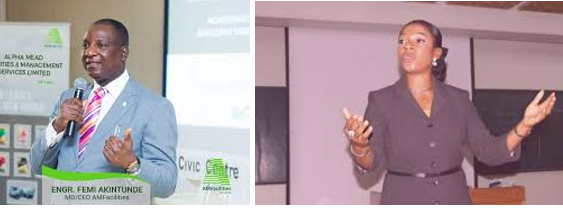
Engineer Femi Akintunde, the Chief Executive Officer of Alpha Mead Group and Dr Henrietta Onwuegbuzie of the Lagos Business School, Lagos are among the professionals who lend their voice to the agreement recently on a professional medium. This piece examines the duo’s views and brings insights for the concerned stakeholders on the continent.

Border Closure: Is It Protectionism or Violation of the Agreement?

Dr Henrietta Onwuegbuzie believes closing borders with some countries has created implementation crisis. She cited Kenya, Eritrea, Sudan, Nigeria and Rwanda as the countries that have closed borders with the expectation that Ghana is likely to follow the same step. “This reveals a crisis of implementation that needs to be resolved over time.”  However, it appears that the border closure will not be resolved soon as the Lagos Business School’s Don expected because the Federal Government of Nigeria has announced extension of the closure till January 31, 2020.

The land borders with Benin and Niger republics were closed on August 20, 2019. Nigerian government says the closure is necessary because of the need to achieve its strategic objectives such as improved internal security and economic benefits, especially encouraging consumption of local goods by its citizens. But, experts such as the Group Manager of Alpha Mead and the Don believe that the Nigerian government is contradicting itself on the free trade agreement. To them, this has reemphasized inconsistent with its 44-year long commitment to ECOWAS. Engineer Femi Akintunde hints that the lack of capacity of most African countries to control the influx of foreign goods from outside Africa into their countries will provide the access into other African countries under AFCFTA. Africa then becomes a bigger dumping ground for these foreign goods rather than benefiting from the intra-regional trade agreement. According to him, “solution is not to close borders, but to insist that only goods produced in Africa or with at least 60-70% Value Add African local content can be covered under AFCFTA. Leaders of countries that feel exposed need to protect the economy of their countries. People should stop blaming Nigerian Government,”

Absence of Comparative Cost Advantage

The lack of comparative cost advantage is another issue identified by Engineer Akintunde. This further reinforces the position of Adam Smith who said in his seminal work titled “The Wealth of Nations” that countries should focus their efforts on producing and selling goods in which they have an “absolute advantage” over their trading partners. Engineer Akintunde believes that most African countries are deficient in this and always called for protective policies such as the border closure. This needs to be solved through conscious and determined efforts by the leader in reducing recurrent expenses and invest more capital in infrastructure. “This is the surest and most proven ways to improve the economy and take people out of poverty,” he points out.

Cultural Issues

The duo identified cultural issues using different approaches, our analysis suggests. Dr Onwuegbuzie observes that “African citizens tend to be strangers to each other and sometimes their knowledge of each other is limited to negative stereotypes.” According to her, this has resulted in mistrust and inhibits trade on the continent over the years. This shackle must be removed through inter-regional meetings that allow familiarisation that facilitates trust. For instance, the recent World Export Development Forum afforded participants the opportunity to find great business opportunities to export to other African countries, she points out.

When we examined the duo views within the context of the national norms peculiar to the countries that have closed borders and made some policy initiatives since the signing of the agreement, we discovered that  the superiority, which has been contextualized within the high power distance, and the fear of the unknown, which has also been defined within the uncertainty avoidance by Professor Hofstede remain the significant factors [see exhibit 1].

Exhibit 1: National Norms of Select African Countries
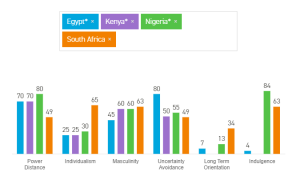
Source: Hofstede Insights, 2019

Deficit Infrastructure

Supporting Engineer Akintunde’s earlier position on the infrastructure gap on the continent, Dr Onwuegbuzie observes that the continent lack “the basic infrastructure to facilitate the logistics of goods and services and the ability to produce all we need to prevent us from being a big market for other economies, rather than ours. I completely agree with you. We need to get experts to work with the AU, to ensure that private sector contracts are granted to Africans in construction to get these things in place through a PPP of “build operate and transfer” (BOP), such that they recoup their investments through tolling the roads for example.

“The EU, which is much smaller than Africa took 35 years to integrate, so we mustn’t rush things. The devil is in the planning. Once a master plan can be agreed and made foolproof, such that no compromised African president can modify it to suit external powers, we may well then be on our way to greatness.” To meet up with the specific agreements of the Free Trade, Morocco, Tunisia, Egypt, Ethiopia, Senegal, Guinea, Côte d’Ivoire, Ghana, Benin and Rwanda need to invest $2.4trn by 2040.

What Next?

Dr Onwuegbuzie notes that the world has keyed into the opportunities that the African Continental free-trade agreement (AfCFTA) portends, but African countries are still wallowing in the implementation shackle because many remain economically colonized. However, AfCFTA provides an opportunity for the rest of Africa to free them, by making laws such as Engineer Akintunde proposed, Dr Onwuegbuzie stresses.

Engineer Femi Akintunde believes that trading blames and threatening trade wars should be stopped, while the leaders should revisit the ideas suggested by the African CEOs during the last conference held in Kigali, Rwanda. Blames and trade wars should not be the focus at this time. “Africans must find solutions to own problems. Solutions from any foreign party will benefit them more than us. African leaders should wake up to this reality. For some of us doing business across the region know the enormous challenges we are facing to start up and to scale up outside our base countries. This should not be so if we want to develop the continent. Governments should enable businesses for economies to prosper.”

Six Business Trends for Year 2020 in Nigeria

0

The year 2020 for many Nigerians marks the end of yet another decade while for others it is the start of great business and entrepreneurial feats. Without gainsaying, the Nigerian business and entrepreneurial ecosystem has grown tremendously over the past 10 years when the word “entrepreneurship” was merely confined to the lips of economists but now attained a more general and national status of honour, with curricula, policies and even dates to celebrate it.

The past decade also saw the advent of new business tools and innovative technologies making the process of starting and running businesses more efficient and fun, all of which is giving rise to a whole new wave of business and enterprises different from the traditional brick-and-mortar / “demand-and-supply” models that once dominated the Nigerian business sphere.

As usual, projections for the new year have begun with expectations for the new decade even higher. Many business practitioners are equally in high spirits to create the next generation of businesses that will take the nation by storm. It is therefore in this spirit that I present some of the top business trends that will be instrumental in the new decade, characterizing and shaping the Nigerian business and entrepreneurial landscape for the year 2020:

1) Family Owned Startups: As many Nigerian entrepreneurs and business owners are beginning to see the need for partnerships and collaborations, and more precisely the benefits of having cofounders, I predict a significant increase in the number of family cofounded startups that will be birthed in the year 2020. While the previous decade saw college/dorm-mates coming together to start new ventures, year 2020 will witness more familial addition to the mix such as daughters and mothers, husbands and wives, uncles and nephews, brothers, sisters, etc. teaming up to cofound scintillating enterprises. Such ventures have high trust coefficient and therefore stand a better chance at financing and building remark-worthy brand.

  • The Hack: Effective conflict resolution and entrepreneurial management system to the rescue!

2) Subsistence Agriculture: Massive urbanization, rural-urban migration, mechanization amongst others factors have no doubt played altering roles in our farming culture nonetheless I predict that subsistence agriculture will gain a massive resurgence in the year 2020, engaging both young and old, farmers and non-farmers alike.

  • The Hack: Empty spaces (building tops, courtyards, verandahs etc.) will become gold!

3) Adult Education: Perhaps for the pervasiveness of the internet and growing penetration of other technologies too, there’s a growing fascination and indulgence for technology and new experiences among older citizens and as such I predict an interesting increase in and around adult education. Worthy of note is the purchasing power that characterizes this demography but might require the patience and devotion of a kindergarten to fully unlock the potentials.

  • The Hack: Internet for dummies!

4) Niche Marketing: As the new decade appears and the business and entrepreneurship space continues to expand, I predict that more business & startups will further tow the path of finding and occupying a small suited market position as compared to the jack-of-all-trade approach. For example, Marketing, niched down to Digital Marketing, further niched to Social Media Marketing, and further niched down to IG Marketing etc. While many businesses might boast ambitious goals and growth for the year 2020 still, achievement of this growth will be in confined sphere of business or segments.

  • The Hack: Find your juice and SQUEEZE!

5) Mobile Phone: More than ever, the responsibility of our mobile phones will increase exponentially beyond calls, social media and surfing the internet. If you think you can’t do without mobile phones now, wait till your business, finance, health, entertainment and every area of life is dependent on it, as I predict that the mobile phones for the upcoming decade will become more like blood in the body, an accessory we all can’t live without.

  • The Hack: Mobile App for everything!

6) Data Analytics: While the previous decade saw a meteoric rise in information creation, sharing and consequently its overload, analysing data has become a thing, a thing that has come to stay. From figures ? data ? information ? action, I predict that the year 2020 will see massive adoption of data analytics, personalization, and also serving as the new basis for judgement and decision making.

  • The Hack: You can’t manage what you can’t measure….age ain’t a number baby!

The Nigerian Governors’ Forum Letter To First Lady Aisha Buhari On the “Day of Judgment”

2

This is from Premium Times:

The Nigerian Governors’ Forum (NGF) says state governors are not the sole target of a comment by First Lady Aisha Buhari that things are ‘getting out of hand’ in the country without the governments doing much about it.

Mrs Buhari, who has criticised various government organs in the past, took a swipe at the governors, saying citizens do not have access to potable water in some states.

“People cannot afford potable water in this country while we have governors,” she said on Friday at the Nigerian Supreme Council for Islamic Affairs (NSCIA) general assembly meeting in Abuja.

Then the NGF responded. This particular section got me laughing:“To insinuate that the First Lady was referring to Governors when she said, “People cannot afford potable water in this country while we have governors,” erroneously suggests that only State Governors would meet God on the day of judgment.” 

Madam First Lady, your husband is the president. If Nigeria does not have potable water, the governors are simply saying that Mr. President and the governors are jointly responsible. Yes, you cannot deflate this responsibility to governors alone since it seems even the governors now agree that a Day of Judgment will come, even though we may not have a Day of Fair Election!

Simply, tell Mr. President that we do not have potable water in Nigeria.

(Women – do not see this as an attack. I rarely go this far as I always focus on the primary politicians. But with First Lady coming into the fray, I think we need to let her know that Nigeria is still waiting for the promises, including free potable water).

Read the full NGF statement below

”That Aisha Buhari’s rebuke at the National Mosque during the National Executive Council meeting of the National Supreme Council for Islamic Affairs (NSCIA) could not have come at a better time. That the nation’s religious leaders have to be told by none other than the First Lady, Mrs. Aisha Buhari, that things are getting out of hand, is an indictment not just of governors, as the reporters would like the general public to believe, but of the nation’s entire political elite.

“Unfortunately, the haste to paint state governors with one brush or the race to hit the front pages in this case, destroyed the message that the First Lady seeks to convey. Mrs. Buhari was sermonizing on anyone in a position of power or authority to fear Allah in whatever they do because, according to her, as it is said in the scriptures, everybody would eventually account for his deeds before the Almighty God.

“To insinuate, therefore, that the First Lady was referring to Governors when she said, “People cannot afford potable water in this country while we have governors,” erroneously suggests that only State Governors would meet God on the day of judgment.

“It was in the same breath that she said, “We should either fasten our seatbelt (meaning tighten our belts) or do the needful or we will all regret it very soon because, at the rate, things are going, things are getting completely out of hand. The VP (Yemi Osinbajo) is here, some ministers are here, they are supposed to do justice to the situation.”

“How the reporters at the occasion conveniently forgot the above part of the speech and singled out governors in passing the message, therefore, remains a mystery.

“Governors are doing their best to lift Nigerians out of misery and Nigerians are beginning to witness an improvement in their standards of living because of the conscious efforts of State Governors throughout the country. The nation is replete with remarkable improvements in different facets of public life.

“It is therefore incorrect and mischievous to allude to the warning by Mrs. Aisha Buhari as only directed at state governors as there is nowhere in the speech where the First Lady referred directly to the governors.

”For example, public schools in Kaduna have received a serious boost, aged women in Ekiti State are receiving stipends from government to keep their bodies and souls together, food security has taken the front burner in Ebonyi, Lagos and Kebbi States, unqualified Permanent Secretaries have been uprooted in Adamawa State and youth empowerment has taken center stage in Ogun. There are similar examples in every single State of Nigeria, all thanks to the hard work governors are putting into their jobs.

“It is therefore incorrect and mischievous to allude to the warning by Mrs. Aisha Buhari as only directed at state governors as there is nowhere in the speech where the First Lady referred directly to the governors.

“Meanwhile Governors have also lent their voices to the social media Bill that is currently setting the tone for a showdown between the public and the National Assembly. The First Lady also made reference to the Social Media Bill in her speech at the NEC of the NSCIA.

“At its last meeting this November, which was chaired by the Governor of Sokoto State and Vice Chairman of the Nigeria Governors Forum, Rt Hon Aminu Waziri Tambuwal, the governors stated categorically that, because the Social Media Bill affects everybody, it is necessary for the National Assembly to consider holding a public hearing on the Bill before it is passed.”