DD
MM
YYYY

PAGES

DD
MM
YYYY

spot_img

PAGES

Home Blog Page 6589

How Wrong Interpretation of “Contentment” Affects Career Success

0

“Discontentment is the key to success.”

I saw that write-up on a sticker my cousin pasted on the door to her kitchen. I saw this message as far back as 2004 (when I went for a visit to Kaduna during my NYSC days) but it refused to leave my mind. In fact, I got struck by it then because it loudly disputed the usual saying about being contented with whatever we have. Then, anytime I passed that door, I would stop to read the message and ponder at it. My cousin noticed this and told me that she got the sticker from the wrapper of a toilet tissue and pasted it there as a reminder that she shouldn’t relax with whatever she has achieved. I believe she took that message to heart because her achievements today speak volumes for it.

Till date that sticker has been one of my driving forces. It made me realise that being contented isn’t what a lot of people interpret it to be. According to the Oxford Advanced Learner’s Dictionary, contentment is “a feeling of happiness and satisfaction”. People look at these two keywords – “happiness” and “satisfaction” – that occurred together and misinterpret them greatly. One of the entries for “happiness” in this same dictionary shows that the term means emotion or feeling of pleasure while “satisfaction” is “the good feeling that you have when you have achieved something or when something that you wanted to happen does happen.” So, what then does it mean to have a “feeling of happiness and satisfaction”?

I’ll give my own opinion of what contentment is but I want to describe what some people think it means.

  1. A lot of people think that contentment is being ‘ok’ with what they have. By being ok, I mean that they no longer see a reason to strive for more things or results. As for this group of people, they have ‘arrived’ at their final ‘bus-stop’ and do not see any reason for going further. This group believe that they are already successful and if they are asked to seek for more achievements, they will say something like, “I already have this and that, what else do I need?”
  2. There are people that believe that contentment means that they shouldn’t be greedy. To this group, if you strive to get more than you have, you are either avaricious or covetous and will therefore do anything legal or illegal to amass wealth. This group always say things like, “I am ok with what I have. I won’t steal because I want to have more”.
  3. There are people that assume that contentment is synonymous to gratitude. To them, if you strive to get more, you are being ungrateful to the people that helped you and your creator. In fact, this group believes that they don’t deserve what they have so they shouldn’t seek for more because that will be a sign of ingratitude.
  4. Contentment to another group of people means living a stress-free life. To them, if you are not contented, you are going to face much stress obtaining more. This group of people are the ones that tell people to be contented with what they have and not go on stressing themselves because life is too short. Women are mostly the members of this group.
  5. The last group I want to mention here are those that believe that contentment is accepting a predestined Will. They assume that fate has decided for them and has given them what they needed; so going any further means “they are on their own” and will suffer along the line (and may even fail in their ‘quests’). For that, they will want to stay in the confines of their ‘destinies’.

If you look deeply into these different opinions and views of contentment as a concept, you will notice that they are not altogether wrong; but they are not encompassing. For example, you will face stress when you go farther than your present state, but that doesn’t mean that you won’t still face stress if you decide to remain where you are. More so, you have to be grateful for what you have but it doesn’t mean you shouldn’t strive to get more things. So there is a need to widen the horizons of these different groups for them to see what contentment truly is.

The dangers of wrong interpretation of contentment include mediocrity and poverty. I see a lot of these among Nigerian working class and small scale business owners. Those who strive to rise up may find themselves branded with different negative names and characters and may sometimes be discouraged from doing so. This is one of the major reasons Nigerian civil servants are not developing professionally (because they are ‘contented’ with their meagre salaries and ‘unprofessionalism’ and do not see the need to develop themselves). Consequently, only a handful of civil servants and small scale business owners manage to get to the ‘next level’.

With these, I’ll define contentment as “the satisfaction one experiences from achieving a particular goal”. Contentment isn’t an end in itself; it is the beginning of greater achievements. The happiness and satisfaction you have for being able to achieve something should be the propellers that shoot you up to the next level. It should give you the morale to strive for greater things because you already know that you can truly achieve a goal. In fact, to be honest, if you are happy with your current achievement, you will want to obtain more.

So, instead of sitting down to give yourself a pat on the back for achieving a desired result, get up and give yourself more challenges. Remember, “discontentment is the key to success”.

How Lionheart 2 Can Win The Oscars!

2

Good People, I think it is time to move on from this Lionheart disqualification thing; we need to be thinking of way forward.  If you plan to become a movie producer in Nigeria, please do not make decisions on what will qualify you to be considered for the Oscars, rather, focus on what people would like to watch, and pay. Lionheart has won the most important Oscars out there – the Netflix deal with the $millions that came with it.  

I will encourage future producers to focus on that. Yes, do not begin your production by looking at potential Oscars categories you can submit nominations – that is irrelevant. This Oscars thing has been won in Africa, even though it is yet to arrive Nigeria.

Algeria and Ivory Coast have won Oscars before, in the same category Lionheart participated through films (Z and “Black and White in Color” respectively) produced in French. Yes, French.

Yet, South Africa’s Tsotsi won it in indigenous African languages. But Tsotsi did something different: it combined many African languages with little English to execute the deal. It has Sesotho, Zulu, Setswana, Afrikaans and English, making sure the English was below the acceptable level.

So, Lionheart 2 should include Igbo, Hausa, Pidgin, and Yoruba with English. Caution – Pidgin may be English oh!  I am sure the queen of the big board, Genevieve Nnaji, and her team, executing that strategy, will improve the odds. By doing that, she can win the local markets while going for the smiles on the Academy night. 

With this multiple language strategy, she will have something for everyone in Nigeria, guaranteeing the bank alerts. But there is risk: Academy could update its rule, requiring “Foreign Language”, not “Foreign Languages” in one film. The implication being that films with more than one non-English language will not qualify. That returns me back to the original point – do not make films just to win Oscars! 

Importance of Motivational Speakers

0

I watched a video that showed a dog ‘attacking’ a tiger. The tiger ignored the dog for sometime and then fought back. As expected, the tiger went for the kill. The caption on that video read, “This dog must have listened to a motivational speaker”.

A lot of posts and comments are coming up daily on why people shouldn’t listen to motivational speakers or read motivational books. The first time I saw a post like this, I was appalled because I know the importance of motivation in people’s daily lives. Even learning can’t take place if the learner is not motivated. So, why do people all of a sudden turn against motivational speakers?

I don’t really know the answer, but I think I can make some guesses from my observations. From what I gathered, most people believe that motivational speakers misguide people. I won’t debate on this because it is a matter of personal experience. However, it will be worthy to note here that most motivational speakers aren’t experts in what they ‘teach’. They only talk based on their own experience. And by experience, I mean what they have encountered or have seen others encounter, or even feel that others encountered, within their locality. In other words, they only express what they know, and not what is obtainable everywhere. So, it will be wrong for a Nigerian to apply what is ‘taught’ by an American motivator because they operate in different environments with different cultures and values.

Another argument against motivational speakers is that they don’t walk their talk. This argument is as old as man (remember the case of the Pharisees in the Bible). A good example given by most people here is that most motivational speakers advise people to walk away from job interviews because the interviewers were wasting their time. Another matter like this I came across is where a man complained that his wife always talks to women on how to manage their homes while she couldn’t handle hers. Anyway, like we were told in the Bible, listen to their words but don’t do what they do (lol). And like Igbo’s saying goes, “use your tongue to count your teeth” (meaning that you should act according to your discretion).

The last pointer against motivational speakers is that they are sometimes pushy. Most of them give out the air of ‘experts’ and tell their listeners and readers to do things exactly the way they (the speakers) prescribed if they want to succeed. These speakers fail to give their listeners and readers the room to do things differently. This approach of theirs can cause frustration and depression for a lot of their followers because the prescribed methods may just not work for them. By the end of the day, the negatively affected followers will either find out that there are better options or will wallow in their despair. Either way, the motivational speakers lose their fans.

Despite all these things, motivational speakers are still needed. For starters they are the tonics of the mind. Listening to motivational speakers is like taking daily dose of blood tonic and multivitamins so that you will stay healthy. This doesn’t mean that you don’t have blood and energy to move you into action; it only means that you will hardly get fatigued as you carry out your works. Motivational speakers are there to ensure that you don’t lose hope and focus in your endeavours.

Motivational speakers are morale boosters. I have personally experienced this part of them. Anytime you feel down and you listen to good a motivational speaker, you will be surprised at how he will lift up your spirit. Their talks can supply people with the zeal to carry out difficult tasks. They always seem to reach down deep into that part of people that inspires them. They can make their audience see opportunities in their challenges. They make their audience want to act and achieve positive results.

Good motivational speakers heal their listeners and readers. They usually do this by using their stories to make their audience feel that they are not alone in their struggles. They make their audience see that whatever they are passing through is not peculiar to them. Most people who are facing emotional, mental and psychological trauma usually get some relief after listening to speakers that addressed their problems. They inspire people to make changes that will help them in their personal and professional lives. They help people to look deep into their lives and see themselves in a positive light.

Finally, motivational speakers give their audience the feeling of companionship. Every motivational speaker is seen as a ‘friend’ by his audience. They always give people the feeling that they (the speakers) care about them. Being a motivational speaker means one has to open one’s door for constant communication from one’s audience. This duty of motivational speakers has saved a lot of people from harming themselves.

In all, motivational speakers encourage people to act – both positively and negatively. The world needs them. We all need them. But then, we have to sieve through to make sure we are listening to good ones.

Fixing The Root Cause of Nigeria’s Corrupt Society

0

When I talk about corruption and its banes in Nigeria, I think I hold a different view and that has sometimes been met with contempt by people. My response, whenever I’m asked about corruption and its solution in Nigeria, is simple and straightforward: ‘The problem of corruption in Nigeria is foundational. To just be throwing a tantrum at corrupt politicians, leaders, companies, youths et al., is like taking the problem from the head. We need to check and correct our fundamental values and ideals as a people because it is by them we do everything we do.’

The majority of people blame the corrupt system; I blame the wacky values that birthed the corrupt system. Some others blame the corrupt leaders; I blame the parents, guardians and decayed society that groomed the corrupt politicians!

What are our governing ideals or precepts as people? I ask.

To rid Nigeria of corruption, we need to start instilling good ideals and God-fearing attitude in our people from the tender age. As a matter of urgency and importance, we must begin to teach people (while they are yet teachable — most especially when they are kids) to stand and live by good precepts, regardless of the decay or anomalies they find in the society. Let’s inform them that they will consistently (yes, they always will) be faced with moral threats but they should always stand their ground, no matter what.

Thus, as these kids mature and grow into adults, our current crop of corrupt adults would be phasing out, and gradually, we would be building society and systems where sanctity is extolled and strength, effort, and intelligence channeled into right ventures.

I recall when I went for a job interview in one of the Asian countries’ High Commission at Victoria Island, Lagos. After scaling their computer-based tests, I was invited for an interview. I had answered a number of questions when one of the interviewers asked me what I could say about the corruption in the country. I just simply gave them the response above. I told them further that it’s not just about leaders; even most of the young lads they see on the street believe that they have to be corrupt before they can survive or achieve anything.

I thought I was speaking sense to my potential employers until I was told that I was yet to answer their questions! No doubt, they wanted me to start shouting and calling names of politicians: the popular thing people do. And this might not be unconnected with my not getting the job later on!

Now, this is not to say that our politicians are not corrupt or that we wouldn’t have fared better if we had had accountable leaders with high integrity in positions of authority, but the issue here is that we are not facing the right direction as far as eradicating corruption in Nigeria is concerned. We can’t only be condemning our leaders when our younger ones — our foundation for tomorrow — are gravely rotting away — value-wise.

Throughout my three decades on the surface of this earth, I have always seen people condemn the government. As one government left and another assumed position, people continued the same lamentation! Can’t we see that this whole thing is not working? Only people of folly would be doing the same thing in the same way, and without desired result, but continue to do it that way!

This piece is a call for us to critically look at the situation of corruption in Nigeria and start tackling it the right way. Posterity will not smile on us if we do not go back to building our moral system and set people’s idea about the way of life, work and wealth accumulation aright.

God bless Nigeria!

The OPay’s Massive 1% “Tax” on Nigerians

5

OPay has hit Nigeria’s legendary “long” gestation period before a business can turn a profit. Because you are your own electricity board (via your generator), your own waterboard (via your borehole), your own police (via your guards), etc, you have many inefficiencies in the utilization of your factors of production. Unlike in the U.S. or Europe, where your real challenge is growing the business, in Nigeria, you have to deal with orthogonal matters that may trip you the whole day. Yes, the generator man forgot to buy diesel and now there is no light to power the laptops!

So, for OPay, a platform fintech, which began life with the American startup playbook with the typical unlimited ocean of capital, it is looking like things are not working out. That explains why the company has become another “tax agency” in Nigeria by taxing its customers. But unlike the government tax agency where Senators can easily approve bills they have not seen, OPay does not even need Senate: it wakes up in the morning and changes its fees. 

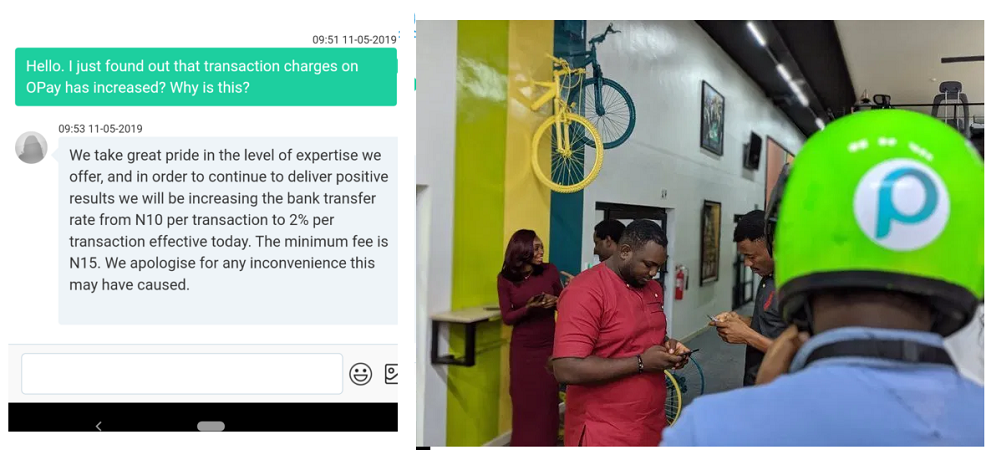
People, we have an OPay double clip (hello Ireland and Amsterdam double dips, sure for tax reduction techniques). It involves wasting N45 for first transfer of your money from OPay wallet to your bank, and then 1% flat fee subsequently. The  1% was after a revolt by the believers; the company had set it at 2%. At 1%, every bank in Nigeria at our regular N52 flat fee offers better value.

OPay is facing perhaps its first-ever backlash from customers. On Tuesday, users found out they had to pay a 2% charge for transferring money to other banks, at a minimum rate of N15 per transaction. OPay apologised for not communicating the increased fees to its customers. The company then revised the fee to N45 for the first transaction a user makes in a day, while subsequent transactions will incur a flat 1% processing fee. (TC Daily)

Let me say it here: if OPay’s playbook is to “tax” Nigerians this way, it has no future. It has been proven that Nigerians like FREE things. If you try to ask them to pay, they move in exodus. Yes, provided it is free, you are the best service provider. Any playbook that depends on attracting users with freebies and expecting a paid conversion without a new level of product evolution will fail in Nigeria. So, OPay, you can burn your $50 million war chest, and the day that money runs out, all the users will look for the next deal in town. There is nothing like lock-in in Nigeria because the hardest thing is to get a Nigerian to spend money!

Sure, OPay may be using these fees to deepen intra-Wallet transactions where everything stays in its ecosystems. In other words, provided no one is transferring outside the Wallet, no fees will be incurred by the users.

But this redesign is actually good news in the ecosystem: it validates one thing – OPay is not doing magic by making costs to disappear. With the subsidized rides on ORide, OBus and OTrike, one could have imagined that this company was not under the gravity of high cost of doing business in Nigeria. But hello – OPay is just typical. It is being normalized in the beautiful nation. If you think you can achieve what took Paga about ten years in 18 months, Lagos Lagoons will welcome your ideas and OLX, Efritin, etc may be like peers in the swimming rivers.