In apiece, I noted that Google Pixel is an attempt for Google to define what a real Android (and Chrome) hardware would be just as Microsoft Surface has done for Windows products, blunting the rise of Mac.
This is exactly the reason why Google continues to make Android mobile devices (the Pixel series). Simply, it wants to match iPhone quality and in the process help Android to be seen as an OS that can power great mobile devices of the future. Leaving that work alone to Android OEM partners could affect Android, in the long-term, if the partners fail on execution. Largely, if Google Pixel succeeds, the Pixel will become the benchmark for Android devices. Yes, Google does not need to make money from Pixel – merely inspiring the Android OEMs will be good enough!
In this article, TechCrunch made the same point. Simply, our analysis cannot lead astray!
The Go is clearly Google’s attempt to lead the way for manufacturers looking to explore Chromebook life outside the classroom. It has some nice hardware perks, but it’s not the revolution or revelation ChromeOS needs.
[…]
Google’s recent hardware event was, perhaps, something of a referendum on the play. The original Pixelbook, while not discontinued, has yet to get a refresh two years after launch. Heck, even the troubled Pixel Buds got a reprieve as the company previewed their successor. The Pixelbook, on the other hand, got the Go.
The new device isn’t a Pixelbook replacement — at the very least, Google’s looking to sell through its back stock, with some deep discounts earlier this year. Rather, the device seems to be more a tacit admission that the company was shooting a bit too high the first two times around.
The bottomline is thus: there is a time when outsourcers cannot define your product vision. You need to step up and take charge, just as this comment postulated.
You get to a point where you realise that there are certain things you cannot outsource, if you want to tell stories that are consistent with your values…
Once you figure out that your partners cannot measure up with your level of innovation, you simply take over and show them how it should be done.
There’s no guarantee that you will be successful in the new domain, but if you eventually succeed, you become a reference point, the new benchmark!
I may not agree on all the points but these ones are Y for Yes, for me:
Spending VAT proceeds on recurrent expenditure is counter-productive.
Phase out Senate and let us have only the House in the National Assembly. The experiment at the state level , with only the House equivalent, is just working fine.
The Press Release
Text of a Press Release Issued by the Board of Trustees of ActionAid Nigeria, after a review of the State the Nation on the 26th day of October, 2019 in Abuja, Nigeria
ActionAid Nigeria has followed with keen interest the various developments in Nigeria within the third quarter of 2019. Not discarding the efforts of government in improving the economy, we believe that much more can be done to make Nigeria better and safer for the citizens.
We have therefore reviewed the happenings in government, economy and issues of security within the last quarter, particularly as it affects vulnerable groups: women, children, Persons with Disabilities (PwDs), and the youths. Below are some of our findings and recommendations.
OBSERVATIONS:
• Cost of governance in Nigeria is disproportionately high relative to productivity and there is need for urgent action if government really wants to improve the situation.
• The current VAT collection system is ineffectual and porous. Spending VAT proceeds on recurrent expenditure is counter-productive.
• The 2020 proposed budget has huge provisions for debt servicing and does not address the high need for infrastructural development given the growing population.
• The growing insecurity and volatile environments in different parts of the country will make it very difficult for development programmes to be implemented if not promptly dealt with.
• Climate change is perhaps the most serious environmental threat to the fight against hunger, malnutrition, disease and poverty in Nigeria, mainly through its impact on agricultural productivity.
• The rights of communities where mining take place in Nigeria are not adequately protected. There are gaps in mining laws and investors do not comply with regulations.
• Nigerian universities lack gender-specific mechanisms to tackle violence against students, particularly females and their peculiarities.
RECOMMENDATIONS
1. To cut running cost, Nigeria must reduce the number of Ministries, Departments and Agencies as a matter of urgency. Government also must liaise with the Revenue Mobilization and Fiscal Commission (RMFAC) to slash salaries of all lawmakers and political office holders in order to save money for the infrastructural development of Nigeria especially now that funding the 2020 budget poses a huge challenge. The Senate or the House of Representatives should be scrapped as a bi-cameral legislature increases the cost of governance.
2. There is need for more consultation with stakeholders, as the proposed VAT increase will hike inflation and put more economic burden on the masses. Rather than increase VAT, AAN calls for broadening of the Nigerian tax base. We insist on a thorough appraisal of the current VAT regime and ask FG to account to the people how the proceeds are spent.
3. The 2020 budget should capture adequate funding of Agriculture, Health and Education sectors given their strategic importance. Agriculture employs up to 80% of the population, especially in the informal sector, where the majority of the small-scale food producers are women farmers. The health sector requires improved funding. Our health centers, maternities and hospitals lack basic essential facilities and drugs and evidences have shown that increased investment in these pro-poor sectors has strong impact on poverty and inequality reduction, while simultaneously creating employment opportunities.
4. While we acknowledge that the police alone cannot deliver on security, we charge the Inspector General of Police to take the battle to the criminals’ doorsteps by re-evaluating and implementing new operational strategies to stem the tide of kidnapping, armed robbery and banditry. We urge the federal and states’ legislatures to strengthen Nigeria’s legal framework in order to have stiffer sanctions that will deter people from engaging in criminal activities.
5. All hands must be on deck to cut down on carbon emissions as a way of combating global warming. We urge leaders to show courage in combatting entrenched interests in fighting climate change and also show commitment in investing in the opportunities of the future. Massive and aggressive tree planting campaign should be embarked on to reduce the effects of global warming/climate change. In addition, there should be an explicit national agricultural policy framework, adequate provision for irrigation, drainage, weather forecasting and other agricultural technology infrastructure. Furthermore, to boost agriculture, the following should be prioritized; incentive for training in agriculture, participatory capacity building for farmers, drought resistant and short duration high yielding crops development, integration of indigenous and modern knowledge on climate change adaptation, strengthening of the extension services, and encouragement for the nurturing of existing farmer groups.
6. AAN supports the Federation of Nigerian Mining Host Communities in demanding a review of laws that regulate the mining sector. We demand that the communities’ rights must be protected in the process of issuing licenses for mining. We also call for a robust mining audit to ensure fairness and transparency as well as making legal provisions for artisanal mining.
7. The 9th National Assembly should revisit and prioritize the Sexual Harassment in Tertiary Education Institution Prohibition Bill and Nigerian University Authorities across the country should take preventive measures and protect students, particularly female students by setting up safe systems that protect survivors and encourage them to report and get justice.
Moi University will be making computers and other digital devices. According to TC Daily, the ” devices include desktops, laptops and workstations using the MU Fortune brand name. Launched in partnership with Portuguese firm, JP.TK, the devices were assembled by the university’s MU technologies Digital Assembly Plant. According to the school, the plant has a capacity to produce 4,000 devices per day. The newly launched devices will retail for between $290.11 and $967.02.”
Moi University unveiled six-locally assembled Information and Communication Technology (ICT) devices that will target students, enterprises, government institutions and SMEs on Tuesday 22.
The devices, under the university’s brand name, were assembled at the university’s digital assembly plant at Rivatex in Eldoret at a cost of Sh500million.
The devices include MU Fortune Slim Book and MU Trigono, Slim desktop, mini Personal Computer (PC), Fortune desktop, Workstation and Workbook all running on the latest intel and Microsoft technologies.
Moi University will have its moment in the market. But the challenge ahead will be what happens in Kenyan borders and ports. Only the Kenyan import policies will help this experiment. With the 4,000 devices per day capacity, the unit economics will not work in favour of the university when some competitors like HP, Dell and Lenovo produce in hundreds of thousands, if not millions of units, daily. That big capacity gives the foreign brand pricing advantage through economies of scale. Yes, for Moi University plant to thrive, Kenya has to adjust some elements of its import policy. If not, this experiment will fail.
I saw a post earlier this year, where someone asserted that the only government agency that knows that people live in every nook and cranny of the country is the INEC. This may sound weird, but it’s unfortunately true. During elections in this country, electoral materials and personnel reach every part of the country (at least I believe so judging from the results) irrespective of their levels of development. But immediately after that, the interior communities become invisible to the map, again.
Now, NCTO (National Cash Transfer Office) that is established for the poor and the vulnerable couldn’t reach out to all of them. This office has several wonderful programmes running for the “poorest among the poor” but it has not been able to make itself known to every Nigerian. To be honest, I only learnt about this agency on Monday 22nd October, 2019, when I read the news published by the Punch newspaper on the disbursement of $103.64m ‘Abacha Loot’ to the poor.
While reading the news, I couldn’t help wondering what was going on. I mean, I heard one time that the federal government will collate names of the very poor people in the society. But that was all I know about this exercise. To be honest with you, I was still waiting for when this collation will start so that I can tell many of the poor people I know and beggars on the streets to go for this registration. And here I am discovering that something has been happening since 2015.
I felt cheated because most people from my area need this but they weren’t involved, nor were they informed in the first place. I decided to take some actions by going into NCTO website to source for information. Permit me to say that I came out with less than I had when I went in.
Being a government agency, I was disappointed to find out that a lot of information were missing. Some of these much needed information include:
1. Who are the Poor: What I was looking for here was just the parameters on how someone will be qualified as a beneficiary of this programme. I couldn’t find any such thing. The only thing I noticed is that communities decide who should be on the National Social Register (NSR) and who shouldn’t. However, the agency devised a way of certifying that all the people recommended by the community leaders (I presume) are qualified to be included in the register (which contains the names of those that take home #5k every month).
But then, the agency needs to provide a lot of missing answers to questions that will create transparency in their dealings. For example, the agency needs to spell out the parameters for qualifying beneficiaries, who the current beneficiaries are, where they come from (state, local government and town), their age, occupation and sex, if they have any disability, and other personal information that could be made public. In fact, there should be a comprehensive list of all the beneficiaries. We need to know the people sharing our money (after all, for starters ‘Abacha loot’ belongs to all of us).
2. What are the Participating States: I noticed that not all states in the federation have keyed in into this programme (NCTP – National Cash Transfer Programme). I seriously searched Google to see if I can get the list of the States of the Federation that are benefitting from this; but I only noticed that about 30 states are in it. Now, how do I know if my state has joined?
I’m not blaming NCTO for not getting all the states involved, so to say, because they have conditions which any interested state must fulfil before their citizens begin to enjoy this programme. It is however unfair that the public will not be able to see if their governors are lax about this programme. It is unfair that citizens of a state will be left out of something like this because their state government didn’t deem it necessary to bring them in. I strongly believe that there should be a way out for the poor citizens of those states that their government hasn’t fulfilled NCTO conditions for enrolling in the programme. But before that, the participating states should be made available for public perusal.
3.What Impact Has the Programme so Far: When I first read that $103.64m of the ‘Abacha Loot’ has been disbursed, the first thing I asked myself was, “was the money for food or for business?” Of course, I couldn’t answer that question, and I am yet to find the answer to that. To start with, the money given out is just #5k, which will get nowhere (not with the high cost of everything). So, if only #5k was given per month to these people, what impact has the programme had on their lives so far? Has any research been carried out to find out if this programme is actually helping or is just a way of throwing away money that would have been channelled to something better?
When I was searching for the beneficiaries and how that huge amount of money was disbursed, I was hoping to see that some of these poor people now have their own little houses that will shelter them from the elements. I was also hoping to see a petty trader whose business was established through this programme. Furthermore, I was equally looking for students and apprentices who are being sponsored by this programme. Anyway, I couldn’t find any – that is why there is a need for a comprehensive list.
If you ask me, I’ll only say that these people just gather every month to collect their ‘national garri’ and go out to continue with their struggle. As far as I am concerned, giving out #5k every month to people will have no positive impact on their lives. Better channels for that money should be planned. But before that, NCTO needs to carry out a survey to find out if they have actually been wasting their time.
I know that NCTO means well for Nigerians, especially the poor; but I don’t see how they have been improving on the lives of Nigerians. They need to re-strategise or all the money pumped into this will end up a waste. They need good business and economic analysts that will help to create plans to teach these poor people how to fish, and not just handing them fishes. The current method adopted will not solve the poverty problem in the country. They should think fast now before more money is given out.
But, NCTO should do one more major thing – creating a loud awareness. NCTO should make itself a household name. It shouldn’t hide in the background, where the people that need it most won’t find it. If NCTO is for the “poorest poor”, it should reach out to them and not wait for state governments to do that. And it should remember that poor people exist in every part of the country.
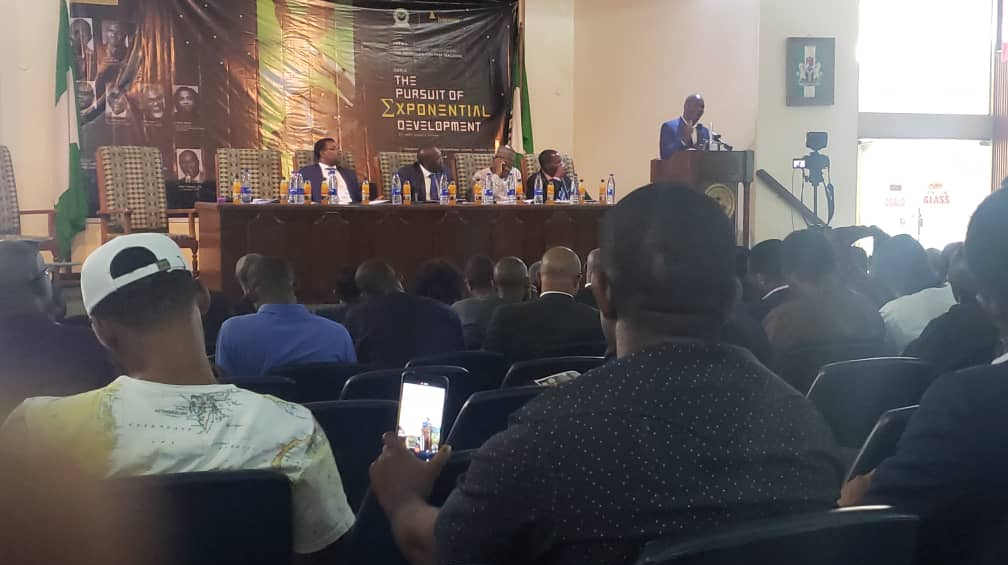
Like other alumni associations and interest groups, the Federal University of Technology, Owerri, Alumni association converged on Victoria Island, Lagos few days ago to deliberate on the issue of national importance. The gathering, which had scholars, professionals and public analysts in attendance was the 6th Biennial Lecture of the association. From the Keynote Speaker, Dr. Kingsley Fregene, to the Guest Speaker, Professor Ndubuisi Ekekwe, and the Vice Chancellor of the University, Professor Francis Eze, the theme of the conference “the pursuit of exponential development” was dissected through practical and empirical lenses.
The speakers walked the audience through linear and exponential growths and how they have been pursued around the world. From them and other existing sources, linear growth indicates the development of an object by the same rate in each time it takes to advance to a new position. In other words, it is a change in size that proceeds at the same rate over time. Exponential growth is an indication that a change is occurring when ‘the instantaneous rate of change of a quantity with respect to time is proportional to the quantity itself.’
The consensus among the speakers and the participants was that Nigeria needs to work on her policies and programmes towards economic development and growth because ‘the traditional growth strategies are grossly inadequate in addressing the daunting 21st century challenges.’ According to the Vice Chancellor of the institution, Nigeria had witnessed stunted growth over the decades, which has continued to be the bane of making millions remain in poverty and failed to place her on the league of developed nations.
Speakers and participants, once again, reminded Nigerian government and citizens about the consequences of population being grown exponentially while the economic growth is being achieved at snail pace. “As Nigeria’s population grows, there is need to embrace technologies, innovate on how we grow crops, add value to them and invent technologies to fight hunger and live a modern live,” the Vice-Chancellor stressed.
What the Numbers Say
From the practical lens to the empirical lens, the speakers and participants emphasized the need to look at what various economic numbers have implied for Nigeria in the last decade and still represent as the country moves to another decade. Professor Ekekwe believes that exponential growth hurdle is a matter of being an inventive society, not only an innovative one.
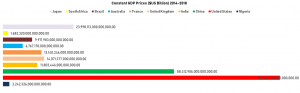
To buttress his stance, the renowned scholar and entrepreneur compared the United States of America and China using 2,000 years’ GDP constant price ($US billion). The comparison shows that China has been matching the USA’s constant prices growth rate in recent years. This was attributed to the country’s efforts to be an innovation society with the intent of advancing socially and economically.
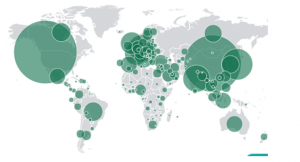
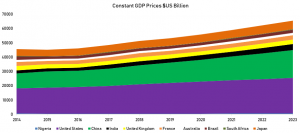
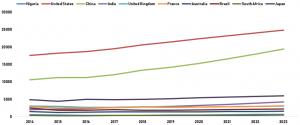
Between 2014 and 2018, Nigeria and other countries in Africa and Asia had irregular constant GDP prices growth. Within the period, it was difficult for Nigeria and South Africa to have growth similar to what was recorded by the United States of America and China [see Exhibit 1-4 for the place of Nigeria among the select countries in Africa, Asia, America and Europe]. Going forward, Nigeria is likely not to be on the par with the two countries (USA and China) because the projected constant GDP prices indicate the irregular growth rate as from 2020 [see exhibit 2].
Exhibit 1: Nigeria among other countries within constant GDP Prices Growth 2014-2018
Source: World Economic Outlook, 2019; Infoprations Analysis 2019
Exhibit 2: GDP Constant Prices ($US dollars) 1980-2024
Source: World Economic Outlook, 2019
Professor Ekekwe’s postulation was further analysed using select competitiveness indicators of Nigeria as studied by the World Economic Forum over the years to pinpoint specific issues preventing Nigeria from achieving exponential development and growth. Analysis reveals a number of results which require critical examination from the policymakers, scholars and professionals.
Analysis shows that Nigeria’s Global Competitiveness rankings within the government procurement of advanced technology products, the efficiency of the government spending, irregular payments and bribes, strength of investor protection and quality of overall infrastructure impacted the GDP constant prices growth between 2014 and 2018 negatively.
Exhibit 3: Comparison of Constant GDP Prices $US Billion I
Source: World Economic Outlook, 2019; Infoprations Analysis, 2019
Exhibit 4: Comparison of Constant GDP Prices $US Billion II
Source: World Economic Outlook, 2019; Infoprations Analysis, 2019
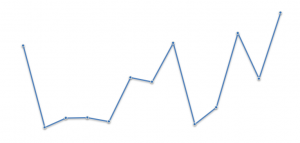
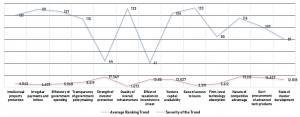
The results also indicate that poor and unsustainable tax policies and programmes, the difficulty in accessing loan and inadequate technological adoption by businesses denied Nigeria additional 45% of its GDP Constant Prices ($2,242,326,000,000,000.00) between 2014 and 2018. The severity of the select competitiveness indicators ensured that the constant GDP prices moved irrationally [see exhibit 5 where the coefficient correlation of the trend of the select global competitiveness indicators analysed along with the trend of the GDP Constant Prices ($US dollars) are presented].
The inconsistency was aided by the government failure to make the right decisions towards faster innovation, undocumented extra payments and bribes connected with imports and exports, public utilities, annual tax payment, awarding of public contracts and licenses and obtaining favourable judicial decisions.
The lack of efficiency in public fund spending, extremely underdeveloped of transport, communications and energy infrastructure, the difficulty in obtaining bank loans, low capacity for investor protection, the impact of taxes on the readiness to invest and low adoption of the latest technologies by businesses were also the blocks that prevented the country from realizing substantial constant GDP prices. These results suggest that the country needs new strategies and tactics for exponential growth as espoused by the keynote and guest speakers.
Author with Ndubuisi Ekekwe
In contrary to the position of the speakers and participants at the conference, analysis reveals that it was much easier for companies to obtain information about changes in government policies and regulations that affected their activities, for start-up entrepreneurs with innovative but risky projects to obtain equity funding and that intellectual property was protected to some degree from 2014 to 2018. It was also found that there were business clusters across the country and to some extent the Nigerian companies had some level of competitive advantage globally. However, the competitiveness was mixed between low labour cost and having unique products and processes.
Exhibit 5: Trend of GDP Constant Prices ($US dollars) and Select Global Competitiveness Indicators Correlation
Source: World Economic Forum, 2018; World Economic Outlook, 2019; Infoprations, 2019
Steps to Exponential Development
From the insights, it is obvious Nigeria needs to improve on policies and programmes that will ensure investor protection, competitive advantage, government procurement of advanced technological products, venture capital availability, enabling environment for businesses operating at different clusters across the country. These among others are essential for Nigeria’s exponential growth attainment. To be at par with the United States of America, the United Kingdom, China, Japan, India and others, Nigeria needs three categories of mindset, according to the keynote speaker.
The mindsets evolved from the development attitude index, which aims at reorienting Nigerian government and her people to the right approaches to exponential growth fulfillment. Based on the keynote speaker’s analysis and observation, it is glaring that Nigeria needs additive, multiplicative and combinatorial mindsets at different stages towards the exponential growth arena. Based on the results presented on exhibit 5, Nigeria would have attained more than what she had for the constant GDP prices between 2014 and 2018 if additive and multiplicative mindsets have been adopted while making or developing and executing policies and programmes. This is premised on the fact that at one stage to the other some select GCI indicators were constantly in movement with the constant GDP prices, which requires additive mindset. On the other hand, the select GCI indicators increased as the trend of the constant GDP prices increased, which called for multiplicative mindset.
As Nigeria continues to aspire to be exponential development and growth, the keynote speaker warned that having the mindsets are not enough, governments, businesses and people must have ‘competition scale thinking’. Within the scale, there must be evolutionary, competitive and revolutionary before the needed exponential growth could be achieved. There must be enabling public policy, retrofit, wide-aperture of human capital and clustering beyond borders within competitive, evolutionary, revolutionary and exponential developments respectively.
Exhibit 6: Factors Restricting Nigeria’s Movement to Exponential Development Stage
Source: World Economic Forum, 2018; Infoprations Analysis, 2019
Making the Steps Successful
The convergence to exponential development is not always linear. Nigeria must be ready to operate simultaneously in all four states of development. In addition to the previous suggestions, a number of frictions must be fixed by the government and relevant stakeholders, according to Professor Ndubuisi Ekekwe.
Professor Ekekwe calls for germane knowledge development and entrepreneurial capitalism. The call for knowledge-driven processes and production further reinforced the need to do every task related to input and output using knowledge and skills. On the entrepreneurial capitalism, he stressed the need for governments to make environment ideal for those who are ready to utilize knowledge and pioneer new things to fix existing frictions across the sectors.
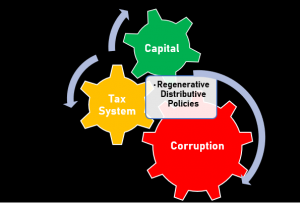
To ease the effects on taxes on the incentive to invest, establishing and operating business, he stresses the need to fix the tax fold to enhance capital availability and advocates smart tax policy to encourage more people to inject more capital into universities. Though, a positive connection was discovered for the intellectual property right protection and the constant GDP prices between 2014 and 2018, Professor Ekekwe believes that the right must be strengthened, while the fraud in the government procurement system must be eliminated using advanced technologies. Frictions in the agriculture, especially the land rights and healthcare sectors equally need attention with regenerative distributive policies that work to regenerate capital assets.
Exhibit 7: Frictions and Nigeria’s Movement to Exponential Development