DD
MM
YYYY

PAGES

DD
MM
YYYY

spot_img

PAGES

Home Blog Page 6616

The Need for Nigeria’s National Cash Transfer Office to Re-Strategize Money Disbursement Plans

0

I saw a post earlier this year, where someone asserted that the only government agency that knows that people live in every nook and cranny of the country is the INEC. This may sound weird, but it’s unfortunately true. During elections in this country, electoral materials and personnel reach every part of the country (at least I believe so judging from the results) irrespective of their levels of development. But immediately after that, the interior communities become invisible to the map, again.

Now, NCTO (National Cash Transfer Office) that is established for the poor and the vulnerable couldn’t reach out to all of them. This office has several wonderful programmes running for the “poorest among the poor” but it has not been able to make itself known to every Nigerian. To be honest, I only learnt about this agency on Monday 22nd October, 2019, when I read the news published by the Punch newspaper on the disbursement of $103.64m ‘Abacha Loot’ to the poor.

While reading the news, I couldn’t help wondering what was going on. I mean, I heard one time that the federal government will collate names of the very poor people in the society. But that was all I know about this exercise. To be honest with you, I was still waiting for when this collation will start so that I can tell many of the poor people I know and beggars on the streets to go for this registration. And here I am discovering that something has been happening since 2015.

I felt cheated because most people from my area need this but they weren’t involved, nor were they informed in the first place. I decided to take some actions by going into NCTO website to source for information. Permit me to say that I came out with less than I had when I went in.

Being a government agency, I was disappointed to find out that a lot of information were missing. Some of these much needed information include:

1. Who are the Poor: What I was looking for here was just the parameters on how someone will be qualified as a beneficiary of this programme. I couldn’t find any such thing. The only thing I noticed is that communities decide who should be on the National Social Register (NSR) and who shouldn’t. However, the agency devised a way of certifying that all the people recommended by the community leaders (I presume) are qualified to be included in the register (which contains the names of those that take home #5k every month).

But then, the agency needs to provide a lot of missing answers to questions that will create transparency in their dealings. For example, the agency needs to spell out the parameters for qualifying beneficiaries, who the current beneficiaries are, where they come from (state, local government and town), their age, occupation and sex, if they have any disability, and other personal information that could be made public. In fact, there should be a comprehensive list of all the beneficiaries. We need to know the people sharing our money (after all, for starters ‘Abacha loot’ belongs to all of us).

2. What are the Participating States: I noticed that not all states in the federation have keyed in into this programme (NCTP – National Cash Transfer Programme). I seriously searched Google to see if I can get the list of the States of the Federation that are benefitting from this; but I only noticed that about 30 states are in it. Now, how do I know if my state has joined?

I’m not blaming NCTO for not getting all the states involved, so to say, because they have conditions which any interested state must fulfil before their citizens begin to enjoy this programme. It is however unfair that the public will not be able to see if their governors are lax about this programme. It is unfair that citizens of a state will be left out of something like this because their state government didn’t deem it necessary to bring them in. I strongly believe that there should be a way out for the poor citizens of those states that their government hasn’t fulfilled NCTO conditions for enrolling in the programme. But before that, the participating states should be made available for public perusal.

3.What Impact Has the Programme so Far: When I first read that $103.64m of the ‘Abacha Loot’ has been disbursed, the first thing I asked myself was, “was the money for food or for business?” Of course, I couldn’t answer that question, and I am yet to find the answer to that. To start with, the money given out is just #5k, which will get nowhere (not with the high cost of everything). So, if only #5k was given per month to these people, what impact has the programme had on their lives so far? Has any research been carried out to find out if this programme is actually helping or is just a way of throwing away money that would have been channelled to something better?

When I was searching for the beneficiaries and how that huge amount of money was disbursed, I was hoping to see that some of these poor people now have their own little houses that will shelter them from the elements. I was also hoping to see a petty trader whose business was established through this programme. Furthermore, I was equally looking for students and apprentices who are being sponsored by this programme. Anyway, I couldn’t find any – that is why there is a need for a comprehensive list.

If you ask me, I’ll only say that these people just gather every month to collect their ‘national garri’ and go out to continue with their struggle. As far as I am concerned, giving out #5k every month to people will have no positive impact on their lives. Better channels for that money should be planned. But before that, NCTO needs to carry out a survey to find out if they have actually been wasting their time.

I know that NCTO means well for Nigerians, especially the poor; but I don’t see how they have been improving on the lives of Nigerians. They need to re-strategise or all the money pumped into this will end up a waste. They need good business and economic analysts that will help to create plans to teach these poor people how to fish, and not just handing them fishes. The current method adopted will not solve the poverty problem in the country. They should think fast now before more money is given out.

But, NCTO should do one more major thing – creating a loud awareness. NCTO should make itself a household name. It shouldn’t hide in the background, where the people that need it most won’t find it. If NCTO is for the “poorest poor”, it should reach out to them and not wait for state governments to do that. And it should remember that poor people exist in every part of the country.
Model for Exponential Development in Nigeria: Notes from 2019 FUTO Alumni Biennial Lecture

0

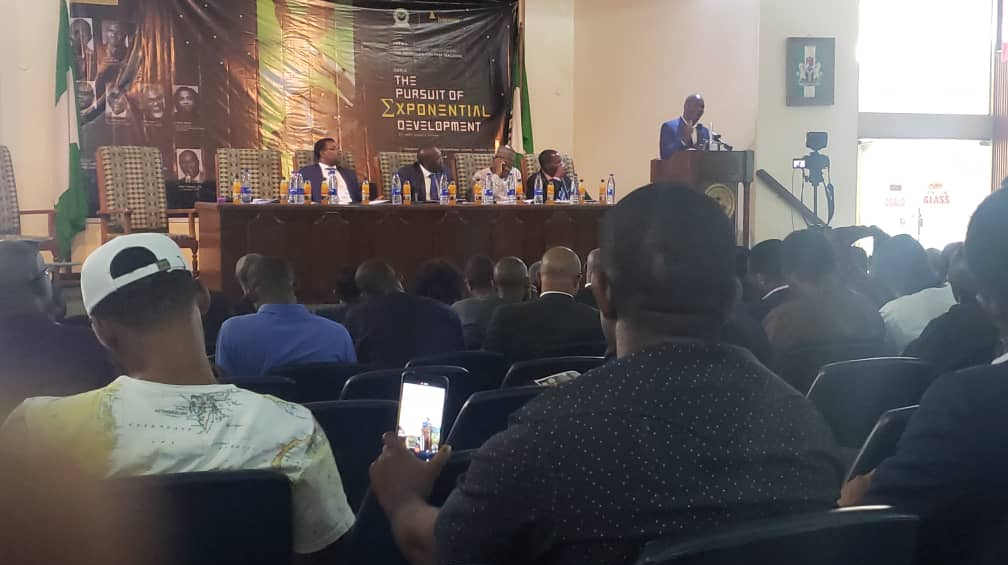
Like other alumni associations and interest groups, the Federal University of Technology, Owerri, Alumni association converged on Victoria Island, Lagos few days ago to deliberate on the issue of national importance. The gathering, which had scholars, professionals and public analysts in attendance was the 6th Biennial Lecture of the association. From the Keynote Speaker, Dr. Kingsley Fregene, to the Guest Speaker, Professor Ndubuisi Ekekwe, and the Vice Chancellor of the University, Professor Francis Eze, the theme of the conference “the pursuit of exponential development” was dissected through practical and empirical lenses.

The speakers walked the audience through linear and exponential growths and how they have been pursued around the world. From them and other existing sources, linear growth indicates the development of an object by the same rate in each time it takes to advance to a new position. In other words, it is a change in size that proceeds at the same rate over time. Exponential growth is an indication that a change is occurring when ‘the instantaneous rate of change of a quantity with respect to time is proportional to the quantity itself.’

The consensus among the speakers and the participants was that Nigeria needs to work on her policies and programmes towards economic development and growth because ‘the traditional growth strategies are grossly inadequate in addressing the daunting 21st century challenges.’ According to the Vice Chancellor of the institution, Nigeria had witnessed stunted growth over the decades, which has continued to be the bane of making millions remain in poverty and failed to place her on the league of developed nations.

Speakers and participants, once again, reminded Nigerian government and citizens about the consequences of population being grown exponentially while the economic growth is being achieved at snail pace. “As Nigeria’s population grows, there is need to embrace technologies, innovate on how we grow crops, add value to them and invent technologies to fight hunger and live a modern live,” the Vice-Chancellor stressed.

What the Numbers Say

From the practical lens to the empirical lens, the speakers and participants emphasized the need to look at what various economic numbers have implied for Nigeria in the last decade and still represent as the country moves to another decade. Professor Ekekwe believes that exponential growth hurdle is a matter of being an inventive society, not only an innovative one.

To buttress his stance, the renowned scholar and entrepreneur compared the United States of America and China using 2,000 years’ GDP constant price ($US billion). The comparison shows that China has been matching the USA’s constant prices growth rate in recent years. This was attributed to the country’s efforts to be an innovation society with the intent of advancing socially and economically.

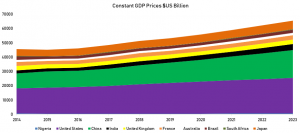
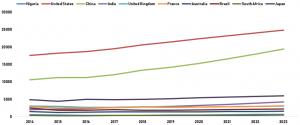
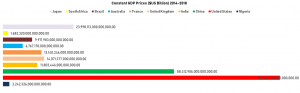
Between 2014 and 2018, Nigeria and other countries in Africa and Asia had  irregular constant GDP prices growth.  Within the period, it was difficult for Nigeria and South Africa to have growth similar to what was recorded by the United States of America and China [see Exhibit 1-4 for the place of Nigeria among the select countries in Africa, Asia, America and Europe]. Going forward, Nigeria is likely not to be on the par with the two countries (USA and China) because the projected constant GDP prices indicate the irregular growth rate as from 2020 [see exhibit 2].

Exhibit 1: Nigeria among other countries within constant GDP Prices Growth 2014-2018

Exhibit 1: Nigeria among other countries within constant GDP Prices Growth 2014-2018
Source: World Economic Outlook, 2019; Infoprations Analysis 2019

Exhibit 2: GDP Constant Prices ($US dollars) 1980-2024

Source: World Economic Outlook, 2019

Professor Ekekwe’s postulation was further analysed using select competitiveness indicators of Nigeria as studied by the World Economic Forum over the years to pinpoint specific issues preventing Nigeria from achieving exponential development and growth. Analysis reveals a number of results which require critical examination from the policymakers, scholars and professionals.

Analysis shows that Nigeria’s Global Competitiveness rankings within the government procurement of advanced technology products, the efficiency of the government spending, irregular payments and bribes, strength of investor protection and quality of overall infrastructure impacted the GDP constant prices growth between 2014 and 2018 negatively.

Exhibit 3: Comparison of Constant GDP Prices $US Billion I

Source: World Economic Outlook, 2019; Infoprations Analysis, 2019

Exhibit 4: Comparison of Constant GDP Prices $US Billion II

Source: World Economic Outlook, 2019; Infoprations Analysis, 2019

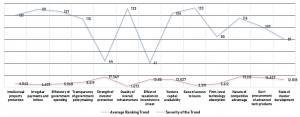
The results also indicate that poor and unsustainable tax policies and programmes, the difficulty in accessing loan and inadequate technological adoption by businesses denied Nigeria additional 45% of its GDP Constant Prices ($2,242,326,000,000,000.00) between 2014 and 2018. The severity of the select competitiveness indicators ensured that the constant GDP prices moved irrationally [see exhibit 5 where the coefficient correlation of the trend of the select global competitiveness indicators analysed along with the trend of the GDP Constant Prices ($US dollars) are presented].

The inconsistency was aided by the government failure to make the right decisions towards faster innovation, undocumented extra payments and bribes connected with imports and exports, public utilities, annual tax payment, awarding of public contracts and licenses and obtaining favourable judicial decisions.

The lack of efficiency in public fund spending, extremely underdeveloped of transport, communications and energy infrastructure, the difficulty in obtaining bank loans, low capacity for investor protection, the impact of taxes on the readiness to invest and low adoption of the latest technologies by businesses were also the blocks that prevented the country from realizing substantial constant GDP prices.  These results suggest that the country needs new strategies and tactics for exponential growth as espoused by the keynote and guest speakers.

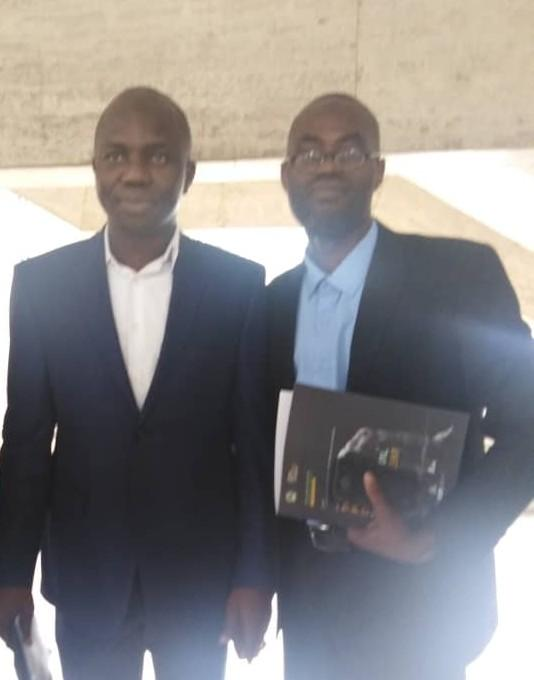
Author with Ndubuisi Ekekwe

In contrary to the position of the speakers and participants at the conference, analysis reveals that it was much easier for companies to obtain information about changes in government policies and regulations that affected their activities, for start-up entrepreneurs with innovative but risky projects to obtain equity funding and that intellectual property was protected to some degree from 2014 to 2018. It was also found that there were business clusters across the country and to some extent the Nigerian companies had some level of competitive advantage globally. However, the competitiveness was mixed between low labour cost and having unique products and processes.

Exhibit 5: Trend of GDP Constant Prices ($US dollars) and Select Global Competitiveness Indicators Correlation

Source: World Economic Forum, 2018; World Economic Outlook, 2019; Infoprations, 2019

Steps to Exponential Development

From the insights, it is obvious Nigeria needs to improve on policies and programmes that will ensure investor protection, competitive advantage, government procurement of advanced technological products, venture capital availability, enabling environment for businesses operating at different clusters across the country. These among others are essential for Nigeria’s exponential growth attainment. To be at par with the United States of America, the United Kingdom, China, Japan, India and others, Nigeria needs three categories of mindset, according to the keynote speaker.

The mindsets evolved from the development attitude index, which aims at reorienting Nigerian government and her people to the right approaches to exponential growth fulfillment. Based on the keynote speaker’s analysis and observation, it is glaring that Nigeria needs additive, multiplicative and combinatorial mindsets at different stages towards the exponential growth arena.  Based on the results presented on exhibit 5, Nigeria would have attained more than what she had for the constant GDP prices between 2014 and 2018 if additive and multiplicative mindsets have been adopted while making or developing and executing policies and programmes. This is premised on the fact that at one stage to the other some select GCI indicators were constantly in movement with the constant GDP prices, which requires additive mindset. On the other hand, the select GCI indicators increased as the trend of the constant GDP prices increased, which called for multiplicative mindset.

As Nigeria continues to aspire to be exponential development and growth, the keynote speaker warned that having the mindsets are not enough, governments, businesses and people must have ‘competition scale thinking’. Within the scale, there must be evolutionary, competitive and revolutionary before the needed exponential growth could be achieved. There must be enabling public policy, retrofit, wide-aperture of human capital and clustering beyond borders within competitive, evolutionary, revolutionary and exponential developments respectively.

Exhibit 6: Factors Restricting Nigeria’s Movement to Exponential Development Stage

Source: World Economic Forum, 2018; Infoprations Analysis, 2019

Making the Steps Successful

The convergence to exponential development is not always linear. Nigeria must be ready to operate simultaneously in all four states of development. In addition to the previous suggestions, a number of frictions must be fixed by the government and relevant stakeholders, according to Professor Ndubuisi Ekekwe.

Professor Ekekwe calls for germane knowledge development and entrepreneurial capitalism. The call for knowledge-driven processes and production further reinforced the need to do every task related to input and output using knowledge and skills. On the entrepreneurial capitalism, he stressed the need for governments to make environment ideal for those who are ready to utilize knowledge and pioneer new things to fix existing frictions across the sectors.

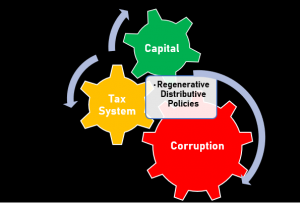
To ease the effects on taxes on the incentive to invest, establishing and operating business, he stresses the need to fix the tax fold to enhance capital availability and advocates smart tax policy to encourage more people to inject more capital into universities. Though, a positive connection was discovered for the intellectual property right protection and the constant GDP prices between 2014 and 2018, Professor Ekekwe believes that the right must be strengthened, while the fraud in the government procurement system must be eliminated using advanced technologies. Frictions in the agriculture, especially the land rights and healthcare sectors equally need attention with regenerative distributive policies that work to regenerate capital assets.

Exhibit 7: Frictions and Nigeria’s Movement to Exponential Development

Source: Infoprations Analysis, 2019

Libra Suffers Setback As Facebook Gets Government’s Knocks

0

Once again, Mark Zuckerberg found himself standing before the House Financial Services Committee on Wednesday. His journey to Washington DC has been necessitated by many questions the US Congress has in store for him, mainly on the activities of Facebook.

Although Zuckerberg was hoping to make a case for Libra, the hope was quashed by the wave of questions hitting him from many angles on antitrust and the ad services of Facebook.

Earlier in the month, US congress woman and Democratic presidential hopeful, Elizabeth Warren, has called out Facebook for publishing ads containing outright lies for President Trump. She said the influence of the social media giants in shaping electoral decisions cannot be ignored, and therefore, there is a need to keep its activities in check respecting upcoming elections in the US and what Facebook publishes in ads.

There is also a general concern about the power at the disposal of tech companies in the US, mainly, Facebook, Amazon, Google etc. and the calls to break them up is getting louder. In a campaign promise, Warren said.

“I want a government that makes sure everybody – even the biggest and most powerful companies in America – plays by the rules. And I want make sure that the next generation of great American tech companies can flourish. To do that, we need to stop this generation of big tech companies from throwing around their political power to shape the rules in their favor and throwing around their economic power to snuff out or buy every potential competitor.

“That’s why my administration will make big, structural changes to the tech sector to promote more competition – including breaking up Amazon, Facebook, and Google.”

Recently, the US government’s interest in the activities of the tech industry has upped, and Facebook has taken the center stage of the Government’s askance. The deteriorating relationship has resulted in Mark Zuckerberg’s frequent visits to Washington.

So on Wednesday, when Zuckerberg stood before House Committee once again, the arrows of quiz aimed at him were about issues like political ads, disinformation and child pornography. Therefore, there was no room for deliberation on Libra. The Democratic chairwoman of the committee, Maxine waters, puts this way:

“As I have examined Facebook’s various problems, I have come to the conclusion that it would be beneficial for all if Facebook concentrates on addressing its many existing deficiencies and failures before proceeding any further on the Libra project.” She said.

Although Zuckerberg argued that government’s failure to approve Libra would give China an advantage to lead the world of digital currency, the committee didn’t balk. In fact, they made it clear that their opposition to Libra has been because it opposes the US dollar.

“It should be clear why we have serious concerns about your plans to establish a global digital currency that would challenge the US dollar.” Waters said.

Since June when Facebook announced the idea of Libra, the US Government has not hidden its skepticism about it. The subsequent suspension of the idea has bordered on the fear it could usurp the dollar because it wouldn’t function under the control of regulators.

Facebook’s cryptocurrency head, David Marcus told The New York Times that regulators have been much more receptive to the idea in their private meetings than lawmakers. Facebook has been pushing to have its way through lobbyists and series of private meetings with regulators.

But the hope is dim and time is running out. Facebook appears to have so much dirt on their hands to clean up and the challenge of not getting broken up is becoming bigger. With the next election about one year from now, and Elizabeth Warren not relenting on her promise to tame the bullies in tech industry, there is a little chance that Libra will become a reality.

The Differences Between A Mentor And A Godfather

0

Having a godfather is good sometimes; at least you will have someone that watches your back. The good thing about godfathers is that they force you to sit-up and work (or get ditched). So it’s not bad to have one; at least it’s not really bad if you can find a good-hearted one (unlike The Dons in Mario Puzo’s “The Godfathers” – lol).

At times, someone may seek a mentor and end up with a godfather. He may find himself getting good jobs, business contracts, overseas trainings, better positions in offices, rapid promotions and so on, because he has ‘connection’. But he may find out later that a slight fallout with (or loss of) his ‘connection’ will crash-land him to the very rung of the ladder where he was before he met this ‘connection’, or even lower than that. This is why it is necessary that you know if that person you are ‘following’ is a mentor or a godfather ( I believe we all want to sustain what we have when we land in a better place).

Before going into the differences between a mentor and a godfather, I’ll like to state here that they both share some similarities. For instance, both of them are well respected and admired by the ‘seeker’. If not, he wouldn’t have approached any of them in the first place. Another thing is that they are in positions that this ‘seeker’ admires and wants to attain. And then, they are both advisers – at least they can both guide you to achieve a goal (the difference now is whose goal is being achieved).

So, here are the differences between a mentor and a godfather. Kindly note that the notion of mentor and godfather used here isn’t in relation to crime, but to legal career attainment and progression.

  1. Professionalism: Both mentors and godfathers are well established in their own professions; in fact they are experts there. But a mentor can only take-in a mentee in his own profession. He offers professional advice that are well needed by his mentee. It will be quite odd for him to take up someone whose career interest isn’t in his area of specialty because he won’t be able to help him (as needed).

But godfathers don’t necessarily take-in people in their areas of specialisation. Their godsons are like their tentacles which they spread to tap into other areas. The advice they can offer their godsons that come from other fields is a general one that will push them to get the job done. This means they may not be able to offer deep insights into some aspects of their godsons’ professions (this is one major reason godsons lose it all when they have fallout with their godfathers – they actually don’t know much about their careers).

  1. Financial Gain: A mentor doesn’t necessarily need to gain financially from his mentee. Of course mentees will always tag along and do some errands for their mentors because that’s how they learn. They (mentees) can also decide to work for them (their mentors) in order to gain deeper knowledge on their profession. But, a mentor doesn’t really take in a mentee because he sees him as a money-making machine.

This is not the case with godfatherism. Every godfather sees his godson(s) as an extension of his businesses. Godsons are to increase their godfathers’ income. They are not there to learn and gain insight into their own profession unless that will be the best way to increase their godfathers’ earnings.

  1. Career Growth: A mentor grows as his mentee(s) grows. He wouldn’t mind if his mentees become ‘huge’ in the future. They even take pride to announce to the world that they were in their mentees’ success stories. Truth is, they are there so the mentees can learn and become independent.

In a godfather-godson relationship, a different thing is obtained. A godson can never, and I mean ‘never’, be ‘bigger’ than his godfather. He (the godson) is meant to ‘serve’ him (the godfather) for as long as the relationship lasts. Any career growth the godson gets is because it will place him in a position to serve his ‘master’ better. In summary, there is no financial independence for a godson – he will always be under the whims and commands of his godfather.

  1. Encouragement Type: Mentors encourage their mentees but godfathers compel their godsons. This means that your mentor will encourage you to leave your comfort zone and face your challenges by making you see reasons you need to do that. In most, if not all cases, the reasons proffered by these mentors do not benefit them (the mentors); but they don’t consider that.

But if the person you have is a godfather, he will force you to leave your comfort zone to carry out whatever duty you are given. He doesn’t care about your comfort or welfare unless it will affect his ‘businesses’. This is to say that godfathers are very pushful (and I think some people need them for starters).

  1. Goal Achievement: Mentors are selfless because they help their mentees achieve their (the mentees’) goals. This is quite different in the case of a godfather who places his own goals before that of his godson. Put differently, in the case of mentor-mentee relationship, the goals achieved are the mentee’s; while in the godfather-godson relationship the godfather’s goals are achieved.
  2. Sustenance: So long as you are ready to learn, work hard, grow and improve on your skills and career, your mentor will always be there for you because he loves to see you grow. In fact, by teaching you, he too is sharpening his own skills. A mentor only drops a mentee when he (the mentee) ‘refuses’ to improve or waste his (the mentor’s) time.

But a godfather will only keep you as long as his need for you lasts. Once that ‘project’ he took you in for exhausts (and he doesn’t have any other ‘project’ for you) he will ditch you. So pray your godfather always have something for you.

Anyway, this is just a little piece for us to really look deep within to find out if we have a mentor or a godfather (or even to know what exactly we wanted). I believe we all know the right thing to do.

Wakanda and Akon’s Homecoming Album

2

In a recently published article Akon Delivers New Album AKONDA, it was reported that Global icon Akon is reconnecting with his West African heritage to release an album Akonda, his fifth studio album under his Akonik Label.

This album is an Afrobeats-influenced, ten-track release, which features “a slew of emerging stars from Nigeria and other African nations, including Olamide, Kizz Daniel and Skales.”

While “Low Key” is reportedly the album’s lead track, it is the following two tracks that captured my imagination and raison d’etre for this article: Track 8 entitled “Kryptonite,” and Track 10 labelled “Wakonda.” You need to listen to these clips to appreciate the homecoming.

Picture this – ‘Wakonda’ is a Black Panther-referencing parody of the UK sensation at the forefront of the flourishing ‘Afrowave’ sound, Afro B, with the hit ‘Drogba (Joanna)’, a track that is currently in the Hip-Hop Singles charts Top 10.

Akon has been acknowledged by Forbes, having been previously ranked #80 in the ‘Forbes Celebrity 100,’ and #5 in the ‘40 Most Powerful Celebrities in Africa’ list. He also clocked in at #6 on the list of ‘Top Digital Songs Artists of the Decade’.

Looking back at my 2011 article “Marketing Senegal through hip-hop – a discourse analysis of Akon’s music and lyrics” assessing the man, his diasporic chords and the place marketing of Africa in general and Senegal in particular, I must say that I am pleased with the following highlights.

It was by no accident that Akon was recruited by PepsiCo for the 2010 FIFA World Cup in South Africa through a charity single – Oh Africa! 

Future research may need to consider how to leverage the potential of celebrity endorsement or partnerships in place marketing strategies.

In an article I published almost a decade ago, I sought to highlight hip-hop’s contribution to the entrepreneurship and place marketing literature from the lens of an individual artist, Akon, whose music and lyrics ? a “hybrid of silky, West African-styled vocals mixed with North America’s East Coast and Southern beats.” In so doing, I relied upon a “discourse analysis” of the lyrics from two non-chart songs Senegal and Mama Africa, which provided the conceptual base for a better understanding of the fusion of music and entrepreneurship with place marketing.

In my findings a made an audacious claim that “through music, Akon has bridged socio-cultural (ethnic cuisine, immigration and social exclusion, faith or spirituality) and economic attributes (notably remittances) – with implications for entrepreneurship and place marketing.”

I also argued that my study “demonstrates that music and entrepreneurship can be extended to place marketing using discourse analysis.”

The latter point is noteworthy as, “Away from music, Akon pioneered the Akon Lighting Africa project, which aims to provide electricity by solar energy in Africa. Founded in 2014, the project has provided electricity in 14 African countries, employed over 5000 people and reached 1 million households.”