DD
MM
YYYY

PAGES

DD
MM
YYYY

spot_img

PAGES

Home Blog Page 6619

3 Beliefs Nigerians Need To Let Go

0

I’ve started this writing several times but I’ve never been able to pen something down. It’s not like I don’t have ideas to put down, it’s just that I don’t want to create a wrong impression in the minds of the readers. I’m always careful when addressing people’s beliefs because of their stronghold on them. But I think it’s time to voice this out.

I will introduce these beliefs I’m about to discuss here with three short stories of events I witnessed.

  • EVENT 1 – Few weeks ago, I met this woman and her daughter that is about 8 months old. This beautiful daughter of hers doesn’t pass stool through the normal channel (I think it’s a congenital issue). According to this woman, her daughter has been through two surgeries already – shortly after birth and when she was 3 months old. She was scheduled to come back for another surgery 3 months after the second one. According to her, her baby became ok after the second surgery until she was “attacked” and the problem came back again. Anyway, she is working on taking her for the third surgery.
  • EVENT 2 – There is this man in my village; he keeps having misfortune after misfortune in his businesses. It seems that any business he goes into is bound to flop, so he just ‘zeros’ his mind and waits for it to fail. One day I overheard him saying that he has “ajo chi” (bad personal god) and that’s why all his efforts towards financial independence yields no good result.
  • EVENT 3 – This one is quite hilarious, but serious. I was in commercial bus with other travellers. We were plying the disastrous Enugu-Onitsha Expressway. Those at the backseat weren’t finding it funny because of all bumping up and down of the bus. The conversation in the bus later turned to the bad road. One of the travellers at the backseat was so furious that he started calling on God to come and judge the politicians and the construction company reconstructing the road.

These three events are just three out of the millions we witness every now and then. To discuss these three events critically, I’ll brand them the ‘attack belief’, the ‘bad destiny belief’ and the ‘revenge belief’ respectively.

THE ATTACK BELIEF

This is the belief that most Nigerians hold onto when struck by ill-health or ill-luck – they believe that someone or something is ‘attacking’ them spiritually. I’m not saying that I don’t believe that there are witches, wizards and ‘the village people’. For sure, as a Nigerian, I’m forced to know of all these forces and what they do. But then, how can someone be sure that the misfortune he or she is facing isn’t as a result of mismanagement or normal course of life? How can you determine the one that came naturally and the one that came from the manipulations of something spiritual?

Before we decide that what we are passing through is a supernatural thing, we need to evaluate critically all our decisions and conducts to be sure the fault isn’t ours. I’ve heard of some people that assumed that the mistakes and wrong decisions they made were the manipulations of some evil forces. I don’t know anyway; but I think this belief is really affecting a lot of people.

For example, some sick people won’t go to hospital because they believe it’s not what doctors can handle. Some of them will go to ‘prayer houses’ for deliverance. That aside, a lot of businesses are suffering right now because their owners believed that their ‘enemies’ are doing voodoo on them. So, instead of they learning and acquiring some outstanding business skills, they jump from one place to another seeking for people that will find who their enemies are and see the future for them.

We need to let go of this belief. Even if people are coming after you spiritually, do the much you can to make life better for you and then leave the rest for God.

THE BAD DESTINY

Having an ‘ajo chi’ almost means the same thing as having bad destiny. The people here believe that they have been destined to suffer in this life. Some of them see their ill-health as one of their ‘agreements’ with their ‘chi’. This is also the same thing with those in this group that are poor.

I know that life doesn’t really give it all to one person, but I believe that some things are preventable and avoidable. For example, someone that is having issues with his business might have to sit back and do a proper evaluation of his skills and decisions. He may also want to find out why his business isn’t moving as it should. I believe that when such a person is asking and finding true answers to his questions, he will notice that destiny has no role to play in his misfortune.

One more thing, the people that belong to this group easily resign themselves to bullying, bad governance and corruption. The major problem I have with this type of people is that they are not easy to help. In fact, the more you try to pull them out, the more they drag themselves back into their ‘holes’. They see their predicaments as ordained by a divine force and your help may not be appreciated.

THE REVENGE BELIEF

A lot of people belong to this group. These people won’t ask for what is theirs, even if they could, because they believe that there is a supernatural being that will do that for them.

If you ask me, I’ll say that this is Nigeria’s general problem. We refuse to talk at times when our rights are being trampled on because we hope that God will revenge for us. Please, I’m not suggesting that we revenge when we are wronged; my point here is that we have to fight for what is right and not fold our hands and wait for a divine battle to come down and do that for us.

When some things happen that Nigerians need to seek redress for, they usually just walk away in bitterness and pain with the belief that God will revenge for them. Of course, God fights for the trampled and the downtrodden; but if you have the means of seeking redress or getting your voice heard, are you still among the downtrodden?

In this life, we have to keep learning and unlearning. I believe Nigerians should unlearn these three beliefs, they are not helping us.

10 Rules To Live By

0

As the year is running to an end, I know there are many things you would have loved to accomplish. Perhaps, you set some goals when 2019 started and said, ”I will achieve this goal before the year runs out.”

But when you look back into your diary and compare what you have set for the year, it seems like you are nowhere near the target.

The annoying part is social media. It doesn’t seem to do you any good whenever you log in. You will always see so many success stories. Listen, we simply cannot look at someone else’s mile 50 and compare it to our mile 5. You’re still running the race and it’s not over yet. And for some, you’re just warming up.

It is so sad that whenever we look around at our peers, our colleagues, our idols and we think, “I’m behind in everything.”

Absolutely no, you’re not behind. You are simply doing what’s best for you.
It’s no wonder so many of today’s students are so stressed out.

We grasp so hard at things that often are not even in our control. We live in an imperfect world that continuously tries to appear perfect. That’s just not realistic.

We are missing so many things whenever we compare ourselves. We should never compare to measure success or achievements, rather, we should compare to learn.

So many people are living imaginatively. I am not against anyone setting goals. Of course, set big goals for yourself, and yes get excited about it. But, understand it may take time to get there. And that’s okay.

Is it not funny that we underestimated the things we should have overestimated and overestimated the things we should have underestimated?

As Brendon Burchard says, “the next level opens after your next committed step” and Jay Shetty also said – ”everyone has their own timing”.

You’re not ahead, or behind, you’re where you need to be to learn what you need to learn.

Your ENTIRE story is so much better than just the first and last chapter. Have gratitude for the journey, it’s a beautiful thing. Sometimes the only thing that’s standing between us and our goals, is time.

According to Nadia, ”to succeed in life, you have to be crazy enough to pursue what sets your soul on fire. To follow your dreams and let them take you higher. Don’t be a copy of someone else
Dare to revolutionise, be an adventurer, create your own path in the woods and face the future.

Be a chaser to beat your fears. Without a saber, be a coach. Embrace your flaws without reproach. Be a painter. Paint your life with vibrant colors and make it brighter
                                                      
Be a writer and write your own story like a cavalier. Be a poet. Inspire others to dream and be their best. Be a preacher who helps others find their light and feel better. Be a stylist. Build your own style that makes you feel classy and smart.

Be everything you love. Be a blessing to the world. Let your voice vibrate through walls. Let your heart touch people’s souls. Don’t worry if others think you’re weird. Don’t forget, geniuses  are often strange.

GOD made you unique. Embrace your uniqueness. Let your gut guide you to the road that will change your world and leave indelible footprints wherever you go.

As you walk in your paths, these are the ten commandments you should always remember:

  1. Don’t base your happiness on material achievements.
  2. Success comes in different forms. Financial Success is just one out of all.
  3. Offering to help and being kind to a total Stranger has opened doors for so many.
  4. Life is like Water. It takes the shape of your mindset and how you view it.
  5. Hard work rules but Smart work is the updated Version.
  6. It takes just one decision to change your life.
  7. Never abandon those who were there for you in your time of need.
  8. There will be distractions along the way in your life journey.  Focus is key.
  9. Create moments out of the present, because the future Isn’t guaranteed.
  10. If you want to go far, create a team.


Added : Be flexible and adaptable to change to Survive in this fast-evolving world.

Thank You Soulmate Industries

1

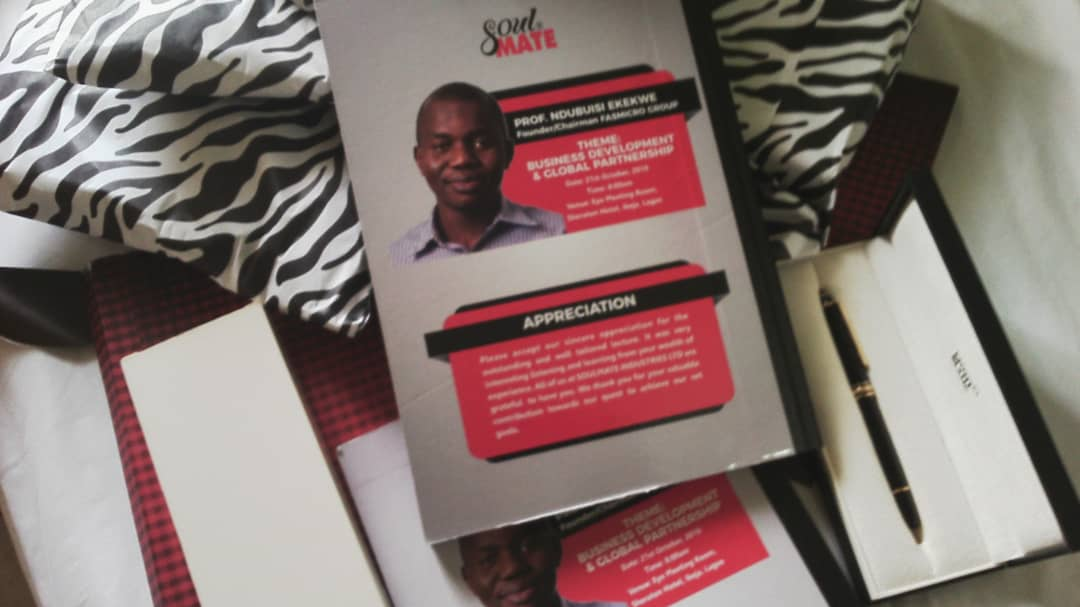
It is always a privilege, for us, when companies, big and small, invite my practice into their lives. We go with humility, knowing that we cannot know your business more than you do. But that humility is packaged with unmatched tenacity, excellence and dedication to deliver category-king value.

Yesterday, at Sheraton Ikeja, it was Soulmate Industries. Soulmate was started about 25 years ago when the founder commercialized his undergraduate chemistry project. Today, it is the largest indigenous haircare company in continental Africa, and a leading exporter from Nigeria.

People, I will have excess luggage challenge, as I make it back to U.S. Soulmate customized many gifts in my name, and practice, and then added a special pen, Mont Blanc, noting “the pre-workshop synthesis note, preparing and conditioning our team for this workshop, is so valuable that we want to ensure you will never lack pens to write”.

Soulmate – life is better when you have found your soul mate! 

With Soulmate Founder in Soulmate Factory

Lessons from Ben Enwonwu’s Christine Art

0

I love art, I love the ambience they give to a living space and some of the untold stories that emanate steadily, endlessly each time you stare at them. I’ve collected a few paintings though, mostly the ones I find attractive on the road side and I’m not done collecting yet.

Ben Enwonwu was perhaps the best we’ve had or perhaps to avoid reactions from many progressives who believe that something better is here or is yet to come I could say he was one of our finest.

The late artist is considered the “Father of African Modernism”.

His 1974 painting of the Ife princess, Adetutu ” Tutu” Ademiluyi was dubbed the “African Mona Lisa” by veteran Writer Ben Okri who won the Booker Prize for literature in 1991.The painting of the young Ife Princess after having disappeared for close to four decades, was later found in a London apartment. The artwork was later sold off at a record-breaking USD 1.6 million last year.

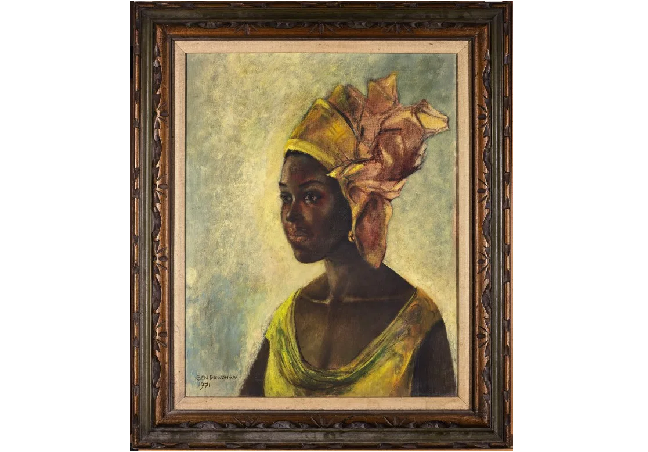
COURTESY: SOTHEBY’S Ben Enwonwu’s Christine, 1971.


CHRISTINE:

The ever charming, ever smiling Christine ,the captivating portrait of Christine Elizabeth Davis, an American hair stylist  who was of West Indian descent is the latest to be discovered. Christine had worked in Ghana before moving to Lagos with her Husband who was British in 1969. In one of their travels, they met and befriended Enwonwu and Christine’s husband commissioned the work as a gift for his wife in 1971 before they eventually moved back to the US a few years later. 

Not long ago the painting was valued by Sothebys at around $200,000, but on Tuesday (15th October, 2019) the portrait sold in London for about seven times the estimated price at $1.4 million.

This all began when a family member found an old portrait of their mother  and then googled the signature on the painting. 

THE TAKEAWAYS 

There are so many positives to take away from the story of Christine. To me it is a story of self discovery,  a story of a journey from oblivion and near nothingness to the climax of self actualization.

I will try to enumerate some of the eligible lessons from Christine below: 

  • Time has no hold on something of great value.
  • Considering the fact that it was before auctioning valued at around $200,000 but eventually sold for $1.4 million,  value depends on your bargaining power.
  • Value is relative and has got a lot to do with where something is at the moment( it probably wouldn’t be worth a fortune in a local art gallery)
  • Information is a game changer.  They only were able to discover the real value of that piece of art only when someone googled the signature on it. So if  he had not, it would only have been a beautiful piece of art hanging on the wall, standing as a reminder to the wonderful memories they shared together with their mother.

Enwonwu died in 1994 at the age of 77, he was a Nigerian artist ,the very best if you ask me whose career spanned across six decades seeing the journey of Nigeria from a colony of Britain to an independent nation.

Nigeria’s Aso Rock – This House Cannot Thrive On The Shoulders of One Man

0

From the beginning of time, the concept of division of labor has been a sacrosanct requirement for maximized productivity.

Division of labor involves the separation of tasks in any system so that participants may specialize at divisional levels of management in order for desired outcomes to be effectively and efficiently maximized.

In the Christian account of the story of creation recorded in the Bible, God created the first man Adam, but then, the omniscient God sensed a lack of completion in His creation. He felt that it is not a good thing for Adam to take sole management of the world He has created, so God created woman called Eve to partner and assist Adam.

The partnership and assistance provided by Eve led to the multiplication of the human race such that the world population currently stands at more than 7.7 billion.

Even if your scientific mind doubts the biblical account of human creation, it is impossible to fault the fact that it must have taken the existence of a first man and woman for the human race to have multiplied.

Such is the power of a divided labor!

One of the early thinkers of the division of labor concept which led to its formal practice in economic and political management was Scottish social philosopher and economist Adam Smith, who lived from 1723-1790. He believed that a society with a sophisticated usage of division of labor can be more productive and therefore, would develop more quickly than a society without it.

A cursory look at the management system of the Nigerian state reveals a system that assumes a management stance of being wiser than God. It shows a management system that stubbornly refuses best global management practices for a system that depends on the whims and caprices of whoever wields state power.

Nigeria practices a federal system of government in which there is a central government and federating units. This is why we have a federal government, 36 state governments and 774 local governments.

The governance system is designed in such a way that the powers of a single President who heads the federal government is greater than the combined powers of 36 state Governors and 774 local government Chairmen. What makes this Presidential power much more dangerous is the fact that the accountability system to checkmate it is weak.

To put this insane power in clearer perspectives, the incompetence of a single President can render useless the competency of 36 state Governors and 774 local government Chairmen when measuring national progress with varying metrics.

Consequently, in order for this peculiar power to be maximized for the progress of Nigeria, whoever wields it must have the moral and intellectual embodiment that is at least equal to that of 36 state governors and 774 local government chairmen combined. Of course, this is impossible! No single human being can be that blessed.

This is why the country keeps running around in the same circle. The fate of a complex diverse nation has always been placed in the hands of one man who wields presidential powers and the country’s progress inevitably becomes dependent on the action and inaction of one person.

Definitely, this kind of system is a recipe for disaster in productivity and development. The current state of the Nigerian economy and politics perfectly explains the result of not fully embracing division of labor in political management practices.

David Hume (a Scottish philosopher and economist) has this to say of the indispensability of the concept of Division of Labor –

when every individual person labors apart, his force is too small to execute any considerable work; his labor being employed in supplying all his different necessities, he never attains a perfection in any particular art; and as his force and success are not at all times equal, the least failure in either of these particulars must be attended with inevitable ruin and misery. By the conjunction of forces, our power is augmented: By the partition of employment, our ability increases: And by mutual succor we are less exposed to fortune and accidents. It is by this additional force, ability and security, that society becomes advantageous.

Division of labor creates strong institutions. When institutions are strong, the deficiencies of certain individuals will not be able to create a major damage to the whole system.

The Nigerian police for instance is performing dismally in internal security because it operates a centralized management structure. The heavy corruption and criminality within the Nigerian police force continues to thrive because of a centralized system that is unable to conduct effective oversight of the operations of its vast security network.

It is common sense that the best way the Nigerian police can function effectively is to put their operations under the complete authority of state Governors. The empty argument against this is that state Governors cannot adequately fund a police force except for Lagos. It is a simple mathematics – the allocated funds deployed to run a centralized Nigerian police force should be re-channeled to the 36 states to fund a decentralized police force. The state Governors can take it up from there.

The vast kilometers of federal roads in Nigeria like the Lagos-Abeokuta express road are in a state of rot because they are under the authority of the President. Put these roads under the complete management of state Governors and the residents of each state will be able to effectively hold their Governors accountable. The state of these roads continues to undermine the economy and put citizens’ lives at risk.

That state Governors rely on monthly federal allocations to fund their operations is an archaic, inefficient and enslavement financial management practice. The system needs to enable state Governors independently manage their economy and generate their own revenue. The 36 states combined will most likely outperform a single federal government in fiscal management.

Immanuel Kant noted the value of division of labor:

All crafts, trades and arts have profited from the division of labor; for when each worker sticks to one particular kind of work that needs to be handled differently from all the others, he can do it better and more easily than when one person does everything. Where work is not thus differentiated and divided, where everyone is a jack-of-all-trades, the crafts remain at an utterly primitive level.

By the virtue of conferred powers, the Nigerian President is a jack-of-all-trader. Such trader ends up being a master at nothing. An historical observation of the performance of different heads of state in Nigeria reveals a tale of management failures.

A look at the proposed 2020 budget of Kaduna state under the management of Nasir el-Rufai clearly shows that the fiscal intelligence that goes into preparing that budget was more thorough and progressive than that of the 2020 national budget.

The management style of the current Governor of Oyo state, Seyi Makinde, easily beats that of the President of the Federal Republic of Nigeria in all parameters of good governance. Yet, the President holds all the powers that matters to the nation’s well-being.

No matter the good management practices in Kaduna, Oyo, Lagos etc, they are all still within the Nigerian entity and are not insulated from the consequences of action and inaction of the Nigerian President by virtue of the insanely concentrated powers in that office.

Lord Acton, an historian and moralist said:

Power tends to corrupt, and absolute power corrupts absolutely. Great men are almost always bad men. When a person’s power increases, their moral sense diminishes.

It is therefore not a surprise that presidential aspirants passionately make developmental promises during election campaigns and become something else when they enter Aso rock. The powers vested in the Nigerian presidential office is more than enough to make any human beings grow complacent and disconnected from the people he represents.

The federating units of Nigeria needs to be fully constitutionally empowered to take control of their socio-political, security and economic fate. The excessive presidential powers needs to be shed off and given to federating units for optimum use in bringing about transformative sustainable development.

It is a once in a lifetime that exceptional leaders like Nelson Mandela, Lee Kuan Yew, Abraham Lincoln and the likes emerge to change the fate of a nation. Strong institutions can consistently be relied on to get the job done. Strong institutions only exist where there is a clear-cut division of labor, clear-cut division of power and authority such that an individual is unable to do reasonable damage to the system no matter how powerful he/she is. The case of Donald Trump and the United States of America is a classic example.

In my reasonably factual opinion, Nigeria cannot get out of this circle of mediocrity until the constitution is fundamentally altered such that the President, by virtue of conferred powers, ceases to be the Alpha and Omega of the Nigerian state.

Olusegun Obasanjo, Musa Yar’Adua, Goodluck Jonathan, Muhammadu Buhari etc – they have all failed to give us the Nigeria of our dreams. We need strong institutions, not strong leaders.

We need a system that can survive all seasons. A strong, truly federal system.