DD
MM
YYYY

PAGES

DD
MM
YYYY

spot_img

PAGES

Home Blog Page 6620

The Glo-Airtel Disconnection: Punishing Nigerian Subscribers for Errors of Telcos

3
Glo

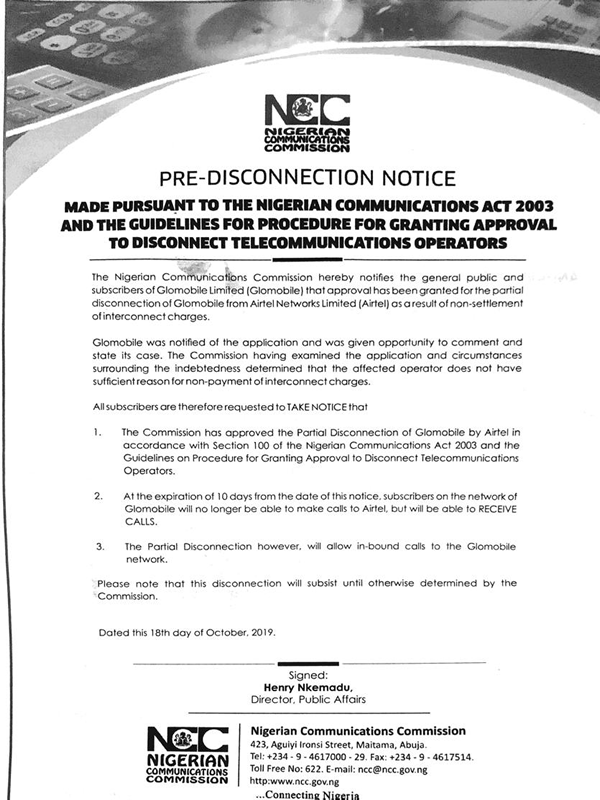
“The Nigerian Communication Commission hereby notifies the general public and subscribers of Globacom Limited (Glomobile) that approval has been granted for the partial disconnection of Glomobile from Airtel Networks Limited (Airtel) as a result of non-settlement of interconnect charges.

Glomobile was notified of the application and was given the opportunity to comment and state its case. The Commission, having examined the application and circumstances surrounding the indebtedness determined that the affected operator does not have sufficient reason for non-payment of interconnect charges.

All subscribers are requested to take notice that:

“The Commission has approved the partial Disconnection of Glomobile by Airtel in accordance with section 100 of the Nigerian Communication Act 2003 and the Guidelines on Procedure for Granting Approval to Disconnect Telecommunications Operators.

At the expiration of 10 days from the date of this notice, subscribers on the network of Glomobile will no longer be able to make calls to Airtel, but will be able to receive calls.

The partial disconnection however, will allow in-bound calls to the Glomobile network.

Please note that this disconnection will subsist until otherwise is determined by the Commission.”

This is a statement signed by the Director of Public Affairs, Nigerian Communication Commission (NCC), Henry Nkemadu. And it is telling an unpleasant story that network subscribers have heard and experienced before, and it didn’t sound or taste pleasant.

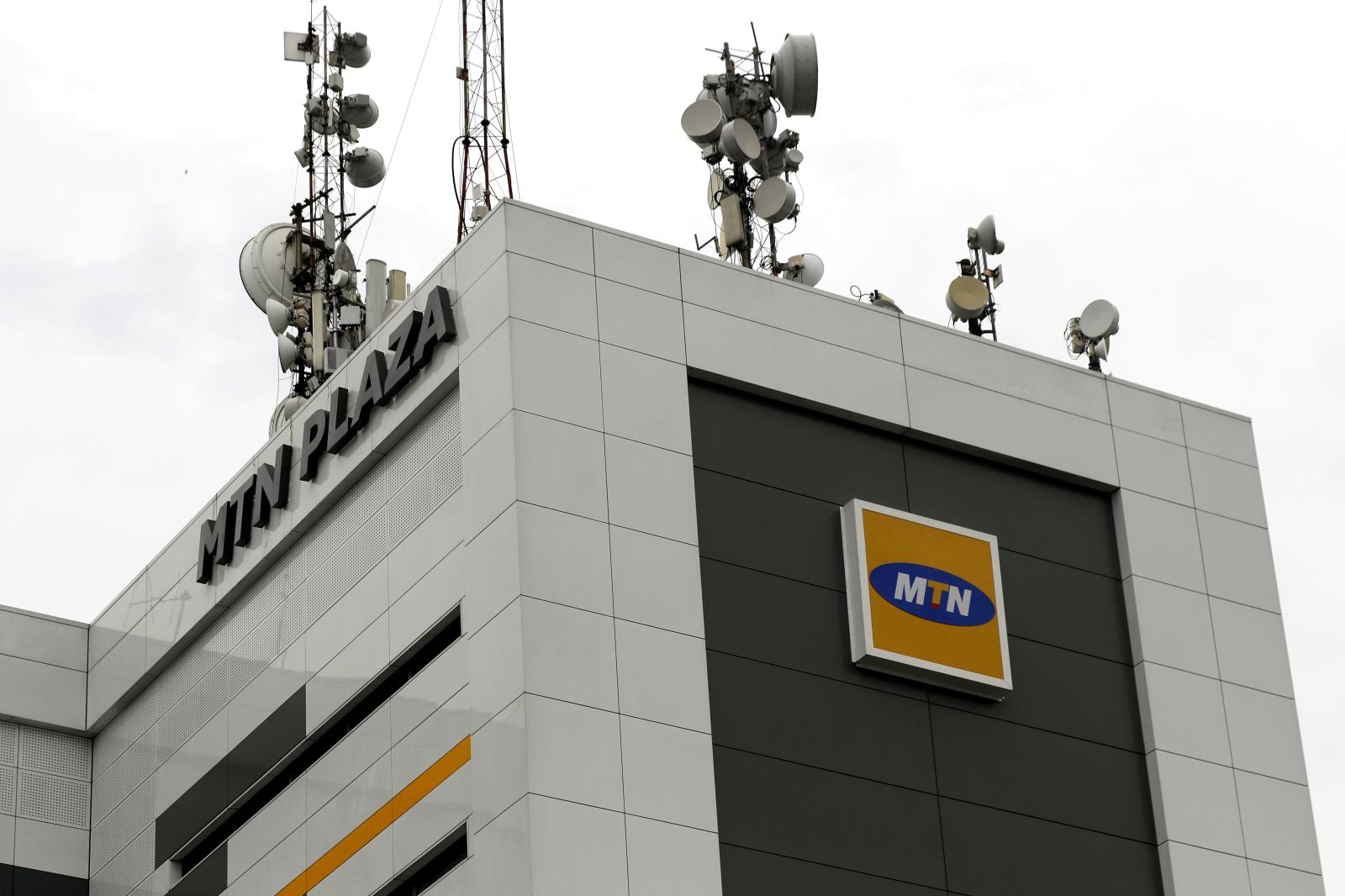
In July, Glomobile got into the same fight of non-interconnect charges with MTN Nigeria, putting subscribers in a situation of non-communication. MTN partially restricted calls from Glo, and the dispute lingered until August when Glo paid the N2.6 billion interconnection charges.

People thought they have learned their lessons and it’s never going to happen again. But they were wrong, and this time it even got messier. The intervention of the NCC here, as in other occasions, has been to recover the money for Airtel at the expense of subscribers.

Subscribers have to bear the brunt of the fight between Glomobile and Airtel, and the only alternative is switching to some other networks. Business lines will not be reachable from certain customers, and so it will be with every other thing powered by the interconnectivity of the two telcos.

The question everyone is asking is: Why do subscribers have to suffer the consequences of a telcos’ shortcomings? The NCC should find another means of debt recovery that will not penalize subscribers for offense they did not commit.

In the past, many of the operators had been caught up in one saga or the other with the regulator, and fines were levied against defaulters. For instance, in 2015, MTN was handed a record $2.5 billion fine for failing to disconnect unregistered SIMs, and the fine has kept them on their feet since then when it comes to SIM registration.

The Nigerian Communication Commission should have followed the same pattern and leave subscribers out of a squabble they have nothing to do with. If Glomobile knows that they are going to pay more than they owe in fines, they would not hesitate to pay their interconnectivity charges.
USSD Charge in Nigeria: Blame the NCC, Not the Telcos

0

Since 2011 when the Central Bank of Nigeria (CBN) introduced cashless policy, aimed at reducing the cash-based culture that Nigeria has been functioning on, there has been one development or the other contradicting it.

The most recent has been the introduction of charges on Unstructured Supplementary Service Data (USSD) transactions. Some Telecommunication companies on Saturday 19th of September sent messages to their subscribers as notice of charges on USSD.

“Yhello, please note that from Oct 21, we will charge N4 per 20 seconds for USSD access to banking services. Thank you.” The message from MTN reads.

This means if you spend 5 minutes checking your account balance, you will be charged N60. It was a rule approved by the Nigerian Communication Commission (NCC), without prior notice, and it is one among many.

Although the Ministry of Communication reacted quickly, a statement signed by Mrs. Uwa Suleiman, the spokesperson to the Honorable Minister of Communication, directed the NCC to discontinue the plan with immediate effect. It reads:

“The attention of the Federal Ministry of Communications has been drawn to the viral text message allegedly sent by the Mobile Network Operator MTN Nigeria and other Mobile Operators notifying subscribers of a four naira (N4:00) charge per 20 seconds on USSD access to banking services from the 21st of October 2019.

“The office of the Honorable Minister of Communication Dr. Isa Ali Ibrahim Pantami FNCS, FBCS, FIIM is unaware of this development and has hereby directed the sector regulator, the Nigerian Communication Commission (NCC) ensures the operator suspends such plans until the Honorable Minister is fully and properly briefed.”

It is becoming a norm. The viral outrage that instigated the intervention of the Communication Ministry has been that these agencies in collaboration with corporations, in the exercise of their independence are obnoxiously imposing one extortive rule or the other.

And in the case of Telcos, it is happening when subscribers are facing a lot of hiccups in voice and data networks. A UK based price comparison network, cable, counted Nigeria, out of top 10 African countries. with data price concern. A situation the Minister of Communication found worrisome.

What is more is that over 174 million subscribers who are paying the high price are not getting the service they deserve. There are complaints of illegal deduction of data amidst the high cost.

It is against these backdrops that the NCC approved charges on USSD that was designed to encourage cashless policy and ease banking services. Although Hon. Pantimi, has ordered downward review of data prices, and improved quality of service, there is little hope it is going to solve the problem.

The bone of contention has been who is going to pay for the USSD services. The agreement that birthed the service seems not to favor telecom operators anymore, so they want to make subscribers the scapegoats with the support of NCC. That means as usual, the banks will have nothing to lose.

So the despair emanates from the perception that the supposed umpire (NCC), is part and parcel of every undoing of the telcos. And it wouldn’t take long before another exploitative rule is introduced. Many believed that the solution lies with the regulator, not service providers who only need to obey the right rules if they are made.

So to solve the problems of the telecommunication industry in Nigeria, the Nigerian Communication Commission needs to do better.

OPay no pay again

2

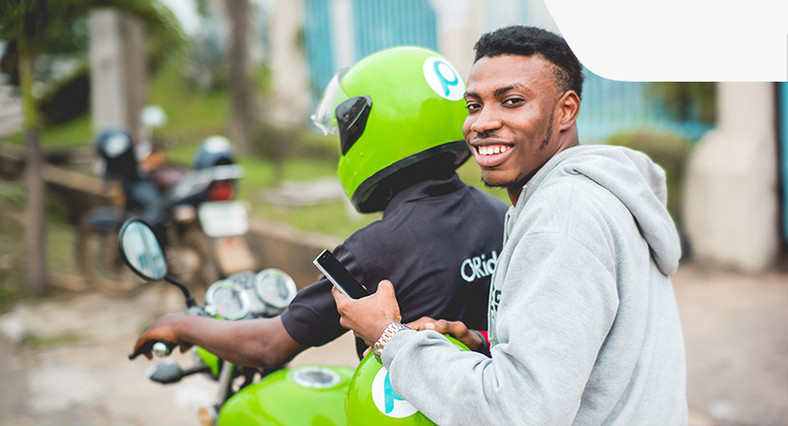
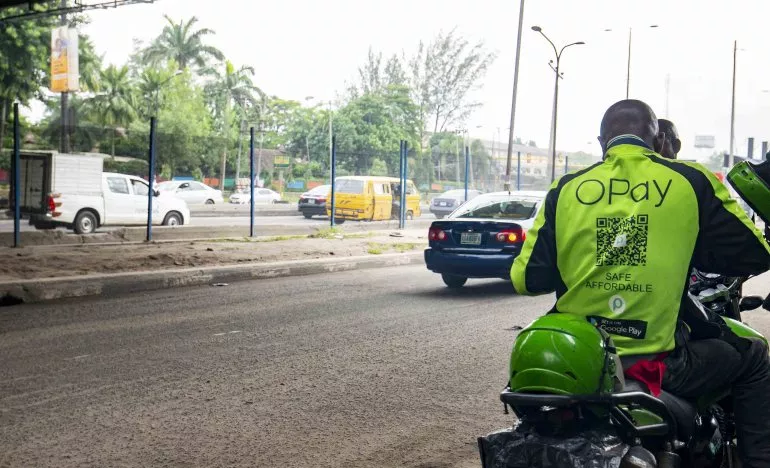
The OPay company took over the Nigerian transportation business like a rocket. In a short space of time, everywhere you go, it is OPay.

The fact that they made commuting cheap and easy to use, sold them to the people. Everyone can sit at home and book a ride on an app like the Uber way.

Isn’t it amazing as motorcycle go digital?

OPay became the real deal, shutting down Gokada completely. As much as OPay has taken over all the places in the West, they seem to be resting on their laurels.

Adeleke Lekan, a customer that enjoys using their service lodged his complaints. He shared his frustration on a social media platform – LinkedIn.

Adeleke shared, ”OPay riders are becoming frustrating. Yesterday at around 5:30 pm, I logged into my OPay app and booked a ride. I was going to New Garage in Ibadan.

It took me 10 minutes before I could get a rider.

The rider I got was so hot-tempered that his utterances are not the words of a gentleman.
He said he shouldn’t have come to pick me up because the money he will be paid at the end of the journey is nothing to write home about.

He seemed to be so offended that he was driving recklessly. I nearly slapped him because I have also lost my cool. What the hell was he driving? Life is too short, and I can’t let this reckless rider send me to an early grave.

That aside, he made the whole thing worse than I could have ever imagined by dropping me off to a place that we never bargained for. I told him that I haven’t gotten to my destination, after all, he could also see from his own app as well. But he insisted he would not be going any further.

I was so angry that I lost my cool totally. This was not the first time I would be experiencing such a situation. He aimed some abusive words at me that prompted me to reply. We traded words of insults at each other to a point that we almost fought. Thanks to someone passing by that intervened and calmed me down.”

I asked if Adeleke would continue to use the service, he said he doubted if he would still want to use them unless they do the needful.

As much as I have never patronized their service, I love them. I really want them to stay in the market for a long time because of the job opportunities they have created for many unemployed graduates.

However, with what I am hearing from their customers, it seems – ”OPay no pay again”. OPay riders may bring heavy havoc to OPay company.

Adeleke further offered his advice to OPay company,

”Dear OPay manager,

Please, warn all your riders from insulting your customers before it gets too late. They are becoming too vulgar.

I think you should penalize any riders being reported by your customers because we need to enjoy every penny spent.

I love OPay company but your riders are becoming more annoying and unbearable.”

 hope the company will look into this matter. Perhaps, they should create customer feedback on their platform that allows every customer to rate or report any form of dissatisfaction. This will help save the company.

Remember, it is easier for a tiny hole to sink a ship.

Putting Your Phone To Work Or Why OPay Is Winning

0

Your smartphone is not an asset. You can use it as a tool for communication and do other kinds of tasks. It can be very convenient and effective. But, I don’t consider it an asset. It also has a way of stealing your time and attention and this could be very distracting and costly. Using programs to track how much time you spend on your phone would shock you. However, since the introduction of several apps and services this position could be changed. I am beginning to find apps that reduce costs and remove barriers from certain activities that bring income and increase savings. What are savings? Well, savings is income not spent. A lot of times it means money in a savings account. But in Nigeria keeping money in a savings account does seem like a good idea.

First, inflation means that by the end of the year you have less money than you did at the beginning of the year. Second, Most Nigerian banks have a way of using strange charges and fees to reduce your balance. Very annoying but these combined means that your savings have lesser value. Now this may not be significant but if you can’t keep the value it is very difficult for your money to preserve the value of your savings. You need to find a way for your money to preserve the value and if possible make it compound. That is why you, at least, need ways to cut costs, reduce expenses and earn passive income. I won’t go into investments but having savings is key to building opportunities to invest and living under your means is a path to a more relaxed lifestyle. But, how is that possible and what can make that easier to achieve? I will introduce a few apps and their services that I think are instrumental doing that.

Professor Ekekwe has promoted the concept of “Double Play”. This is how a company can introduce a product or a bouquet of products that deliver value to the customer simultaneously. He has also evaluated the effects of the Opay offerings in the market. One of the Opay’s offerings is Oride. This is bike ride hailing service that is rivaling Gokada in the market. I agree with him that the main purpose of the Oride is to onboard people to Opay’s wallet service. This may be a smart way of customer acquisition. The results are yet to be fully examined but something is very interesting to me here; pricing. With Oride, you can get comparatively cheaper bikes rides especially when you are in a clinch with the app on your phone. I find this very positive as it reduces cost and increases convenience. But, since it seems infrequent; I wonder if it is an overall winner. However, the second offering by Opay leads to a better judgement of Opay.

The Obus runs very few routes and it doesn’t operate on the weekends. But when it does run, for a limited time since it’s still promotional, it gives much cheaper fares than anything else. Ikeja to Victoria Island-Sandfill route costs a pittance of N100. I really don’t care much for the air conditioned bus or the clean interiors of the vehicle. But getting below market price bus trips every weekday is labelled under the category of “These are a few of my favourite things”. On some days when there is really terrible traffic, some routes may not be available because they still have a few buses. But for each time you use the Obus, realise you are making savings that combined over just a month are considerable. Having a smart phone makes this possible as you don’t have to purchase the readable Obus ride cards. Also, I think this is just a promotional run. So, I expect this pricing to be increased in the very near future. Nevertheless, this is really one of the few times that I know of an app combined with the use of your phone can save you money.

Opay does have a wallet and I am not still sold on it. The usurious rates of Okash is ridiculous and I am not really enticed by the rates of OWeath. However, there are two other services that do appeal to me. These two services I am considering using are: Airtime and TV. Recharging DSTV online on some platforms still charge N100 which I find laughable. The app does this free. Airtime gives you 3% of the value back to your wallet. As I don’t talk that much I don’t find it that significant but a win is a win. All these services combine to give some valuable savings at the end of a very hectic month. So I am sure savers would like an app that helps with penny-pinching. Opay’s portfolio of services on its app is why I advise any Lagosian to download the app. However, it doesn’t do much for savings. That goes to another app. 

Cowrywise has app to help you save and invest. You connect to it with your bankcard/ ATM card. I like the concept of automating your savings. I find it difficult to go to the trouble of saving every month. I find myself always going into my savings or forgetting to put money aside. I think that automating this saving habit is a savvy move. Cowrywise also gives a competitive rate for saving. That is why I use it. This alone would have been good enough. But, when I started using Cowrywise, I got invited to an event to teach people how to travel around the world on a tight and realistic budget. I found this event alone worth the price of entry to using their services. I met someone who gave me cost saving ideas and other investment programs.

There are other apps such as JUMIA One but JUMIA One kind of sucks. It gives you discount codes by e-mail after the promotion is over. It also gives discount codes of poorly thought out offers. Considering the marketing expense of operating JUMIA One and the data they have on customers, it is surprising they drop the ball like this frequently. Since I personally don’t use much of their other services, I can’t really say I can recommend JUMIA One.

Cowrywise and Opay are services that regularly save me money although they are also convenient and save time. With apps such as these on your phone, you can generate income and save on costs. This is a massive improvement to keeping money in savings account that gets constantly attacked with surprise deductions and unwarranted charges.

An Option for Nigerian Communications Commission On New USSD Charges

1

As a new battle of fees and taxes erupts in the beautiful Nigeria, I will like to drop a small hint to NCC (Nigerian Communications Commission), the telecom regulator: copy and adapt what they do in most countries. Largely, in places like U.S, people in cities pay more for telecom services in order to help subsidize for rural people! That is the capitalism CNN and BBC do not tell us in Nigeria.

The Federal Government has directed the telecom firm, MTN, to suspend its plan to impose a new charge on customers who use its short codes to access banking services.

MTN Nigeria in an SMS message to its subscribers on Sunday said the decision was at the request of the banks and would take effect from Oct. 21.

“Yello, as requested by your bank, from Oct. 21, we will start charging you directly for USSD access to banking services. Please contact your bank for more information,’’ the message said.

Yes, in the quest to make internet accessible to many rural people, telcos have to do business in highly unprofitable territories. To give them incentives to deploy their services there, U.S. regulations demand that city dwellers pay a small fee to ensure the prices telcos charge those rural people do not get out of the roof.

This is economics: the city dwellers have volume (density) and unit prices are fairly better. That contrasts with rural areas where fewer people share the infrastructure. Yet, those people do not earn much as most are in farming services which pay mostly minimum wages.

Of course, Nigeria has not emerged in a way we can fairly categorize which community is rural or urban; that debate will engineer massive strikes in the nation. Lagos may be urban, well ahead of Umuahia, but there are areas in Lagos which Umuahia trumps. With no effective zip code for micro-billing, everyone will simply go and register his or her sim card in the cheapest “billing community” in Nigeria if NCC adopts the U.S. model.

But Nigeria needs to find ways to ensure equity rules. Most people are happy to pay a fine of N60 or so at an ATM on the 3rd withdrawal from out of bank network. It saves you time and money because there is no way that money can cover going to a bank branch with all the associated time wasting. Yet, some may not easily absorb that fee, and prefer to visit a bank. Unfortunately in some banks, they have phased out some in-person services, pushing all to digital platforms.

NCC has to invent new ways to manage these issues. If banks are not paying or refunding telcos, it is natural that telcos go to the users to pay. But where they cannot collect the money, it means everyone wants the telcos to offer services free. That may not be fair because the real culprits here are banks whose services the users are benefiting from. But where the government thinks that has to be that way, then it has to design a way for heavy users to cover the fees of those that cannot pay. Yes, anytime you recharge for more than N10,000 in a month, you lose 2% of the value to help subsidize for one guy who must not reach N500 monthly recharge, otherwise he/she loses the benefits of free USSD services! Or where that cannot work, mandate telcos to block the services so that banks send the necessary cheques to have them back again!

This is one area I do not expect government to start issuing mandates – the banks and telcos can deal with this matter and the government can focus on more urgent things like the border closure, national debts, mass illiteracy, security, etc. This is exactly how the CBN Governor sees it: “The banks are the people who give this business to the telecom companies and I leave the banks and the telecom companies to engage. I have told the banks that they have to move their business, move their traffic to a telecom company that is ready to provide it at the lowest possible, if not zero cost.” Period!