DD
MM
YYYY

PAGES

DD
MM
YYYY

spot_img

PAGES

Home Blog Page 6621

The New USSD Charge in Nigeria

0

There have been discussions going on for a while, on whether Nigerians actually pay their taxes at all or whether actually in reality they are being over taxed. This also depends on what you consider to be a tax. Anyway, permit me to  slightly move away from that, but not completely out of the topic.

Recently some of you may have seen messages like this from your network provider:

“Yello, as requested by your bank, from Oct 21, we will start charging you directly for USSD access to banking services. Please contact your bank for more info.”

And this:

“Yello, Please note that from Oct 21, we will charge N4 per 20 seconds for USSD access to banking services. Thank you.”

And the deductions continue for the average Nigerian. The list continues, from the card maintenance fees to so many other bank charges that are unexplainable. Oh! what difference does a little deduction make?  Many would ask. Trust me I don’t even know as well if it does make any difference or even if it is legal in the first place.

I expect some of these things to be challenged by Nigerians,  not because those deductions are so burdensome, but actually so that the populace cannot be seen as docile and easygoing accepting anything without questioning. Yes, things like this should be questioned.  Things like this has to be tested and stretched to its full measure in the right places, probably the law court or through the legislature.

On the other hand, it may be time to embrace those banking Apps.

Either way I see it playing out in favour  of the two big players if eventually it comes to stay. Banking apps run on mobile data, and that would mean more revenue for the data providers who happens to be the same telecommunication firms.  Also downloading Mobile Apps belonging to banks for the sake of transactions will also be good business for the banks.

At the moment, the government has stepped in and all we can do is to watch eagerly as it unfolds. According to the Guardian, “Nigerian government on Sunday ordered the immediate suspension of the proposed Unstructured Supplementary Service Data (USSD) charges on customers who uses them.”

So far the minister of communication Dr Isa Ali Ibrahim Pantami claims he is ignorant of the development, and has ordered its suspension until his office is fully briefed.

“The office of the Honourable Minister of Communications Dr Isa Ali Ibrahim Pantami FNCS, FBCS, FIIM is unaware of this development and has hereby directed the sector regulator, the Nigerian Communications Commission (NCC), ensures the operator suspends such plans until the Honourable Minister is fully and properly briefed,”  That’s according to the spokesman to the minister Uwa Suleiman .

While many are seeing this for the first time, many Bank customers have been experiencing these ussd deductions for a long time now and are quite surprised that they have been all alone in all this. So should customers actually pay for these services? Hopefully in the coming days a clearer perspective will emerge on what exactly the case should be and how.  The Anticipation continues.

Nigerian Youth Must Have A Shift In Their Mindsets

0

The problem in our country, Nigeria, is more than leadership. Of course, I can not overlook the mess the leadership of the country has brought upon us. They are the reason why we are still way behind. But when you look at the citizens that make up the country, you will be wondering if we can ever get it right.

Go on our roads and see how common citizens treat one another. You will be surprised. Even the traffic lights are not being obeyed until a police officer is assigned to arrest the offenders. I wonder what good things can come from a nation that her citizens are not law-abiding.

There are some basic rules and regulations that every citizen must obey. In fact, it is for our own good, but you would hardly see anyone who wants to obey these rules. The mindset of fighting and competing for everything has eaten deep into our hearts that we always see the simplest things as the hardest. Hence, we are ungovernable.

I know many people will disagree with my point of view. It is fine, as long as I am saying the truth. I wrote an article about corp members being posted to a church for their Primary Place of Assignment, but the reaction I got from it was really discouraging.

Some people who claimed to be well educated saw nothing wrong with it. I even read a comment that says, ”There’s nothing wrong with being posted to a church. In fact, some churches pay corp members very well. It pays to serve God.”

That comment summed up everything about the country. We are so deep-rooted into religions that we often neglect some basic principles of life.

Our youths are living in fantasies. Only a few are living the real life.

Here’s a question I have for anyone who thinks that serving in a church is better – ”what practical experience would a graduate acquires in such a work environment?

The country has gotten to a stage where everyone has to be creative and tactical in the labour market. Expecting a graduate to serve in a church simply because he or she wants to obey God is a joke.

If we go with Biblical setting, David did not just sit at home to be crown the King. He went into the bush and killed bears several times. He protected his father’s lambs and was diligent. At the same time, he polished his musical talent. David was really hard working and never lived a life of mediocrity. A good reason why God saw him as a perfect fit for the throne.

I think we are getting it wrong in that aspect. I am never against anyone serving God, but it has to be a choice. Let’s call a spade a spade. We want graduates that can solve real-life problems in Nigeria. We want graduates that can think outside the box and offer logical and usable solutions in the country.

We need to stop hiding behind religion. So many people have become lazy by hiding behind religion. Religion is not stupidity. Neither is religion equal to laziness.

Our youths are lazy. They love free things. Why do you think they follow these politicians? It is simple – they love the free money and food being shared at every political meeting.

Of course, poverty is in Africa. I understand that it is easier for anyone to deceive the masses by offering them freebies. But the truth be told, we need a total shift in mindset. We need to start believing in practical ideas and not sit and hope for God to do everything for us.

Common! God has given us the brain. What else do we need? I stand to be corrected – until we understand that nobody can give us the life that we want except us, we will keep living a life of mediocrity.

An Empirical Look at Seyi Makinde’s Dazzling Engagement in Oyo State

0

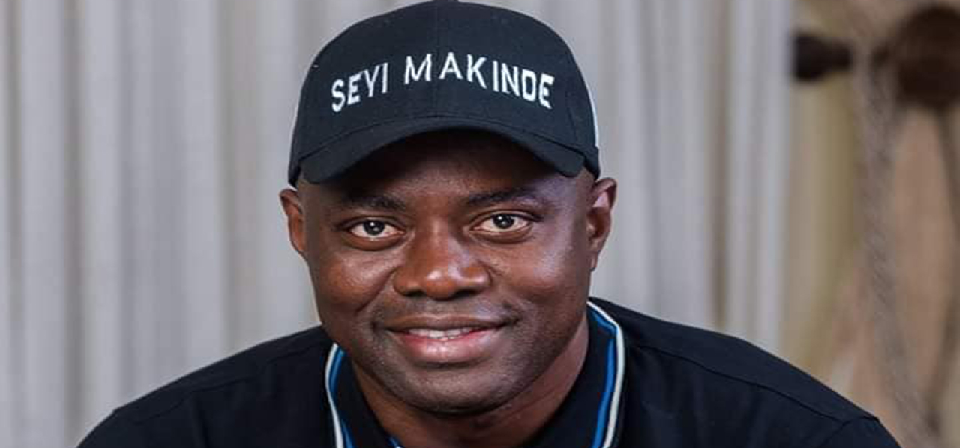
Since his assumption of office, Governor Seyi Makinde has dazzled not a few Nigerians with his style of governance. The Nigerian multi billionaire has shown himself to be different from run of the mill politicians with the way  he seems to be rising above party politics to chart a new model of governance. From adopting a youth friendly approach to government to leverage on techies to solve extant perennial problems, the governor is seen as a trailblazer in Oyo political landscape. As a youth himself, one area he is showing leadership is his ability to deploy all the communication infrastructure provided by the internet and social media. His social media handles are actively running. He engages issues and shares his thoughts on them via social media accounts. This has continued to resonate with the demographics that seem to hail him for being tech savvy. What many did not know was that his communicative engaging culture dated back to the election period earlier in 2019 when the business man was making a third attempt to govern the pacesetter state.

In a research conducted by me and two other colleagues, we examined the social media usage of the then two most popular candidates in the race to the government house in Agodi. Two critical things made us carry out the study. One, the modern society is such that is characterized by interactive communication platforms which allow ordinary citizens to engage issues, air their views and get some kind of feedback either from co users or the traditional power holders. So, we intended to know if social media platforms would assist to deepen such communicative engagements in the highly contended 2019 Governorship election in Oyo State. Two, the use of social media seems be an emerging strategy in political campaigns in Nigeria. Attention was first paid to online and social media engagement of potential voters in the 2011 general election by the then incumbent President Goodluck Jonathan.

The former president compiled his interactions with users on Facebook (mostly youths), published and launched the book in Lagos in 2010 as a way to begin his campaign the following year for Nigeria’s presidency. Analysts were of the opinion that such deft move made the then president a darling of the Nigerian youth and thus led to his eventual emergence. Even though, there are fears in some quarters that social media may only help in accentuating the voices of the users but may not lead to the desired change, there is still evidence to show that online engagement is not all a waste. This made the researchers investigate the kind of communicative dialogue that took place between the two popular candidates and their followers or potential voters during the gubernatorial campaigns.

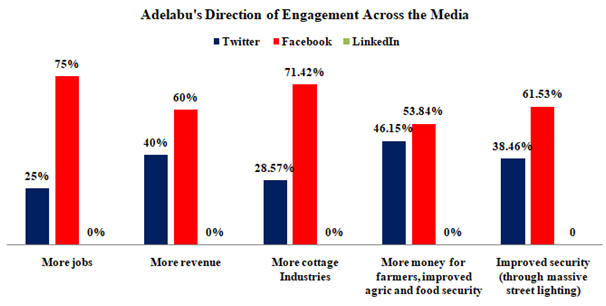
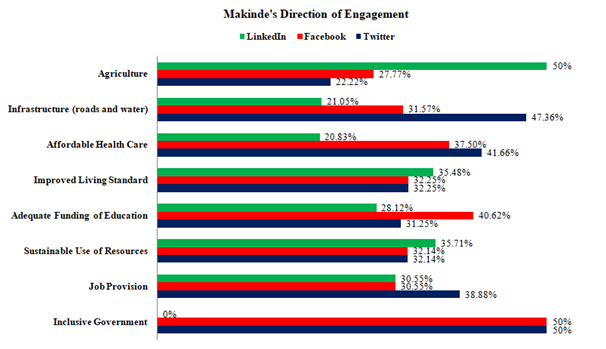
In doing this, the researchers sought to understand three areas of the engagement. We set out to know the focus and pattern of engagement as well as the trend of interaction between the two governorship candidates and their supporters. So, the researchers analysed the content of the available social media handles for the two of them. Of the two contenders, Seyi Makinde appeared more visible on the three social media platforms with some following – Facebook (60,800 followers); Twitter (12,800 followers) and LinkedIn (20,519 followers). Even though his online followers fall short of 100,000 threshold, it is better when he is compared with that of his rival. Bayo Adelabu had 6,623 followers on Twitter and 37,486 on Facebook with no presence on LinkedIn at all. The social media accounts of the two governorship contenders were monitored from December, 2018 to February, 2019 which marked an intense period of the campaign.

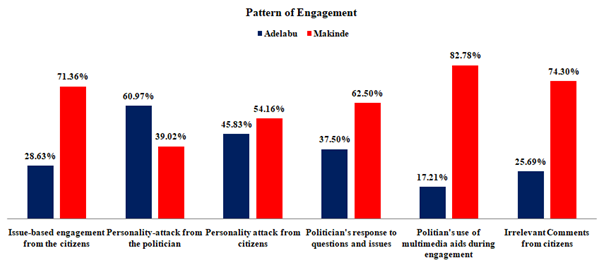
The two, as aspirants then, were found to have engaged their followers on social media handles. They lay bare their manifesto bordering on job creation, food security, functional educational and provisional of affordable health care facilities. However, the then Candidate Seyi Makinde  was seen to be more creative in deploying the social media platforms for his campaign. The supporters of the two candidates were observed to have engaged the candidates on the different social media platforms with comments and questions on their posts. This notwithstanding, a one-way communication pattern was noticed in the engagement from both the candidates and the public they sought to engage. On the part of the two contenders, questions raised and observations made by the followers were ignored while some of the followers raised comments that did not align with the focus of some of the posts.  This pattern of engagement pointed to some flaws in social media campaigns in Nigeria. Even though this was observed at the sub national level, it could have implications for online media campaigns in Nigeria in future campaigns.

Seven months after assuming office, Governor Seyi Makinde has continued the intense online engagement with the people of Oyo State. Some people within and outside of the state  have expressed fears that he would soon lose the steam. Others believe otherwise claiming as he was prepared for the office. For the two sides, only time will tell.

The Best Time To Leave A Business Deal

2

Recently I came across the story of the Wall Street shoe shine boy.  A story of an event that happened a long time ago. It is such a shame I got to hear of it just recently. Anyway, it is better late than never.

It happened that one day a Wall Street mogul was having his shoes shined. Along the line, a casual conversation sparked off  between this businessman and the boy who was cleaning up his shoes . Unexpectedly, the Shoe Shine Boy began to intelligently discuss various stocks and their potential to generate great profits.

At that very moment, the stock market was the hottest thing in town . Everyone from Cobblers to Gardeners to Plumbers to Taxi drivers were all thinking, talking, buying and selling stocks. They were all also giving tips. At that moment, he knew it was time to get out.

Mr. Joseph Kennedy immediately withdrew his investments from the Stock Market. Shortly afterwards,  the Stock Market Crashed in 1929 . Everyone including Businessmen, Stock Brokers, Bankers and even Cooks, Taxi Drivers and Shoe Shine Boys, lost all they had put in. This culminated in the Great Depression which affected not just the United States, but the rest of the world.

It’s just about knowing when to get out many would say.  The stock market and the ponzi scheme has got a few things in common, but hold on a second!  I have never been involved in any ponzi scheme and would never advise anybody I know to join one. The similarities could be in the area where a crash looms the moment the “shoe shine boys” start getting in.

I remember the MMM crash of 2016, prior to the crash even people who were initially sceptical about the whole scheme had started putting in their money into the scheme. Bankers, the clergy, housewives, students, practically everyone now wanted to cash in and out of the new “miracle” money.  The risk part was gone as people had seen others get paid over and over again. Then came the crash.

I could write down a few things as to what the red flags for a bad business could be as a result of the number of lessons this story holds.

  • Once the obvious risks are gone, the business opportunity may also be gone. Every good business possesses some good risk.
  • If you must take a business risk, take it very early.
  • Watch out for the “shoe shine boys.”If every Tom, Dick and Harry are now getting into a business line, just know that that field may now be saturated.
  • Pay attention to what you hear and observe.
  • If a deal is too good to be true, then know that there are likely hidden heavy consequences.

In the end you have to be cautious before getting into any business deal, if really it’s a business.  Gather enough information as you can, ask enough questions . You can also consult the experts in the field.

Experts are important, but it is also important to keep an eye on them.

How Nigerians can Battle the Border-Closure-Induced Rice Scarcity

0

I went for a seminar presentation at Chuwkuemeka Odumegwu Ojukwu University (COOU), Igbariam Campus, on 17th October, 2019. There, I went to their famous Green Canteen for some plates of rice and met the food costlier than it was. The owner of the canteen complained that the cost of rice in the market is going up on a daily basis (and it is local rice for that matter). In fact she was antsy because the enquiry she made that morning (concerning the price of rice in Achalla in Anambra State) revealed to her that a bushel of rice, popularly known as Mars (hope I got the spelling right), was #9000, while a bushel of the one known as 14-14 (fourteen-fourteen) sold at #10,000. She wasn’t comfortable because there were predictions that the prices will still shoot up.

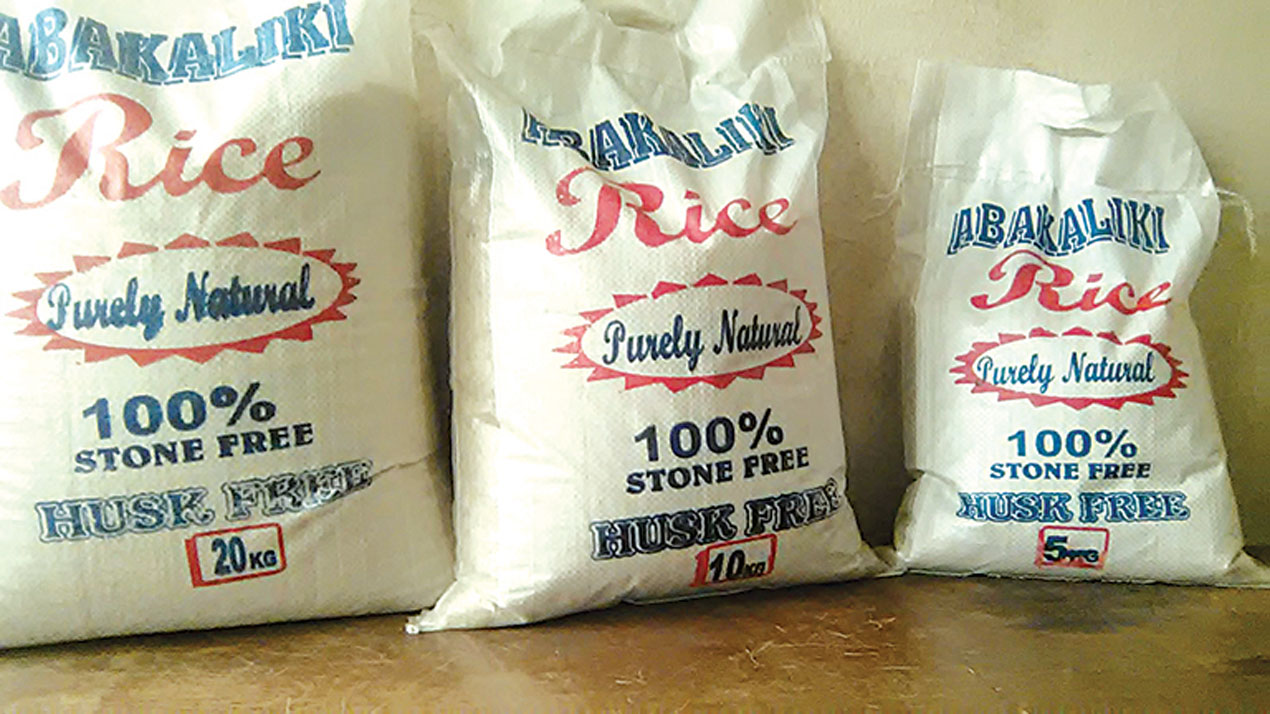
Here in Enugu, a bag of foreign rice (50kg) sells at #21000, while a 25kg bag of Abakiliki Rice sells at #8500. I asked someone in Awka about the price of rice over there and she said that she went to Eke Awka market some days ago to buy rice but the person she usually buys from only had beans to sell.

The way I’m seeing it, rice will be scarce very soon. But I believe it will only be temporary because I have this strong feeling that a lot of people are right now working on how to bring this commodity back into the market (I trust Nigerians for this). But as we wait for rice to come back into the market, we need to eat and keep our body and souls together. I have some suggestions on how we can survive this waiting period.

TIPS FOR SURVIVING THIS RICE SCARCITY PERIOD
I’m not an economist, but I’m a Nigerian who believes there is a practical solution to every problem. Well, for us not to notice the absence of rice in our markets, here are some things we need to adopt:

1. Switching to other African Dishes: I know a lot of people are panicking right now because of their over-dependence on rice; they need to know that before rice came into this country, people were eating. Different tribes in Nigeria have several local dishes that are richer and tastier than rice. There are even many that are also as easy to cook as rice, if not easier. We need to start going back to all those foods.

I have already started this adjustment. Honestly, I started introducing a lot of African dishes into my family menu long before the border closure. Now that rice is ‘doing shakara’ I don’t even feel it. For example, my family staple food includes more of potato, beans (including moi-moi and akara), fio-fio, dried akidi, abacha, okpa, yam, plantain, Igbo soups (bitter leaf, okro, ogbono, egusi, oha, etc.), nri oka and so on. We eat rice only twice a week, so you can imagine how long a bag of rice will last for us. And if I don’t have any rice to cook, my family may not feel it.

2. Going for Pastas and Noodles: Luckily for us, a lot of pasta-making companies are located in Nigeria. Now is the time for those that can’t do without rice to switch over to pastas. While in the North, I found out that there are so many types of pastas in Nigeria – the one I’m missing most right now is couscous. I even found out that people make their own pastas using wheat flour (like the Hausans make ‘talia’ in their homes). So, what are we waiting for?

Personally, I’m not a pasta person, but we have to make do with what we have. So, time to stock our houses with spaghetti, macaroni, couscous, and so many others that I don’t know their names.

For those that love noodles, well they are there for you too; but try to eat healthy.

3. Farming: The farming I’m talking about here isn’t subsistence farming. What I want to say here is that farmers should be encouraged to go back to farming. I know a lot people will say that rice farming is the in-thing right now; but I think that isn’t proper. Farmers should be encouraged to plant every kind of food. If these farmers focus more on rice, it may flood the market and the farmers may not really profit from their sweats. So I believe that as farmers are cultivating rice, they should also plant other crops (especially our local crops).

So, dear Nigerians, let’s stop lamenting about the high cost of rice, we have many other kinds of food. If you don’t know how to prepare most of these local dishes, ask the sellers of these foodstuffs for direction or go to Youtube to search for a video tutorial. Don’t depend so much on rice, at least for now.

Remember, before rice came, Nigerians were eating, and they were eating well then.