DD
MM
YYYY

PAGES

DD
MM
YYYY

spot_img

PAGES

Home Blog Page 6622

The Effect of True Capitalism in Efficient Sectors

0
Mr B. Fashola is Nigeria's energy minister

Considering the current population growth, and the ever increasing demand for energy and the obvious inability of our energy sector to meet up with all these components, I don’t think there will ever be a time when steady power supply will be achieved in Nigeria as a result of government investment. This isn’t me being pessimistic, this is me being realistic. In some ways, one can conclude that the government has given up building more or upgrading existing refineries to meet up with local demands, going by the emphasis and attention being given to the refinery project by Dangote. A lot will be solved by that project when it eventually gets completed.

There are so many reasons why getting complex things done by the government get eventually complicated along the line given the very complex nature of our socio-political space.

Take public water supply for instance.  Public water supply existed in Nigeria before independence until it gradually wound down around the 80’s. And then the era of chronic inefficiency where water boards would supply water to towns and villages say once every week or as it pleases them.  This continued until gradually though painfully Nigerians began to supply their own water by sinking boreholes. Today practically every home owns one or has access to one, and the water board is no more. The death of public water supply was caused by inefficiency and negligence.

We can also have a look at what happened in telecommunication. The collapse of NITEL  for instance was as a result of how redundant they became when the GSM market opened up in Nigeria, bringing in competitors like MTN, GLOBACOM  and many other pioneers in those early days. Today NITEL is gone, and Nigerians are communicating better.

You can add NIPOST and Nigerian Airways  to the list if you like. Then we have our primary education system. It was pioneered by the government in the past, today whoever wants quality basic education would send his or her ward to a private school.

So maybe I can say that capitalism is taking over the country. Or could it be that in our own case capitalism encroaches to replace inefficient systems? We’ve seen it happen.

So could it be that the inefficiency in the Power sector is a good sign?  A sign of the looming taken over by the private sector or the fact that soon the average Nigerian will be able to power his home and workplace from a source outside the national grid?

Considering the trend, I think it’s a good sign. Renewable energy is getting more available though the immediate initial cost is high. But that was exactly what happened in the telecom sector but today most Nigerians can afford a mobile device . The prices of mobile devices fell drastically in the years following its introduction to the Sub-Saharan African market.

The same is expected to happen with photovoltaic cells. In fact, it has been happening constantly for months and years now, as the technology gets better and the efficiency of the PV  cells increases.

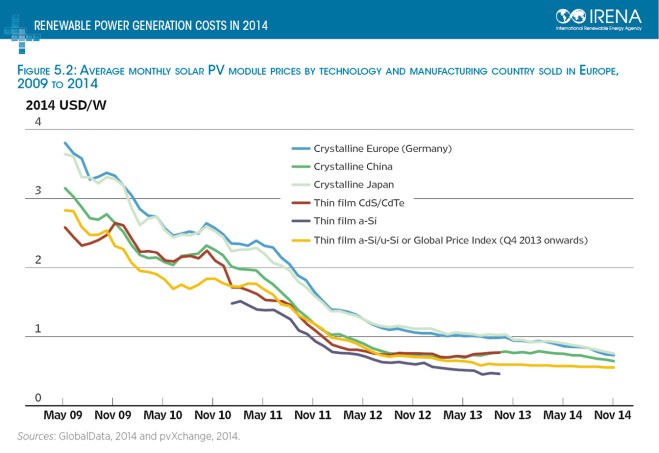
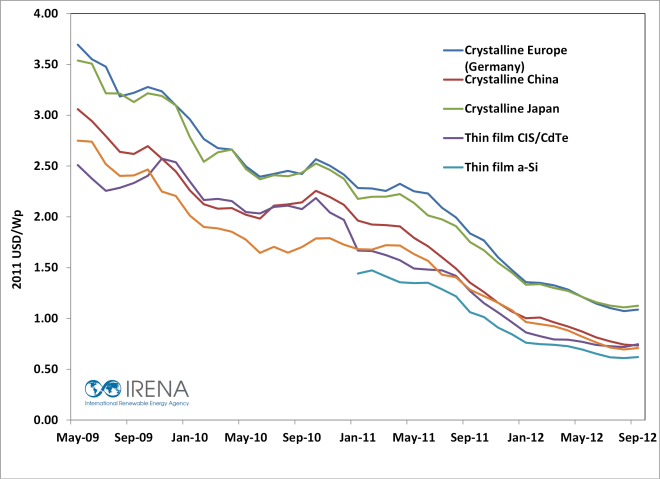
These graphs below from IRENA (International Renewable Agency)  shows a steep decline in prices of PV cells in different countries.
Average monthly solar PV module prices by technology in Europe


Average monthly solar PV module prices by technology and manufacturing

As you can see, they are all pointing downwards.

So hopefully it will get to a point where just like mobile phones, most Nigerians can own a PV Panel which could ultimately lead to the total collapse of the government-anchored power sector.

I would expect also that big industry players would also start investing in power for business.

Largely, as we continue to further our journey into true capitalism, expect a lot of government owned agencies to become redundant.


The New Nigeria Communication Commission (NCC) Directive

0

I recently wrote about the new Nigeria Communication Commission (NCC) directive. It generated mixed reactions, as expected. Many are outraged, and others have gone to read through the new directive to indeed find out if this is true. A couple of people have specifically referred to words like monitor and interception in their plain every-day language without looking at the definition of the words, as used in the directive. I therefore thought it best to shed some light on the definition of these words, as given in the document, for those who do not have the time to read the whole document.

Page B117 of the Lawful Interception of Communication Regulation, 2019 clearly define the terms used in the document, as given below.

Monitor means the recording of communication by means of a monitoring device.

Monitoring device means any instrument, device or equipment which is used or can be used, whether by itself or in combination with any other instrument, device or equipment to listen or record any communication

Interception and cognate expressions shall be construed (so far as it is applicable) in accordance with these Regulations and shall include an interception of archived communication or communication in the course of its transmission, by means of a communication system if, and only if, another person

  • a) Monitor by means of aural or other acquisition of the contents of any communication

  • b) Modifies or interferes with the system, or its operation

  • c) Monitor’s transmission or archived data made by means of a monitoring device

  • d) Retrieves communication data on a communication system

  • e) Monitors transmission or stored data made by wireless telegraphy to or from apparatus comprised in the system, as to make some or all of the contents of the communication available, while being transmitted, to a person other than the sender or intended recipient of the communication

Page B110

10)1) Every Licensee (telco) shall take necessary steps as the commission may by way of notice direct from time to time, to install interception facilities that allows or permits interception of communications.

11) 1) Notwithstanding any other law in force, no Licensee (telco) shall provide any communication services which does not have the capacity to be monitored and intercepted.

2) Every Licensee shall within such period as may be specified by the commission, acquire all necessary facilities and devices to enable the monitoring of communications under this regulation.

3) The investment, technical, maintenance and operating costs to enable the Licensee give effect to the provisions of these regulations shall be borne by the Licensee.

The document also mentions a warrant will be required to obtain intercepted communication and lists the authorized agencies that can request the intercepted communication.

For more details, please read Lawful Interception of Communication Regulation, 2019 on NCC website.

The Tragedy of “African Time”

0

Over the years, Africa has been plagued with a chronic malady instituted in the minds of its people. The high disregard for time and the lackadaisical attitude behind the default in time consensus is alarming. The mindset of arriving minutes or even hours later than pre-agreed has been subtly built into the mental residence of the African people. An average African will never keep to the time, earlier agreed upon, but instead go by the so-called slogan – “it is African time”. My question now is, what is this “African time”?

African time is an erroneous ideology that incorporates in it a disregard for the significance of time. It is an ideology that creates the spirit of irresponsibility meditated in the soul of procrastination and revealed in the body of lateness. “African time” is simply a slogan that  unveils the retrogressive mentality of the African people as Algaswhyneh and Basri (2015) puts it that people’s loss are more pronounced when time is wasted intentionally. Hence, the reason for the loss or retrogression of the African continent. 

Time is one of the most essential resources of life that when misused cannot be regained neither can it be saved for the future. Alwan and Ahmied (2009) had this to say, time is an opportunity to achieve set goals and objectives if used judiciously and could also be a means to failure if wasted. This implies the double-edgedness of the sword of time. Given these statements, one factor responsible for the slow pace of growth and development in the African continent is this issue of time. Africans fail to understand that negligence in keeping to time for a particular event will of a certainty have a ripple effect on the arranged schedule of other events for that day which could spill over into the next day and continues like a chain.  Now, when the achievement of set goals and objectives of an individual are on a go-slow combined with that of other individuals, we discover that the macro entity becomes unable to achieve its set goals and objectives at a fast pace. Thus, a reason for the slow progress being achieved in Africa.

Taking a cursory look at the continentality of advanced nations, one identifiable similar characteristics is the high value placed on time. The high esteem being placed on pre-agreed time for rendezvous or events translates into the positivity seen in their respective nations. It is no surprise that Africa is way behind them because of poor value for time. 

For Africa to experience rapid progress, individuals both leaders and followers must pay respect to the factor of time, put on the garment of responsibility that kicks away procrastination and avoids lateness. Events at all levels should no longer commence later than stated even in the scantiness of attendees. These of course would not translate into positivity suddenly but if consistently executed would re-shapen the mindset of Africans and consequently produce positive results. 

African time is not a positive ideology but an erroneous one that promotes irresponsibility which ultimately translates into failure both at the micro and macro levels. Therefore, the term “African time” should not be seen as a casual or common societal parlance but a societal psychological disease worthy of eradication. Hence, the formulation of the topic, “the tragedy of African time.”

References

Alghaswyneh, O. F., & Basri, W. S. (2015). The role of time management and its impact on students’ academic achievement: A case (students at Northern Borders University). International Research Journal of Finance and Economics, 136, 118-125.  

Alwan, Q.N., & Ahmid, N. R. (2009). Time management: Concepts-operations and applications. Amman, Jordan: DarAl-Thaqafa. 

The Microsoft Satya Nadella’s Interview on Surface

2

Apple Mac was gaining market share from Windows-based PCs and laptops; according to  Fortune, between 2006 and 2012, Apple’s U.S. market share in the PC market jumped from 4% to excess of 14%. But since 2012, Apple’s market share has fallen back to 12%, and has remained around that number for years. Interestingly, 2012 was also the time Microsoft started making Surface. Largely, the arrival of Surface blunted the momentum of Mac devices.

There is a big lesson: Microsoft had relied on partners like HP, Dell and Lenovo to make Windows laptops and computers. Unfortunately, these entities were not at the top of the games on the composite of cost, derivable value and product innovation, triggering the loss of market share `which Windows was experiencing between 2006 and 2012.

But Microsoft decided to enter the hardware business – to make hardware it believes Windows will happily live in. That did not only blunt the encroachment from Apple, it provided a solid platform for Microsoft to create a definitive product Windows-based OEMs (original equipment manufacturers) could use as a standard when making devices.

This is how Microsoft CEO Satya Nadella explains it in an interview.

“In doing a great job with it, I think we are inspiring others to do also a great job and raise their game..If you look at the ecosystem today and the quality of the PCs coming out this holiday from everyone and you compare it to the pre-Surface era, that’s a marked difference.”

This is exactly the reason why Google continues to make Android mobile devices (the Pixel series). Simply, it wants to match iPhone quality and in the process help Android to be seen as an OS that can power great mobile devices of the future. Leaving that work alone to Android OEM partners could affect Android, in the long-term, if the partners fail on execution. Largely, if Google Pixel succeeds, the Pixel will become the benchmark for Android devices. Yes, Google does not need to make money from Pixel – merely inspiring the Android OEMs will be good enough!

Working Towards Gender Equal Opportunities

0

For a long time, the advocacy against gender inequality in all sectors of the society has been on the increase as several scholars, activists, feminists, professionals and organizations, both for profit and not for profit organizations, utilize available opportunities in ensuring that discrimination in the society and at workplace is eradicated completely. Gender equality and women’s empowerment continue to be central themes in global treaties, covenants and declarations because they are now acknowledged as catalysts to people-centered development strategies.

Despite the significant contribution of women in domestic activities and the few societal positions given to them, Nigeria still records a very low rate of women participations in various sectors such as technology, politics, economic, health and agriculture as these sectors are believed to be best fitting for men to occupy. In effect, a well-being and equity perspective, such gender inequalities are problematic as they lower well-being and are a form of injustice in most conceptions of equity or justice (Stephen and Francesa, 2009).

The history of discrimination against women stemmed up from the patriarchal practice where women had been stereotyped to play certain domestic roles and functions while the men dominated vital roles in the society, hence exploiting and oppressing women. This stereotyped culture has hitherto led to the slow development in the aforementioned sectors. Women who have overtime played tremendous roles in the socio-economic development of any nation are given limited slot in Nigerian strategic sectors, especially those stereotyped to be best fitted by men alone.

This practice aroused the interest of both international and local bodies, hence the need to formulate policies with the aim of fostering equality among genders. Policies such as the Beijing Declaration and Platform for Action (BDPFA) were formulated. BDPFA was passed on the Fourth World Conference on Women held in Beijing, China on 4th to 15th September, 1995 and it addresses discrimination against women in key sectors such as education, health, economy and power and decision making, among others. The policy advocated that gender mainstreaming should be strictly followed in all spheres and aspect of an organization.

In Nigeria, the National Gender Policy was formulated in 2002 during the President Olusegun era, with the goal of building a just society devoid of discrimination. The National Gender Policy emerged due to the permissive nature of gender discrimination inherent in the society and it was signed to support gender mainstreaming in policies and governance. The policy also stipulates that 35 percent of women should be present in all governance process. Sani (2013) posits that the attainment of gender equality is not only seen as an end in itself and human rights issue, but as a prerequisite of sustainable development.

Despite the existence of constitutional provisions and commitments to regional and international human rights treaties and conventions, the rights of women and girls are grossly violated and devalued in Nigeria and many African countries.

Schools of thought believes that women (compared to men) lack access to employment opportunities because of low investment in their human capital, especially their low level of education, and lack of skills appropriate for formal labour employment. However, women therefore dominate small-scale commerce in food, textiles, household goods and consumables. The few women employed in the formal labour market work within an environment which is very unconducive and full of discrimination.

Dr. Nancy Snyderman, an American physician wrote thus in her article; “Women in the workplace lack promotion opportunities”:

“It seems that women on the path to leadership tend to get less access to the people, input, and opportunities that accelerate careers. As a result, you see few women advancing to the top of the corporate ladder. This disparity is especially pronounced for women of color, who face the most barriers to advancement and experience the steepest drop-offs with seniority.

The new report from McKinsey & Company and LeanIn.org. finds that for every 100 women promoted to manager, 130 men are promoted. Another statistic that is disheartening is compared to women, almost twice as many men are hired from the outside as directors—and more than three times as many are hired as senior VPs.

A recent article in Fortune Magazine reports that one inequity that seems to jump out more than any other is women being passed over for employment promotion opportunities ”

This erroneous discrimination imposes on the Government, human resource practitioners and recruitment agencies to develop programs, practices and processes aimed at advocating gender equality at workplace, developing and empowering women to meet up with workplace human capital demand.

Ensuring equal representation of women in the workplace can have positive effects across the entire organization and by extension, the nation.

Also, harnessing the benefits of gender diversity enhances collaboration, improves productivity, creativity and innovation in a work system and this reflects in the national performance.