DD
MM
YYYY

PAGES

DD
MM
YYYY

spot_img

PAGES

Home Blog Page 6655

The Challenges I faced As A Teenager

0

As a teen, I have faced a lot of challenges that have made me realize that life isn’t as easy as I thought it was. Starting from the age of 13-19, I actually understand the fact that the lifestyle we live as teenagers is the same as the adults. Likewise, the mentality we have as teenagers is almost the same as that of the adults. Even if there’s a difference, it’s not really much.

From my understanding of the word – ”teenager”, it means a person who is between 13 – 19 years of age. According to research, in the 1920s, the word “teenager” was never considered as something that was really important and that’s the reason why many of our teenage youths had suffered a great loss.

Teenagers are usually classified as turbulent times. The reason is that – when I started growing up as a child, I was going through so many growth changes both physically and mentally. My parents were only concerned about monetary and material things. They felt if they had provided me with enough money and material things, they have done the best as parents.

Looking at it that way, they were right. But I needed more. I wanted more than clothes and shoes. I wanted their time.

There are some challenges I faced throughout my teenage years. I needed someone to explain them to me, especially my parents.

I faced self-esteem and body image problems that resulted in me been frustrated. Actually as a teenager, I started feeling stressed when am with my peers. The peer pressure and competition at schools put me in a rat race. There was a point when I was sexually harassed in school. Who would I tell? I had to bury the thoughts in my head.

I decided to share my experience in other to open many parents’ eyes to this. We need more than clothes and shoes. We want your time. We want some explanation about our physical shape and changes that occur day-to-day.

Here are some common challenges I faced:


  • Acceptance – Even as I see myself as the most self-assured person, I still struggle with acceptance from time to time. However I find it hard to feel accepted about my emotional feelings due to the lack of maturity and perspective. But my parents find it difficult to offer their paternal acceptance and advice.
  • Stress – As a teenager, there are a lot of pressures from peers and society that I faced as a teen. The pressures come from peers in school, parents and family members at home, and the people in the society. It created an ongoing pattern of stress for me. The reason is that my parents didn’t help me to deal with life stresses may be either by health boundaries or by teaching me how to prioritize and to simplify my life. They themselves don’t even understand so they could not even create a safe atmosphere for me at home.
  • Respect – My opinion or decision do enhance my self-confidence and  self-esteem. As a youth my abilities to develop positive self-esteem is been affected by my physical life styles and my parents criticism. My parents find it difficult to see it that – making respect mutual virtue will help in developing a stronger bond between myself and them.


I hope parents would learn from this and put things right. Most kids have gone astray because of the little things that were overlooked – ”Time”.
The Politics in Hiring

0

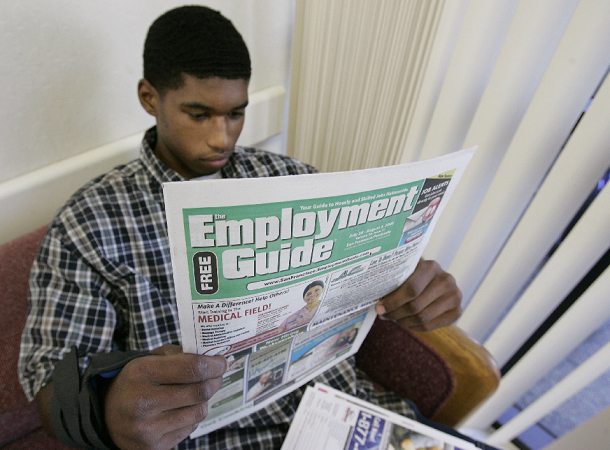
2016 was a very tough year for me. I experienced the worst office politics. I had applied for a job through a reputable firm in Lagos.

Two weeks after my application, I got an invite for an interview. It was scheduled to hold in the afternoon – 1:00 pm.

I got there and passed both the aptitude test and oral interview. I was told that the board would get back to me after two weeks. That would be when they will make the final selection from the successful applicants.

Two weeks after, I was sent a congratulatory mail. I have been selected for the position of a teller at a popular bank. They had helped that reputable bank to recruit. The proposed monthly salary was eighty thousand naira. Based on what I heard, the actual monthly salary was – one hundred and twenty thousand naira, since I am being contracted, the company takes forty thousand naira every month from my salary. I had no idea how true was that though.

I packed my bags and moved to Lagos since I reside in Ibadan. On getting to the office on Monday, I tendered all the documents indicated in the mail.

To my surprise, the Hiring Manager told me to hold on as she was struggling to read some things on the computer screen before her. After waiting for thirty minutes, she asked some irrelevant questions from me.

Questions like:

  • ”Did you get this mail from us?”
  • ”When did you come for the interview?”
  • ”When did you get this  mail?”

She told me she couldn’t find my name amongst the successful applicants. I was told to go home and wait for some time. She would get back to me as she’s trying to figure out everything.

I waited for six weeks, I never heard anything from her or the company. So I decided to visit the office again and ask if there’s any progress. I was told by an insider that my position had been given to another applicant who was closer to the recruiter. The applicant didn’t even go through the interview session with us. She was referred by someone.

The only available position they have for me was in Port Harcourt. I walked out and never came back. It was the worst experience I ever had from a reputable recruiting firm like that.

Relationship Between Literacy and Productivity Across 36 States of Nigeria

6
States in Nigeria

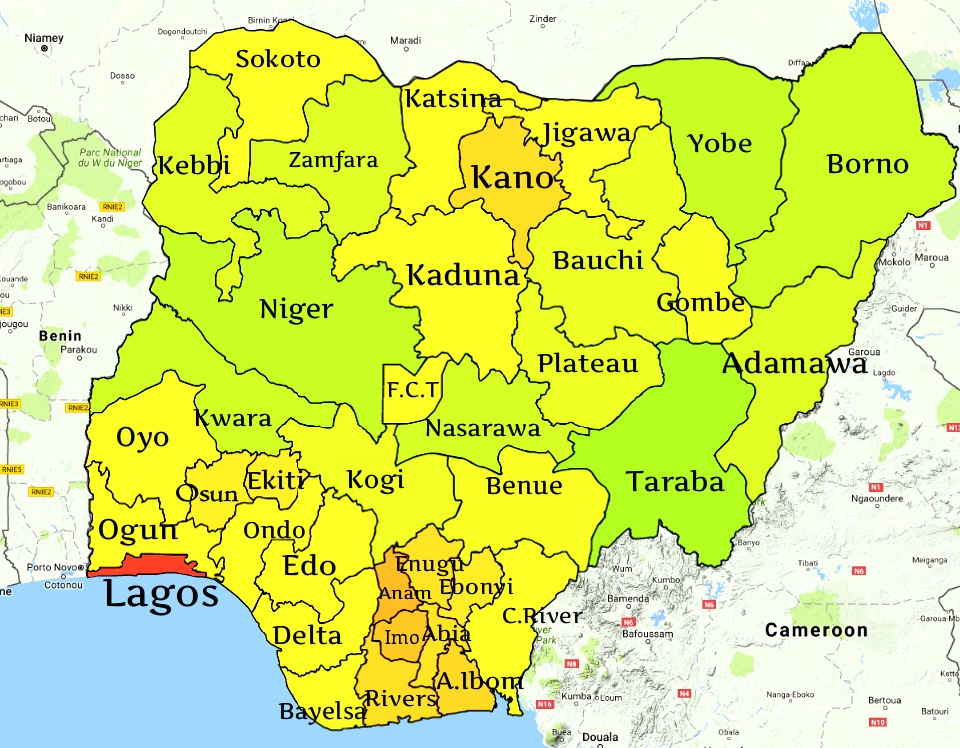
Two key features of industrialized countries are high literacy and productivity rates, while the reverse holds for Less Developed Countries, LDCs. This fact makes literacy a significant index to attain for the growth and development of the Third World Countries. I was inspired to investigate the relationship between productivity and literacy across the thirty-six (36) states of Nigeria as I read Professor Ndubuisi Ekekwe’s piece titled, Nigeria’s Big Challenge on Human Development. Using the Chinese and the U.S. model of funding public education at the primary and secondary levels, he called on the Nigerian government to shift its priority from subsidizing tertiary education to basic education if the country must make progress.

If productivity is defined as the amount of goods and services that a group of workers/citizens produce in a given amount of time, say, a year; and literacy is defined as the ability to read and write, and competence in a specified area, therefore, there should exist some form of relationship between these variables. Does higher literacy rate increase the productivity of Nigerians, and vice-versa? Is there a correlation or causal relationship between these factors? And based on the outcome of my investigation, what decision should policymakers take?

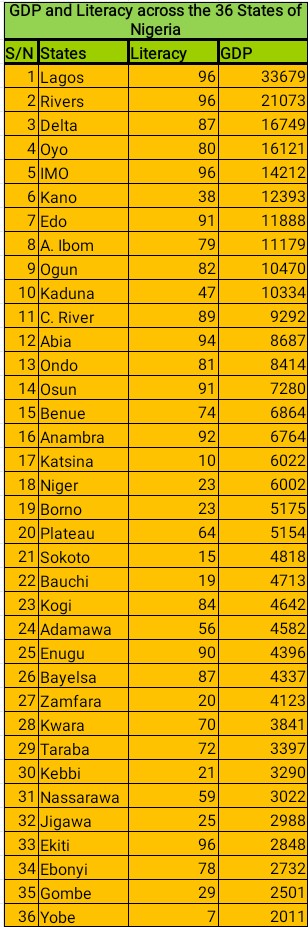
Using the Pearson Correlation Coefficient and data on GDP and literacy across the 36 states, save the FCT from the Nigerian Bureau of Statistics, 2018, I got a value of r = 0.01 indicating a weak positive relationship between literacy and productivity across all the states. A correlation is a measure or degree of relationship between two variables with possible values ranging from –1 to +1. We have a positive relationship if productivity increases with literacy. A negative relationship when literacy increases and productivity falls; and zero correlation when the change in the value of either affects neither.

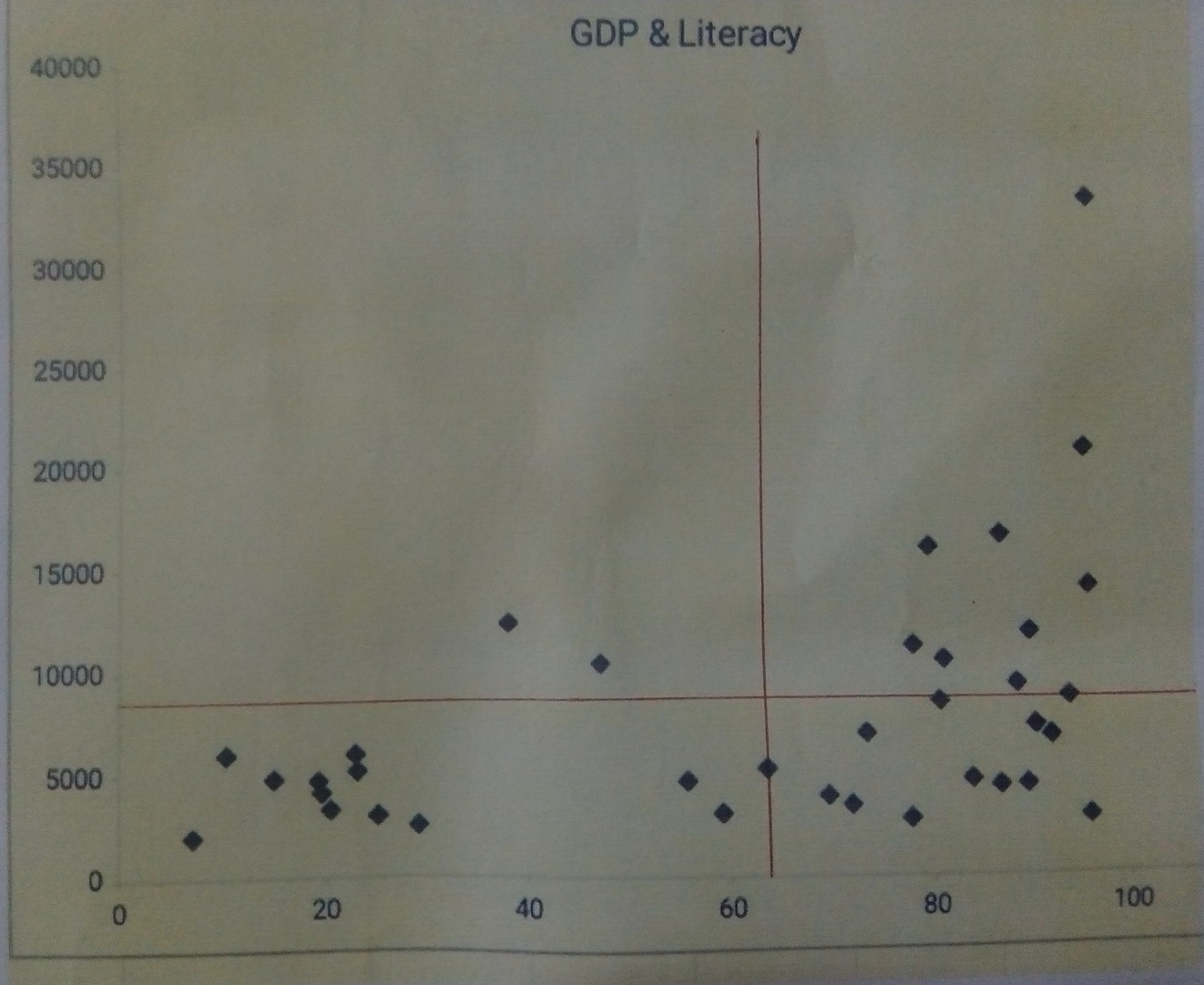
On a graph, for a good interpretation, GDP is used to represent productivity on the vertical axis, while the literacy rate is plotted on the horizontal axis. With $7.9 million as the average output of the 36 states, the graph is horizontally divided into two sections; and with 64% as the average literacy rate for all the states, the graph is further divided vertically into two making four sections with significant implications.

In the top right section of the graph, there are eleven (11) states with their respective productivity and literacy rates above the averages of $7.9m and 64%. This is the Safe Zone. The states in this region are Lagos, Oyo, Ogun, Ondo(Southwest), Rivers, Delta, Edo, Akwa Ibom, Cross River (South-south). These states are amongst the 13 richest states in the country. Here a positive relationship is observed between literacy and productivity but we cannot tell which one causes the other.

In the bottom right section we have ten (10) states that are above the average literacy rate and below average productivity. The states are Osun, Benue, Anambra, Enugu, Ekiti, Bayelsa, Kogi, Ebonyi, Taraba, and Kwara. Here a negative relationship is observed between literacy rate and productivity, that is, productivity lags behind literacy. This may be attributable to a disconnect between curriculum and industry.

In the bottom left section we have thirteen (13) states that are below the averages of literacy and productivity. This is the Danger Zone. The states are Katsina, Sokoto, Niger, Kebbi, Jigawa, Zamfara (Northwest), Bauchi, Borno, Gombe, Adamawa, Yobe (Northeast), Plateau, and Nasarawa (North-central). Here we observe another positive relationship but in a negative sense because productivity nosedives with literacy.

In the top left hand section, we have just two (2) states of Kano, and Kaduna that are both below the benchmark for literacy and above the benchmark for productivity. The reason for this could be attributable to Kano being the commercial hub of Northern Nigeria and Kaduna as the administrative capital.

The gap between the safety and danger zones with respect to literacy and productivity are 59.8% and $107, 363m. It means states in the danger zone need 59.8% improvement in literacy and $107, 363m improvement in productivity to catch up with those in the safe zone. Every state not in the safe zone, especially those in the danger zone, is sitting on a keg of gunpowder and something significant and urgent has to be done in the area of social investment at all tiers of government.

“Yes, it is either we find money to fund basic education and universities concurrently, or we prioritize basic education, and remove all subsidies in the universities.”— Prof Ndubuisi Ekekwe.

The first part of this quote on finding alternative means to fund basic education appeals more to me. I recommend that education should be devolved from the concurrent list to the residual list to enable local communities to devise ingenious ways to equip themselves with skills through “community education.”


Stream 1 2018 NYSC Corps Members: It Is Time To Reflect

0

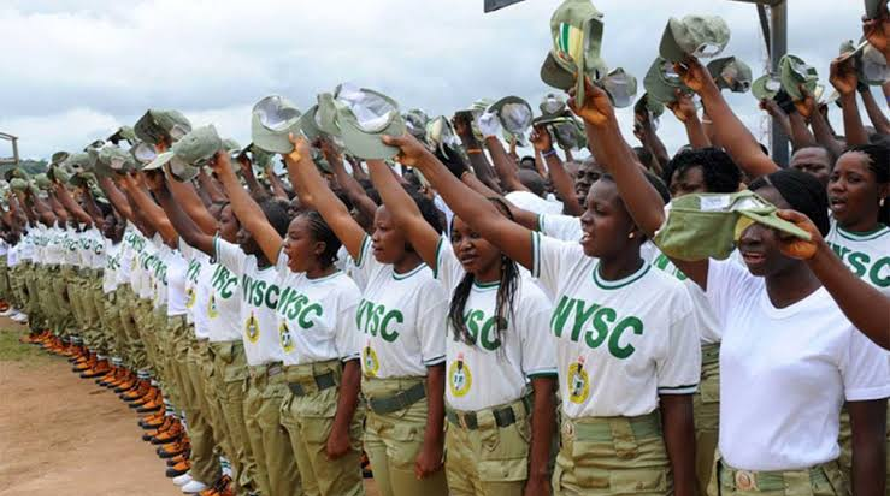
On Thursday 3rd October, 2019, the National Youth Service Corps, the body with the mandate to ensure Nigerian graduates undergo the compulsory one-year service to their father land has released the corps members who fall into the stream one batch of 2018 after their year of service. I congratulate them. Yet, this piece is to remind them of opportunities gained or lost as the case may be during their just concluded service year. There is  also a charge for them to move on and conquer their world post national service.

Trust the digital natives who form the bulk of those who passed out, photos was all over the social media announcing the end of the rite of becoming a graduate in Nigeria. But, there are so many things that have come to an end with the passing out parade.

First and most important is the month stipend given to these youths while in service. It is popularly called Allawee. It is some kind of social safety net for fresh graduates. And it is collected for the entire period of the service year. This shields the kopas from the harsh realities of life beyond the campus. For some, the money is not enough to take home. For others, their savings from the allowance is huge. Whether badly spent or well saved. That luxury has come to an end.

Second, the protection given to the corps members is gone forever. As a youth corps members, they are referred to as government pikin (children). With the NYSC uniform, there is hardly nowhere a youth corps member could not access. The access is unlimited! But that is over forever. Some corps members leverage on that to network and connect at the highest places. Such connections have yielded a lifetime opportunity for them. That opportunity is no longer there. A government child of yesterday has become an ordinary citizen of today. What goes around has eventually come around.

Third, the opportunity to get employment opportunities or drive a business as a corps member is over. There are companies who long to recruit youth corps members with a view to paying less than they would with a fully fledged graduate. The experience does not always end well. But, some youth corps members cut the teeth of their professional practice in the organisations where they serve. They are luck to be retained. They never feel the pang of being jobless after service year. Others lose that opportunity because they fail to see a jackpot where they should. They believe there would always be another opportunity.  So, instead of putting in their best and showcase hardwork, commitment and team spirit, they pass it on simply because they are just corps members. The folly of that singular action would soon dawn on them in a couple of months. For some, they hit gold because they are perceptive. They see their host community’s problem as their own and proffer solutions to them. The act of owning such a problem provides a source of livelihood for them. They become suppliers of that solution to the community. And for life they stay put in places where they serve either as an entrepreneur or third sector operator. Now, those who pass out have passed the opportunity over. The baton is for those coming in to take up. If indeed they know!

Fourth, the opportunity to experiment, ideate, incubate and accelerate business ideas by the corps members is also gone. Many fail to realise that the period of the service year provides an opportunity to experiment and launch a venture for themselves. The mandatory national service year is the dusk before the dawn of a real and tortuous journey of looking for jobs or trying to establish one. It is the period to search, prepare and secure a dream of securing the dream of studying abroad or acquiring industry relevant skills.  Many succeed; many fail. But life goes on.

Lastly, the period of service year is an opportunity to fulfill marital dreams. A lot found the love of their lives in the course of serving the fatherland. Love relationships grow and blossom into full life time commitment. Others are scammed and scarred. Many young handsome men use the period to dupe beautiful, naive and  unsuspecting female colleagues or even girls of their host communities. Whether negative or positive, good or bad, that singular opportunity is gone to return no more.

The lessons here are for those who have missed in action not to rue the missed opportunities. They can only be ready to explore other opportunities after service year. It is just that they are more hidden because they are more desperately needed. Those gearing to go and serve their country should also take note. The national service is not for the monthly stipend alone, it should be recognized as the needed gap year to have a career clarity and launch to become the best they could be after service.

Artist Pracademic Extraordinaire: Professor Nnenna Okore

0

Let me get the jargon out of the way for those unfamiliar with the phrase “Pracademic” – it is the cross between a practitioner and an academic.
OK, let me come out straight, Professor Nnenna Okore is not directly known to me. Yes, her husband was a classmate of mine. Himself an erudite scholar, businessman and ex-employee of a leading accounting and auditing firm, Ernst & Young in the Chicago area.
 
Having said this, my first physical encounter with Nnenna was at the October Gallery in London, where I was privileged to attend her showcase of on Igbo Art entitled “Ukwa Ruo Oge Ya O Daa (i.e. There’s a time for everything).”
This exhibition, which took place at the October Gallery in London between  26 October and 2 December 2017,  was an eye-opener for me, and also prompted my interest in exploring this woman of stature further. That exhibition is one of many in the long line of exhibitions spanning geographic spaces from Africa to Australasia, Europe to North America. For instance, her works were featured in the inaugural exhibition “Second Lives: Remixing the Ordinary” at the Museum of Arts and Design in New York. She has also exhibited at the Goethe Institut in Lagos and has participated at the Dakar and Johannesburg biennials as well as the prestigious 29th Sao Paulo Biennial.
Nnenna Okore
Nnenna Okore
 
Nnenna’s notable works include her debut project Ulukububa – Infinite Flow as well as Metamorphoses . She continues her work exploring new materials and new textures deployed in rather ingenious and impressive ways. Her Art highlights how the circular economy can be harnessed as she uses sustainable materials in transforming the customer experience.
Here’s a sneak peek at her personal statement taken directly from her web page.

My work broadly focuses on the concepts of recycling, transformation, and regeneration of forms based on observations from ecological and man-made environments. I am drawn to uniquely diverse and tactile characteristics of the collective physical world. I am astounded by natural phenomena that cause things to become weathered, dilapidated and lifeless – those events slowly triggered by aging, death, and decay – and subtly captured in the fluid and delicate nature of life. My materials are biodegradable and comprise largely of old newspapers, found paper, ropes, thread, yarn, fibers, burlap, dye, coffee, starch, clay, etc.

Nnenna also points out that there are challenges along the way and especially so for female artists and even more so in challenging environments. For example, in one of her interviews with Art Design Cafe she opined:
“My choice was passion-driven, and therefore fairly stress-free. It is generally difficult to sustain an artistic career in Nigeria, and more so for women.”
Ultimately, Nnenna has become a role model for budding female artists having navigated turbulent waters and emerged as a force majeure on the Art scene.