People have either been known as being rich or poor. Despite this, the stakeholders cannot do without devising means of taming poverty, the single indicator of knowing the poor over the years. Before Nigeria became one of the countries where people with the extreme poverty live, there are having been policies and programmes towards socioeconomic advancement. From the Structural Adjustment Programme to the Operation Feed the Nation, and National Economic Empowerment and Development Strategy to the Seven Point Agenda, Nigeria has shown significant interest in taking many out of the national and international poverty lines with little results.
In 2015, Nigerian government joined other countries for the realisation of making the plant meaningful for people to live under the Sustainable Development Goals, pledged to commit its financial and human resources to the elimination of extreme poverty (one of the 17 SGDs) across the country, especially among the people in the rural areas and women. With 10 years and less than 3 months to 2030, it is imperative that the governments reflect on the successes and challenges on the actions taken and still been taking on the Goal since 2015.
This is critical as the recent report indicates that Nigeria remains the country with the highest number of people living in extreme poverty. World Poverty Clock adds that the extreme poverty is increasing by nearly six people every minute. Failure to reduce the trend would result to approximately 3 people every minute in the next decade. Globally, World Poverty Clock puts the current escape rate per people per second from poverty at 0.5, whereas the world needs to target 1.7 rate per people per second before the world could reach the total elimination by 2030.
As concern is being raised by the professionals, policy makers and government officials in the developed countries, those in the developing countries are not resting on calling for the right policies, programmes and strategies for the Goal attainment. In its efforts, Nigeria developed its Country Transition Strategy (emanating from the MDGs assessment) which aimed at achieving the Goal and others by 2030 using three stages. In the first stage, which spans 2016 to 2020, Nigeria intends to build on the existing foundations. These foundations are expected to be scaled up between 2021 and 2025. From 2026 to 2030, Nigeria believes that no Nigerian would be left behind without benefits from the attained Goals.
Unfortunately, it appears that the country is experiencing a number of challenges in the first stage. There is an issue of having unified data for the measurement of progress being recorded at state, local and federal levels, though a few months after the announcement of the SDGs by the global leaders country’s SDGs Baseline Indicators report was released. In spite of this, over 130 global Civil Society Organisations in a statement ahead of the 2018 United Nations High Level Political Forum said there is no idea whether the 2030 Agenda is recording the desired results, especially in the developing countries. These among others have led to the Development Experts and Professionals questioning the country’s track to end extreme poverty by 2030 considering the recent report and governments’ commitment towards the Goal. This piece provides some answers to the question.
The History of Extreme Poverty
The answers could be more understood within the extreme poverty trajectories from the global to the national perspectives. From 1820 to 2015, the share of the world population living in absolute poverty moved from $2 to $1 and to $1.90 per day. With the last amount, the World Bank notes that the number of people within the threshold has reduced from about 1.9 billion in 1990 to about 650 million in 2018. The amount ($1.90) and other previous amounts used to measure level of poverty remain controversial.
In the 90s, poverty did not primarily have a place in Africa. Then, over a billion of the extremely poor lived in China and India not in Nigeria and Democratic Republic of Congo. The governments of China and India know that the rate is time bomb which will continue to have severe impact on the countries if not properly addressed. The countries really addressed the income inequality with various socioeconomic and political measures. From the East Asia to South Asia, the concentration of the global’s poorest moved in the 90s. Now, the sub-Saharan Africa is having the greatest pie of the consequences of having the high number of people living in national and international poverty thresholds.
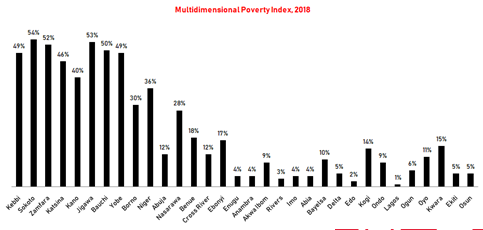
This trend is not quite different within the Nigeria context of understanding the history of poverty. Over the years, various reports have pointed the northern region as the place with the huge number of the poor. Most of the reports have found Sokoto state as the state with the highest number of the poor in the last three years. Current statistics indicates that 81% of the population in the state is poor, while poverty incidence is much lower at 34% in Niger. Experts believe that political leaders in the region are not appropriating the resources judiciously for the benefit of everyone. In addition to this, corruption has been identified as the main factor ensuring the perpetual stay of the people in the extreme poverty threshold across the region and the country.
Where are the Governments
It is obvious that the extreme poverty trends have shifted to SSA and Nigeria in particular. The question now is where are the governments in addressing the challenge in line with the indicators developed for the attainment of the Goal. SDG 1 as conceptualised has 7 targets and 14 indicators. These represent the metrics for tracking the attainment of the targets. The first two indicators aim at measuring the proportion of population below the international and national poverty line considering gender, age, employment status and geographical location.
Looking at the rate of unemployment and the number of women in need of basic social amenities such as health, education and water, it would not be too far for someone to conclude that governments are struggling to attain these indicators in the last four years. This becomes more glaring when the men, women and children of all ages in the multidimensional poverty index are considered. These are the people who lack access to basic health, education, living standard and prone to various threats since 2015. For this index, a 2018 report puts the proportion of the people in it at 97 million, the highest in Africa.
As painted earlier, the north region equally remains the region with the highest number of people living in the MDI. If Nigeria will eventually not achieve the targets within the SDG1, the region is most likely to be the clog in the track of the realisation because the region has a large number of states with the people in the MDI. While the north region seems to be the real clog, a significant number of states in the south and west regions are reducing the rate of the people in the MDI. For instance, 1% of the people in Lagos live in multidimensional poverty.
In the course of the investigation and analysis, it was discovered that states and federal governments have developed varied social net programmes with the intent of leaving the people out of extreme poverty. But, there are issues militating against the full implementation of the programmes. The low budgeting for health, education and social welfare such as child protection by the governments remain the main issue. Apart from this, existing programmes are reaching a few percent of the poor because of the fragmentation approaches to project implementation. Already, the newly conditional cash transfer of N5, 000 to vulnerable households have been described by non-state actors as political tool being used by the Federal Government to favour the ruling party –All Progressive Congress.
The right to land is another indicator capable of taking a significant number of people from extreme poverty. When the vulnerable are given access to use their land for economic activities, experts say the growing poverty rate would be reduced, analysis suggests. From 1978 to 1992, and recent policies by the state governments, Nigeria has had the cause to ensure people’s right to land acquisition with little or no successes. The 1978 Land Use Act gives the state governor and local governments the power to grant “statutory rights of occupancy”.
The place of this Act in ensuring secure tenure rights to land in terms of legal recognised documentation and income status remains debatable among the experts and public analysts. According to experts and analysts, some state governors and local council chairmen are using the Act to their advantage –approved the required documents based on the people they have affinity with or organisations they have stakes in. In what appears as a new tool of making life meaningful for the vulnerable herdsmen, Nigerian government recently came up with the idea of harnessing lands for them to ease their cow rearing businesses, which some citizens and analyst frown at. The government initiated the idea in line with the incessant attacks on the farming areas and the farmers. The farmers have largely been displaced and killed by the herdsmen at various locations, especially in the northern and southern regions. The attacks add to the number of people displaced due to the Boko Haram insurgency since 2009, which constituted 79% of the IDPs population in 2015.
The consequences of the attacks, missed people, killings and kidnappings have been severe on the economic activities. For those who are saved from the attacks, many are still struggling to survive. Their lands have been degraded. The families of the kidnapped victims have paid ransoms of several millions of Naira in the last three years. These impacts are pointing to the fact that the country’s GDP is bleeding, which has the tendency of thwarting the expected GDP growth rate for 2019 and the next three years.
With the SDG 1, the Nigerian government and others are also expected to equal distribution of income. However, the last four years have been characterised with the dwindling and increasing inflation rate, causing prices to fluctuate, and increase unemployment and poverty. Nigeria’s inflation has been higher than the average for African and sub-Saharan countries for years. Despite the unstable inflation rates, the Federal Government is yet to find a balance for taxing businesses and citizens in line with the income status, fueling the income inequality across social status and geographical locations. Experts believe that the poor are being taxed heavily while the rich are enjoying various tax reliefs. A public analyst notes that “the amount of money that the richest Nigerian man can earn annually from his wealth is sufficient to lift 2 million people out of 6 poverty for one year. Lifting all Nigerian people living below the extreme poverty line of $1.90 out of poverty for one year will cost about $24 billion. This amount of money is just lower than the total wealth owned overall by the five richest Nigerians in 2016, which was equal to $29.9 billion.”
Correlates, Determinants and Consequences
We have seen what governments’ data say about the SDG 1. For a deeper understanding of the progress made so far, there is a need to look at the correlates, determinants and consequences of the progress. From the GDP perspective, Nigerian government recorded ‘significant growth’ in 2015. This growth was hit by the economic recession in 2016, making the GDP to be at -1.62% before growing to 0.81% in 2017 and 1.94% in 2018. Examining the existing data from the GDP purchasing power parity perspective, Nigeria also had poor economic performance in 2015. The PPP is a measure that shows the economic power of the people in terms of their purchasing or spending power in a year, which could also determine the number of the people at the upper, middle and bottom of the pyramid [see GDP PPP’s chart for more understanding].
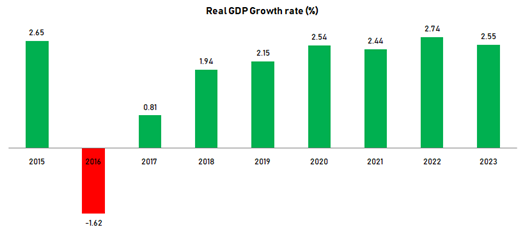
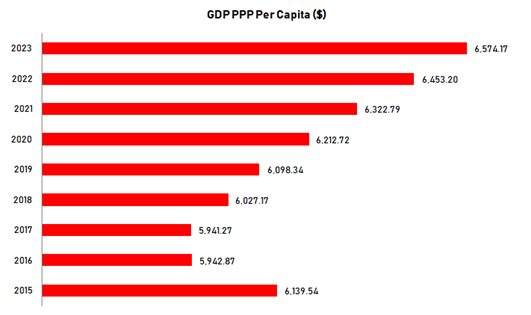
With the good macroeconomic performance examined and projected ones, it seems that Nigeria is likely to attain some of the indicators examined earlier if the results are allocated and used judiciously. However, experts believe that the poverty will increase as long as the population grows exponentially, while the economic growth remains dwindling. This indicates that the current growth of the economy will not lift people out of poverty. The economy must grow above the population.
Now, let us see the correlates and determinants that exist in the last four years among the emerged data. Analysis shows that population and economic growth had 22.2% connection between 2015 and 2018. This is an indication that one percent in population equal 22.2% increase in economic growth. In spite of this linkage, Nigeria was unable to lift the majority out of poverty within the period (see earlier statistics). During the period, the average population growth was 2.66%, while economic growth was 0.95%.
Analysis further shows that the population and PPP grew negatively during the period. A 46.0% reduction in PPP was found based on the population growth rate, indicating the low contribution of the populace to the economy and earning of the income that was not sufficient to make a standard living. Analysis specifically establishes that during the period, the average population was 188,461,404, while the average GDP PPP per capita was $6,012.71.
Since the economic and population grew during the period because of the people and government’s activities, the country’s economic competitiveness rankings between 2015 and 2018 were analysed along with the macroeconomic indices. The results are striking. According to the World Economic Forum, the country recorded poor rankings within the public institutions, private institutions, infrastructure and efficiency enhancers. These are the indicators appropriate for the determination of the government progress on the SDG 1.
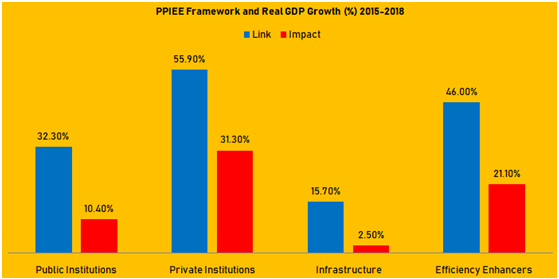
During the period private institutions had significant impact on the real GDP growth than the public institutions. Infrastructure had an insignificant connection with and impact on the Real GDP growth. These connections and impacts show the extent to which the poor rankings connected and severed the real GDP growth. This has many implications. For instance, the processes and activities are not sufficient to ensure good linkage with the economic growth. This is also applicable to the level of infrastructure. It is obvious that people did not have adequate facilities that could improve their contributions to the economic growth between 2015 and 2018.
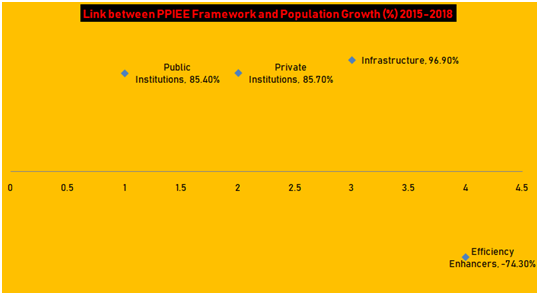
From these insights and implications, it is clear that the governments and policy implementers need to tweak the existing transition framework developed from the MDG impact assessment. It is highly commended that the Federal Government has institutional, policy and legal, partnerships, human resources, communications and financing frameworks. But, these are not enough as it could be deduced from the previous analyses that they are not really yielding the desired results. Within the institutional framework, property rights and government efficiency need to be improved upon, while the fight against unethical behaviour, corruption and undue influence should be intensified. These efforts are not be intensified by the governments alone, private sector also has significant roles to play, especially in their interactions with the public officials, politicians and other firms.
Going Forward
It has been established that one policy or strategy cannot eliminate extreme poverty in a society. Before achieving SDG 1, there is a need for mixed policies and strategies. Governments should stop measuring the number of people escaping poverty from the macroeconomic performance alone. Many countries in the developed world have stopped using this approach. Attention has been shifted to 3PT when social policy and direct household-level support become the means for reducing poverty and inequality.
The vulnerable people need to be supported with the real social assistance programmes. When this is done, they should be prevented from falling into or further into poverty. It is not enough to give them cash every month, support their informal businesses with stipend and expecting them not to be in poverty again. Many eventually spent the cash and stipend for business on health and accessing basic education. Politicians and others who have interest in eliminating extreme poverty should engage the vulnerable households in productive activities that have a propensity of increasing their income. Giving agricultural subsidies to the people who have political connections is not a transformative approach to social net programme implementation. It is a retrogressive approach that increases gender inequality and social discrimination.