DD
MM
YYYY

PAGES

DD
MM
YYYY

spot_img

PAGES

Home Blog Page 6686

Utilizing Blockchain to Enforce Rules of Origin in AfCFTA

0

The African Continental Free Trade Area (AfCFTA) is an initiative of the African Union to create a single economic market of 1.2 billion people and a $3.4 trillion dollar opportunity by eliminating the common frictions which affect intra-African trade.

The Rule of Origin states that only goods which are manufactured with local inputs in member countries can be exported to other territories that belong to the same market and enjoy tariff free status. Due to the fact that with the exemption of South Africa, most member states do not have strong industrial base to produce most of the goods their citizens consume locally and as such resort to imports majorly from the Western and Eastern markets. Due to this construct, some African countries have economic partnership agreements skewed against their favor which makes it possible for an industrialist in Europe, America or China to produce goods in their markets, ship them down to African states they have trade relations with and have them repackaged as locally manufactured products so that they can easily enter large markets on the continent such as Nigeria, Ethiopia, Kenya, etc without paying duties.

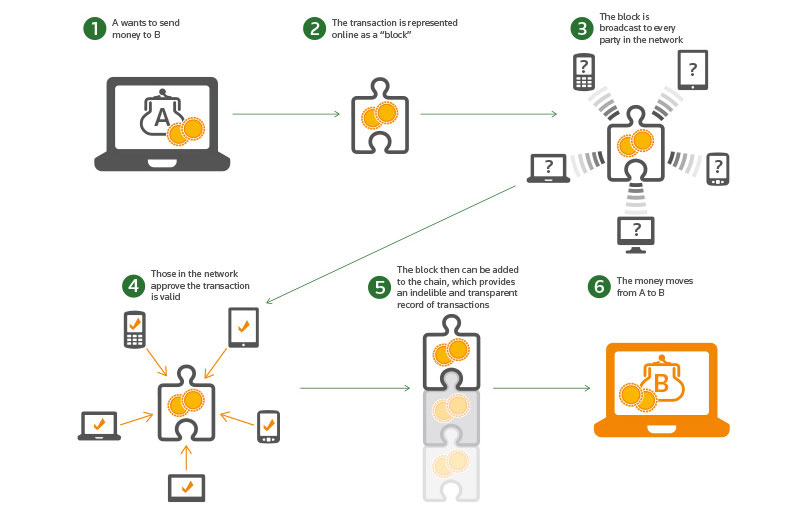
How blockchain works

This problem can be sorted out with the application of blockchain technology. The African Customs Union and African Manufacturers Association comprising the participating states will create a single digital distributed secure database which will contain information on all products locally manufactured according to the laws of each country in the regional alliance and monitor their logistics and supply chain up to their exports across the borders so that the Customs of every member state already has real time data of each product from neighboring and other distant African countries coming into their territories. 

The importance of this is to ensure that no local industrialist will collude with non-African countries to breach the rules of origin by bringing finished products and packaging them as indigenous manufactured leading to the creation of dumping grounds for smuggled products which is an economic sabotage that can make the common market to collapse.

The AfCFTA Secretariat needs to consider the adoption of this solution before the full implementation of the Pan African economic market to prevent unfair trade practices that could result in litigation and withdrawal of membership by aggrieved members.

The Possible UberLYFTization

2

Uber is having crises – it is cutting more workers. Last time, it was marketing, but this new one includes engineering and product units. But yet, these cuts will not help Uber. Its fate is simple: Uber and Lyft will come together very soon. Yes, everyone will see that these companies are not making money and could be allowed to survive through merger; similar rivalries have ended together: Elance/Odesk (now UpWork),  Groupon / LivingSocial, Sirius / XM and Rover / DogVacay.

For the second time in three months Uber is cutting staff in an effort to boost its bottom line.

The company confirmed on Tuesday that it has laid off 435 employees—265 from engineering and 170 from the product team. In July, the company cut 400 employees from its marketing department following the departure of  Chief Operating Officer Barney Harford and Chief Marketing Officer Rebecca Messina.

“This is some bad news coming out of Uber as the company continues to go through some bumpy roads since its IPO,” said Dan Ives, analyst at Wedbush Securities. “This is not the news The Street wanted to hear, and it speaks to the challenges the company is contending with.”

Yet the real challenge is ahead for the gig economy which Uber is a guardian: California state senate passed a bill to classify workers doing things like driving for Uber and Lyft as full-blown employees, not independent contractors, thus blowing up the business model. The bill still has to be approved by the state assembly and signed by the governor, Fortune notes.

The California Senate passed a bill that could force Uber and other gig economy giants to reclassify their workers as employees. Such a change would secure labor protections for thousands of people across the state and deal a significant blow to companies that built multi-billion dollar businesses on independent contractors.

Under the new law, Assembly Bill 5, people in California could generally only be considered contractors if the work they’re doing is outside the usual course of a company’s business. Companies like Uber Technologies Inc. and Lyft Inc., which rely on armies of drivers to service their customers, would likely fail that test without transforming how they do business. Employees are entitled to a minimum wage and overtime pay, neither of which is a common protection within the gig economy.

By the time few other states follow California, Uber will call Lyft for a meeting; Lyft could also initiate the call.

Uber stock is falling

The Apple’s iReversal

3

Few months ago, I noted that for Apple to compete in this new age of mobile device competition, it must reduce its prices on iPhone. My thesis was based on product maturity construct where hardware products over time become fairly good enough that customers may be open to try new brands. In other words, unlike say six years ago, one can now get really great Chinese phones that cost far less than the iPhone, while delivering decent and acceptable composite value. Under that scenario, the hardware differentiation within the software exclusivity that Apple has used to increase prices of iPhone products will hit a ceiling. Simply, any marginal increase will push many to drop the Apple brand for an alternative. The iPhone X was a good experiment for Apple; the result was that you cannot just keep increasing prices without losing customers!

Fast forward to last quarter, Apple made some changes. Yes, Apple reduced the prices on iPhone and in the process stabilized China iPhone sales. The results were not clearly pretty—profits and revenues fell, and iPhone sales dropped by 17%, their sharpest decline ever—but executives said price cuts in China led to a pickup toward the end of the quarter, sending shares up more than 10% in after-hours trading, as reported by Quartz.

Today, Apple is a service company. Service companies win with volume. The implication is that having many people using Apple devices will help deliver the volume needed for any service-based strategy to work. So the news that Apple is reducing prices while having marginal improvement on its products makes a lot of sense.

iPhone 11, iPhone 11 pro and iPhone 11 pro max came as the phone newbies of the year.

The new products are not quite different from the ones introduced last year, though there is camera system upgrade to allow for wide-angle photos. There is also an upgrade in battery capacity, such that it could last a few hours more than the predecessors.

Speed is also another new feature that differentiates the new from the old. A bit of it makes the trio faster than the predecessors.

Then they came with ridiculous prices that beat the expectation of users. iPhone 11 at $699 is $50 cheaper than its predecessor, the iPhone XR. iPhone 11 pro costs $999  while iPhone 11 pro max sells for $1, 099 .

This week, Apple unveiled Apple Games with $5 monthly subscription, Apple TV+ with $5 subscription besides the iPhone, iPad and watch. The subscriptions will be motivations for Apple to reduce its hardware prices. The company will continue to go deeper into this price reduction. By Apple iPhone 15 which is largely four generations away, the iPhone pricing will reach an inflection point that it could go mainstream in Africa. In other words, the prices will be affordable enough for large adoption in Africa. That price has to come down from $699 to say $450 as I have maintained: “This strategy will become very clear in coming quarters. I have noted that Apple must have a phone with price range in the neighborhood of $300-$450.”

Yet, Apple has to be very strategic in its pricing. My suggestion is this: increase the price of the highest version of iPhone to $1,200 and make it more premium. And then introduce a phone brand called Apple and make the price $350. Make the design of Apple (the phone brand) to be radically different so that you do not cannibalize the premium iPhone. By having these two brands, Apple can compete in both the upper and lower segments of the markets. We will have Apples in Nigeria while they will sell their iPhones in New York. This is similar to Toyota selling Lexus and Honda selling Acura.

Apple as a service company has to optimize its addressable market which means working hard to have many people to use its hardware – the more people, the better. That differs clearly for mainly vertically-focused hardware companies which dwell on the differentiation of their gadgets to win customers. By reducing hardware price, typical for service-inclined business, Apple will be pursuing a horizontal strategy and that means Africa could become an important part of its future. It is decreasing prices – it wants more users for its services. Fortune captured its thus, “It was a day of price decreases and incremental product improvements that might have been mistaken for a shutterbug convention.”

This is a huge iReversal which is typical when a hardware company pursues a service strategy. Apple iPhone has to become more affordable and I expect this trajectory to continue.

The Need To Bring Onitsha Main Market Into The Digital World

1

Has anyone ever thought what it will feel like turning Onitsha Main Market into a mega online wholesale and retail outlet? Has anyone ever tried to bring in Onitsha Main Market traders into the digital world? Anyone ever tried telling our OMATA (Onitsha market amalgamated traders association) men that they can sit down in their shops and sell things to people in different parts of the world by just a click?

Well, I met a young man who nurtures that dream. But it seems to me that his dream is gradually fading away because he believes it wouldn’t be an easy feat to achieve. As he said, it will take more than a young corper, who grew up in Enugu, to get any of those business moguls to change their traditional ways of buying and selling.

“Who is this young man?”, a lot of people will ask. Well, I didn’t get his name. And I didn’t get his contact too. We had the opportunity to talk because of the very bad Enugu-Onitsha Express way. The journey that would have taken just an hour ended up taking three solid hours. And since my boys (whom I was taking to Awkuzu to see grandma for some days) were occupied by other children, I had to hit off a very insightful conversation with this young man (an NYSC member currently serving in Onitsha). He gave me a deep insight into his journey trying to convince a trader (who happened to be a friend’s father) to allow him to market his wares digitally. His challenges, discoveries and strategies are the things I will present here.

“Why is this piece important?” you may ask. Well, I believe that if you are an ‘outsider’ and you want to penetrate Onitsha Main Market to hit off a business, you may want to know what you will encounter. I equally believe you may want to look into the strategies this corper suggested, which he believed he couldn’t achieve alone because he is an ‘outsider’.

So, here are the obstacles and the challenges you may face while proposing a business venture to an Onitsha Main Market trader:

1. Trust for Strangers: According to this young man, he couldn’t get this trader to allow him market his wares digitally because he is an ‘outsider’. That he is a friend and course mate to this man’s son isn’t enough (and his friend isn’t at home to convince his father). From what he said, the man told him bluntly that he won’t entrust him with such an ‘expedition’ because he doesn’t know what his motives are.

When I asked him to find another shop, he told me it is not as easy as it looks. According to him, you have to be one of them to be allowed in. Since the only person he knows wouldn’t let him in, no one else in that ‘line’ will (the trader is into cameras and related materials). I hope you know these traders have a strong network?

2. Fear of Loss: According to this young man, it is difficult for these traders to leave their shops to be managed by someone else. This is the reason they are always present in there. They don’t want to take any chances with their businesses. Even holidays and vacations are not welcomed (their families can go to wherever they want but they, the traders, don’t go anywhere). I believe this is true because I noticed that in every shop I enter, the oga is there as if he is monitoring the ‘umu boy’. So, OMATA man doesn’t believe in entrusting his business to anyone because something could go wrong in his absence.

3. Recruitment of Financial Experts: The oga is also the chief accounting officer. If he couldn’t do that, the chief apprentice will do the job. If the chief apprentice is not available, then the banks will have it. No offence, but I believe the staff of the banks in Onitsha are truly enjoying this job. The thing is that almost all those shops you see in Onitsha do not have any trained accountants to manage their finances. This is one area this people need to do something about.

4. Slow to Change and Innovations: This came up when I told the young man to explain the benefits of digital marketing and digital shops to the trader. According to him, this trader said that he doesn’t trust all those computer stuffs because fraudsters can get to him through them. In fact, he said the man told him they don’t need the help of a computer to make their millions. Well, that’s true, to some extent, but they need to think of making billions this time.

5. Preference for Cash over E-Payment: Onitsha man prefers being paid in cash to e-payments. For example, POS is not common in Onitsha Main Market despite the volume of sales going on there. It is either you pay cash, or you do a bank transfer, which means you have to wait for the credit SMS alert to get to them before they release whatever you paid for to you (if the bank decides not to send their alert at all, you are on your own). Besides, not all of them will even release their account details to unknown buyers. So, paying cash is always the best option.

6. Lack of Trust: To the Onitsha trader, everybody is a potential fraudster. This is one reason they find it hard to trust people. Even their children and wives are not really treated with much trust. And come to think of it, some of these traders don’t allow their family members into their businesses. If their wives or any of their children declare interest in the business, they will open another outlet for them. I don’t really know anyway, more research should be done here.

We have seen some of the challenges someone that wants to ‘do’ business with an Onitsha man will face. But then, there is need to harvest a lot of potentials from that market. Anyway, here are some of the insights I gathered from the young corps member on how to win over these OMATA men:

a. Be honest to them. Of course you know you are trying to build a reputation, so don’t give them a reason to be suspicious. Tell them the whole truth, and nothing but the truth.

b. Don’t push them; give them time to adjust to whatever change you are bringing. Pushing them could make them suspicious, which in turn will only make them turn off their antennas. But you still have to follow them up, only do so in a subtle way.

c. If you are an ‘outsider’, get closer to them through a member. In other words, find someone that can bring you into their circle. You can’t just jump in on your own. As for this corper, he is trying to get in through one of the man’s children who has shown interest in digital marketing but in a different section.

d. Be ready to invest your money first. I think this is another area this young man is having a problem. He told me that he is raising money to start buying some of the things he will market (of course he will buy them from this trader’s shop). He strongly believes that when he starts this way, the trader will be assured of his seriousness and then bring him closer.

e. Give them real life instances of how the business works and how it will favour them. For example, if you want to go into an online shop, they need to see how and where it is used and who used it to make more sales. So, do you homework well.

f. Speak their language. Yes, language is a mark of identity and solidarity. You need to learn the variety of language they use in the market so you can easily be accepted. Sounding off will label you an ‘outsider’ and create room for mistrust. So, learn their colloquial and slang and make use of them while interacting with them. You are trying to mingle with them, right? Then, sound like them.

Well, this is the much I can give here. I believe experts will know how to take it from here. I still believe that someone, or an organisation, needs to go into the big markets in Onitsha (they cover almost the whole of Onitsha, Nkpor, Obosi and the environs) and carry out an intensive research on their business challenges and strategies. Africa, and indeed the world, needs to know what makes Onitsha what it is today.

If you have interest in bringing in new techs into this market, do deeper work before venturing in. Best of luck to you.

First-Class Graduates – What Can You do?

3

It hurts anytime I see First Class graduates reach out to me, in search of a job, and I can’t help them. Here are the questions I ask myself:

  • ”What else does a graduate need to succeed?”
  • ”Are certificates not enough?”

My former colleague in school, Ajewole Samson, told me, ”Forget First Class. In fact, some of them are just bookish. They actually cram to pass in school. Only a few could actually defend their certificates.”

He continued, ”The First Class on paper is different from First Class in the brain. Interview some of these so-called First Class graduates, they have nothing meaningful to offer. This is the 21st century, the future belongs to those who can use their brains.”

 I paused and reflected on this. Indeed, the future belongs to those who can solve problems. Those who can replicate their academic success in real life. But here is the question – as a First Class graduate, what can you do?

You have excelled academically, but how can you navigate your way through?

 You can sit at home and brag about your academic achievement, it still boils down to what you can do with your head.

 Finding a job takes the grace of God in a country like Nigeria. While you sit and lament about life not being fair, be intentional about your life. Take actions. Learn something new. You never know what lies in store for you. If you can excel in school, you should be able to replicate that in real life.

The similarity between life and school is – both require hard work and dedication to be successful. Your success in school shows that you are hardworking and dedicated.

Now, get up and show the world you can do it. Don’t give up! Fight for what is yours. The world is ready for you, but are you ready for the world?

 Think about it.