Medicine is a great profession but it is also a lousy scalable call. A doctor has the worst marginal cost paralysis in all the elite human professions: you cannot scale your specific individual services irrespective of demand because your “customers” (yes, patients) are different across all major variables. So, at anytime it is one doctor per patient and that means a doctor is bounded by time and geography. There is a reason for that: doctors are called for greater missions because they have the zenith of all missions – lives and human wellbeing. And you cannot give them anything more than that.
But as Africa continues to see the exodus of its doctors out of the continent even as the population expands, we need to fix the marginal cost paralysis in medicine. How can one doctor treat thousands of clients at the same time? In other words, how can you scale the care doctors deliver to the world?
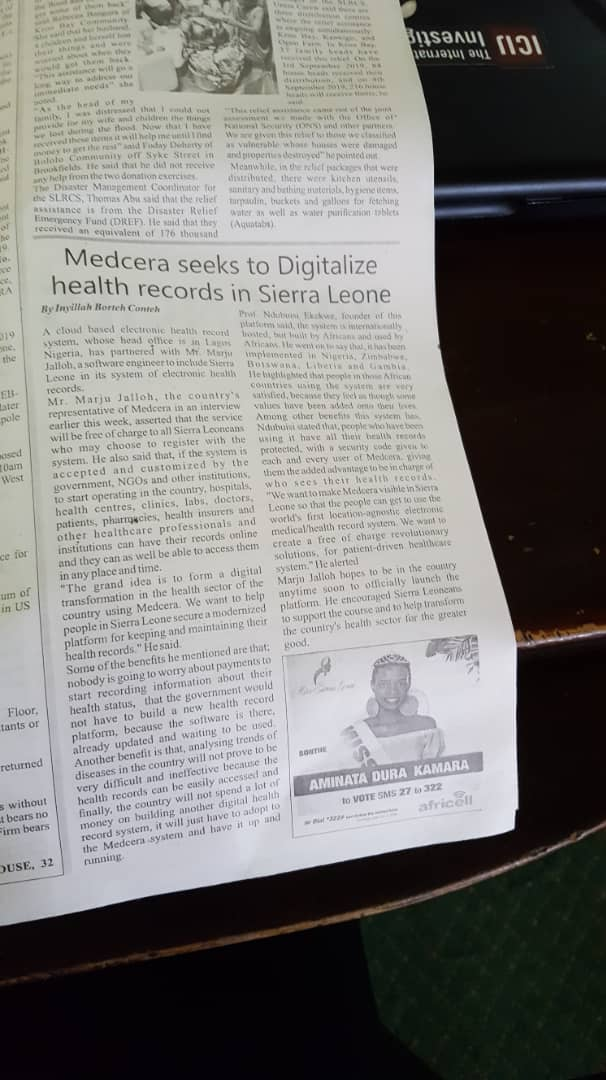
At Medcera, we are working to make that promise possible, and very soon, Medcera CareAI will serve as “digital doctors”. Put your symptoms, our AI will diagnose basic ailments and make recommendations bounded by our statistically confidence interval. Where we do not have high confidence, then a human doctor will take over.
Sierra Leone loves this future and it has gone Medcera. We are scaling across Africa; join our mission – one African, one Health record, one Medcera.
We are excited to be in Sierra Leone to begin digitizing the health records of the good people of Sierra Leone. We are confident that we will improve health outcomes and help our partner clinics and doctors in saving lives.
China designed and executed a policy that shrank the industrialization process in a mere 25 years — something that many economies took at least a century to do. That redesign has brought immense dislocation in global commerce and industry, enabling China to become one of the world’s leading economies.
If you run a startup in Lagos, Accra, Nairobi, or in any African city, and your playbook is Silicon Valley’s, you will likely not do very well. There are many variables in emerging markets which make Silicon Valley model largely irrelevant. My suggestion is that you pick your perspectives from China and India: those nations share many things in common with Africa. This is not to say that Silicon Valley playbook will not succeed in Africa. My point is that you have a higher chance of success if you invent yours or at least copy Chinese or Indian firms.
When Alibaba began, evidently inspired by Amazon, they noticed that the main problem was payment, and not necessarily ecommerce. When India’s Flipkart began, payment was also before it. Both firmsdropped the Amazon playbook (Amazon did not create any scaled payment infrastructure) and went into building a payment system. Amazon did not have any payment issue because Mastercard, Amex and Visa had solved those frictions for it. But in India and China, payment was just a big opportunity as ecommerce.
Largely, in emerging markets, most entrepreneurs become parallel entrepreneurs as they have to build enablers to seed the ecosystems they have to operate. While Silicon Valley will preach doing one thing very well (because others are doing other things great as well), if you use that playbook, you will run out of gas. Our markets are still at infancy to run that playbook. Yes, Jumia and Konga quickly realized that ecommerce was not just the friction, payment was a big problem. Largely, you would have expected them to go after it at scale since payment has to come before ecommerce. Without electronic payment, you cannot have electronic commerce; it is as simple as that. The implication is that until Nigeria can fix digital payment, our ecommerce will have a ceiling. Of the $301 billion spent in Nigeria, on consumer transactions,98% is still on cash!
Why African Is Different From Silicon Valley
There are many reasons African founders cannot just use Silicon Valley playbook. Here are some reasons.
Resources: You are under-resourced and that means you need to find how to survive daily. Silicon Valley does not have that problem.
Regulation: You are mostly under-regulated and that means you may be writing the rules as you go. That means you may be the one thinking for the government.
Political instability: The national policies keep changing and that means you plan per election cycle. U.S. core policies are largely stable irrespective of the president in power.
Suppliers: Your suppliers typically disappoint you and that means you may plan to vertically integrate as quickly as possible.
Macroeconomic paralysis: The macroeconomic issues you deal with are huge and the forms keep evolving.
Non existent infrastructure: When you have two generators and work on diesel supplies, your counterparts in Silicon Valley may not understand. Electricity has been solved there for decades. But you are your own local government, providing security, power, water and more.
Customer Base: You have a thin customer base withpoor purchasing power. Also, these customers are price-sensitive unlike the Americans that can shop as a hobby.
Currency fluctuation: Most currencies are pegged on the dollar. That gives Silicon Valley stability you do not have. Silicon Valley does not deal with currency issues because they are the currency.
Competition: Across most African capitals, it is not the best ideas that win. Most times, your contacts are more important than your products.
IP protection laws: The Supreme Court of Nigeria has been booked for non-political cases till the end of 2021. That means justice in Nigeria is severely delayed. A court case that closes in Silicon Valley in months will drag for years in Nigeria and broad Africa.
Talent: You are going to work to retain brilliant people in a region with severe unemployment. That should change your equation and how you approach the game plan. In Silicon Valley, they have talented people money can easily buy in abundance. In your case, you have few people to source in a region with severe unemployment.
Mentors: Mentors are scarce and failure rate is high because the support system is low in Africa. In Silicon Valley, they have these people they call Venture Capitalists who are simplyprofessors of business but also write cheques to people.
You Are Not A Disrupter
In Africa, you need to be humble on the use of the world “disruption”. Yes, always remember that you have nothing to DISRUPT because technically you are likely the one starting the sector. If you work in agtech and you think you are disrupting agriculture, you are wrong. Africa has no strong agro-industry that is open to disruption. My point is this: you are likely starting a new sector over disrupting something as typical in Silicon Valley. I feel bad when people write “I will disrupt the transportation sector in Africa” – who told you that we have one to start with. Largely, you are going to build a new transportation sector since as of today we cannot say we have any within the lens of Silicon Valley.
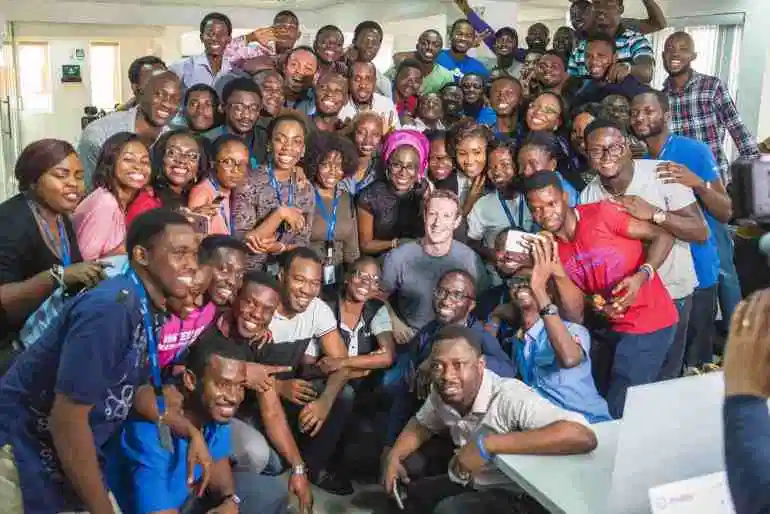
Mark Zuckerberg visits Nigeria
Asset-Hybrid Is Fine
Do not be blindfolded by the mantra of asset-light. It is easy for American companies like Uber and Lyft because they can connect into other enablers which are asset-heavy. But where you do not have such, you may be forced to help build them. Yes, if you are in the business of moving food produce from rural areas to cities, using aggregated buses, a time may come when you will notice that you do not have enough buses. There is nothing wrong if you have to revisit the playbook to put supply through financial modeling via a Special Purpose Vehicle. American and British firms may not have such problems but Indian firms surely do. So, the asset-light company becomes a little asset-heavy to become what I call asset-hybrid.
Do Not Break Fast
Do not break things very fast because you want to blitz-scale. It does not work easily here because most markets are heterogeneous which means you cannot scale one business model. Within countries like Nigeria, the game plan for Lagos may be different from the one you will use in Yobe.
Break things and scale fast is irresponsible in Africa. If you have that philosophy, you will fail. One government agency may hold an approval for 6 months and there is nothing you can do. Also, the rapid somersaults on policies will make that strategy challenging. You need to have a strategy that puts resilience and sustainability at the heart of your business. Growing by all means and cost will destroy you because whenever there is a major change in the macroeconomic system, you will be off.
This does not mean that you should not scale. My point is that you cannot blindly follow a Silicon Valley playbook that can be activated in 50 American states which are largely homogeneous once the hypothesis has been validated in their two states.
All Together
It is important to understand that what Silicon Valley tech titans do in U.S. is different from their playbooks in Africa and other emerging regions. Google is a quasi-payment company in India even though it has none of such in U.S. Facebook is investing in connectivity systems in Africa when in U.S., it was not an issue. Yes, for every new sign-up Facebook gets, Wall Street watches: IP address is IP address. .My point is that these U.S. firms are not doing them for charity, they have to become parallel ecosystems to pursue their missions. Yes, they have to do things beyond that core mission which they have pursued in America because they do not have other entities helping them to fix the enabling frictions in emerging markets.
To do that, they have to open new playbooks, beyond what they have preached in Silicon Valley. Google is now a fiber-satellite-balloon telecom company, and it is just getting started. You need to understand that Silicon Valley and broad American is different even when they tell you that Mark Zuckerberg and Bill Gates are dropouts;personally, I do not see them as dropouts. Read beyond the playbooks and think what makes sense here. Google and Facebook do not follow their Silicon Valley playbooks when they come here: you need to understand that reality.
Beautiful young asian woman holding a credit card and shopping online with using laptop computer at cafe on blue tone, girl payment on internet, business ecommerce icon concept.
Over the years, I have consumed so many articles with concrete proof stating that no single e-commerce store in Nigeria has broken the jinx of profitability, not even the almighty Jumia, Konga, and Dealdey. These big e-commerce stores are still struggling or are about to fold up. This had me wondering what the cause may be; could it be logistics, warehousing issues, price stability, wrong hiring or product listing to catch the right market demands?
Well, according to a research by www.timetrade.com, it stated that about 85% of shoppers till date still prefer to shop in physical stores as opposed to shopping online despite the rapid growth rate in the e-commerce niche in Nigeria and Africa as a whole.
One funny thing people don’t know is that every digital inclined technological conscious business does business online; from posting your products online, to referring someone to purchase a product online e.t.c. could be directly or indirectly linked to e-business or e-trading, better known as e-commerce. You then wonder why the popular e-commerce stores do not have their own physical stores or brick and mortar stores.
From my own perspective, there is absolutely no need for an edifice to accommodate their physical stores, no need to worry about construction and all its affiliates when it comes to erecting a new physical store. Their warehouses could actually serve that purpose and they could make it a strictly commission based stores, where all registered users can just walk-in and register and have their goods placed in the physical store spaces allocated to them without paying rent money. The e-commerce store on its part then has a fixed commission percentage it fixes on all goods which have been placed in the physical stores and deducts such commissions after every successful sale of such goods.
There is a need for major e-commerce stores to consider an omni-channel means of scaling their business models, one of which could also include third party logistics services and not just in house logistics services. Imagine having a Black Friday in a physical store; Lagos would be closed down for days due to traffic gridlock problems.
This model works both ways; imagine already existing profiting brick and mortar stores now having fully functional ecommerce stores, what do you think would happen if a company like Shoprite that is already profitable now opens an Amazon like kind of e-commerce business? Great profits if the ropes are well tied and spawn to eliminate loose ends.
Sustainable agriculture dates back to old conventional methods of farming that were practiced in the early days, where the leaves were used to cover the soil, to prevent excessive water loss, or when animal dung or waste was recycled, and used as manure to improve crop yield. In modern days. these technologies are still been practiced but there is a need to scale up and employ more modern sustainable methods like the incorporation of Technology and Renewable Energy to ensure self sustainability and regeneration geared towards continuous availability of agricultural products for food and textiles production.
It’s imperative that from the planting – harvesting – storage – processing – transportation and marketing, there is a need to incorporate sustainable modern practices like technology and renewable energy for sustainable agriculture geared towards economic, social, ecological and financial prosperity.
Technology: Why do we need to visit our farms daily or look for the nearest botanist or crop/animal health specialist to deliver our worries about our farms when we can use remote sensing, precision farming, use IOT or send data over the internet? Hence the need to develop more agricultural inclusive technical applications like: Zenvus and TRENAGRIC to automate and bring convenience to farmers thereby easing off tedious processes.
Modern technologies also has to be incorporated in terms of growing our crops like soilless farming; better known as hydroponics and the recycling of aquatic waste better known as acquaponics to improve farm yields in all aspects of farming.
Renewable Energy: there is a need to incorporate renewable energy practices through the use of farm waste being recycled through anaerobic digestion to give bio-fuel, bio-gas, bio-gel and fertilizers. This would go a long way in aiding in the proliferation of agricultural produce.
Windmills for pumping water or wind turbines to supply electricity needed in the farm for various activities
Other key applications in the conversion and utilization of solar energy includes: water pumping for irrigation systems, solar fence chargers, solar incubators and hatchery, solar dryers, solar precision farming, solar drone, solar lighting, solar spraying, solar planters and weed harvesters.
Another key application of solar energy is in food storage; in Nigeria alone, billions of naira worth of produce goes to waste due to poor storage facilities. Under the right temperature the most perishable goods could be further preserved from spoiling for about 21 more days giving more timeframe to source for market or to process them. The use of solar energy for preservation is a very feasible feat as it’s currently been employed by Coldhub Nigeria which uses energy derived from the sun to power its mobile cold room and offer cooling as a SaaS (software as a Service) model.
Recycling: Recycling of farm waste to form compost manure, animal waste for manure, eggshells, bones or shells for calcium and wood for energy. This also involves the method of re-using old farm equipment and tools, and less soil corrosive chemicals and detergents.
Sustainable agriculture can’t take place if we don’t decouple fossils fuels form our everyday most basic farming activities, and employ technology alongside to compliment its activities.