DD
MM
YYYY

PAGES

DD
MM
YYYY

spot_img

PAGES

Home Blog Page 6737

The EFCC Clean UP

0

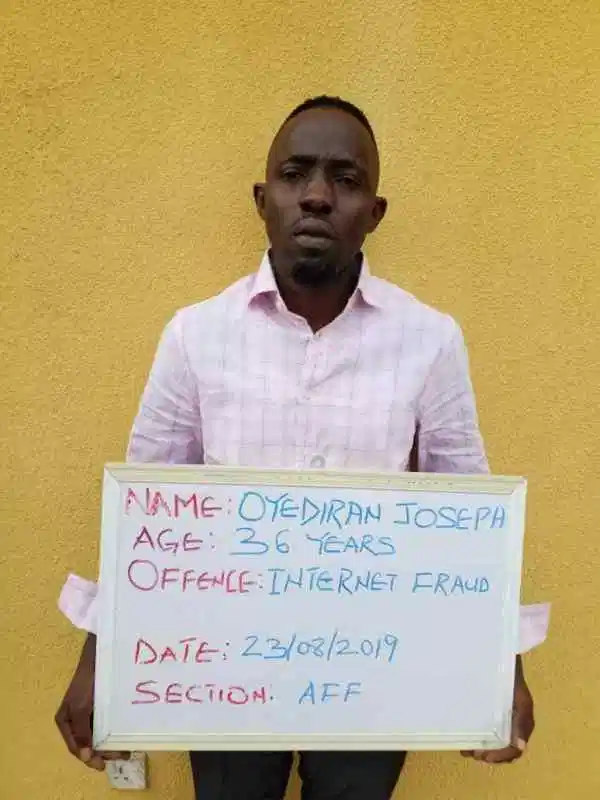
It is typical in Nigeria, the world sneezes and we get into action. Yes, FBI arrested some idiots on digital frauds – and EFCC, Nigeria’s financial crime fighter, woke up. Over the last few days, EFCC had recorded a decent success rate on picking alleged fraudsters across Nigeria.

My question is thus: why did EFCC wait this long before picking these men if the process is this easy? Why did they wait for Nigeria to be embarrassed before breaking the syndicates. From the success so far, after the FBI list, it is evident that EFCC could have saved Nigeria this shame.

They have picked suspects from Ekiti state, Kwara state, Imo state, Rivers state, and across the nation sustaining the federal character: ”The official said the commission is assisting the U.S. authorities in unraveling the syndicate.” Possibly, these suspects will join their brethren in U.S jails as they wait their days in courts.

He explained that the suspect, Ajayi Festus, was arrested in Ado-Ekiti following an alleged illicit transaction through his Nigerian bank amounting to N223 million.

”You will recall the shock and embarrassment we all suffered as a people when the news about the indictment of 80 Nigerians in massive cybercrime cases investigated by the Federal Bureau of Investigations (FBI) of the United State was broken last week.

Nigeria deserves institutions that work proactively over these knew-jerk reactive processes we see daily. Largely, EFCC did have enough intelligence to have broken most of the operations but nothing happened. If they could make these arrests in just a week, imagine if they work on that construct 52 weeks in a year. Possibly, internet fraud will go because the men will know that Nigeria cannot host them!

They are fleeing from EFCC and Nigeria; EFCC should pursue them.

Days after the Economic Financial Crimes Commission, EFCC, vowed to fish out Nigerians indicted in the recent United States wire scam,Saturday Sun has learnt that most of the young men with questionable source of living are currently on the run. While many have gone underground, those with the means have fled to some West African nations and even beyond the sub-region to evade arrest.


Ndubuisi Ekekwe Will Deliver FUTO 2019 Biennial Lecture

0
FUTO is a top technical university in Nigeria

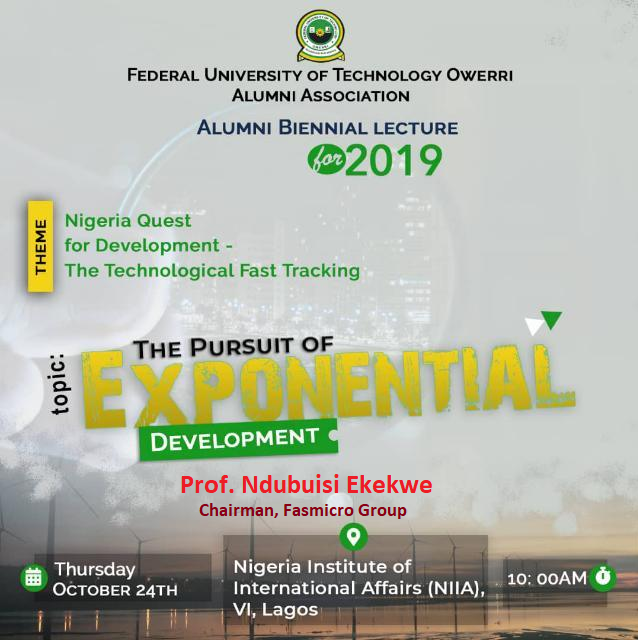
Today, I am so happy to announce that GREAT FUTOites – students and graduates of our great institution, Federal University of Technology Owerri (Nigeria) – have chosen me to deliver the Main Presentation in the highly prestigious FUTO Biennial Lecture. The lecture is scheduled on Oct 24, 2019 at the National Institute of International Affairs (NIIA), Lagos. I will speak on “The Pursuit of Exponential Development” for Nigeria.

Since 2006, The Federal University of Technology Owerri (FUTO) Alumni Association, has been organizing this public lecture with the theme: “Nigeria’s quest for development – the technological fast tracking”. This year’s lecture is the 6th in series. The first edition held in 2006 on the topic “Power and Development in Nigeria: seeking that workable solution” was delivered by Prof. Bart Nnaji under the distinguished Chairmanship of Prof. Dora Akunyili of blessed memory.

I will return next week with a link for those that would like to attend [the organizers will share this weekend]. It is a free event but requires prior-registration.

Made-in-Aba and the AfCFTA

0

On 7th of July, 2019, Nigeria joined other 53 African countries that have signed their membership of the AfCFTA with President Buhari signing of the free trade agreement. According to the African Union (AU), the objectives of AfCFTA are to:

  • Create a single continental market for goods and services, with free movement of business persons and investments, and thus pave the way for accelerating the establishment of the Continental Customs Union and the African customs union.
  • Expand intra African trade through better harmonization and coordination of trade liberalization and facilitation regimes and instruments across regional economic communities (RECs) and across Africa in general.
  • Resolve the challenges of multiple and overlapping memberships and expedite the regional and continental integration processes.
  • Enhance competitiveness at the industry and enterprise level through exploiting opportunities for scale production, continental market access and better reallocation of resources.

To me as a development practitioner – just like other Nigerian development professionals who look for international development work opportunities beyond Nigeria and in Africa in particular – the news of Nigeria joining the AfCFTA is received as a would-be blessing: For one thing, AfCFTA will answer the question of ‘‘are you permitted to work in this country’’ which always comes up in applications for development job openings within the African continent. 

But beyond this free movement of professional in the area of services, in the area of goods –finished goods not just raw materials–the news of Nigeria’s membership of AfCFTA is yet to go down my throat: With my basic knowledge of Economics and my awareness of the inherent peculiarities of the Nigerian economy – in terms of low level of manufacturing and high level of importation – I have my reservations. In fact, I tend to favour some level of trade protectionism for the Nigeria situation–with emphasis on bilateral trade agreements than multilateral trade agreements. 

I am among those who strongly share the feeling that there is a possibility that AfCFTA would further expand the Nigeria market as an import dumping ground. As such, in terms of volume of trade in finished goods (with all their value chain positive effect on economic growth), my reservation above seeks answers to the question of how Nigeria will benefit from AfCFTA. As a result, my economies imaginations seek answers to these pertinent questions:  

  • What quality finish goods will Nigeria be bringing to the table of AfCFTA? Are we going to be at the receiving end as the case has been with all of its negative economic effect? For instance, are we still going to be bringing crude oil (and other primary/raw material products) to the table of AfCFTA instead of its refined products? 
  • To what extent have our local manufacturing and other forms of production served our robust local demands? And how much have we developed our domestic market for our domestic manufacturing and production? 
  • How is Nigeria faring in this era of globalisation in terms of trade? Like the AfCFTA, globalisation to extent has opened up the world as one global market; what quality finished goods has Nigeria traded in this globalised market? And on the hand, to what extent has globalisation contributed in further dumping of goods in Nigeria and killing of (struggling infrastructures starved) local industries?  

It is basic economies that an economy first optimises and harnesses its domestic market potentials in production and trade before it could benefit more from international trade–even at regional and continental level. As such, Nigeria government must go beyond signing membership of AfCFTA (which I take as more of avoiding the possibility that Nigeria could become a loner in the realities the new AU arrangement would spring up) to coming up with time-bound strategies on how Nigeria will benefit in the continental trade arrangement. 

This brings us to the potential of Aba in Abia State, just like other manufacturing clusters in Nigeria–which in the spirit of AfCFTA must be maximised – and other new clusters created.  Aba has one of the biggest SMEs concentrations in Africa–with a thriving lather and garment industries among other industries. According to businessday.ng (February, 2019), one million pairs of shoes are produced by more than 80,000 leather maker in Aba each week. With 48 million pairs produced each year at an average price of N2,500 a pair, the industry is said to be worth up N120 billion, the newspaper reported. As such leather works and garment products are among the finished goods Aba can bring to the table of AfCFTA.  These industries and others which have growth potentials should be expanded – particularly in the spirit of AfCFTA.

Citing a study findings presented by Professor Okechukwu Anyamele (a Professor of Economics and Finance, at Jackson State University, in the United States) at the Aba urban renewal summit in 2015, Premiumtimes Nigeria (2016) gave an economic outlook of the city as follows: 

  • Between 2000 and 2015, Aba’s economy grew at an annual rate of 7.44%.
  • In 2000, Aba’s GDP stood at $1.57 billion; by 2015, it had grown to $4.9 billion.
  • In 2014, Gross National Income per capita of Nigeria was $2,760
  • Aba’s GDP with official population of 917,355 will put Aba’s income per capita at $9,778.
  • Aba’s income per capita in 2014 was 3.5 times that of Nigeria.

It is worthy of note that Federal and Abia state governments are prioritising the economic growth potential of Aba–particularly with the Enyimba economic city project, Aba dry port project, power project and other efforts. Abia State governor, Dr Okezie Ipeazu is also leading the Made-in-Aba goods promotion campaign. 

Now – in the spirit of AfCFTA – these efforts have to be doubled and tripled. As a matter of policy strategy, Abia state government should have AfCFTA focal office in Aba. This office will work to support, educate and mobilise the producers on the market window of opportunities AfCFTA would bring. This also applies to other industrial clusters in Nigeria. 

In the agricultural sector, there are evidence based value chain products – like rice, cassava, coco and aquaculture – that should be leveraged on across Nigeria. Evidence of measurable and time-bound result oriented manufacturing/production and trade based programmes across Nigeria (not politicise programmes), is the only way Nigerians like me can go to bed with our eyes closed – that Nigeria will benefit from AfCFTA – when it’s realities unfold.

You Are Not A Pushover

0

Yes, I mean it. How you see yourself is how people see you. When you believe nothing moves without you, so it is. And if you also believe things move with you, so it is. People will try you. As a matter of fact, they will push you but your courage and determination will make them realize that they can try you but they can’t push you.

I always say that what you permit stays. Come to think of it, some things making you restless are not even up to your standard. In life, you come across people that may want to act like demigod over your life but the truth is – you permit it. With my experience so far in life, I discovered that when people discover your weakness, they capitalize on it.

Irrespective of what they do to you, you are not a pushover. Because a pushover is someone who never stands up for his own interests. He might be easily convinced to do something he doesn’t want to do, or he might be unable to put himself first, even at his own personal expense.

I always tell people that being kind is a necessary virtue and a quality proven to sustain long-term, productive and healthy relationships. However, there is a fine line between kindness and pleasing others. When you are pleasing others, you tend to have very few, if any, personal boundaries. That makes you appear weak to others. If there is one habit that will impede your success long-term, it is the habit of pleasing others – romancing someone else’s ego.

Pleasing comes from fear of being criticized and it is always accompanied by a lack of confidence. You become a pushover if you fear people’s judgment. Likewise, if you are not 100 percent cooperative or supportive or if you fear you will be seen as overbearing, domineering and disagreeable.

You are a pleaser if you consistently say – “yes” when you are to say – “no.” Most pleasers have learned to survive through placating others, and in doing this set themselves up to be treated without respect. In life and business, you cannot be taken seriously without a little determination to your personality.

4 ways to avoid being a pushover

  1. Be real: When I say be real, I mean you should be yourself. Make mistakes and don’t cover-up or fidget over it. After all, we are human. When you make a mistake, learn from it. Be true to yourself, not because of others but because of you. This way, you earn respect and avoid being pushed over.
  2. Learn to say No: I do say this all the time – ”what will be will be.” Don’t think it too hard. Let them look down on you for being firm and upright. Not all questions or request deserves a ”yes”. Say yes when you ought to and vice versa.
  3. Stop pleasing everybody: I mean this, the moment they discover your weakness they will crucify you for any little thing you do. But the moment you stop dancing to their tune, they change towards you. Be who you are. You are the CEO of your own life. Stop being a people-pleaser.
  4. Be bold: To avoid being a pushover, you have to be bold. Surely, people will test you with all sorts of things but your boldness will definitely show them who you are. If they push you over, you push them aside. 

The “E” That Makes The Difference

14

The first time I went to Ghana, I had to wait at the front of Accra Mall for my host to come pick me. 

While I was waiting for him to come, I had the privilege to behold the beauty of the Accra Mall and its environment. 

The Mall is indeed beautiful. Great design, spacious car park and friendly people.

It was my first international journey so everything was of great interest and appeal to me.

I saw black people drive into the parking lot of the Mall and I saw white people from other countries who are resident in the region drive in, too.

I listened keenly to how they call things and I found that they call “bus” bas. They call “pastor” pasta. “Nature” nacha. “Coordinator” codinata and they call the male folks “Charlie.”

I went into the Mall to get a loaf of bread for my host so we could share at least because I couldn’t get one before I left my home.

I asked one of the workers in the Mall where I could get bread and he said,  “The bakery section have not “opined.” Check back by 9am.” Then I said okay, they’ve not “opened.” He smiled back and said “Yes!”

I got to know that based on oral English transcription that’s how those words should be pronounced. “Stuff” sounds like “staff” .

I’ve been improving my pronunciation lately.

Of all the things that caught my eyes while I was waiting for my host to come pick me, there was one that stood out among the many.

Of all the cars, the people, the structures and the conversations, there was something special that caught my eye.

It was a little signpost on the other side of the road. Just 20 meters or so from the front of Accra Mall.

The amazing thing about this signpost is that it is different from all other signposts. It wasn’t for advertisement, nor for traffic regulation nor for direction. It was simple and special in its own way. Standing all alone.

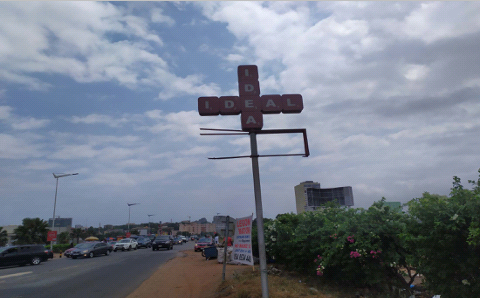
Just 8 pieces of boxes joined together to make something that looked almost like a cross. 

On it were written two short tiny words: “IDEA” and  “IDEAL”

When I first saw the signpost, the questions that came to my mind were, what is this stuff doing at this strategic point in the heart of the capital of Ghana? Of what relevance is the signpost and why the two short tiny words?

IDEA and IDEAL.

In my amazement, I took a closer look at the placement of those words on the signpost and I discovered that if you look at it from the left hand side down, you have “IDEA.” If you look at it from the top down, you have “IDEA. If you omit the first box from the left hand side and look it forward to the right, you have “DEAL.” And if you play with the word “DEAL”, you have “LEAD.”

I looked further and I discovered that the boxes that bears the letters that makes these words were placed two box at the top, two at the left, two at the right and one at the base. Two, two, two, one.

And each of the two, two, two, one box are all connected to the center box that bears the letter “E”.
Then, I asked myself, what is that unique “E” in an “IDEA” that makes it “IDEAL”?

What is that unique “E” in an “IDEAL” that makes it a worthwhile “IDEA”? 

What is that unique “E” in an “IDEAL” situation that brings good “DEAL”?

And finally, what is the unique “E” in “IDEA” and “IDEAL” that can make one a “LEADer”?

That “E” must be the “E” that makes the difference!

As I tried to unravel this puzzle while still waiting for my host to come, it became clear to me that the “E” is “EXCELLENCE.”

The only thing that makes an idea ideal, the only thing that makes an ideal a worthwhile idea, the only thing that makes an ideal situation bring good deal and the only thing that can blend an idea and ideal to make one a leader in whatsoever one does in life is “EXCELLENCE.”

What sets top business leaders apart from the others is that they deliver per excellence.

Everything that comes out of their company in terms of products or services has a perfect touch of excellence. 

Their unique value/selling proposition is excellence.

An idea might be what you need to enter a market. An ideal situation might be what you need to launch, but it is “EXCELLENCE” that will keep you in the market.

When the forces of demand and supply begins to act, it is “EXCELLENCE” in product and service delivery that will give you competitive edge.

Ladies and gentlemen, until excellence becomes your brand, you don’t have a business. You just have a hobby.

Your brand is what you’re known for. It is people’s perception about you. It is what poops up in the minds of people when they mention your name or hear about you. It is what you’re remembered for. Your brand is you.

And until excellence becomes your brand, you do not have a business.

As entrepreneurs, as businesspeople, as leaders and as key players in the affairs of our lives, let everything we do have a touch of EXCELLENCE. 

In my secondary school days, I saw a picture post that says, “I want to be so full of Christ that when a mosquito bites me, it would fly away singing there’s power in the blood.”

Likewise, I wish that we would develop a magnificent obsession for EXCELLENCE in delivery of products and services and discharge of duties such that our clients would leave us singing, s/he delivers per excellence.

If you’re a manufacturer, manufacture with a touch of excellence. If you’re a fashion designer, design with excellence. If you’re an engineer, repair with excellence. If you’re a musician, sing with excellence. If you’re a teacher, teach with excellence. If you’re an IT solution provider, providing solutions with a touch of excellence. If you’re a consultant, consult with excellence. If you’re a bricklayer, “bricklay” with excellence. If you’re a comedian, perform with excellence. If you’re a leader, lead with excellence! 

While I was still engrossed in unravelling this puzzle that this little signpost brought, my host came. And as we drove home from the front of Accra Mall, I remembered the words of King Solomon of ancient Israel when he said, “Whatever your hand findeth to do, do it with the whole of your heart.” Yes, do it with a touch of excellence.

Even if you’re a candle stick seller or a pepper seller, sell with a touch of excellence.

If someone asks you to help them write a letter or edit a piece, (that’s a lifetime opportunity for you to create an impression) write that letter and edit that piece with a touch of excellence.

Martin Luther King Jr. once says: “If a man is called to be a street sweeper, he should sweep streets even as a Michael Angelo painted, or Beethoven composed music or Shakespeare wrote poetry. He should sweep streets so well that all the hosts of heaven and earth will pause to say, here lived a great street sweeper who did his job well.” That’s doing your job with a touch of excellence. 

Over the years and even while I was an undergrad, I handle projects for people. And the good thing is, even if what you are asking me to do for you is to help you compose a one page text message, it must be done and delivered per excellence.

Isn’t it a thing of joy when doctorates read through the project that you did for a client and they approve the work immediately? That’s my brand. Excellence.

Last month, I got a call from a friend and she said, Pius, I need to make a case before the Deputy Vice Chancellor of my University over an issue that I am having. Can you help pull up a letter in this regard in my favour? I said yes. As fast as I could, I sent her my draft and the following day, she called saying “wow, the letter passed through immediately. Thank you.” That’s a touch of EXCELLENCE.

Three days ago after I returned from my second trip to Ghana, I got a call from a student who I aided in putting up her Industrial Training Report alongside her PowerPoint Slides for defense. She called to say thank you that she had an “A” in the course.

You may not understand the weight of this “A” but it means she had a GPA of 5.0 on a scale of 5.0 in an academic semester. You can imagine the good boost that this score will give to her CGPA. 

Anything that I put my face and name on today must have a touch of excellence. Anything that passes through my table must have a touch of excellence. Anything that has my signature on it must have a perfect touch of excellence. That’s my brand. It is not pride. It is a discipline that I am working on everyday. 

Yours may not be writing, speaking or editing. It might be as little as rendering help, guiding someone, teaching someone, or decorating, painting, serving, printing, marketing, whatsoever. My advice is, let it have a touch of excellence. Be known for excellence. Let excellence becomes your brand, your identity, your value and all.

And that will make the difference and lift you higher in life.

Africa is a promising continent. Our potentials are enormous. If we would put EXCELLENCE in all we do in terms of product and service delivery, we would become the envy of the world.

May these ideas bring you good luck and happiness in all you do.