DD
MM
YYYY

PAGES

DD
MM
YYYY

spot_img

PAGES

Home Blog Page 6739

How The Igbos Won The Battle Against Illiteracy

0

During my primary school days, the Igbo people were seen as those that love money and wouldn’t go to school because they wanted to make money quickly. Then, the Igbos were accused of sending their young sons away to serve as ‘boy’ (apprentice) to traders and marry out their daughters at tender age. Their sons will ‘graduate’ from their apprenticeship when their mates were still struggling with their secondary school education and their daughters will be grandmothers as their age mates were graduating from the university (I remember a woman that was in the same class with her daughter in UNIZIK).

Let me be honest with you, we that were in school used to envy these boys then. You know why, we were always broke while they had money to throw about. But then, we had something they cherish – education (or should I say ‘literacy’ because they too had a form of education). Anyway, some of them had to find their way into the university because they want to have what we had (then there were so many Onitsha traders in UNIZIK weekend Continuous Education Programme (CEP)).

Anyway those days had long gone. Today, the literacy level of the Igbos has shown that the story has turn around for the good. An analysis of state-by-state literacy level presented by The Guardian of 24 July, 2017, shows that the state with the highest literacy level in the country is Imo State, with 96.43%. Other Eastern States came as follows: Abia – 94.24%, Anambra – 92.11%, Enugu – 89.46% and Ebonyi – 77.76%. The same newspaper showed that in 2016, Abia State was the best state in WAEC, and Anambra State took the second position.

The above analysis shows that the Igbos really worked on themselves to achieve these feats. My interest today is not on how the state governments worked on the education sector to achieve their aims (because they actually did). My interest is on how the change in the mindset and attitudes of the individuals led to Ndi Igbo being counted among the literates.

1. Culture: The Igbo people believe that “Ofu onye adi azu nwa” (one person cannot raise a child). They are ready to let others help them raise their children. One of the places to find such helpers is the school. In fact, when a mother is having challenges raising an obstinate child, the advice everybody will give her is, “Send him to school so that the teachers can help you to train him very well”.

In Igbo land, teachers are seen as ‘formators’ and disciplinarians (that is why they are called ‘ony nkuzi’ – the person that shapes things well). And every parent wants to have an obedient and socially accepted child. So, the natural thing to do around here is to send your child to school so that he or she will be ‘well trained’.

2. Quest for Knowledge: That is just a simple truth. Every Igbo man wants to know what you know. This is why you hear parents saying things like, “I want to send him to a good school where they will teach him very well.” These people don’t mind whatever it takes to achieve this so long as their children find the best place to acquire knowledge that will pull them through life.

3. Respect for the Educated Rich: If you are educated but you are not rich, you will have your respect. If you are rich but you can’t read and write, one day a small boy will point it out to you that you are an illiterate (ask those that go to umunna meetings). But when you are educated and rich, you are the bomb.

People always say that Igbo people love money. But I am here to tell you that Igbo people love people that are rich and well educated. Do you know what it means to be a professor or a medical doctor and that you can travel out of the country at will? Just ask around and you will understand.

So everybody wants to be educated and rich.

4. Increase in the Number of Working Mothers: Igbo working mothers are increasing by the day. Most of them do not feel comfortable leaving their babies with nannies. So they take them to crèches when they were still tender. This is also seen in villages where mothers send their children to school immediately they wean them. To them, the children should go to school where they will be safe while their mothers run around for their jobs and businesses.

5. Attitude towards the English Language: Ability to speak English places one among the elites in Igbo land. In fact, when you start speaking English, people will keep quiet to listen to you. And you know that you can’t learn English unless you go to school.

6. Wide Travelling: The Igbo people are known to travel far and wide. They need to be able to interact with the people they meet in their host communities. And Nigeria being a multilingual nation means that either these travellers learn the over 400 Nigerian indigenous languages, or learn the English language that links all of them. So, they go for the best option – English. The thing about learning this language is that it comes with the ability to develop its four skills – listening, speaking, reading and writing.

7. The Media Campaign: There is no way I can drop this piece without acknowledging the efforts of the media. I could remember that different television and radio programmes were aired on NTA Enugu to discourage school dropouts. Then, the usual advice was, “At least let them write their WAEC first before going for business or getting married”. I could remember that some people believed that anybody that has finished secondary school is too old to be an apprentice or get married (at least in Awkuzu girls were expected to marry while in SS 1). But gradually, our girls started getting married after secondary school and the boys started ‘learning’ trade when they are done with their WAEC. This shows that the campaigns of the media worked a lot on the psyche of a lot of parents and individuals, who found reasons to send the younger ones to school.

In as much as I celebrate the high literacy rates of the Igbo communities, I believe that all works have not yet been done. The percentage of literates is not up to 100% so we shouldn’t celebrate much yet. We need to work on those in the rural areas where the major number of illiterates can be found.

However, as we Igbos continue to work on ourselves, I enjoin other states that registered high rate of illiteracy to emulate these Igbo communities so as to help their people.

Marketing Facilities Management Training With(Out) Hashtag and Visualisation Intelligence

0

The existence of the Internet has improved interactions among people, businesses and governments on Internet-enabled platforms through various communication elements such as emoticons and Hashtag. However, many users of these elements do not know the histories and understand the meanings of the elements.

For instance, information has it that Hashtag emanates from the city of Hastings, located in the South East of the United Kingdom. In the 12th century, the city is known for her flourished fishing market.  “Fishermen from the city fished in the North Sea off East Anglia and they sold much of their catch in Great Yarmouth.”  How does the Hastings connect with Hashtag? The answer lies with the Battle of Hastings in which Harold II, the King of the city, fought with the Norman forces of William in 1066, to secure his province.

The Battle of Hastings and Hashtag as Digital Marketing Tactic

King Harold lost the battle to William. Harold was killed by an arrow shot into his eye. Existing information indicates that the battle was fought on Senlac Hill, seven miles from Hastings, England.

From this battle, the current #tag emerges to depict how the arrow shot to the King Harold penetrated his eye and the place of it in attracting people’s attention to contents on digital platforms for maximum reactions. Chris Messina, a social technology expert, has largely been credited to have developed the first Hashtag.

The element has been created and used by individuals and organisations to advance their brands and establishments within customer or audience journey of attention, interest, desire and action. While using the element, analysis reveals that users still mainly employ fear, humor, logical and bandwagon appeals in constructing specific words and phrases that accompany it. Digital marketers of Facilities Management companies (FM) in Nigeria are not exempted from this tactic.

How Alpha Mead, Maxi-Migold Are Using the Hashtag

In the previous analysis, the two companies’ posts on FM training were examined. The insights from the analysis offer better marketing practices.  Beyond message construction for various FM training courses, it is highly imperative to understand the place of Hashtag in attracting prospective trainees.

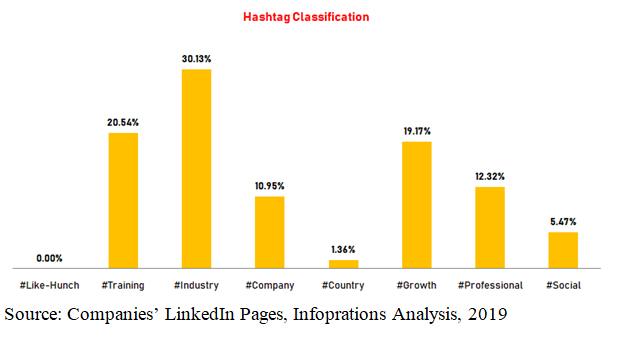
Based on the available data, the two companies’ patterns of Hashtag usage include training, country, growth, company and industry specific at the expense of Like-hunch pattern which has been described as a most appropriate Hashtag type when it is essential to gain “Likes and comments” tractions from the followers.

Within the training category, #training, #corporatetraining, #coaching dominated the posts between July 1 and August 12, 2019. For the country classification, #Ghana is employed mostly. #valuableskills and #certifications were some of the hashtags used within the growth category. In order to engage professionals on the LinkedIn, the two companies predominantly used #propertymanagers and #facilitymanagers, while #maxmigold, #maxmigoldltd #AlphaMeadTraining and #AMTC were the toast of the marketers within company category.

Analysis suggests that these were employed with the strategic intent of improving the visibility of the companies on the LinkedIn. The need to align with the social trends led to the use of #throwback and #throwbackthursday. The data also indicate #MotivationMonday was equally used to encourage followers towards being productive during each week of the period of the analysis. The intent of advancing the Facilities Management industry motivated the marketers to use #FacilitiesManagement and #construction during the period.

In all, 73 hashtags were used by the companies. Over 79% of this figure constituted non-invented, indicating the use of general hashtages. Only 20.54% of the figure was invented by the companies’ marketers. Since hashtags are being used to move prospective trainees from one place to another within the digital platforms. The expectation is that these hashtags were clicked by the followers for more information or understanding of the messages posted by the companies.

The 73 hashtags led to 162,066,478,829 average results on Google Search, 36.55107143 average time of loading the results for the hashtags, 161,471,897 average followers. This implies that two companies had a significant number of people to reach with the employed hashtags. Analysis further shows that #work was the hashtag with the highest number of contents (25,270,000,000) on Google Search Engine, #careers had the maximum time of 0.88 seconds for loading associated with the existing results (contents) on the search engine. #innovation had over 37 million followers. This is the maximum followers found for the 73 hashtags used by the companies.

Comparing these results with the dominant hashtags used by the companies, it is obvious that the used hashtags did not command significant attention. For instance, 4 contents were only discovered for #MeetTheFM, while no followers were found for #alphamead, #certifiedtraining, #enhancingcapacity, #MakingRealDifference, #AMTC, #happynewmonth, #August, #certifiedtrainingcentre, #AlphaMeadTraining, #FacilitiesManagementTraining, #professionaltraining, #professionalcourse, #CertifiedCourse, #gbs4, #maxmigold, #fmmc, #maxmigoldltd, #givingbackseries4, #changelives, #maxmidweeknugetts, #MeetTheFM, #toplevel, #valuableskills, #professionalcareer and #paidtraining. This signifies that the messages associated with these hashtags failed to get the followers and other people’s attention during the period.

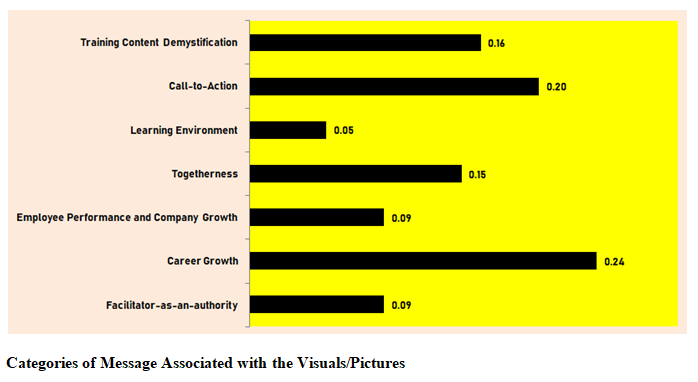
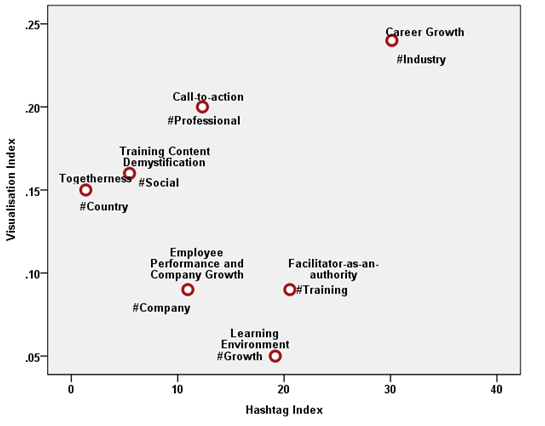
In the future engagement, marketers need to popularize invented hashtags, most importantly those that connect with the companies’ brand names and specific training courses. This is important because analysis further suggests a strong connection between the loading time of searching for additional information using the dominant hashtags and number of existing contents. It is also desirable to use words and phrases that resonate with the graphical contents along with hashtag symbol (#) because analysis reveals only 14.6% of the dominant hashtags connection with the visuals employed during the period.

The Movement of the Messages on Visuals/Pictures with the Hashtags

Source: Companies’ LinkedIn Pages, Infoprations Analysis, 2019

Time to get out of the “Woods” – Marketing of Nigerian Media & Entertainment

0

Prior to my paper on the Nigerian Movie industry in 2010, I drew inspiration from an interesting article entitled “Step Aside, L.A. and Bombay, for Nollywood” by Norimitsu Onishi published in the New York Times in 2002. Now the stepping aside has returned with more calls for further stepping asides. For example, the KwaZulu-Natal Film Commission in conjunction with the South African Department of Economic Development, Tourism and Environmental Affairs have brought “Dollywood” to global spotlight in a recent article entitled Stepaside Hollywood, enter KZN’s Dollywood.

Furthermore, an article had previously described African Cinema as a “schizophrenic industry.” But that might have been rather judgmental and recent trends have opened up newer opportunities for creativity, innovation and marketing.

Reflecting on my 2010 article I pointed out that Nollywood, with a production capacity of about 2,000 movies a year, and based on July 2009 estimates, ranked third globally only behind the behemoths such as “Hollywood” and “Bollywood”. Since then, numerous other “woods” have sprung up mimicking Hollywood – for example, Dollywood, Ghallywood, Kollywood (Tamil cinema), and even Kannywood from the northern fringes of Nigeria. Three things need to happen going forward, and perhaps daringly in the following order.

https://youtu.be/XI5hr5mi6hE

First, there is the need for a name change. Nollywood needs to rebrand if it wishes to get out of the “woods” that it is currently shackled to.

Second, and the reiterate the urgent need to get out of the woods, there are numerous other emerging “woods” that only serve to perpetuate the marginalisation of the African media and entertainment sector.

Third, and rather instructive, the entertainment sector in Nigeria has now extended beyond film/ movies with a resurgence of the music sub-sector leading theAfrobeats revolution that that not only dominated the African music scene, but also the global radio airwaves. Why can’t there be a synergy between the Nigerian movie and music sector?

The Oscars have shown that movie soundtracks are also award-winning categories, so what are “Nollywood” and “Afrobeats” doing for relevance.


Further Reading:

Madichie, N. O., Ajakaiye, B. O., & Ratten, V. (2019). The Impact of New Media (Digital) and Globalisation on Nollywood. In Digital Entrepreneurship in Sub-Saharan Africa (pp. 89-121). Palgrave Macmillan, Cham.

Nigerian Banks Activate BVN 2.0

7

Bank Verification Number (BVN) is a very nice initiative in the Nigerian banking sector. For a nation without a mechanism of factually “knowing” its citizens, BVN offered a vista for banks to know their customers. With your biometric data in the banks’ database, they have a very good share of you!

Now, the banks are activating the BVN 2.0. The BVN 2.0 is the unification of debts. Yes, if you owe one bank, all banks in the nation can help that bank to get its money back: “… customers that you agree that should you default on the loan, the total amount of deposits you have across the banking industry would be applied towards repaying the loan.” I expect this to encourage banks to lend more.

The Central Bank of Nigeria (CBN) and commercial banks in the country have agreed that loan defaults will be settled using deposits made in other banks.

Addressing journalists after the Bankers Committee meeting on Monday, Aishah Ahmad,  CBN’s deputy governor, financial services system, said the directive is to encourage banks to increase lending.

“We are not unaware of the challenges/reasons why credit has not been growing. Part of that was the appetite of banks to lend especially when you have customers that willingly refuse to pay their loans,” she said

“In this respect, we have come up with a new clause that will be included in the offer letters that will be granted going forward.

“This is going to be a credit risk protection clause. Basically, it will contain the BVN details and TIN of the customers and more or less it will be a commitment on the part of the customers that you agree that should you default on the loan, the total amount of deposits you have across the banking industry would be applied towards repaying the loan.

“This is not uncommon because banks already have rights of set-off within a bank. Which means you take money from a bank, the bank usually has a clause in the letter that allows your bank to repay your loan from the assets you have with the bank.

“This is just extending it across the industry.”


Inspiring Joy in Learning

0

Learning is a continuous process, and pupils are not limited to asking questions in the classroom alone, in Africa, there is a saying that a Teacher can not steal because everywhere they go, there is a student who knows them.

Learning is continuous, there are scenarios where teachers had to stop in the marketplace, just to help out a pupil who had identified with him.

In this article, we shall identify the 8 ways to inspire joy in Learning.

  • Radiate in Happiness – Happiness is a prerequisite in learning. As a teacher, you should radiate happiness in all you do. Students have to be happy before they learn. Engage them, make them feel Loved. Ask questions like, How are you today? Are you happy? Why are you angry or who annoyed you. These questions go a long way to show the students that you care for them. In cases where the parents are the source of anger to the kids, do engage the parents in a civilized manner, make them understand the importance of the Child’s Emotional Wellbeing.
  • Make Learning Fun – The new way of learning is fun. Rigid classrooms do not encourage learning. Yes, there are lessons that turn out not to be all fun, but another approach can be used to make it fun. Imagine buying packs of sweets, and asking each student/pupil to take a few, while they eat some whenever a subtraction class is going on. This gets stuck in their subconscious, never to forget how subtractions are been made.
  • Mistakes are Steps to Learning – It’s okay for your students to make mistakes while learning. Do not sit and watch other students make jest of other students’ mistakes, tell them that it’s rude.
  • Love Hard – Everyone deserves to be loved, even the toughest kids. Do not discriminate.
  • Use Real Life Situations – While teaching, do make use of concrete examples, things they experience all their lives. It makes the learning process easy.
  • Give Second Chances – An education environment is a place for second chances. Teachers should be patient, give second chances, share a conviction that whatever challenge a student is going through, that it can be won.
  • Use Edtecth – Use EdTech where available. It makes the job easier.
  • Students Interest First – Keep up with the trends that interest your students, this is important as it makes the kids pay attention to your class. Imagine talking about Spiderman or Wakanda before the class begins, drawing up examples that are relevant to your teaching from it.