The Presidency queried the Chairman of Nigeria’s tax agency on the nation’s “recent” lackluster performance on our tax receipts. The Chairman, Mr. Babatunde Fowler, responded explaining what everyone had already known: Nigeria’s has no sustainable economy. Yes, we are in a stage with the pendulum controlled by oil prices. His response was believable if you remove the alternative situation [Nigerians do not believe their leaders anymore].
In 2015, FIRS set N4.7 trillion target but was only able to make N3.7 trillion in the actual collection. In 2016, 2017 and 2018, the target collections were N4.2 trillion, N4.8 trillion and N6.7 trillion but the actual collections were N3.3 trillion, N4.0 trillion and N5.3 trillion, respectively.
Worried by the variances, the presidency asked Mr Fowler for an explanation.
“Accordingly, you are kindly invited to submit a comprehensive variance analysis explaining the reasons for the variances between the budgeted collections and actual collections for each main tax item for each of the years 2015 to 2018,” Mr Kyari wrote.
In Mr. Fowler’s response, you will weep for Nigeria; Premium Times captured it thus: ‘He associated the general lower collection since 2015 to oil market crisis which has seen a fall in commodity price compared to the period under Mr Jonathan, and recession “which slowed down economic activities.”’ Of course that recession was also tethered to oil price. So, at first and secondary levels, oil prices dominate everything in Nigeria despite all the noise since 1999 to redesign the architecture of the economy! Chairman’s letter is a solid testament that we have not made real substantial progress in Nigeria since telecoms, banking, and other sectors cannot absorb any shock from crude oil.

Why is this an issue? Simply, our current tax receipts cannot cover our recurrent expenditure. That means, Nigeria cannot pay workers, settle common bills, etc even if it stops investing in infrastructure or broad capital projects. There is no economy in the world that has created meaningful human wellbeing under that redesign.
Yet – this is not any President’s fault. The President, the Senators, the House members, the citizens, and indeed every Nigerian is a victim. But we need to find answers fast as if this trajectory continues with our population growing faster than economic opportunities, our nation will hit a severe inflection point where it will experience turbulence.
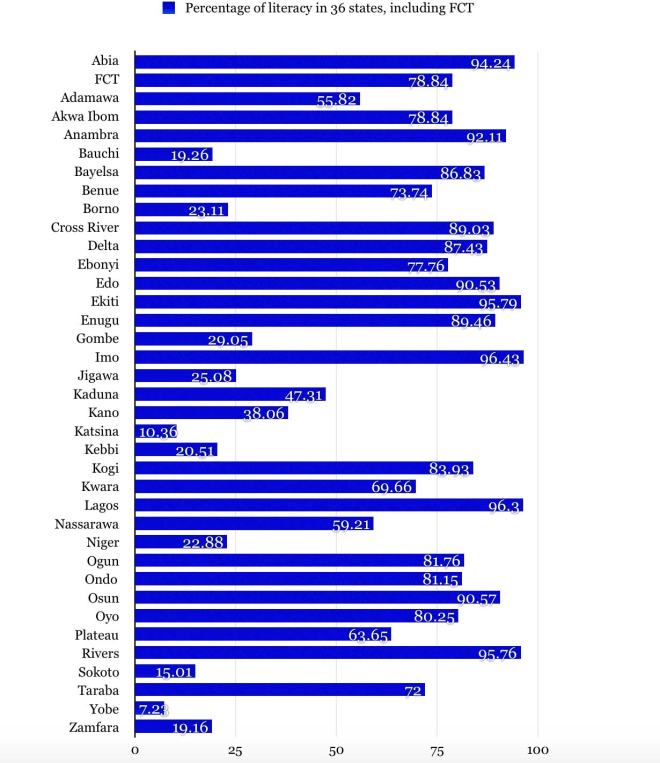
Yobe State has a literacy rate of 7.23%. Yet, if you run the numbers of the funds given to the state many years ago from the Universal Basic Education fund, it is at parity with Imo State (#1 with literacy rate of 96.43%). Has someone asked the successive governors in Yobe state what happened to all the money the federal government sent them to send kids to schools? Nigeria needs to ask fundamental questions to make progress in this age. Things are not just working!
I have noted that we have only 30 million people as the core addressable market. But it seems the oil sector is really what matters (I have updated this number to 32 million people). If oil price drops, even the 32 million people become meaningfully irrelevant to a large extent. That is very unfortunate and needs to change.
In most of my analyses when it comes to people that actually have money to spend or pay for (technology) solutions in Nigeria, I use 30 million people. Yes, despite 198 million human population, the effective addressable market in Nigeria is less than 30 million people. In Fasmicro Group model, these are people with decent incomes for anyone to craft solutions to their personal and business-related frictions. The remaining 168 million people are opportunities, nevertheless [they have to eat, shower, etc]. But we see them from the track of the core 30 million people who have the money to pay for tech things. For most technology solutions (think gaming, apps purchase & digital subscriptions and the platforms like smartphones, computers and connectivity required for them) where the buyers are usually the direct beneficiaries, the 30 million is rock solid. (Of course, on largely non-tech areas like food where everyone has to eat, the 198 million people become the addressable market.