DD
MM
YYYY

PAGES

DD
MM
YYYY

spot_img

PAGES

Home Blog Page 6758

Why Scaling The Greatest Of All Charities Is Important

0

Discussions related to charity have always been sensitive because charity is closely associated with religion (another hyper sensitive area). In fact a lot of people believe that being charitable will ensure their success in this life and happiness in the life after. This strong belief has also been gainfully used by beneficiaries to obtain more from their benefactors.

I am not here to discourage the act of charity; I only want to divulge my observations on its effects on the beneficiaries. I know charity is all about giving money, food and other necessities to the needy, but has anyone actually asked who the needy truly are? How do we know who they are? How do we measure their needs? When will they cease to be among the needy? How long will they continue to live on charity? Can’t they be gainfully employed?

And, has anybody else ever wondered why the countries that benefit from charities still remained impoverished? Well, I believe the experts have answers to this. But I bet you that the first excuse everybody will give regarding this is bad governance.

Anyway, I don’t think I can answer the questions concerning the negative effects of charity on the country, but I believe I can give an insight on its effects on individuals. I know that benefactors are also affected, something that most people know, but my focus here is on the beneficiaries.

Charity affects the self-esteem of the beneficiaries. I have seen so many people who, deep down, believe that they can’t survive without the help of their benefactors. Some say it is fate, some call it luck, and others, curse. Some believed they owe their benefactors so much gratitude that they make themselves their benefactors’ slaves.

One that I met recently felt too uncomfortable to submit his CV to a new school within my area because he couldn’t envision himself earning a living. He already had the servitude spirit because he, his siblings and his mother lived off the charity of a relative, who sponsored his education to ND level. So, for him, serving this uncle is the only way he could repay him for his generosity. He believed it is inappropriate for him to look for a job since the uncle needs him around.

Some beneficiaries feel that the act of charity they benefit from is their entitlement. This ordinarily is not supposed to affect their desire to find a source of income. However, for some reasons unexplainable, most of the people that feel this way end up not earning a living. Someone who comes to me every now and then for a little help unwittingly revealed that since I am paid by the federal government, my salary is as good as hers, after all the money is for every Nigerian (*eyes rolling*). I can’t really say, but I believe part of why she wouldn’t apply for a job in a nearby establishment, like I have been suggesting to her is because she believes that I and the others should ‘share’ our earnings with her.

I have equally met people who hold that they are entitled to charity because their benefactors were made ‘rich’ by God so that they could help them (the beneficiaries). Some of them even told me that if their benefactors refuse to help them, his wealth will disappear, or rather God will take their wealth away from them. So, for them, some people are made poor so that the rich will have people to carter for (sounds unbelievable but it is true). In other words, their benefactors’ incomes are also theirs (except that the benefactors are the custodians).

Charity can increase laziness of the beneficiaries and thereby cause over-dependence on the benefactors. This could lead to a lot of social vices because when the benefactor fails to ‘perform’ as usual, the beneficiaries will find other ‘easy’ way to make their living. Also, the benefactors may decide to make these beneficiaries carry out heinous jobs.

There was this woman my mother was always giving food and money to because her husband has no stable source of income. One day she came to see my mother as usual. But my mother told her that she should clear the grasses around the compound so that she will pay her instead of merely ‘dashing’ her money. She did the work halfway and came for the money. My mother gave her half of what she usually gives her and asked her to finish up the work to collect the remaining. She also told her that henceforth, she will be paying her salary for doing some odd jobs in the compound. Of course, this woman ran.

I know that people may think that she begs because she was lazy. But, what if no one gave her when she begged, wouldn’t she be forced to work?

People that benefit from charity do not have the zeal to improve on themselves. Like I said earlier, charity can encourage over-dependence of the beneficiaries on the benefactors. I think this is the major problem with Africa and the Africans.

The desire to improve only comes up when someone needs to earn extra income and knows that he has nowhere to turn to but to himself. But in a situation where this person knows that he can get that extra from someone else through charity, he will relax. Trust me, that shop owner in the village who opens his shop irregularly will be forced to work harder if that his brother or sister that always restock his shop decides to cut him off.

Like I said, this is the problem with Africa. Africans have this mindset that they need help from the Global North before they can survive. This, beside bad governance, is the reason Africa is still where it is.

So, charity is good, really good, but that doesn’t mean that we should make it the only way of helping humanity. We need to be sure that the person we are helping truly deserves it. We need to be sure that the beneficiary of our generosity understands that he or she should find a source of earning because our help is only temporary. We have to be sure that our help is not having negative effects on the beneficiaries. And let us always remember that since it is a charity, it is not business. Hence, we should not expect anything in return. This way, the beneficiaries will not feel enslaved to us.

Remember the saying – give a man a fish, and you feed him for a day. Teach a man to fish, and you feed him for a lifetime. This is the greatest of all charities.

Facebook Plans to Integrate with Whatsapp and Instagram

1

Facebook is planning to bundle its kid companies into one. Instagram bought in 2012, and WhatsApp bought in 2014, have been operating independently from the parent company Facebook, with each having their own CEOs, making it difficult for many users to know that they belong to Facebook. The CEO of Facebook, Mark Zuckerberg confirms that the independent era is over. The spokeswoman, Bertie Thomson, stated that it’s time to make the products and services of Facebook clearer.

“We want to be clearer about products and services that are part of Facebook.” She said.

The plan is to attach at the bottom of the login page and the setting page this statement – “Instagram from Facebook.” Another way is by merging the WhatsApp and Instagram messengers to encrypted Facebook messenger.

But the timing suggests that there is more to it. Although Zuckerberg says it waited for so long, about 3 years of intense criticism to have operational control over the two companies that have been operating separately from Facebook. The recent hearings between the Federal Trade Commission (FTC) and the Department of Justice and Facebook has been suggesting otherwise.

In fact, Facebook confirmed that it has been under investigation by the agencies for possible anti-trust activities. There have been concerns that Facebook is acquiring too much power and it’s buying up competitor companies in a bid to eliminate competition. A concern that many believe could only be quelled by breaking up Facebook into segments to minimize its influence.

So the plan is likely to fuse the three apps in a bid to convince investigators that there is only one entity – Facebook. But it may likely have consequences. When Microsoft had a similar issue with its operating system and window explorer 20 years ago, government investigators claimed that Microsoft was playing dirty, that the explorer was tied to the windows in a bid to eliminate browser competition. Well, Microsoft won on appeal, but it took 4 years of legal tussle that stalled many innovations that the company would have made. Facebook is treading the same path, especially when it seems that American Regulators are rising to challenge put up by their European counterparts. Who have been constantly confronting the online tech industry on issues of best practices.

Just last month, Facebook was handed a $5 billion fine for the Cambridge Analytica privacy breach, and $100 million for not disclosing it to the Security and Exchange Commission (SEC). it was the highest levy given to a tech company, and Facebook accepted the fine, promising to follow FTC’s recommendation to avoid further problems.

The recent decision by Facebook to integrate the messaging services of Instagram, WhatsApp and Messenger has been dividedly received. Although Zuckerberg claims he is taking the step to ensure protected privacy of users, others made us to think otherwise. Facebook cofounder Chris Hughes said the integration will make it harder for the company to break up from a technical standpoint.

A lot of key employees working with WhatsApp and Instagram have disagreed with quite a number of ways that things are going down in the companies. When Zuckerberg proposed that ads be served inside WhatsApp, the founders disagreed, it led to unresolved differences that they couldn’t take, so they left. Last year, Instagram co-founders, Kevin Systrom and Mike Krieger left the company due to frustrations over how Zuckerberg handles things.

There seems to be more people who are going to find the exit way with this new development. Zuckerberg says that WhatsApp and Instagram have been developed to their standard using resources of Facebook, and it’s payback time. The plan, if implemented will see employees change their emails from @Instagram, @whatsapp to @facebook.com

July Was Really Bad for Jumia, Now Trading Below IPO

2

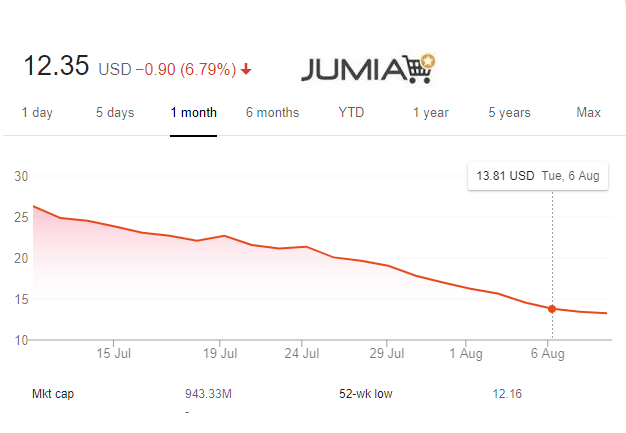
July was a really bad month for Jumia. But if it reports great numbers in two weeks, during its quarterly earning, everything will be fine. The ecommerce company lost about 36% of its value in July. It has now fallen below its IPO base number of $14.50 (see image below for the current closing number, $12.35).

Jumia Technologies had its initial public offering in April, pricing its stock at $14.50 per share. Shares reached just shy of $47 per share at the beginning of May , but coverage published by Citron Research’s Andrew Left kicked off a steep decline for the stock and a wave of short-selling. The stock has now dipped below its IPO price and is trading in the $13.50 range — valuing the company at roughly $1 billion.

Jumia baptized itself as “Africa’s first”; so, we are watching how it plays out as it will become a baseline for assessing future African tech firms that would dream to be in the big board.

On Impressive Half Year Report, MTN Notes Momentum On Ayoba, Its WhatsApp Challenger

7

MTN Group is winning markets and territories; H1 2019 was a good one for the company. Here are all the great things happening in this African evolving technology conglomerate:

  • Impressive financial results: “We saw growth of 12% in adjusted headline earnings per share, which is the first time that we have delivered growth in this measure in recent years. Our service revenue grew just below 10% and EBITDA just above 10%, both on a constant currency basis. Our holding company leverage remains stable at 2.3x, well within our guidance range of 2 to 2.5x.”
  • Solid User Growth: “strong subscriber growth of 7,7 million in the first six months of the year to reach a total of 240 million subscribers.  The number of active data users grew by 3,5 million to 82 million and our 30-day active Mobile Money users grew by 2,4 million to 30 million”.
  • Listing in Nigeria and Jumia IPO: “We successfully completed the listing of MTN Nigeria on the Nigerian Stock Exchange and our e-commerce joint venture Jumia listed on the New York Stock Exchange.”
  • Ayoba is growing: ” instant messaging platform, Ayoba, is now live in three of our West African markets and has more than 300 000 active monthly users.”
  • “Super-agent licence in Nigeria”.

MTN needs to offer a 20% discount on airtime to encourage people to forget WhatsApp and use Ayoba! Provided you do not have WhatsApp on your device, you will get 20% bonus anytime you reload. If not, we may be concerned for another 2go. 

WhatsApp has a near-zero marginal cost which means it can be offered free to users. Competing against free is hard. We will see MTN’s game plan: zero-metering (i.e. you can use it even when you have no data) Ayoba is another game plan it can unleash to get over WhatsApp. Yet, WhatsApp continues to find how to grow. It is now in KaiOS feature phones.

KaiOS Technologies  maker of KaiOS, the leading mobile operating system for smart feature phones, and Facebook, the social media platform whose goal is to bring the world closer together, have announced WhatsApp’s availability for download in the KaiStore, on both 512MB and 256MB RAM devices. Further, by Q3 2019, most smart feature phones powered by KaiOS will have WhatsApp preinstalled upon shipment.

“KaiOS has been a critical partner in helping us bring private messaging to smart feature phones around the world. Providing WhatsApp on KaiOS helps bridge the digital gap to connect friends and family in a simple, reliable and secure way,” said Matt Idema, COO of WhatsApp.

The full press release below…

MTN Group has announced an encouraging set of results for the six months ended 30 June 2019 in the context of difficult trading conditions across its major markets.

Commenting on the results, Rob Shuter, MTN Group President and CEO, said: “We had a good first half, reporting solid financial results, good commercial momentum and encouraging strategic progress. We saw growth of 12% in adjusted headline earnings per share, which is the first time that we have delivered growth in this measure in recent years. Our service revenue grew just below 10% and EBITDA just above 10%, both on a constant currency basis. Our holding company leverage remains stable at 2.3x, well within our guidance range of 2 to 2.5x. And, as we grew revenue and carefully managed our investment programme, we saw capex intensity drop further, to 16,9%.

Commercially, we had strong subscriber growth of 7,7 million in the first six months of the year to reach a total of 240 million subscribers.  The number of active data users grew by 3,5 million to 82 million and our 30-day active Mobile Money users grew by 2,4 million to 30 million. Our continued focus on the customer experience has seen us record brand NPSˆ leadership across more than 50% of the portfolio, with 12 markets now leading. That contributed to MTN being named the most valuable South African brand in the Brand Finance South Africa 50 report and the most admired African brand by Brand Africa 100.

During the period we had some landmark events. We successfully completed the listing of MTN Nigeria on the Nigerian Stock Exchange and our e-commerce joint venture Jumia listed on the New York Stock Exchange. Within three months of announcing our asset realisation programme, which is targeting at least R15 billion over the next few years, we delivered R2,1 billion in proceeds.

Our advanced instant messaging platform, Ayoba, is now live in three of our West African markets and has more than 300 000 active monthly users. We are very pleased with the formal approval of our super-agent licence in Nigeria, which clears the way for the launch of phase 1 of our Nigeria fintech business while we await a banking licence.”

Operating environment

In South Africa, the group contended with a weak macroeconomic environment as well as the introduction of new end-user requirements and the repricing of out-of-bundle data rates. In Nigeria, economic activity was muted in the time of presidential elections and prior to the formation of the cabinet. In Iran, the rial weakened sharply after the re-imposition of US sanctions.

Financial performance

Notwithstanding this environment, in constant currency terms, service revenue grew by 9,7% to R67,9 billion and earnings before interest, taxation, depreciation and amortisation (EBITDA) expanded by 10,2% to R31,2 billion. The holding company net debt to EBITDA ratio remained stable at 2.3x, which is well within the group’s guidance range of 2.0 to 2.5x, and capex intensity dropped further to 16.9%, indicating greater efficiency in deploying assets.

Looking ahead, Shuter says: “MTN is well positioned to grow by leveraging our scale and enhancing our competitive position.

In the second half, in South Africa we will focus on the continued turnaround of the enterprise business, the recovery of prepaid and the launch of Mobile Money. In Nigeria, we will focus on the further rollout of 4G coverage, the launch of Ayoba and Music Time! as well as accelerating our fintech ambitions by fully leveraging our extensive distribution network to offer a range of transfer and payment services to our GSM customer base.

Across the rest of the portfolio we have six focus areas. These are: the continued turnaround of our operations in the West and Central Africa region; the resolution of some of the more complicated regulatory situations; the rollout of MusicTime! and Ayoba across the group; the asset realisation programme; launch of our pan-African MTN 4 Good campaign and delivering on our medium-term targets.”

Making Aba Shoe Industry Globally Competitive

0

According to Business Day, a newspaper, the Aba leather industry has about 80,000 players operating in different clusters across the town. These players engage in the production of shoes, bags and trunk boxes, producing 48 million pairs of shoes annually at an average price of 2500 naira which gives it a market value of $333 million (120 billion naira). Its global competitors include China which produces 12.6 billion pairs of leather shoes and exports shoes and leather products worth $9.1 billion, and Vietnam which produces 760 million pairs annually with an export value of $6 billion. Indonesia, in third place, produces 660 million pairs with $2.6 billion in shoes exports while Italy produces 205 million shoes with export value of billions of dollars too.

There are different factors responsible for why the Aba shoe industry is not globally competitive. They include:

  • Unavailability of export data on footwear
  • Players in the leather industry not utilizing the internet in marketing and distribution of products
  • High lending rate by Nigerian banks which has made manufacturing not globally competitive
  • Unavailability of the manufacturers to get animal skins locally 
  • Utilization of crude machines in production.

In May 2008, The Common Facility Centre was established in Aba as a partnership between the United Nations Industrial Development Organization(UNIDO), and  the Federal Government of Nigeria, to aid workers in the Leather and Garment sector to exploit external economies through collective effort and sharing common facilities for enhanced processing of their products, and to serve as a Centre of Excellence for capacity building and provision of cutting edge technology for competitiveness enhancement.  About eleven years after it was established, the majority of the Aba shoemakers have refused to utilize the facility as they don’t understand the purpose behind its set up.

The following solutions can solve this friction:

Upgrade of Facilities and Provision of Manpower for the Common Facility Centre: Considering the fact that the centre hasn’t been utilized in a long time, its facilities need to be upgraded in line with modern requirements. Also, efficient manpower that will run it should be recruited.

– Training Aba Manufacturers with Latest Skills and Technologies: Aba shoes and other leather product manufacturers should be trained in skills such as Industrial and Product Design, Additive Manufacturing and usage of modern machines which automate shoe production to enable them produce more faster at the Common Facility Centre.

– Encourage Aba Manufacturers to Utilize its Facility for Manufacturing their Products: Aba manufacturers should use the Common Facility Centre to produce their products at scale for them to be globally competitive.

– Provision of Credit to Aba Manufacturers at Single Digit: The lending rate of 22 percent to 30 percent by banks in Nigeria is an impediment to the competitiveness of the Aba leather industry when its counterparts in China and other countries access funds at less than 10 percent.

– Utilizing E-Commerce Platforms for Marketing and Distribution: The Aba Shoe and other leather industry players need to utilize e-commerce platforms like Jumia and Konga for marketing and sales of their shoes since they are the biggest channels in Nigeria and Africa. Also, Amazon.com should be used for distribution to global consumers.

– Creating of a Blockchain Platform to track the leather product value chain: Blockchain is a secure  ledger shared by all parties in a decentralized network  which records and stores every transaction that occurs in the network.  A Blockchain platform which will track the production, sales and distribution, of all the players in the Aba leather industry will provide data which is tamper-proof and will validate the economic status of the industry.

If we implement these suggestions, we will get Africa’s largest cluster of shoe making working at maximum level besides being globally competitive.