DD
MM
YYYY

PAGES

DD
MM
YYYY

spot_img

PAGES

Home Blog Page 6760

How Nigeria Can Prevent Fuel Diversion – ThisDay Report of My Perspectives

0

How can data improve fuel distribution in Nigeria, removing many elements of information asymmetry we continue to experience? Yes, we can fix fuel diversion in Nigeria!

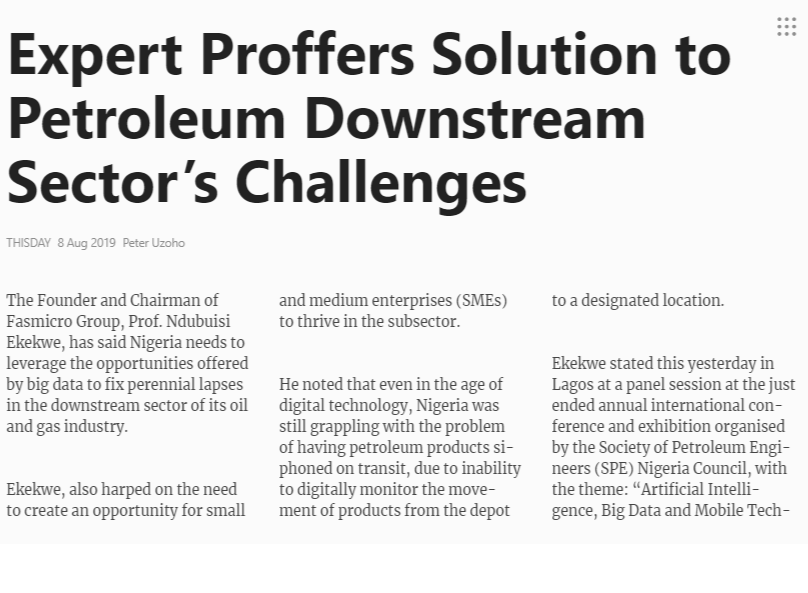
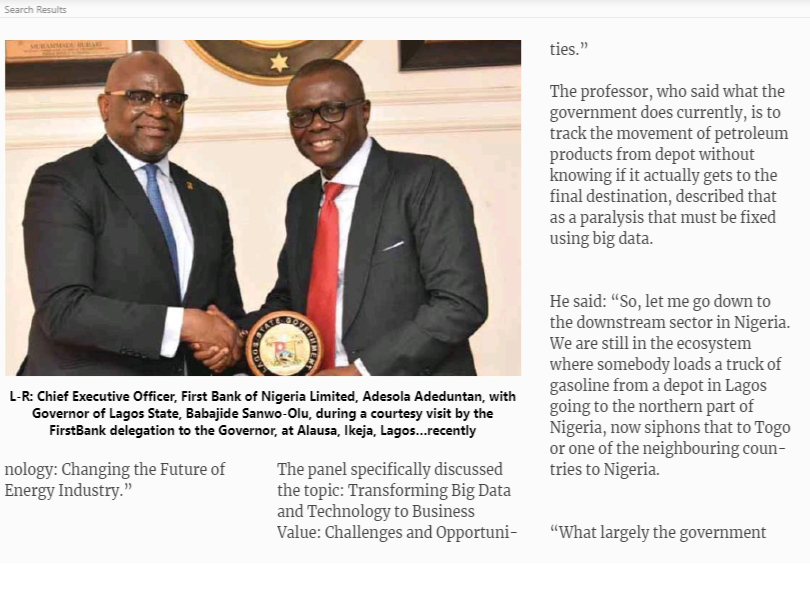
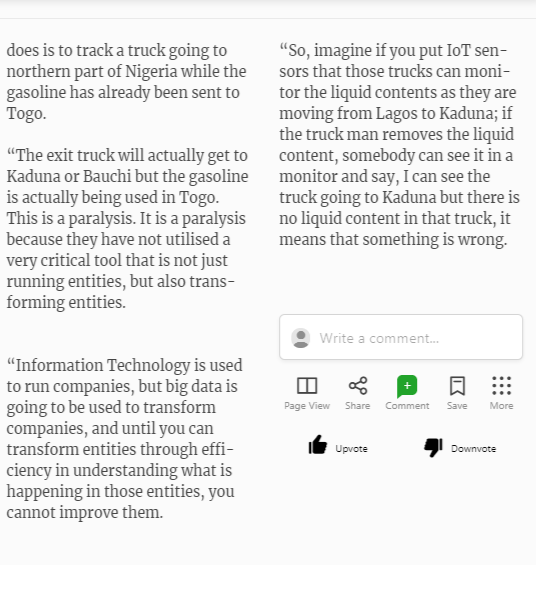
During the SPE (Society of Petroleum Engineers) conference, I explained how Nigeria can prevent fuel diversion and illegality in fuel distribution. Yes, you are tracking the truck from Lagos depot to Bauchi when the liquid content has been diverted to Togo. You will get your empty truck to Bauchi and blindly tell Bauchi citizens that a truck has offloaded fuel for them! 

ThisDay newspaper has an expansive piece on that conversation quoting me verbatim. Read below.

Econet’s Kwese Falls

3

In 2017, I wrote that the video-on-demand (VoD)  market in Africa must adapt to thrive.  The competition is never localized but globalized which means these entities are not competing with local companies but any entity in the world. Within the unconstrained and unbounded Internet distribution mechanism, local startups have bigger markets but are also exposed to massive global competitive forces. I explained this element in a recent Harvard Business Review piece. The video below made the case also.

Those forces have consumed one company in Africa. Yes, Econet’s Kwese, the online on-demand video company, has collapsed. That is very unfortunate but not unexpected: “It is a difficult decision that we could not postpone…, market conditions and content price inflation got in the way of us completing our mission”.


Press release on click.

“It is a difficult decision that we could not postpone. Over the last 4 years we sought to disrupt Africa’s media landscape and enable Africa to tell its own stories using a variety of technologies including satellite broadcast, video streaming and free-to-air TV.  The Econet Group invested heavily into Econet Media and supported the business over the period it operated without any third-party funding. Unfortunately, market conditions and content price inflation got in the way of us completing our mission.

We are particularly grateful to all our dedicated staff and contractors who have worked tireless to bring a great product to market and who until the last day believed in the Kwese story. We are also grateful to our customers and our partners who believed in the Kwese vision and who worked with us as we tried to change how Africans consume and pay for media.

We deeply regret the impact that this decision has had on our staff, contractors, customers, regulators and content providers. We will engage with each of our valued stakeholders transparently and will seek to meet our obligations to each of them as provided under law.

The Econet Group is entrepreneurial and believes in Africa and its potential. Our belief in “an inclusive connected future that leaves no African behind” remains undaunted.

We would like to emphasise and reiterate that the rest of the Econet Group businesses continue to operate normally as each of our companies are separate legal entities with their own management teams and boards.”

The Benefits of a Well Written LinkedIn Profile

0

Do you know that your LinkedIn profile can also serve as your resume/cv?
I bet you don’t know this amazing thing about LinkedIn.

A well written LinkedIn profile covers everything about your professional lifestyle. These days, I don’t bother to edit my CV/resume anymore, I just click the download button on the left-hand side of the screen and submit to any role I’m applying for.

Does it work for me?
Yes, it does work for me many times.
Will it work for you?
Definitely, it will work for you, because a well written LinkedIn profile covers your career experience and summary, your professional skills and accomplishments, and of course, your contact information.
It is also eye-catching. It gives a recruiter a glimpse of what to expect from you in less than 30 seconds.

Despite these amazing features about LinkedIn, only a few numbers of people are actually tapping from the abundance it has to offer its users. If you fall into the category of people who don’t know how to fully utilize the strength of the platform, don’t worry. I have some good tips to share with you.

Brad Blanchard PHR, shared some powerful tips on how to benefit from a well written LinkedIn profile.

How do you benefit from a well written LinkedIn profile:

Dress your LinkedIn for the job you want, not the one you have. If you are looking for a job in banking, ensure your profile summary states that you are interested in working in a bank. This makes it easier for recruiters contacting you. Insert some keywords that help recruiters or hiring managers to find you when they search for them.

If you’re job hunting, optimize your profile to show your expertise. Showing your skills and expertise is the best way to win recruiters’ hearts. Recruiters can easily spot your skills and also see the number of professionals that endorse your skills. This presents you as the best candidate for the vacant role.

If you’re a salesperson, don’t call yourself a salesperson, position yourself as someone your prospect would ask for help. People want people who can solve problems. The only reason why people would want to spend their limited time or hard-earned money on you is when they are sure it does worth it. That is, they are getting value in return.

If you’re a founder looking to scale your business, show the world your vision but stay approachable and human. People can easily buy into your future when they have a clearer picture of what it looks like. However, being approachable is what works most of the time. If people can’t find it easier to come to you, then it would definitely be tough to deal with you. It takes being human to be approachable and humble. You could have the best LinkedIn profile in the world, if your attitude is zero, don’t expect anything good from it.

What do you want your LinkedIn to say about you?
The time to benefit from the amazing platform is now.

Building Entrepreneurship Culture in Nigeria’s Institutions of Learning

2

Some weeks ago, I attended the 78th Interdisciplinary Research Discourse of the Graduate College of Nigeria’s premier university: The University of Ibadan. The discourse was titled an approach to Research and Innovation in National Development: Entrepreneurship Culture in Nigerian Universities. This was delivered by Professor Adesoji A. Adesina, a former professor of Chemical Engineering at the University of South Wales Australia, winner of over US $15 million in competitive grants, a recipient of the Nigerian Order of Merit Award and currently the Founder/CEO of Atodatech LLC, at the end of the two hours discourse, he left no stone unturned.

At the sight of the notification of his presentation, the title attracted me that I quickly had to cancel a schedule so I could attend the discourse. Having walked the corridors of advocating for deliberate drive of entrepreneurship culture in various institutions of learning, the concept of driving entrepreneurship culture in the universities cannot be centered on “buying and selling books”, as this is a perception often held by a good number of persons in the universities. I will take side with the meaning of Entrepreneurship as contained in the EU 2011 Project Report of Entrepreneurship Education: Enabling Teachers as Critical Success Factors, Entrepreneurship for a teacher lies in the ability of the individual to turn ideas into action. It includes creativity, innovation, showing initiative and risk-taking, as well as the ability to plan and manage projects in order to achieve objectives.

On the shelves of libraries of our universities are innovative and problem solving researches that are lying dormant. With a low gown-town impact, this could be tied to a number of valid reasons, ranging from funding, intellectual property theft, bureaucracy of patent acquisition and you just name it. The issue of dormant innovative researches is not from a point of speculation or assumption.  In July – December 2018, I was offered a Campus Ambassador role by Co-creation Hub to comb the Nigerian Universities for innovative researches. My role was a component of the African Universities Innovation Accelerator (AUIA) Project. As I interacted with academics and PhD candidates across different faculties, I was literally blown away by researches that have been conducted (albeit with low social impact) or currently ongoing in the domain of Engineering, Education, Science, Arts, Humanities and Business.  Listening to Professor Adesoji’s discourse increased my interest to work on projects and researches that will drive Entrepreneurship Education (EE) in Nigerian Universities down to our secondary and elementary schools.

Here are ten excerpts from Professor Adesoji’s lecture:

  1. Sustainable development is controlled by Technology, Innovation, Management and Entrepreneurship.
  2. National Science and Technology Policy to drive entrepreneurship as a basis for sustainable development.
  3. Our research must be driven by national priorities, not just an exploratory replication, appraisal studies and re-inventing the wheel.
  4. Our Universities must change her operating paradigm from Anglo-saxion, Hublodotian, and Napoleonic to an entrepreneurial model.
  5. Formation of research clusters for resource and infrastructure optimization.
  6. Sync research clusters for industry-university linkages.
  7. A seed fund for younger/emerging researchers and reinvigorate established researchers.
  8. At the turn of the knowledge economy, everyone in the domain engineering, science, arts, humanities and business must develop competency in Entrepreneurship Education (EE).
  9. A rapid growth in the economy must be matched with a rise in in Global Entrepreneurship Index (GEI).
  10. Entrepreneurial Universities are needed as population grows, Nigeria is below optimum level in the current climate.

His concluding thoughts in one sentence:

“Entrepreneurship is the goal of research, innovation and societal transformation”.

At a cocktail dinner after the lecture, I walked up to Professor Adesoji to get his perspectives on driving this culture (competencies) to students at the undergraduate, secondary and elementary level; as his discourse focused on faculty members and emerging researchers ( candidates at Master, PhD and Post-docs levels). After my conversation, I thought along the following lines as articulated below.

With a rapidly rising unemployment index in Nigeria (36.50% Q3 2018), vis a vis poor employability skill set of graduates of tertiary institutions.  It is critical for Nigeria’s Federal Ministry of Education (FMOE) to implement a pragmatic national policy on Entrepreneurship Education (EE) that is visibly working within the walls of the schools and not just a policy document on the shelf or web links of its web page. The FMOE must as a matter of urgency institutionalize a workable teacher education training to drive entrepreneurship as visible in other climes. This should also be complemented by a more robust private sector, non-profit sector, bilateral and multi-lateral agencies entrepreneurship projects to stimulate interest in entrepreneurial competencies among students. The efforts of Junior Achievement Nigeria (JAN) in stimulating creativity, innovation, design thinking, problem solving and entrepreneurship development among school children is greatly acknowledged.

Managing Difficult Bosses

0

Sometimes, we  come into situations where we have to deal with difficult bosses. I heard a sales girl say on one occasion that her boss is impossible to please. That it doesn’t matter what you do, that he always finds something to complain about. Yes, this is the situation many people find themselves even though there are legal boundaries as to how difficult a boss can be. It becomes a criminal offense when such boundaries are crossed. In that case the appropriate law enforcement agency should be contacted. Within the legal boundaries still, it is important to point out that striving to please a boss is an action whose outcome you cannot determine. Different things please different people at different times. Satisfaction is purely dependent on the individual receiving it.

It is also important to note that it isn’t your job to keep your boss happy or to keep him entertained. Your job is to do your job. So perhaps the first step to follow in trying to build a working relationship with your difficult boss is to have a clear job description. 

Have a clear job description and stick to it : “The Wikipedia defines “A job description  as a written narrative that describes the general tasks, or other related duties, and responsibilities of a position. It may specify the functionary to whom the position reports, specifications such as the qualifications or skills needed by the person in the job, information about the equipment, tools and work aids used, working conditions, physical demands, and a salary range “

Having a job description that is taken seriously can help eliminate some of the hurdles created by overlapping job functions. If a boss tries to override a job description, then it has to be with the permission of the employee, though it is common for that not to happen. Often times, friction occurs in jobs where roles are not clearly defined thereby giving some bosses the chance to take advantage of those existing gray areas.

Mind Your Business: Someone once  asked for my opinion on what to do as two of his immediate bosses were clashing frequently leaving him in the middle confused as to what to do or how to navigate those intricate spaces.  My advice to him was simple: mind your business. This is their battle not yours. so you are not expected to take sides or get involved in a clash of ego or personality.

Avoid Defamation: One reason why you have to avoid saying bad things about others is that you don’t get paid for it. Why not conserve your energy for the work you get paid for? Someone once said to me, “I avoid people who say a lot of unpleasant things about their friends or colleagues. I mean, if they can do that to these people who are close to them, what about me?  Bad words against a boss may eventually get back to them. Remember that walls have ears.

Identify His Interests: Finding out what interests him puts you in a position to know exactly what to do going forward. Some certain aspects of work may interest him more than others. It could be punctuality, it could be proficiency in carrying out some tasks or any other attribute.

Act Like A Professional: Don’t let his attitude affect your job. As much as you can, don’t let your emotions get the better of you. Try to detach yourself from the surrounding conditions. This is difficult but also possible. Remember “only sticks and stones can break your bones”.

Use Your Initiative:  This also implies that you know when to take the lead, when to ask for instructions and also understand that he or she doesn’t know everything and could get stuck sometimes.

Show A Level of Self-Confidence: People with low self esteem seem to be picked out more often than others. In this instance, little triggers which they could ignore could give them a reason to react. Generally, people tend to attack the vulnerable; I don’t know why.

Be Unpredictable: A level of unpredictability can put difficult people off. When people realize there is an other side of you that can spring up in desperate times they feel reluctant to push you to that extreme. Occasionally show your other extreme  in a legal non-destructive way.

Show Empathy: This can also help to bring out the good side of the relatively bad. It is difficult to react violently or aggressively to people who have shown genuine interest in you. 

These are suggestions that can help anyone handle or manage a difficult boss. In extreme situations you may consider leaving the boss completely especially if your mental and physical health is getting affected in unbearable ways.