DD
MM
YYYY

PAGES

DD
MM
YYYY

spot_img

PAGES

Home Blog Page 6771

The Mechanics of Digital Transformation

0

Digital transformation undoubtedly is on the front burner for most businesses today. The question is no longer whether to undertake digital transformation; the question is how to get it right. The pace of change in the business environment is on the increase. Indeed, customers expectations are changing and market dynamics is radically changing; hence, businesses must respond timely and adequately to remain relevant and valuable. 

Digital transformation involves re-inventing your business to deliver value, leveraging digital technologies to understand the customers, and deliver what the customers need, and the way the customers want solutions delivered to them.

According to 9senses.com “Digital transformation is about changing the way processes, people and technology work to create efficiencies, new sources of innovation, and new insight that was not readily available previously. More importantly, digital transformation is most effective when putting the customer at the center of the digital ground swell”. 

Most businesses have embarked on some form of digital transformation efforts, unfortunately, many are not getting the desired results. According to a McKinsey Global survey, less than 30% of digital transformation projects succeed.   

A Harvard Business Review report identified the following as top barriers to successful digital transformation: Lack of a corporate vision for digital, Inability to experiment quickly, Legacy systems, Inability to work across silos, Inadequate collaboration between IT and lines of business, Risk-averse culture, Change management capabilities and Lack of talent/skills required. 

A close review of successful digital transformation stories shows that digital transformation requires a holistic approach that proactively addresses these barriers across the entire organization. Four core elements were seen as major drivers of digital transformation; these are business vision, organizational culture, processes and digital technology.

GETTING IT RIGHT – THE AYOKS DIGITAL WHEEL.

Ayoks Digital Wheel is a framework to guide businesses to get their digital transformation right. It recommends a holistic and coordinated program of change. It presents four elements as the core drivers of digital transformation, which must be strategically coordinated to achieve successful digital transformation.
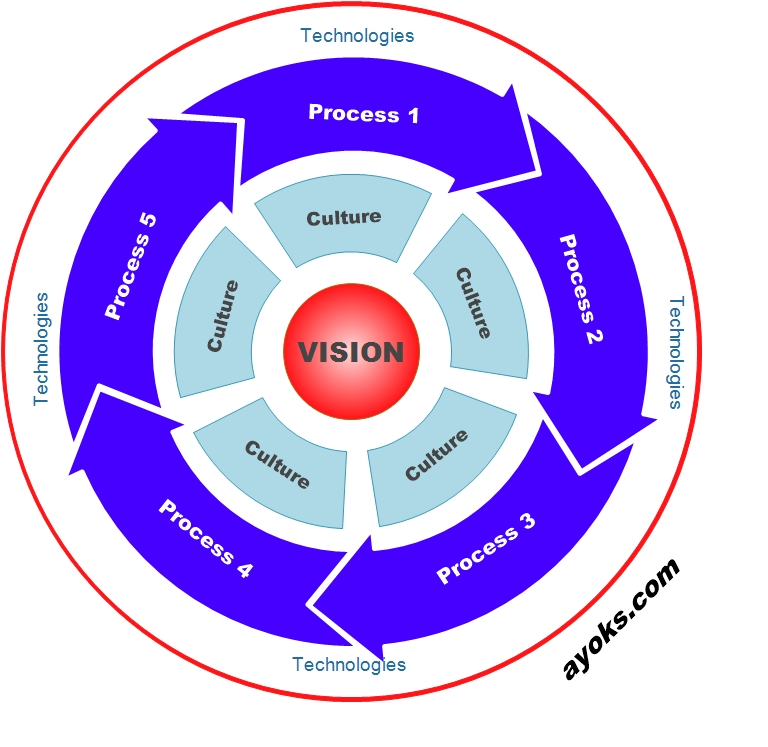
It infers that successful digital transformations are centered on inspiring business vision, nurtured by the right organizational culture, follow iterative processes and are powered by one or more digital technologies. These are captured as different layers on the Ayoks Digital Wheel. 

 At the center of the wheel is the vision which presents the desired business outcome that the digital transformation project is geared towards achieving. The next layer around the vision captures cultural values, practices and beliefs required to achieve the business vision. The third layer from the center shows the series of activities/processes that form the strategic road-map for the digital transformation project. The outermost layer of the wheel represents the different digital technologies that organizations can deploy in their businesses.  

These technologies provide the platform (power) to enhance operational efficiency and fulfil customers’ needs. The technologies provide the interface with the customers and the outside world; they are the most visible component of the transformation story and may be the reason why some businesses erroneously focus on technology alone; but without the other elements inside the wheel, success is elusive.

VISION – THE FULCRUM OF THE DIGITAL WHEEL

At the center of every successful digital transformation is a clear and compelling vision. Technology is an enabler. It gives you power but it does not tell you what to do with the power. Your vision tells you what to do with the power that digital technology offers you.

The businessdictionary.com defines vision as “An aspirational description of what an organization would like to achieve or accomplish in the mid-term or long-term future. It is intended to serve as a clear guide for choosing current and future courses of action”. 

Creating an inspiring and compelling vision for your business should be the starting point of your digital transformation journey.  Your business vision is a picture of the future for your business. It is where you want your business to be in the future (5 years, 10 years, 20 years, etc.) This vision determines your goals, guides your decisions and focuses your actions.

CULTURE – OILS THE WHEEL OF TRANSFORMATION

 According to McKinsey & Co. Research, culture is one of the main barriers that hinder organizations’ digital transformations. In a Gartner’s press release, it stated that 46 percent of CIOs identify culture as the largest barrier to realizing the promise of digital business. 

Developing the right organizational culture therefore is critical in achieving digital transformation of your business. Organizational culture includes an organization’s beliefs, expectations, philosophy and values that guide interactions within the organization and with the outside world. The right organizational culture in today’s digital world will as a necessity include the following; 

Customer centricity – This means making excellent customer experience the focus of all decisions and actions. It involves having a feedback mechanism that ensures customer needs are always captured and addressed. This also means that an organization focuses on what the customer wants or needs instead of what the company offers. 

Cross-functional collaboration –  This is the practice of having effective collaboration across different teams as against a situation where different teams work in silos. This involves creating an atmosphere that encourages sharing of knowledge and insights; it’s an atmosphere that encourages team achievements above ‘key-man’ syndrome. 

 Informed and empowered workforce –  This is a system that empowers employees with the right information, skills and insights. This implies employees are regularly informed and engaged about what the organization is doing and the employees are also empowered to contribute to what the organization is doing. Letting your people know what digital transformation means for the organization and how it will impact the workforce will encourage employees to embrace it.   

Reasonable risk appetite – This is a culture where people are comfortable trying new things; where employees can take calculated risks and are not punished for adverse outcomes. This is important as digital transformation requires challenging the status quo. 

Agile and Innovative culture – A system that allows people to think out-of-box, think big, fail fast, learn and improve. This involves building a system that rewards success and also encourages creative failures and learning from failed attempts. 

PROCESSES – THE MOMENTUM OF THE DIGITAL WHEEL

Digital transformation of your business is a journey that consists of several iterative processes. The following are five iterative processes that can guide a business to successfully reinvent and offer more value to their customers;

 Determine Your Minimum Viable Product (MVP) –  MVP is your value proposition (that is the problem you solve or service you render) packaged as a product for the market in its basic form. It is important you define this with a focus on the real value that your customers get and what they are willing to pay for.

 An understanding of the value you offer is important in transforming your business, as it enables you to rethink your products while improving on the value. Value is not disrupted; it is products that are disrupted.

Determine Your Business Model –   Your business model is how your business operates, creates and captures value for stakeholders in a competitive marketplace. It involves how you structure your cost and revenue streams. Some business models you may use (or modify) include marketplace, freemium, subscription, lease, auction, pay-as-you-go, franchise, affiliate, and razor blade.  You need to redesign your business model to leverage digital capabilities.

 Design Your Digital Awesome Product (DAP) – Your DAP is your product in a form that gives your customers an awesome experience. You can achieve this by embedding digital values into your minimum viable product (MVP) and addressing pain points on your customers’ journey. This involves making your customers journey seamless and giving them great experience consuming your product. Designing your DAP is important for digital transformation of your business.   

Deploy Your Digital Awesome Product  –   Implement your digital awesome product (DAP) preferably using agile methodology. It affords you the opportunity of deploying in phases and going through rapid iterations based on customer feedback. The principle here is to deploy fast, fail fast, learn fast and improve. Continue until you achieve that product that gives customers a ‘wow!’ experience.

Build A Sustainable Ecosystem –  An interesting point in the digital transformation journey is building a digital ecosystem – an interdependent group of enterprises and people who interact on a digital platform for mutual benefit. This enables a business to leverage resources and innovation from outside the organization, hence making it more sustainable. Top tech businesses like Amazon, Uber, and Facebook. have successfully built digital ecosystems and are reaping huge benefits from these ecosystems.

 TECHNOLOGY – THE POWER OF THE DIGITAL WHEEL

Digital technologies provide the power that drives digital transformation of businesses. These emerging digital technologies include social, mobile, cloud, artificial intelligence, internet of things, data analytics, robotics, augmented reality, etc. Businesses need to determine how one or more of these technologies bring values and capabilities that enable them to deliver to the customer what the customer wants, the way the customer wants it. 

Social Media – There has been an increase in social media platforms like Facebook, Twitter, Instagram, LinkedIn, etc. These platforms dedicated to community based input, collaboration and content sharing have provided businesses new opportunities to engage their existing customers, prospect and acquire new ones. 

Mobile – Mobile technologies used in smartphones and wearable have significantly changed how people communicate, shop, work and do business. The adoption of mobile is on the increase. According to Statista, in 2018, over 50 percent of internet traffic came from mobile devices. This is of great importance to business – hence smart businesses are now using a mobile-first approach in their digital transformation projects. 

Data Analytics – This enables businesses to understand customer experience of their products and services, it gives business insights to how, when and where their products and services are consumed. This is of great importance in understanding what the customers want. This is a major driver for digital transformation of businesses. 

Cloud – Cloud computing offers businesses on-demand availability of computing resources to implement their transformation initiatives. This enables businesses to respond quickly to changing market conditions and demands. It catalyzes innovation as businesses are able to quickly test their products or services, reducing time to market and capital investment required to deploy solutions. 

Internet of Things (IoT) – This emerging technology creates a system where internet connectivity is extended to everyday objects like electronic devices, mechanical devices, people and animals. IoT is set to provide a turning point in the world of business. As the number of IoT devices continue to increase globally, businesses can take advantage of this in the transformation of their businesses. 

In conclusion, the core elements of vision, organizational culture, processes and digital technologies (captured as different layers in the digital wheel) are the major drivers of digital transformation of businesses. These must be strategically orchestrated and managed to successfully transform a business to remain relevant, viable and profitable in a fast changing business world.


Nigeria’s Security Challenges: Government Unveils Plan to Mount Cameras on Highways

5

In the latest consultation of the Federal Government to quell issues of insecurity in the country, especially in the highways, the presidency has announced plans adopted. They include, community policing, use of Drones, and installation of CCTVs on the highways. This was announced at the conclusion of the meeting that President Buhari had with South West Royal Fathers on Wednesday, 31st of July.

The recent rise in kidnappings and killings on the East West highways has escalated security concerns from Abuja–Kaduna highway, where bandits and gunmen have made it impossible for road users to ply the routes without fear and trembling.

The adoption of tech-based approach seems interesting since it’s quite different from the previous security measures adopted by the Government that have failed to yield fruitful results. The use of technology in combating crimes has been advocated by security Experts for long, so it sounds like a practical alternative when the FG disclosed that the police will be equipped with modern technology to tackle insecurity nationwide.

The community policing plan involves boosting the number of police through recruitment of personnel from their Local Governments of origin and stationing them there. This will bridge the gap of distrust between communities and security personnel since they have their own interest in their respective communities to protect.

However, the deployment of tech in various states faces some hindrances that the Federal Government is aware of. Concerning this, President Buhari said:

“I will be issuing some directives to the appropriate federal authorities to speedily approve licensing for States requesting the use of drones to monitor forests and other criminal hideouts.”

The plan to monitor highways among other places through CCTVs is to record happenings and activities in these places for security reviews. This technology disposition will likely accomplish two things:

  • The CCTVs will record events of crime to expose those behind it for prosecution.
  • The Drones coverage will alert the security agents in the events of attacks or plans to do so.

President Buhari explained that the military will continue to be used occasionally when the attack is overwhelming. He said:

“we will continue to bring in our military when needed to complement the work of the police, including possible deployment of troops on certain highways on temporary basis, and the use of Nigerian Airforce assets to bomb hideouts where criminals are located.”

Responses to this development seem to suggest that it’s what many have been expecting. However, others are skeptical that it is just another motivational speech that will never come to pass. Recall that the military was the first to announce a plan to use technology, drone precisely to fight insurgency. In February, the Nigerian Airforce unveiled the TSAIGUMI UAV, an indigenous developed Drone, for surveillance and intelligence gathering.

Months have gone by, and there is yet to be seen an improvement in the fight against insurgency as a result of the drone. The police have also shown the lack of capacity in the use modern tech gadgets, giving the impression that the personnel recruited from rural Local Governments Areas will find it harder to master the use of any gadget that the Government may deploy.

 There is also concern about the Federal Government’s unwillingness to prosecute the perpetrators. Some citing instances where Miyetti Allah have taken responsibility for crimes and yet no one was arrested not to talk of prosecution. So there is perception of nepotism in the fight against terrorism in Nigeria that is casting doubt and disbelief on every step the Government is taking to restore peace.

While there is belief and skepticism, only time will tell if the recent approach to the security challenges in the country will restore people’s faith and trust in the government’s ability to protect life and property.

Ecommerce Sector to Shrink As Nigeria Begins Collecting 5% Online VAT Next Year

11

The Head of Nigeria’s tax agency has spoken: online 5% VAT is coming next year.  The Federal Inland Revenue Service (FIRS) Chairman, Tunde Fowler, was clear, “We are thinking that maybe early next year, we will advise banks to start deducting five percent VAT for all online purchases done locally.” Forget that “maybe”, this is a concluded matter; banks will hit you 5% for any transaction processed online via your Nigeria-issued debit/credit card.

“With the existing laws in Nigeria, we can appoint the banks as agents. First of all, all those who make payments for purchases online using bank cards and instruct their bankers to pay, we will tell the banks that, going forward, everyone who gives instructions for service for purchase online, they should deduct five per cent VAT,” he said.

“We are thinking that maybe early next year, we will advise banks to start deducting five percent VAT for all online purchases done locally,” he added.

This is good for Nigeria but would be challenging for digital companies and online-anchored fintech companies. People, why pay 5% more online when open markets (Alaba, Ariara, Kano) sell without collecting VAT from customers. Simply, 5% more will be a privilege to buy online in Nigeria!

But Nigeria needs this money, and we cannot afford the American experiment where they tactically “waived” collection of taxes by ecommerce companies like Amazon to help the then-nascent sector blossom. By not requiring them to collect sales taxes, buying online became artificially cheaper when compared with brick-and-mortar (physical) stores.

See it this way: if you shop in Best Buy, an electronic store chain, for a $1,000 laptop, you will be expected to pay extra $80 as sales tax in some states with 8% sales tax. But buying from Amazon, that tax is not collected and you just pay $1,000 for the same product. With Amazon free shipping and next day delivery, you have saved $80. 

Due to this, physical stores evolved into showrooms to many Americans. Yes, visit them to see the items and then buy online to save taxes. Of course, governments expect you to declare and pay that tax when filing your annual tax returns. Unfortunately, few people do that. As the online redesign accelerated, many physical stores started collapsing in America because they could not compete on price!

But U.S was fine until they got ecommerce to the level they needed.Today, that regulation has been updated and Amazon now collects sales taxes for governments in most jurisdictions.

Between the growth of the digital economy and more tax revenue, Nigeria is going for more money right away. The ecommerce market will shrink marginally once this is implemented. Most smaller ecommerce players will collapse because if you have money in Nigeria, the problem is never where to shop; paying extra 5% to wait may not work for many people!

The ecommerce sector will experience a minor slowdown as government begins implementing automatic and direct collection of VAT on online transactions in Nigeria. See it this way: if a physical open market sells electric iron for N8,000 and Jumia sells the same for N8,000, because Jumia’s customer will be required to pay VAT (5% of cost), the price will jump to N8,400. This extra N400 for online purchase will inflate the price against the open market which typically does not collect VAT. (In U.S., the reverse was the case: ecommerce firms were originally not required to collect taxes unlike physical stores even though the ecommerce companies expect customers to self-report during tax filing. The non collection of online taxes helped Amazon significantly when it started.)

Simply, ecommerce firms will lose many price sensitive customers, and some online payment fintechs may have to be concerned also. But Nigeria needs this, as a poor nation, and we cannot allow the privileged few to shop untaxed! I do not care about the sector-growth: whether it is online or offline, it is all commerce. We just have to grow while paying the taxes required to power Nigeria.

Take ACTION – Raise the Bar

5

“There has never been a recession period that everybody was poor. And there would never be a prosperous year that everybody would be rich.” Poverty and prosperity are products of choice. 

Trace it as far as you can, and you will find, that success has never lowered its standards to accommodate anyone. You have to raise your standards to achieve it. 

God provides food for every bird but not in its nest. Greatness is not reserved for any particular race. Success is not a native of America and Europe. Success is in you. It is available in abundance everywhere for everyone who is willing to pay the price.

Nothing is impossible for the human spirit.  The “can do” spirit of many has brought them from living in poor houses to flying their own jets. There’s no limit to what you can do and achieve as a man or woman. If you can dream it, if you can grind for it and if you can pursue your dreams with the force of a bulldog after a cat, you can achieve it. 

Prayers does not cancel ignorance. It is insane to keep doing the same thing over and over again expecting a different result. To succeed in life, you need knowledge, you need understanding and you need wisdom. 

Knowledge is information. It is gotten through reading and research. The solutions to most of the problems that we have in business, relationships and personal development are hidden on the pages of books. But as simple as this exercise is, nine out of ten will never participate in it, and three out of five are ready to give a defense of how too busy they are to partake in it. Little wonder there’s so much at the disposal of a few number of individuals and so few is at the disposal of many. There’s no denying that 90% of the world’s wealth is in the hands of 10% of the world’s population.

Understanding is comprehension. When you read or mine information, you must be able to comprehend what you have read. This step is necessary because without it, you can’t do number three.

Wisdom is application. It is action. And that’s what makes the difference. Your success in life is in direct proportion to what you do after you do what you’re expected to do. Nothing works in life without action.  If learning about success is all it takes to do great things with your life, then your success would be guaranteed. The bookstores are full of self-help books, each one of them is loaded with ideas that you can use to be more successful. The fact is, all of the best advice in the world will only help you if you can motivate yourself to take persistent, continuous action in the direction of your goal until you succeed. Raise the bar!

To be successful in life, the acceptable is never enough! You must resolve to get up a little earlier, work a little harder and stay up a little later. You must resolve to do today what others won’t do in order to have tomorrow what others won’t have. It won’t be easy but it is a hard grind for a worthwhile future.

Enough of blame game. Cease from it. Your parents are not to blame in totality for what you are today. You got your independence, and become responsible, and accountable for your life the moment your umbilical cord was cut off in the labour room. You’re responsible!

Arise O’ Nigerian youths. Pick up your sickle. Do more than you’re paid for. Do more than others expect of you. Go the extra mile. Get busy. Get going. Take action. Don’t waste time. Rise up to the challenges ahead of you, conquer your fears and never look back. That’s how winners are made. 

August is another 31 days of awesome opportunity. It is a clean sheet given to us by our Creator for us to correct the mistakes that we made in the past. It is not too late for you to become the best that you can be. Whatever your hand findeth to do, do it with whole of your heart and bet the best at it.

Raise the bar! 

See you at the top!!

“Spread the Word” – How Businesses are Winning with Grassroots Marketing in Nigeria

5

Recently, I escorted a friend of mine to a mechanic workshop – one of the largest in town. When we arrived, I noticed a small crowd gathered somewhere at a very conspicuous spot. Some car owners and a few mechanics were there, and there was an umbrella in the middle.

I noticed a guy doing some serious explanations to the crowd. So, as a curious individual, I moved closer. I needed to see what’s going on.

It was a lotto game spot. And the guy was explaining how the numbers he has “forecasted” are winning numbers, and started convincing people to play. In fact, he advises that if you needed a better return, you need to play with N100 and above. People were playing.

It was fun. Though I didn’t understand a thing about lotto games, I asked the guy if he was the owner of the stand, and he said yes. So, I brought out N100 and played the game he was preaching about. I knew I wouldn’t go back there again but I played anyway. I played because I understood what the owner was doing business-wise.

A few minutes later, I was chatting privately with the young man. And he explained to me that he needed to “boost” that spot which is fairly new. He said he had to convince those mechanics that they can win and the moment anyone wins, that spot will continuously “vomit” money for him. I asked him how, and he said I shouldn’t worry that the mechanics will “spread the word about that stand”.

The guy was implementing what we call grassroots marketing. Perception drives actions and results. From my perspective (forget what the textbook says), grassroots marketing is when you target those at the grassroots level. Just like grassroots politics.

Who are those at these levels? Those market women, mechanics, Okada drivers, etc. These set of businesspeople or services-oriented people makes up a large chunk of the 37+ million MSMEs in Nigeria and if your business does not have a strategy to target them, you are losing out.

See why…

  • The sports betting industry in Nigeria came into the limelight a few years ago, and players in this sector have understood the importance of grassroots marketing. Forget the top shots who can afford anything. Market your product to those who struggle to make N1,000 daily. The sports betting and gaming industry is now a N4 billion a day industry in Nigeria. They make use of extensive agent networks that sell to the common man.
  • In my state, if you can convince just 5 Okada men or Keke drivers that your product is good, in one week, you will have more than 300 people buying your product. They are the masters of word-of-mouth advertising.
  • MSMEs contributed N38 trillion to the national GDP in 2015. The federal government does not joke with them. If you want to boost your revenue, create a grassroots marketing strategy.
  • Companies in the sports betting industry can survive for the next year without spending a dime on ads, and they’ll still make billions. Why? Their market segment does not need paid ads. They just need agents located in the streets where Okada drivers or mechanics can easily locate them.

 John E. Lincoln, the CEO of Ignite Visibility, observed this.

Remember Occupy Wall Street? The 2011 movement eventually involved millions of people attempting to cleanse the dirty practices of Wall Street.

But it all started with just a few – a spontaneous group of people who were fed up with the process. That was a grassroots movement.

Grassroots marketing follows the same principal. Using grassroots campaigns, marketers work to purposefully target a niche group of people in hopes that they will spread, or propagate, their campaign message organically.

“The focus of the campaigns is on intent and audience. Your audience = the niche group, your intent = motivation to spread the word.

A man sets up a chain of restaurants around town, and his company’s revenue now exceeds N200 million annually after expenses not because his services are the best, but he implemented grassroots marketing. He used an interactive marketing strategy driven by Okada riders. “Bring up to 4 people to come and eat here, and you’ll get a free meal.” The strategy worked. In a few months, he started opening new branches.

Grassroots or guerrilla marketing starts from the bottom and works its way up. It is the art of advertising using word-of-mouth, and its effectiveness starts the moment you bring in those market women, okada or keke riders, mechanics, etc on board. It is cost-effective and can make your products or services go viral.