DD
MM
YYYY

PAGES

DD
MM
YYYY

spot_img

PAGES

Home Blog Page 6782

Marketing and Sales Strategies of Onitsha Main Market Traders

3

Every seller in a Nigerian open market invites every passer-by to patronise him or her. This strategy can be found in every part of this country. But whether the buyer will respond to this invitation and patronise the caller depends on a lot of things, one of which is the strategy used by the seller. I never realised this thing until I found myself in different parts of the country and witnessed different attitudes of sellers.

Some sellers lose their patience during price haggling and tell the buyers to try other places. Some just ignore buyers and send them away with their silence. There are those that will pick up quarrels because their buyers demanded for prices they believed are too low. I once had an experience where one woman that was selling tomatoes pick up a broomstick, used it to make circular movement over her wares and then threw it at me saying I wanted to bring bad luck to her because I priced her tomatoes low in the mornings (lol). Well, I always find something different in Onitsha Main Market.

My mother always says that an Onitsha market trader can sell sand to a man in the desert because of his sweet words. Truth is, in Onitsha Main Market, once you step into a shop to check on their wares, unless you don’t have money at that moment, you can hardly leave that shop without buying something. And you will be happy that you did. Don’t worry, I’ll tell you the strategies these people use to get me all the time (even till today).

1. Style of Inviting Customers

Once you enter that market (it’s actually hard to state where the market started and ended), I will start receiving invitations from different people. These people won’t say the normal “Aunty, come and buy” sort. They always make theirs colourful and personal. They say things like “Aunty, your clothe is beautiful. I have something like that.” “Fine aunty, good morning. Did you come to market today?” (This type always makes me smile and respond). “Aunty I have beautiful clothes that will size you. I even have for your fine children” (As if they know my children). Honestly, these people personalise their own system of invitation, making it look like they knew you before. Replying their greetings and questions could lead to further discussions on what I want. If I don’t want what they sell, they will happily direct me to where I can get them. If they sell what I wanted, they will lead me like I’m an emperor to their shops.

2. Receiving Customer at the Shop

When I get to the shops, they will first offer me a seat. Next, they will ask if the electric fan is ok for me and all. They will ask about my trip (as if they know where I’m coming from); if it’s been long I have been looking for the thing, and so many other things. By now the person that led me to the shop would have left to look for more customers while someone else attends to me.

You see this strategy, these traders use it to connect with the prospective buyer and then win their trusts. When this connection becomes successful, the trader can access the buyer’s taste and budget. They also use this to learn how to work on the buyer to get him to part with his money. This stage can last as long as possible.

3. Price Haggling

The price haggling of a trader in Onitsha Main Market is worth emulating. To start with, they will bring out goods that are of higher qualities and more expensive. From there, they will keep coming down until they get to the quality and price range you can afford. Then, price haggling starts.

Unlike most places I’ve been to, where traders call people names for mentioning lower prices, Onitsha Main Market man or woman will work on your psyche to get you to see things from his or her side. He will plead; he will cajole; he will tell you that the selling price will only give him a profit of fifty naira; you will even be told stories of how they ‘suffered’ to make ends meet because ‘sales are poor’ (even the current selling price was arrived at because they needed to make some sales). Chai! These people eh. By the time they are done with you, you won’t know how to demand for a lower price.

4. Unavailable Brand

In some places, when a seller doesn’t have the brand requested by a buyer, he will either tell the buyer to check the next shop or just plainly tell him that it’s unavailable. This is not the usual practice in Onitsha. In Onitsha, the owner of the shop you entered will first try to convince you to buy the brands available. If you insist on that one you wanted, he will tell you that someone will be sent to bring it from their ‘other shop’. Which other shop? The person sent out will go to the neighbouring shops to look for it. If they tell you that the brand isn’t in the market, believe them or else you may search through the market and not get it.

This strategy is good for both the seller and the buyer. For the seller, he is able to retain his customer while he creates good working relationship with his neighbours (you know, ‘you sold mine when yours was finished, so I’ll sell yours when mine is finished’ kind of relationship). For the buyer, it saves him a lot of stress moving around the market in search of the product.

5. Team Work

In Onitsha Main Market, the sellers always have cordial relationship with their neighbours even though they sell the same thing. There is no form of competition and fighting over customers there. Rather they will team up to help a neighbour convince a buyer. The major reason behind this practice needs to be found out.

6. Entertaining Prospective Buyers

Sometimes these sellers buy drinks for their prospective buyers – though this depends on the quantity of things the buyer is likely to buy. But they can willingly offer you drinking water. Note that this happens during price haggling, or even before it. So, tell me how I can comfortably walk out of a shop without buying anything after I’ve finished the drinks?

The summary of it all is that in Onitsha Main Market, the traders make their buyers feel special, important and appreciated. They are ready to ‘serve’ their customers. To them, every naira counts – a customer that will bring in N100 is treated with the same respect as the one that will bring in N10,000. There are so many lessons to be learnt from Onitsha Main Market traders.

Business men and women, and sales agents need to learn that everybody is a prospective customer that can bring in much value. They need to learn to connect with their prospective and existing customers. They should learn the power of team work and good relationship with their ‘neighbours’. This means that they should minimise unhealthy competitions with other persons and companies in their line of business. Honestly, someone needs to carry out a proper research on the marketing and sales strategies of the Onitsha Main Market traders so they can become marketing models for businesses.

Ok, so now you know why these Onitsha people collect all your money once you go there. What do you plan to do with this knowledge?

Forces Preventing Nigerian Startups from Being Global Businesses

0

From the north to the east and west to the south, business creation is not difficult as management in Nigeria. Various issues and challenges remain the clogs in the wheel of sustainability of many startups. A recent report indicates Nigerians have the strong sense of spotting opportunities around them for starting businesses, but access to capital, talent and customers have been some of the major obstacles preventing growth of their companies in the last decade.

The prevention has led to non-recognition of the country’s startup ecosystem globally. The country is only getting a mention in Global Startup Ecosystem Report and Ranking despite the claim that the  startup ecosystem is the most valuable in the African continent. The recognition gap might not be a serious issue among the stakeholders, most importantly the policy makers, considering the recent upsurge in capital flow into the country’s startups.

In 2018, 148 Nigerian startups raised $178m in various rounds during the year. Available information indicates that over $17m was raised in Q1 2019, 8.5% higher than they did in Q1 2018. Investigation has also revealed that tech startups raised $110.9m from local and foreign investors between January and June 2019. This has once again established the leading role of the tech startup in attracting significant FDI and Capital Inflow, and the tech as the most preferred investment destination for investors.

There is no doubt, Nigerian startup economy is growing, but not in line with the global peers. Beyond fund attraction, natural and artificial frictions are preventing the sustainable growth of the startup ecosystem and benefiting from over $2.8 trillion value being created within the global startup economy.  This piece examines factors impeding Nigerian startups from being on the global map. The argument is that stakeholders need to contribute to the startups growth beyond providing tax incentives, passing ecosystem friendly laws and establishing capital support programmes.

What’s lacking?

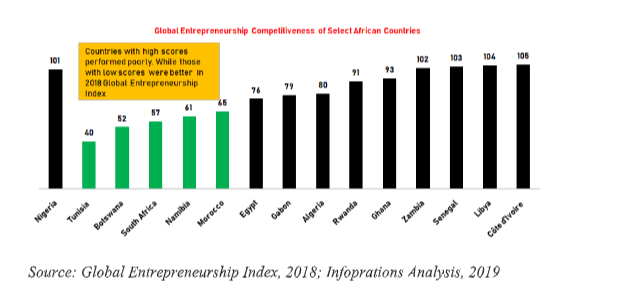
Answers to this question lies with the Global Competitiveness and Entrepreneurship Indexes perception of the country in 2018. The two indexes, according to their proponents, rank countries across the world, considering certain indicators at individual and aggregate levels.

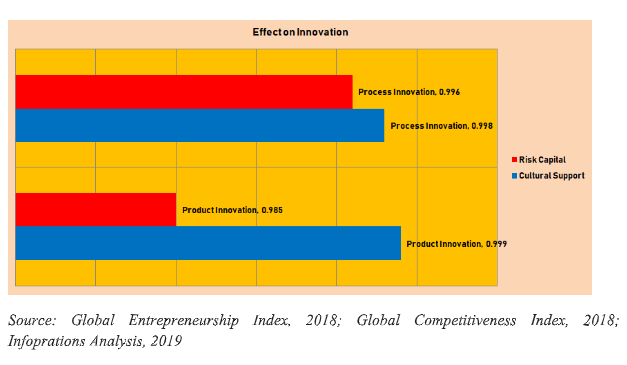
To support the earlier positions and understand the veracity of the issues affecting global placement of the Nigerian startups, startup skills, cultural support, product innovation, process innovation, risk capital and internalisation were the indicators selected from the Global Entrepreneurship Index for analysis along with the selected indicators from the Global Competitiveness Index.

Within the startup skills indicators, among other factors, GEI believes that startups performance depends on the extent to which entrepreneurs have access to tertiary education. The most corresponding indicators in GCI are the tertiary education and quality of the education system.

Prevention and reduction of pervasive corruption are the factors GEI expects policymakers to work on before meaningful and effective cultural support could emerge in Nigeria. This is clearly complemented by the GCI’s measurement of the country’s competitiveness within burden of government regulation, diversion of public funds and irregular payments and bribes. Though, there are policies and programmes helping startups, but it appears that GCI wants the government to address the complexity of regulations and bribes among the agencies responsible for business registration and management.

Apart from the elimination of the systemic corruption, the two indexes expect Nigerian government and other stakeholders to provide an enabling environment for venture capital and private equity financing. GCI specifically emphasises equity financing through local market. These are their indicators within risk capital indicator which must be addressed to pave ways Nigerian startups to reach global status.

Being global requires having the right processes and sustainable products that offer the real values to the users. The two indexes have realised over the years that Nigeria is lagging behind in the areas of product process and product innovation.

To right the wrongs within the process innovation, GEI asks Nigeria to work on the quality of scientific institutions and availability of scientists and engineers. Adding to the discourse, GCI believes that Nigeria must ensure availability of research and training services to the startups to enable them create the right processes for products or solutions creation and delivery.

Innovating the right and better products or solutions, according to the two indexes, depends on collaboration in research between universities and industries, protection of intellectual property. The expectation of the duo is that Nigerian startups globalisation would be realised when the issues in the indicators are addressed in addition to the facilitation of interaction of individuals in increasingly complex networks in order to make products and control of international distribution.

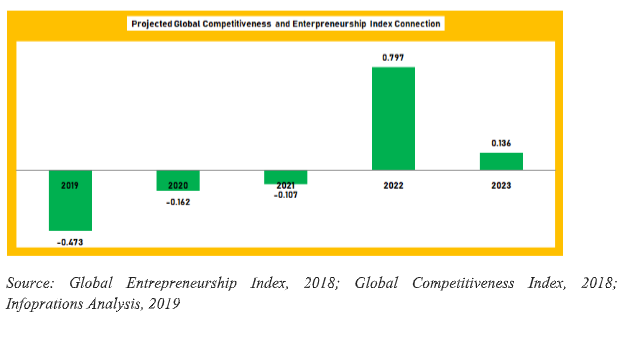
This is imperative because analysis shows that the identified indicators connected negatively. One point in Nigeria’s business environment competitiveness (among other countries) reduces the competitiveness of the startups by 47.3%. The poor ranking of the identified indicators in the GCI remains the significant factors contributing to the negativity.

Using 2018 as the base year, analysis reveals that the negativity would continue till 2021 before showing positive linkage in 2022 and 2023. Failure to solve issues in the indicators would continue to impact the GDP growth. Already extrapolation analysis of the select GEI with the GDP growth between 2015 and 2018 indicates a 35.1% reduction in GDP growth.

Parents Need to Break out of Old Thinking on Children’s Career Planning

3

I grew up in an environment where mothers don’t have a say in the future of the children. Meaning, the fathers decide the children’s future. Whatever becomes of the children lies in the hands of fate.
Mothers can’t challenge the fathers’ authority. It makes me wonder if marriage in Africa is slavery. Are two heads not better than one?

When I was much younger, my dream was to become a writer through the art of storytelling.
My reasons were:

  • I want to help companies present their brands into words or videos.
  • I want to help them sell their products to their target audience without appearing like selling.
  • It’s something I really love doing as I discovered most companies struggle when it comes to getting in front of their target audience.

My passion for storytelling got fueled up when I was awarded the ’Master of Riddles’ in my nursery school days. I was the only one who would be called on to tell stories to the whole school. That was more than money to me.

In my secondary school days, I wanted to go into the ‘Art Department’ because of my love for poetry and writing, but my father insisted I go to the ‘Science Department’, so I can become an Engineer.

However, I struggled throughout my secondary school days. I didn’t do well in my Physics and Chemistry as I would have loved. Those two subjects are the backbone of the Science Department. Although I did manage to pass them. Thanks to the late-night coffee and cramming. I bagged a weak credit in Physics and Chemistry.

Since I already knew what my father wanted, I obtained a JAMB form and applied for Mechanical Engineering course. I wasn’t admitted. I tried three more times but didn’t succeed. After three years of wasted efforts, I had to settle for Statistics at the Federal Polytechnic Ede, Osun. I graduated with Distinction (both at the OND and HND level)

After graduation, I couldn’t find my purpose in life. I was completely lost. I struggled to fit into the labour market. I spent two years in search of a job. When I couldn’t handle the heartbreak and disappointment of job search anymore, I quit and went back to my first love, “Writing”.

Through “Writing”, I had the opportunity to meet amazing people across the globe. I also got many job offers and even started an entrepreneurship journey.

“Writing” gave me money, a car and a house. It also put sumptuous meals on my table. I went from being broke and frustrated to working with top clients and companies in America, Canada and the UK.
What else could I have wished for?

My experience taught me nothing beats action taken by passion. Many are still living a borrowed life by trying to be what their parents want them to be. It’s time to break out of the old pattern of thinking. Yes, I mean to break free from it.

Break out of the old pattern of thinking: The old pattern of parenting is killing children’s dreams. It’s time to let the kids be whatever they want to be.

When I become a father, my job would be: to offer the much-needed support and encouragement for my children’s development. This can only be achieved when I know their strengths and weaknesses.

Most African fathers don’t really know much about their children. Perhaps, what they love doing. They are being subjected to the old pattern of parenting. How their parents raised them choosing everything. They never had a say because they’d be reprimanded for being disrespectful.

I have trained and mentored many job seekers through my digital skills courses and helped them to discover their purpose in life. During my time with them, I realized that many had been subjected to pursue a career their father had imposed on them. Through their father’s act, many dreams had been killed. Many were made mentally retarded and psychologically redundant. Many never got lucky to discover their purpose and never lived to their full potential.

I would appreciate if the African universities will offer courses in Fatherhood. We need to save the future generations and break away from that trend. Of course, I must note that mothers, in some homes, are not left out of this challenge of deciding their children’s careers by fiats.

How our Mindset can Determine our Financial and Social Status

4

Some time ago, one of my neighbours told me about a motivational video called “The Secret”. She lent me the video and I only watched part of it because I lost interest along the line. I mean, it didn’t make sense to me then. I was deep into a financial crisis to have time to listen to what they called “Law of Attraction”. I mean, what has a law or an attraction got to do with helping me pay my bills and offset my debts? Anyway, I returned the CD with a huge “thank you” and “I enjoyed it so much” kind of smile. At least I wasn’t completely lying.

Years later, another person told me about how positive energy attracts good things and negative energy attracts the opposite. I told this very person to go to physics class and lay down his argument (lol). For my ‘ignorance’, I received a book as a gift from this ‘teacher’. Guess the name of this book – The Secret (you can imagine). Honestly, I haven’t had time to read the book because I didn’t want to confuse myself. But a post I saw on LinkedIn about how rich men think helped me understand this theory (The Law of Attraction). I will tell you how.

I’ll first like to define two major concepts I want to use in this analysis – the rich and the poor. When I say ‘the rich’ I mean those people that know how to manipulate the resources within and around them to generate income for themselves and their dependents. By ‘the poor’ I mean those who are unaware of any resources within or around them that can be used to generate their much needed incomes. So, don’t take offence whenever I use any of those terms.

Alright, so here we go. I’m an extrovert – yeah, that’s me. This means that I relate easily and freely with everybody irrespective of their financial status and all. But I noticed that anytime I’m in the midst of the poor I am always uncomfortable because I will have to be careful with what I say so I don’t get them angry. I have to agree with them that there is nothing good about Nigeria; I have to agree with them that everybody is starving; I have to agree with them that no matter how hard you try you can never make it unless you become corrupt; I have to agree with them that all those rich people out there killed their wives and mothers to do money rituals; I have to agree with them that going to school is a waste of time. In fact, for every conversation had with them, something negative must come up. If I make the mistake of disagreeing with them, I will automatically become a traitor (trust me, you don’t want to be there).

With these people, I have to keep my brain in a standby mode (or should I say sleep mode?). If I mistakenly say anything that sounds intelligent to them, I will be seen as an anomaly and therefore no longer a member of the group.

But in the rich man’s camp I can freely express my ideas and have them appreciated and constructively criticised. I can receive insights into everything that exists in the community. I can get motivated by someone’s success story. I can get a mentor who thinks my intelligence needs to be well channelled. I can get someone that will tell me the economic activities that can bloom within my area. I can get someone who will encourage me to take a risk. I can also get someone who is pushing up and wouldn’t mind if I tag along.

Now let me connect what I learnt about this Law of Attraction to my experiences in these two camps. Please, I’m debating this based on the physical sense, not on the metaphysical (I’m not a guru). So here’s the deal – a positive mind attracts positive mind, while negative mind attracts the opposite. Therefore, like minds attract each other.

The truth is that the rich want to keep connecting with the rich, while the poor are comfortable with their kind. The rich man there wants to meet with someone who can give him ideas on how to increase his income. He wouldn’t want to invest his time, energy and money on gossips and complaints about how bad everything is. The only complaint he can endure is how a business venture didn’t turn out as planned. But this complaint must be followed by a solution. The poor, on the other hand, spends the time he will use to think up solutions to problems on lamenting and accusing others. He will seek out his kind who will lament with him. He wouldn’t be comfortable in the midst of those who wouldn’t see his reasons for the complaints. The poor has actually accepted defeat and is now pointing accusing fingers at the ‘causers’ of his problems (which are everything and everybody).

What am I trying to say here? Sometimes our mindset could either make or mar us. For us to be successful in everything we do, we need to think positively; we need to see opportunities in everything; we need to stop complaining and start looking for feasible solutions to our problems; we need to think of how to move ahead and reach our goals despite the hurdles (in fact, we need to turn those hurdles into job and business opportunities); and we need to learn to conquer our fears. Above all, we need to mingle with the rich.

We cannot attain our goals if we don’t have mentors to guide us on how to do so. Mentors are usually those who have been where we are and are already where we wish to be. They are therefore among the rich. It will not be possible to have a mentor if you have the mindset of the poor. Trust me no one wants to listen to a complaint, unless there is a solution proffered by the complainant. So, stop complaining and start taking action.

The Mechanics of Digital Transformation

0

Digital transformation undoubtedly is on the front burner for most businesses today. The question is no longer whether to undertake digital transformation; the question is how to get it right. The pace of change in the business environment is on the increase. Indeed, customers expectations are changing and market dynamics is radically changing; hence, businesses must respond timely and adequately to remain relevant and valuable. 

Digital transformation involves re-inventing your business to deliver value, leveraging digital technologies to understand the customers, and deliver what the customers need, and the way the customers want solutions delivered to them.

According to 9senses.com “Digital transformation is about changing the way processes, people and technology work to create efficiencies, new sources of innovation, and new insight that was not readily available previously. More importantly, digital transformation is most effective when putting the customer at the center of the digital ground swell”. 

Most businesses have embarked on some form of digital transformation efforts, unfortunately, many are not getting the desired results. According to a McKinsey Global survey, less than 30% of digital transformation projects succeed.   

A Harvard Business Review report identified the following as top barriers to successful digital transformation: Lack of a corporate vision for digital, Inability to experiment quickly, Legacy systems, Inability to work across silos, Inadequate collaboration between IT and lines of business, Risk-averse culture, Change management capabilities and Lack of talent/skills required. 

A close review of successful digital transformation stories shows that digital transformation requires a holistic approach that proactively addresses these barriers across the entire organization. Four core elements were seen as major drivers of digital transformation; these are business vision, organizational culture, processes and digital technology.

GETTING IT RIGHT – THE AYOKS DIGITAL WHEEL.

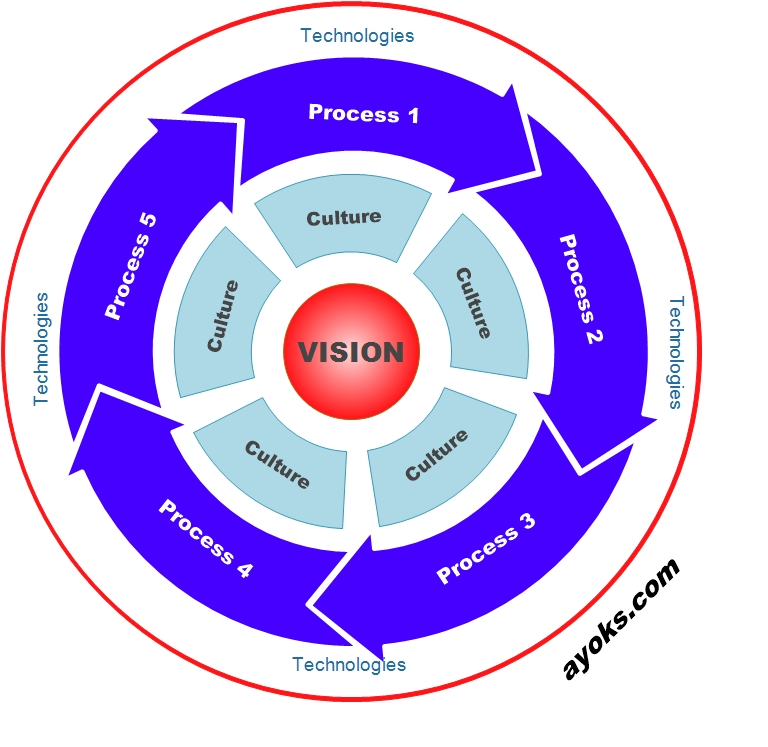
Ayoks Digital Wheel is a framework to guide businesses to get their digital transformation right. It recommends a holistic and coordinated program of change. It presents four elements as the core drivers of digital transformation, which must be strategically coordinated to achieve successful digital transformation.

It infers that successful digital transformations are centered on inspiring business vision, nurtured by the right organizational culture, follow iterative processes and are powered by one or more digital technologies. These are captured as different layers on the Ayoks Digital Wheel. 

 At the center of the wheel is the vision which presents the desired business outcome that the digital transformation project is geared towards achieving. The next layer around the vision captures cultural values, practices and beliefs required to achieve the business vision. The third layer from the center shows the series of activities/processes that form the strategic road-map for the digital transformation project. The outermost layer of the wheel represents the different digital technologies that organizations can deploy in their businesses.  

These technologies provide the platform (power) to enhance operational efficiency and fulfil customers’ needs. The technologies provide the interface with the customers and the outside world; they are the most visible component of the transformation story and may be the reason why some businesses erroneously focus on technology alone; but without the other elements inside the wheel, success is elusive.

VISION – THE FULCRUM OF THE DIGITAL WHEEL

At the center of every successful digital transformation is a clear and compelling vision. Technology is an enabler. It gives you power but it does not tell you what to do with the power. Your vision tells you what to do with the power that digital technology offers you.

The businessdictionary.com defines vision as “An aspirational description of what an organization would like to achieve or accomplish in the mid-term or long-term future. It is intended to serve as a clear guide for choosing current and future courses of action”. 

Creating an inspiring and compelling vision for your business should be the starting point of your digital transformation journey.  Your business vision is a picture of the future for your business. It is where you want your business to be in the future (5 years, 10 years, 20 years, etc.) This vision determines your goals, guides your decisions and focuses your actions.

CULTURE – OILS THE WHEEL OF TRANSFORMATION

 According to McKinsey & Co. Research, culture is one of the main barriers that hinder organizations’ digital transformations. In a Gartner’s press release, it stated that 46 percent of CIOs identify culture as the largest barrier to realizing the promise of digital business. 

Developing the right organizational culture therefore is critical in achieving digital transformation of your business. Organizational culture includes an organization’s beliefs, expectations, philosophy and values that guide interactions within the organization and with the outside world. The right organizational culture in today’s digital world will as a necessity include the following; 

Customer centricity – This means making excellent customer experience the focus of all decisions and actions. It involves having a feedback mechanism that ensures customer needs are always captured and addressed. This also means that an organization focuses on what the customer wants or needs instead of what the company offers. 

Cross-functional collaboration –  This is the practice of having effective collaboration across different teams as against a situation where different teams work in silos. This involves creating an atmosphere that encourages sharing of knowledge and insights; it’s an atmosphere that encourages team achievements above ‘key-man’ syndrome. 

 Informed and empowered workforce –  This is a system that empowers employees with the right information, skills and insights. This implies employees are regularly informed and engaged about what the organization is doing and the employees are also empowered to contribute to what the organization is doing. Letting your people know what digital transformation means for the organization and how it will impact the workforce will encourage employees to embrace it.   

Reasonable risk appetite – This is a culture where people are comfortable trying new things; where employees can take calculated risks and are not punished for adverse outcomes. This is important as digital transformation requires challenging the status quo. 

Agile and Innovative culture – A system that allows people to think out-of-box, think big, fail fast, learn and improve. This involves building a system that rewards success and also encourages creative failures and learning from failed attempts. 

PROCESSES – THE MOMENTUM OF THE DIGITAL WHEEL

Digital transformation of your business is a journey that consists of several iterative processes. The following are five iterative processes that can guide a business to successfully reinvent and offer more value to their customers;

 Determine Your Minimum Viable Product (MVP) –  MVP is your value proposition (that is the problem you solve or service you render) packaged as a product for the market in its basic form. It is important you define this with a focus on the real value that your customers get and what they are willing to pay for.

 An understanding of the value you offer is important in transforming your business, as it enables you to rethink your products while improving on the value. Value is not disrupted; it is products that are disrupted.

Determine Your Business Model –   Your business model is how your business operates, creates and captures value for stakeholders in a competitive marketplace. It involves how you structure your cost and revenue streams. Some business models you may use (or modify) include marketplace, freemium, subscription, lease, auction, pay-as-you-go, franchise, affiliate, and razor blade.  You need to redesign your business model to leverage digital capabilities.

 Design Your Digital Awesome Product (DAP) – Your DAP is your product in a form that gives your customers an awesome experience. You can achieve this by embedding digital values into your minimum viable product (MVP) and addressing pain points on your customers’ journey. This involves making your customers journey seamless and giving them great experience consuming your product. Designing your DAP is important for digital transformation of your business.   

Deploy Your Digital Awesome Product  –   Implement your digital awesome product (DAP) preferably using agile methodology. It affords you the opportunity of deploying in phases and going through rapid iterations based on customer feedback. The principle here is to deploy fast, fail fast, learn fast and improve. Continue until you achieve that product that gives customers a ‘wow!’ experience.

Build A Sustainable Ecosystem –  An interesting point in the digital transformation journey is building a digital ecosystem – an interdependent group of enterprises and people who interact on a digital platform for mutual benefit. This enables a business to leverage resources and innovation from outside the organization, hence making it more sustainable. Top tech businesses like Amazon, Uber, and Facebook. have successfully built digital ecosystems and are reaping huge benefits from these ecosystems.

 TECHNOLOGY – THE POWER OF THE DIGITAL WHEEL

Digital technologies provide the power that drives digital transformation of businesses. These emerging digital technologies include social, mobile, cloud, artificial intelligence, internet of things, data analytics, robotics, augmented reality, etc. Businesses need to determine how one or more of these technologies bring values and capabilities that enable them to deliver to the customer what the customer wants, the way the customer wants it. 

Social Media – There has been an increase in social media platforms like Facebook, Twitter, Instagram, LinkedIn, etc. These platforms dedicated to community based input, collaboration and content sharing have provided businesses new opportunities to engage their existing customers, prospect and acquire new ones. 

Mobile – Mobile technologies used in smartphones and wearable have significantly changed how people communicate, shop, work and do business. The adoption of mobile is on the increase. According to Statista, in 2018, over 50 percent of internet traffic came from mobile devices. This is of great importance to business – hence smart businesses are now using a mobile-first approach in their digital transformation projects. 

Data Analytics – This enables businesses to understand customer experience of their products and services, it gives business insights to how, when and where their products and services are consumed. This is of great importance in understanding what the customers want. This is a major driver for digital transformation of businesses. 

Cloud – Cloud computing offers businesses on-demand availability of computing resources to implement their transformation initiatives. This enables businesses to respond quickly to changing market conditions and demands. It catalyzes innovation as businesses are able to quickly test their products or services, reducing time to market and capital investment required to deploy solutions. 

Internet of Things (IoT) – This emerging technology creates a system where internet connectivity is extended to everyday objects like electronic devices, mechanical devices, people and animals. IoT is set to provide a turning point in the world of business. As the number of IoT devices continue to increase globally, businesses can take advantage of this in the transformation of their businesses. 

In conclusion, the core elements of vision, organizational culture, processes and digital technologies (captured as different layers in the digital wheel) are the major drivers of digital transformation of businesses. These must be strategically orchestrated and managed to successfully transform a business to remain relevant, viable and profitable in a fast changing business world.