DD
MM
YYYY

PAGES

DD
MM
YYYY

spot_img

PAGES

Home Blog Page 6787

The Making of Great Deal Makers: Learning Points for Effective Negotiations

0

The reality of modern business environment is, people will possibly not pay you what you are worth or what you deserve but only pay that which you demand or negotiate. It’s your job as negotiator to convincingly communicate what you deserve to them and justify the same. Putting up good value proposition is not enough. How you pass your message across to counterparties, coloured with some dint of ‘blackmail’, could just go a long way in delivering you a good value or price. Great deal makers are quite good at making their stories sound compelling. An employer or business counterparty is under no obligation whatsoever to pay you more if you agree to take less. So, you decide what your value is and push for same.

Interesting thing about deal making or negotiation is, we all get involved in it somehow. When you go to open markets to buy few household items, and they throw prices at you; you don’t just pay up. You negotiate the prices before committing yourself. Or in the alternative, you compare prices across related markets. Not only that, if you realized that the price in Market A is far lower than what obtains in Market B, you could even decide to take advantage of the arbitrage by becoming a new supplier of the items from Market A to customers in Market B. Similarly, when you’re being interviewed for a role, and they start asking for your current monthly take-home and salary expectation, you sure want to put on your deal-making cap. Negotiation also applies to more sophisticated cases of a start-up company seeking funding opportunities; big companies acquiring or merging with another; seeking public utilities concessions; governments pursuing bilateral or multilateral trade deals amongst others.

Just to be clear, deal-making and negotiation don’t necessarily mean the same. Deal-making relates to an art of closing out on business agreements, transactions or arrangements, while negotiation has to do with a discussion held towards reaching an agreement. Both are seemingly interwoven, but you can make a deal without negotiating for terms thereof. Most upcoming artists or actors sign agreements with record labels or movie producers without even looking at the documents, nor get lawyers to review same. They are a good case study of how never to make a deal. Same applies to many desperate business start-ups.

In this piece, I hope to share few tips with you on how to be a good deal maker or negotiator. Not only that. As we more along, I shall be making some anecdotal scenarios and examples of how people make deals or originate transactions, and hopefully in the process, open your eyes to opportunities sitting right there on your table. And also note, I won’t be bothering you with some hawkish or Trump-type deal making narratives, but do promise to possibly change your mindset. Forever.

Let me be upfront here again. To be a good deal maker or negotiator, you must be confident, resourceful, skillful, visionary, and open-minded. You must be ready to change your mind when facts change. And more than anything else, don’t you ever appear desperate. Admittedly, anyone can be in a desperate situation. But don’t let your counterparty see the desperation in you. In deal making, when you put up a face (a facade though) of someone who has nothing to lose if parties walk away from the negotiating table, it’s called Posturing. It’s exactly what dogs do when they bark at strangers. It’s not for lack of fear but barking gives strangers an impression of a courageous and ready-to-fight dog.

Deal making is an art, and being a good negotiator is not necessarily some in-born quality. It is a skill you can learn and nurture over time. And that begins with how you handle little deals in everyday life decisions. Generally, there’s a process around deal making, especially for complex transactions of a billion US Dollar scale. I’m going to be sharing some learning points from a couple of deal making transactions I have been privileged to partake in, involving oil trades, corporate acquisition bid, critical asset acquisitions, management buy-outs, and startup fund-raising amongst others. And here we go:

One. Define Your Values and be Firm with Them

Like I noted earlier, we all are involved in some business deals and negotiations or another. People looking for job also negotiate their pay and conditions of service. If you’re a bad negotiator and have no clearly defined values or ethical guide, you will always jump from one employer to another in search of bigger pay. Same applies to a contractor or vendor who doesn’t have clearly defined values. Counterparties could potentially make unethical and reputation-damaging demands of you and take advantage of your desperation. More so, when you lack in key values, people price you terribly low in business deals. By values, I mean not just those ethical vibes we often throw around (Integrity, Honesty, and Accountability etc.), you must clearly convince yourself on what you will never do, and what you can possibly do under certain extreme scenarios. Be very clear and intentional about your ‘dos’ and ‘don’ts’. You must set certain ethical baseline for yourself. It will save you from possible blackmail or weird posturing or demands by your counterparties (be they interviewers, investors, suppliers, customers, or service provider).

Two. Identify your Leverage

Deal-making is like a war. No one goes to war, without adequate defence systems and tactics. Neither does anyone go to war to sit pretty and defend away. To have a beneficial negotiation, you must have an irresistible value to offer your counterparty. Do your homework well. Make efforts to understand your opponent’s needs, strengths and weaknesses. You must have something which the other fellow desperately needs. And that’s your leverage. Lack of leverage in negotiation keeps you at a disadvantage point, and thus leaving you at the mercy of the counterparty. As a job seeker, you’re being considered for a role because the employer has some problems or gaps to fill in his/her business growth aspirations or control environment. Your portfolio of skills, competences and track record and how same fit into the employer’s talent requirements constitute your leverage, and how you sell yourself sometimes determines how much you can command, in terms of pay and other benefits.

The employer has a leverage too. You’re not the only talent around. There are many better qualified candidates out there. If you’re currently out of job and desperately in need of one — that is another big leverage for the potential employer. Typically, in a situation like this, salary negotiation will most often be at his/her vantage point. On a personal note, I generally advise people, except in rare cases, that if you want to leave one job for another, don’t resign from the current role, unless and until you’ve received Offer Letter and even done medicals on the new role. There are exceptions to every rule, I must say. Moving from Job A to Job B provides a better leverage than moving from Jobless state to a new Job. Employers will take advantage of your vulnerabilities.

In more sophisticated deals involving buying and selling, mergers and acquisitions, startup fundraising, corporate buyouts (buyout is when the people managing your business agrees to pay you off, so that they can become the new owners), etc., parties on both sides of the negotiation divides always look out for each other’s soft spot and any element of desperation. Both parties look out for each other’s value expectations and use same as a pricing tool.

The key point here however is, whatsoever the negotiation you’re having with anyone, always look out for their needs and weak points and use same to define your value propositions. And there you have it.

Three. Define Your Worth and Stand by It.

I’m not here to sweet-talk you or play to the gallery. We all have a price. Pure and simple! But I must say, no price should ever be enough to buy our conscience. When negotiating for salary for instance, look beyond the money in defining your pay expectations. Let your overall needs per unit of time guide your thought process and decision. Some people work in well-paying but terribly corrupt and toxic environments. Depending on your values, what anyone in such environment might need at some point is sanity and some reasonable but competitive pay elsewhere. Generally, always look beyond the money. Consider other non-financial benefits attached to any new possible role if you’re being considered for one.

And even if all that matters to you is money, it is fine. Very fine. You must be intentional and deliberate about your pay demands. If you have a problem defining your worth, look around for colleagues across different industries handling related roles and of the same experience range with you. The average of what they earn speaks to what you should be looking at as a baseline. Then, you can quote a salary range expectation to your prospective employer. When asked for salary expectations, you don’t just quote a single figure. Give a range, buddie! Ask for a compensation that’s enough to keep you on the job for at least 3 years. Minimum. There’s no honour in having several short experiences scattered all over your CV.

Same applies in business negotiations. If you’re a seller, don’t behave like my tailor. He was to make me some cool cut. He naively made a quote of N5,000 when he knew that I would definitely ‘price’ it down. Much later he came back to say, “no, my fee is N7,000”. But it was too late. When negotiating as a seller, always have at least two figures in your head. Best case price. Worst case price. The worst-case price is that price that’s almost close to your cost, such that any further cut would land you in loss zone. You start a sale negotiation with Best-case Price. But such price must be reasonable, else the deal could be just be killed before it got started. After back and forth, you will likely reach a middle-ground price with your buyer.

As a buyer too, always have at least two figures in your head. The highest you’re willing and able to pay. The reasonable low that would not wilfully hurt your counterparty. See, let’s clear here. Great negotiation deepens an age-long buyer-seller relationship when it’s a win-win. A win-lose or winner-take-all negotiation strategy is draconian and doesn’t always provide a sustainable value. This is my deal-making philosophy.

Four. Choose the Battlefield, if You Can

I urge you to spare some time to watch how eagles hunt for rodents and snakes. Eagles are air-bound. Sky is their base. When they make good catch, they don’t wait to fight you on the land. They change the venue. They drag their victims to the battlefield that gives them better leverage — the sky.

In most job interview sessions, job seekers don’t get to choose the venue of the exercise. The employers or recruiters do. As a candidate, you can’t even choose the sitting arrangement. No point sugar-coating it, the employer has a better leverage here. So as a job-seeker, you need to deal with it. Seek your own leverage.

But in core business negotiations, either as a supplier, customer, investor, or start-up founder, always make an effort to choose the venue of your meeting. Choosing a venue and paying for same, if you can afford it, has a spectacular way of disarming your counterparty. Though, a much more effective way to disarm your opponent is perhaps to have a business meeting in your office. This gives higher leverage. You have a feel of my office ambience. You take my coffee. That goes for nothing. (Smiles).

Five. Exude Grits, Gravitas, Swagger, and yet be Humble

Great deals are not made by weaklings, and neither are they made by disorganized people. How you dress and carry yourself shape how your counterparty’s view about you and, possibly could his/her negotiation strategy. It takes courage, finesse, charisma and problem-solving disposition to making good deals. When you are a party to a negotiation, you must show grits, authoritative demeanor, and fearlessness yet without being haughty or arrogant. Be courageous, yet humble. Be calm and calculative.

During negotiation, show humility when presented with superior facts. Don’t argue blindly, except when such is desirable as mere posturing and defence tactic. Display outside-the-box thinking, general likability, and sacrificing spirit. In more complex deals, you’re likely to be dealing with bullies and hawks with winner-take-all mentality. You must show strength. You cannot afford to give in to blackmail. Deal-making sometimes is a game of dog eating dog. It’s sometimes a game of small fish making attempt to swallow big fish.

Deal-making discussions, as with some job interviews, could at times get hot, ballistic and controversial. You must exercise restraint, tact and discretion. People may intentionally provoke you as a diversionary tactic. Don’t fall for it.

Six. Know When to Take a Walk

In negotiations, parties on both sides of the table make efforts to outdo or out-game each other in order to extract the best value possible. It is a tough competition. But as a good deal maker, know that in certain circumstances, ‘No Outcome’ is the best outcome. Never ever put yourself under pressure to accept a terrible deal. As a job seeker, you don’t just accept every job offer thrown at you. Beyond the money, be sure you really and genuinely want to work in such environment. As start-up founder, don’t be too desperate to accept every loan or equity deal thrown at you. Such deal might turn out to be your company’s death knell. As a big-ticket business deal maker, don’t be too desperate to close that deal if the terms are horrible and commercially indefensible. It’s not every seemingly juicy deal that makes a good deal. The Nigerian Power Sector investors today are licking their wounds because they hoped for Nigerian telecom sector miracle for the power sector too. A bad bet! Life happens anyway.

As a negotiator, having a worst-case price sign-posts when to consider taking a walk. You must have that price-cap or price-floor above or below which you’re not willing to make a deal. It’s a basic requirement in negotiation.

And here is a final rule. Never go into a deal or negotiation without having Best Alternative to Negotiated Agreement (BATNA) on the side. This is your Plan B. This is what gives you the power to say ‘NO’, after endless talks. Know when to walk away.
Crises in Followership – The Cause of Many Leadership Failures

3

It may seem inconceivable that any right thinking individual will put the blame on followers for the emergence or continuity of cruelty of bad leaders. I agree with you. Why would you blame the miserable as if their misery isn’t enough for the cruelty of bad leadership? It looks immoral or even insensitive to do so,at least on the surface.

These are two components of a two dimensional problem,the leaders and the led.  So involving one and excluding the other will not just be inappropriate but will also make it  incomplete. Considering how leaders emerge, I can categorize it into two different processes.

  1. Those who were put in positions of power or authority by the people.
  2. Those who got to positions of power or authority  by unpopular force or influence.

When a leader emerges from the first scenario, you wouldn’t be wrong to say that the followers are responsible for bringing this individual onboard, but will it be wrong to say they are responsible for his actions? This will depend on why they brought him onboard. If it is because his values and ideals align with those of the people, then yes you can say so. This is usually the case even though many will disagree.

But consider this, that the leaders are selected from the people. In other words before they became leaders they were once part of the populace. What this implies in Mathematical terms is that if  the populace is the universal set (U), the leaders are the subset {s}. In mathematics, a subset will always retain some of the properties of the universal set.

Let’s for the sake of this analogy assume that the populace is a  homogeneous mixture of people with similar attributes which define their social identity. This does not imply that they are all alike in all aspects, but only emphasizes that every group has an identity which defines them and makes them unique or peculiar or different from any other group. The same way a pack of cards will contain rectangular cards of identical weight and size but with different numbers and drawings on them. If this has been established then we can go further to say that this is purely a population and sample case .

If I took a handful of sand from the beach, will the properties of the soil sample be any different from the properties of the rest of the sand in the sea shore ? If a blood sample was taken from a patient’s vein, would the properties of the blood sample be different from what lies in the individuals blood. Medical science rely on this most of the time for diagnosis, are they ever wrong?  So if an institution or corporate body or government is repeatedly getting after many iterations a particular kind of leader, In this scenario the leader reflects the ideologies and interests of the people. So his failure is purely a failure of followership. 

For the second scenario, where a leader gets to a position of power by force or unpopular influence,  what happens afterwards is very crucial. I can categorize the general behavior or followers in this instance into four:

  1. Survival sycophancy
  2. Constructive Criticism
  3. Outright rebellion or opposition
  4. Silence.

This highlights the fact that followers have a series of options to follow which when they do, can affect either positively or negatively the status quo.

In the first instance, they only say what they think the leader would want to hear even when his actions are against the interest of the group or team. This they do out of either personal selfish interest or fear. Either way it points to the fact that they are bad followers.

In the second instance this can help transform or enlighten the leader on what needs to be done, or on what the real needs of the team or group is. If this is consistent, it either transforms the leader for good or it leads to the third which is;

Outright opposition or rebellion . When this happens it culminates to the leader being forced out by the sheer will power of the people who are led, hopefully ending the leadership crisis.

In the fourth instance, the words of Martin Luther King Jr  in his Testament of hope speech adequately summarizes it, “History will have to record that the greatest tragedy of this period of social transition was not the vitriolic words and violent actions of the bad people, but the appalling silence and indifference of the good people. Our generation will have to repent not only for the words and acts of children of darkness, but also for the fears and apathy of the children of light.” 

Who takes the praise for the economic success of the Germans after both WW1 and WW2  even after obvious leadership failures? The people or the leaders or both? Who takes the praise for the Japanese success story after two nuclear disasters and a tsunami? The people or the leaders or both?  Whatever your answers to these questions are, the attitude of these people must have played an important role. Sure the government or corporate leaders has got a lot to do when leadership or economy fails, and this article does not try to exonerate them. Rather it tries to hold everyone responsible.

In the end, considering all the factors listed it becomes evident that leadership failure arises, stays, or continues as a result of the actions or inactions of the followers.

Open Banking In Nigeria Evolving

2

One of our contributors wrote about open banking few days ago on Tekedia. The industry is evolving looking at the partnership EY just announced.

Ernst & Young (EY), a global professional services firm, has finalised arrangements with Open Banking Nigeria to develop and advocate for a standard Application Programming Interface (API) for the country’s financial services industry. The partnership will, in addition, transform the management of financial data and extend services to individuals and businesses across Nigeria.

EY, in a statement, disclosed this recently after it inked an agreement with Nigeria’s foremost Open Banking advocate and facilitator, Open Banking Nigeria.

With this agreement, EY joins other leading industry stakeholders to analyse the need of the industry for a common API standard among banks and other financial institutions, support the development of API standards, promote adoption with stakeholders—players and regulators—and enable further innovations in Nigeria’s financial services industry.

The introduction of a unified API across financial institutions creates a foundation upon which data can be effortlessly accessed and securely shared, real-time. It would, among others, empower individual and corporate users of services within the payment ecosystem to instruct their service providers to share their bank balance and transaction information with regulated Account Information Service Providers (AISPs).

This interoperability would result in the development of modern payment services, cost saving for operators and increased innovation while also guaranteeing information security and privacy, which would not cause an uneven playing field for industry players.

According to a statement by Dapo Adewole, Partner, Technology Advisory, at EY: “As part of our commitment to support the building of a better working world, EY Nigeria is working with stakeholders to use open banking to reshape financial services, especially as regulators and governments seek to increase competition and choice. 

“We understand that customers also expect more convenience and flexible access to services, driven by broader digital experience and emerging technology. It is our desire to bring this goal to fruition, while working with other player in the industry.” 

Welcoming EY Nigeria to Open Banking Nigeria, Ope Adeoye, a trustee at Open Banking Nigeria, noted the firm’s top-notch contributions, along with other stakeholders, would lead to the development of the next generation of API standard for the Nigerian financial services industry.

Already acknowledged as the future of banking on the globe, the adoption of Open Banking in Nigeria would enhance the service offerings of players in the financial services industry, improve customer engagement and build new digital revenue channels. It would also transform the operation of other industries, including telecommunications, power, hospitality, retail and insurance, seeking to leverage data for the improvement of their operational scope and service offerings to clients.

Press Release

Cryptocurrencies – Digital Wealth In A Flip

0

The cryptocurrencies or digital currencies are currencies which you can neither see, touch or feel but you can buy and sell using it. They are currencies in which encryption techniques are used to regulate the generation of units and verify the transfer of funds, operating independently of a central bank. Unlike the common money we know, digital currencies are digital; e-monies, you can’t lay hold of it but it qualifies as money since it is a recognized means of buying and selling and a medium of exchange. They are decentralized and no government or organization could claim to have control of it and hence nobody can regulate it.

A cryptocurrency (or crypto currency) is a digital asset designed to work as a medium of exchange, it uses strong cryptography to secure financial transactions, control the creation of additional units, and verify the transfer of assets.

It has been a controversial topic as to the initiator or founder(s) or starter(s) of cryptocurrencies, while some claim that is the mysterious Satoshi Nakamoto, whose identity is unknown, some link the invention to another individual but it is a known fact that digital currency finally gained success in the year 2009 when Bitcoin (represented as Btc) was released as open-source software after numerous futile attempt to create digital currencies.

Bitcoin is generally considered the first decentralized currency. It is not regulated by any government or organization neither is it under the control of any state or person.

Till date, bitcoin remain the most popular, most accepted and the most expensive among all other cryptocurrencies as there have been more than 3000 other cryptocurrencies released into the market since 2009, after the huge success of bitcoin.

Some out of the numerous cryptocurrencies released afterwards include Ethereum (represented as Eth), Litecion (Ltc), Stellar (Xlm), Ripples (xrp), Bitcoin cash (bch), Pivot (pvt), namecoin etc. All these other coins other than bitcoin are referred to as altcoins.

Bitcoin was valued for the first time in 2010 when someone decided to swap his 10,000 units of bitcoins for two pizzas on 22nd of May 2010 and this date is celebrated every year as bitcoin pizza day in remembrance of the day bitcoin gained value.

Bitcoin depiction

Since 2010, Bitcoin has gained more popularity, and is widely accepted and extended into more countries in America, Europe, Asia, Australia and even Africa. Bitcoin and other digital currencies have remained a unit of investment, business and means of livelihood for most individuals.

Although many people are yet to know what cryptocurrencies are, it is a way to make money at the comfort of your home without physical contact with the person you are buying from or selling to; all you need is a smartphone or a computing device. Since it is digital or an E-money, you can transact with any body in any part of the world; you can buy, sell, hold, mine or swap.

It’s high time individuals avert their attention to this digital way of making money as it is on the ‘soft work’ way of making money and creating exchange.

There are about four segments in this business and four distinct way a person involved in it can make his money as it doesn’t only revolve around buying and selling; there are the traders, the holders, the miners and those engaged in swapping.

The traders are those engaged in the buying and the selling of the coins on daily bases. They buy in order to sell, they sell with little or more profit margin. It takes a lot of experience to be a trader of cryptocurrencies. A trader should be conversant with the pull and the push factor that leads the rise and fall of the prices.

Then there are the holders, the holders are the investors, they invest in the cryptocurrencies, they can hold that for years and can only withdraw it when they feel it’s necessary. Holding in the real sense of it is the most lucrative part of cryptocurrencies. 

Earlier this year, a bitcoin was sold for $4000 USD but by June the same year, bitcoin hit $14000.There are other coins (referred to as altcoins) which is less than $1 now but have the prospect of hitting $11000 in the nearest future. Some of those altcoins include; Ripple (Xrp), Stellar (Xlm), Bitcoin cash (bch) etc. These coins are predicted to be worth more than a thousand dollar in the nearest future and due to the success of bitcoin the prediction will not be far from the truth despite the fact that each of those coins cost less than one dollar.

There are those that are into mining of bitcoins and other cryptocurrencies. Constant energy or electricity is required for mining. Most times the cost of power and the cost of machines to be used in mining makes cryptocurrency mining less lucrative. Some of the most popular machines used in mining are Antminer S9, Antminer R4, Avalon 6 etc (you can check the cost on Amazon if you are interested in getting one).

There are also those that are into swapping of coins. All they do is to swap one coin for the other, they make their income from the fees they charge for swapping.

The good news about cryptocurrency investment or trade is that there is no minimum or maximum amount of money that’s required to start up the trade, you can start with as low as 10 dollars while you can invest with as much as one million dollars. All it takes is to create an account on any of the online exchanges and buy any of the coins with any amount of money you wish and send the coins into your wallet and there you go.

Be it noted that since it’s a business and just like other trade, it is determined by the market forces of demand and supply; the price could fall and rise at any time. The $10 worth of bitcoins or any other coin you get today could experience 10% increment by the next day and it could also fall by 10% by the next day; you must always study the price chart of each coin for you to be able to decipher the fate of the coin. Reading a chart is not rocket science, basic knowledge of economics will help you.

Be smart when dealing with crypto – it can make or burn you financially depending on the market.

The Brilliance of Bashir Umar’s Honesty to ALL Nigerians

2
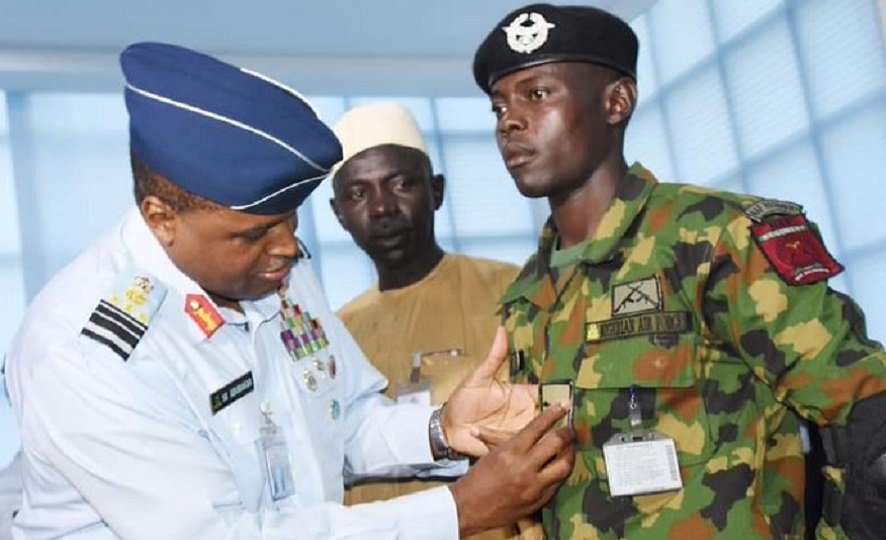
Umar decoration on his promotion

On Sunday July 7, when ACM Bashir Umar stumbled on 37, 000 euros ($41,000 or N14,820,000) at Kano airport, the Air Force personnel had two choices: 

  1. Grab the cash and quietly walk away, resign from service and live a private life and his poverty will be in the past. 
  2. Return the money to the owner, remain poor but honest. 

He chose the latter, a decision that would have sounded silly in a country where integrity is scarce, and survival is for the fittest.


He was not the first to do something like that, so what’s the big deal? In 2014, a cleaner, Josephine Agwu, who works at the Murtala Muhammed International Airport Lagos, found 12 million naira and returned it to the owner. 

There have been little instances of honesty here and there in a country where corruption is paramount. But not enough to disregard sincere efforts of fidelity that has become so insignificant because of the contagiousness of corruption that has tainted the image of Nigeria, and enabled the askance look especially from the outside.

You could recall that it was in the same month of July that five Nigerian soldiers were declared wanted for absconding with millions of naira belonging to a VIP they were escorting. That’s just the tip of the iceberg in many cases of fraud and disloyalty growing with disheartening prevalence. Mockery and ridicule have been employed as recruitment tools by the majority who have accepted stealing as a way of life. The stories fill the news everyday.

There are excuses though, “Nigerian Leaders are thieves, they are only there looting public funds in large sums. And they do so with utmost impunity. So why should I not do the same when I have the chance”? This is the defense line of an average Nigerian whenever the question of honesty comes into play. The soldiers who scampered with the millions of naira they were escorting had been handling such transactions involving huge amount of money for so long. So they know the drill, most of these transactions are illicit, and their principals live off it to the penury and jealousy of their subordinates.

The Nigerian Army has not been able to explain what the millions being escorted from Sokoto to Abuja was meant for, and the VIP, Mr. Okiti, an Army commander, is yet to make any explanatory statement about the huge sum. It’s a constant display of impunity that has always put sensitive conscience on a state of dichotomy, and it’s only those who developed their conscience on the staunch of fidelity that can resist the urge to join them when obviously they can’t beat them. ACM Bashir Umar is one of those. There is always a question of what do you have to gain on the side of morality when there is impunity to be enjoyed on the other side?

Bashir Umar received a double promotion to corporal, Josephine Agwu also was promoted at her place of work, and appreciative Nigerians donated money to her to the tone of 1.4 million naira. But the objective in being honest is never to be promoted or to be praised financially by people. 

It’s more like being a good example to a fragile conscience, or a personal hygiene awareness campaign in a time of deadly virus. “But it’s just some drops of clean water from the dirty stream,” says the man who has not read the Bible’s story of the 12 Spies. The insignificant 2 numbers with positive claims won over the 10 who had negative reports. And God was pleased. 

In fact, their testimony resulted in victory for the rest of the Israel nation. But the two Spies were different because of their mental attitude, they had trained themselves to see through the good and bad, and to take sides with the good. So fidelity is like a personal hygienic attitude that protects a person from diseases, and it starts with little things like:

  • Picking up a wallet with a stash of cash and fighting off the urge to keep it.
  • Picking up a lost phone and returning it to the owner.
  • Paying the bus conductor when he has forgotten to take money from you.
  • Returning money to the owner when your account is mistakenly credited etc.

No doubt, these traits helped Bashir Umar and Josephine Agwu to develop a measure of honesty that has stood the test of our corruptible time. And it has also inspired so many others to do the same. The benefit of honesty goes beyond you being a reference point of trust and all the public applause. It comes with peculiar peace that its source is rooted in your heart.

Examples of rare virtues of honesty should be study cases at homes and schools. The younger generation needs to replace what is immorally common with what is morally scarce. A corruption free future cannot be attained by anti-graft laws only, but through a mindset that sees graft as an unwelcome guest in the mind.