DD
MM
YYYY

PAGES

DD
MM
YYYY

spot_img

PAGES

Home Blog Page 6796

Time for #PropertyTech in Nigeria

2

Let me say it clearly, Nigeria can easily grow our economy and reduce unemployment within 12 months. If you pay attention to the recent drivers of our GDP growth, you will notice that digital technology (and startups) sector is critical.

If all the houses in Nigerian villages are moved from their dormant states to dynamic assets, you will create more than five million jobs in three years. In the books, those houses in villages are dormant assets with no (significant) monetary value. They are not tradable and investable which means someone cannot easily create value on them, by buying and reselling them. Dormant assets kill growth.

As a nation, we can change that through public private partnership.

Yes, government does not need to be directly involved but government must recognize new species of startups – PropertyTech – to transform those dormant assets into investable assets. Add farmland to the real estate, you will see Nigeria hitting great numbers.

How can that man whose father left 100 hectares of rural farmlands tap into that asset to expand his business in the city? Today, the land worth nothing and the man is looking for $10,000 to put in his business when he has control of 100 hectares of land somewhere. No luck on bank loan because the dormant asset has no value before banks and insurers.

A property with cameras. The real tech is the formalization of property ownership.

Unlocking those assets by using digital companies will improve the wealth of Nigeria. To execute that, I will vote for-profit digital companies, giving them vouchers to work with the property owners who will pay them to capture the values towards formalizing the assets and unlocking better futures across villages.

If you model at the impacts, you can have 5 million jobs created in three years. There are so many things we can fix in Nigeria to be at parity with developed world. And most of those things cannot be leapfrogged upon. Yes, not using property rights to unlock expansion of the economy is a failure in our political and economic leadership.

We need to overlay technology in the real estate sector to have PropertyTech just as we have technology on financial services to have Fintech.

Like Nike Said: Just Do It!

0

By Chisom Nwosu

I cannot be the only person who has listened to motivational speeches and read Feel Good articles or books about finding one’s purpose and following one’s passion. There are a million and one videos on the internet telling me to, “Make no Excuses”, “Accept challenges” and “Believe in myself”.

Truth be told, I am tired of the rhetoric. Talk is cheap. Give me practical examples; real life stories.

Finding one’s purpose has got to be one of the most elusive things to achieve in life. For some people amazingly, finding purpose comes quite easily. Some actually stumble onto it by chance. For the rest of us, sadly, it is one painstaking process that can take place over the entire course of our lifetime.

It is also often quite a lonely one as well.

For me, I have done some introspection and made a decision:  I’ll take Nike’s advice. I’ll just do it.

I am just going to live. I am just going to do the things that I enjoy doing, for example, writing down my thoughts and telling stories. I am going to be kind, look for opportunities to serve others. I shall keep asking questions and thinking about ways to solve the problems I encounter in my daily interactions both at work and in my personal life. I shall continually seek improvement in my processes, skills and relationships.

I want to leave a positive trail of value-adding in my wake wherever I go.

Who knows, along the way, I may finally realise that I have been living my purpose all along.

How to Overcome Recognition Gap in Nigeria’s Facilities Management Industry

0
Source: LinkedIn, Infoprations Analysis, 2019

By Mutiu Iyanda

Despite its primary purpose of ensuring a healthy environment and facilities for healthy living of human and materials, the recognition of the facilities management (FM) industry remains low in most developing countries. Placing the industry at the strategic position of developing and maintaining infrastructure or facilities has been a herculean task for users of FM solutions, especially government establishments.

Recent researches have shown that the issue remains due to the inability of the FM providers to appropriate proven strategies for awareness creation and maintenance. Among other consequences, the facilities management industry has been misconstrued as asset and property management in the last 5 years. Previous analysis has shown that the misconception is on the rise because of the simple description of solutions being employed by the players in the industry. Analysis indicates that the companies prefer simple description of the solutions to the classical structure, which allows categorisation of solutions based on their similar features or benefits.

Check has equally shown that FM companies in Nigeria pay little attention to the customer reviews on the Internet, most importantly, those expressed on Google Business and online communities or forums.  Analysis shows that a negative connection exists between the number of reviews received by 10 FM companies between 2017 and 2018, and average ratings given by the reviewers. Specifically, analysis reveals -10.4% connectivity and 1.1% of the reviews determined the average ratings. Based on these insights, this piece offers thought leadership as an emerging strategy to bridge Nigeria’s Facilities Management sector recognition gap.

A 2019’s report reveals that thought leadership is more powerful than marketers think. It is a tool that has helped and still helping businesses and individuals to generate leads and convert them to sales. It gives the desired results when it is not seen as an avenue for the mere description of a company’s products or services. This position reminds us of the simple description of FM solutions in the country which must be overhauled by the marketing and communications personnel of the players.

Thought leadership, when used appropriately, will assist FM brands deliver perspectives beneficial to their clients and prospective ones. Companies that develop insights are most likely to solve problems on facilities analytically, proceeding through the problem using step-by-step approach.

Beyond blogging, thought leadership would be effective when the companies employ formats such as research report, videos, essay, white paper, thought piece, webinars and presentations. These formats have been used and found effective in reaching B2B and B2C categories of clients in many industries in the last 5 years.

Source: LinkedIn, Infoprations Analysis, 2019

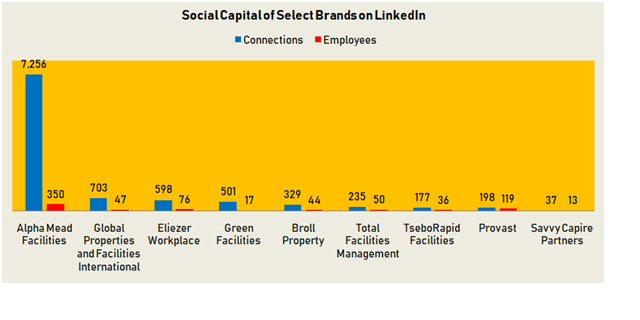
Producing though pieces is not enough. Efforts should be made for effective dissemination and evaluation of the pieces. For the maximum value derivation from thought leadership strategy, businesses need to improve their social capital, most importantly the presence of their employees on LinkedIn. Analysis reveals less than 50% connection of followers on LinkedIn with the number of employees (past and present) of select brands.

The main implication is that it would be difficult for businesses that need FM solutions to gain insights on facilities issues through the platform.  Apart from the presence, players also need to encourage their employees to engage in thought piece production and dissemination on the platform. This is important because analysis establishes low contributions in terms of articles sharing and comments on FM issues by employees.

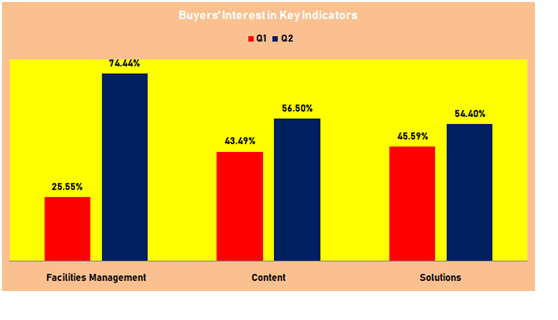
For instance, buyers’ interest in facilities management, content and solutions has been on the increase since Q1 2019. This signifies that players in the industry need to develop content that align with their solutions and disseminate them via LinkedIn and other channels. When the dissemination is done using LinkedIn and the employees share the content with the members of their network, analysis indicates that the social capital (employees’ presence) has the capability of increasing buyers’ interest in FM solutions by 26.3%, while the current brands’ connections can ensure 38.6% interest.

Our Model is That 5G Will Arrive Nigeria by 2025

1
5G network, adaptable business model

By Olayinka Oduwole

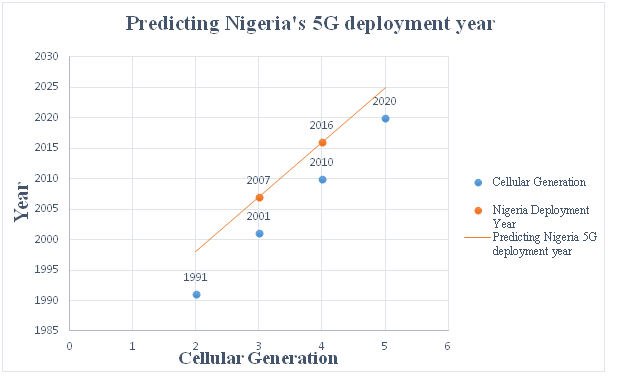
Every ten years, there is always a shift from previous generation onto a newer generation. In 1991, the development of GSM made voice calls to become reliable and cheaper and encouraged the widespread adoption of SMS (short message service) and MMS (multimedia messaging service). 1n 2001, 3G ushered in an era of data services and allowed workers access to emails from any location, and this increased work productivity. 1n 2010, 4G led to the development of mobile internet and video based applications which triggered the development of many sectors like online shopping, e-banking etc. 2020 promises to usher in a revolutionary era of high speed connectivity, ubiquitous coverage and low latency, which promises to transform industries, societies, enterprises, and nations due to the deployment of 5G.

When should we, as Nigerians, expect to witness this global digital transformation, that is even causing great rift between the US and China? All things being equal, and if we ignore demand and supply considerations and other market forces, assume we continue at the same rate of deployment, 5G should be upon us in Nigeria by 2025, as depicted below. This result obviously ignores the commencement of GSM in Nigeria in 2001 (an obvious outlier) and depends on the past deployment rate of cellular technologies in Nigeria.

Interestingly, GSMA in their 5G outlook for Sub Saharan Africa, recently interviewed respondents asking them when they expect to witness 5G in their markets and 67% of respondents revealed that would expect 5G in their sub Saharan African markets after 2025. Therefore, based on the result above and GSMA’s interview results, we should expect 5G in Nigeria by 2025.

As developed markets commence the launch of their 5G networks in 2020, Nigerians, MNOs (mobile network operators), MVNOs (mobile virtual network operators), internet giants, verticals, regulator, policy makers, Nigerian Government, investors, and other interested stakeholders can hold their breath till 2025, and patiently await the arrival of 5G, assume Nigeria continues at the same rate of deployment.

If we however, wish to deploy 5G in Nigeria before 2025, we can definitely borrow a leaf from the Chinese Government’s handbook, who made an amb

itious plan to dominate this space through its ‘Made in China 2025’ policies.

P.S: If we consider demand and supply forces and other market forces, the above result can be made much more accurate. This simple study can be repeated and used to predict the 5G deployment timeline for other developing countries.

The Sad Tales of Nigerian Minimum Wage

3

By Samuel Nwite

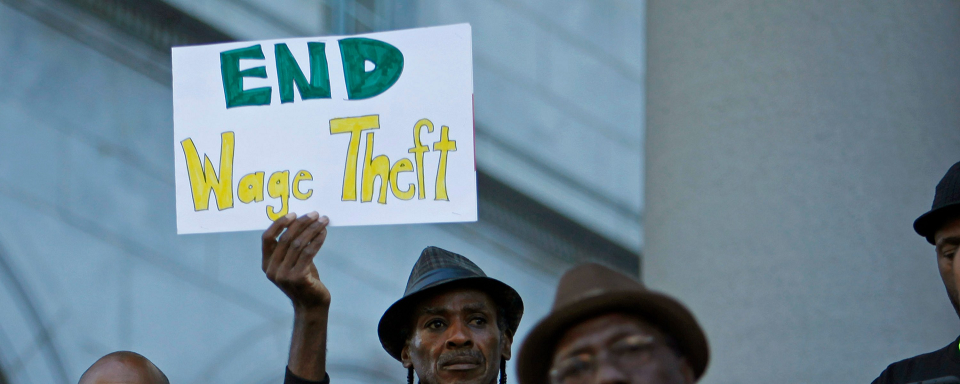
The Nigerian labor market has been stricken with abject underpayment for years, which has done more than stripped workers of dignified means of livelihood. The 18.000 naira minimum wage has been nothing but a disguised ridicule that could barely cover the transportation bill of a single for a week muchless a family with miscellaneous needs. House rent, School fees, medical bills, utility bills, food etc. are all encamped around this token, ready to unleash their ferociousness at the end of every month. The hope of livable minimum wage has been coming every four years in discussions at the National Assembly. Each time, the discussion gives a false hope to the impoverished workers who hope for a better life through increased wages. Even when the issue goes beyond discussion, the action has been nothing but mockery to livelihood.

In 2004, the 5th Assembly passed the bill that set the minimum wage at N5, 500 per a month. With that, the National Assembly scored some credit worthy of applause if not for the fact that it’s a ridicule to the realities at the homes of Nigerian workers. Exchange was 130 naira to a dollar, and the cost of living in Nigeria was not in any way close to the minimum wage. So an average Nigerian worker was living below 60 cents per day, all thanks to Nigerian Labor Unions, they fought hard to make it happen.  Series of strikes by the Nigerian Labour Congress (NLC) and the Trade Union Congress (TUC) forced the Obasanjo’s administration to bend so that a raise of 2500 naira was added to the derisory 3000 naira minimum wage that workers used to earn prior to 2004.

The choiceless workers accepted it in good fate. After all, 2500 naira could ease the burden of cooking gas, Nepa bill, and maybe water. The rest of the month will determine what will happen to the remaining 3000 naira.  However, one thing is sure, whatever will happen to the 3000, will need far more than that. It was on these appalling circumstances that workers waited for another time of minimum wage review. But until then, they survival depended on three things:

  1. Alternative means of income
  2. Borrowing
  3. Corruption: extorting everyone they owe services at work.

Option number 1 does not always come easy because of a lot of factors ranging from fund to enabling environment to strategy etc. And so does option number 2, you always run out of creditors before you know it. So survival rests on the number 3, corruption. The shocking practices of extortion you see in government offices today is deep-rooted in meager wages. And there are two set of Nigerians at the receiving end of the consequences of her poor minimum wage. Workers who take the pay home, and every other person who gets extorted by the workers. These two categories of people have one thing in common; the hope that things will change for good. The change everyone is expecting lies mainly on livable minimum wage that is not in government’s agenda for the nearest future. The industrial action that influenced the government to implement the 5, 500 naira wage was not going to happen again anytime soon. Even if it happens, the governments may not yield. But that doesn’t mean the people were not going to try anyway, it’s a quest for survival.

In 2008, the NLC made a public demand for upward review of the minimum wage to the late President Musa Yar’Adua. It was a long overdue demand following the incessant rise of cost of living, especially in the petroleum industry. The proposed deregulation of the downstream sector was a brunt that can’t be sustained on 5, 500 naira minimum wage.

The NLC, having consulted widely through an internal committee that it set up, set the minimum wage demand at 52, 200 naira. It was more like a continuation of the battle for the implementation of the previous agreement of 25% increment that Obasanjo’s administration only saw fit to effect 15%. Only that this time, a whole lot of factors have come into play, all emanating from the high rise of the cost of living. The 2000 Wage Review Agreement made provision for 25% wage increase that would take effect from May 1, 2001, and subsequently, further 15% increase that would be effected from May 1, 2002. It never happened.

Year Minimum wage
1981 N125
1990-1991 N250
1999-2000 N3,000
2004 State-N5, 500

Federal-N7,500

2011 N18,000
2019 N30, 000


The NLC knew they were dealing with an insincere government that will never stick to agreement. The government could only agree just to get the Labour Unions to call off the strike, and then after reneged on the agreement. So the 52, 200 naira wage demand seemed impossible but Labour Union was not going to give up easily, not without a fight. The 20.9% increase in the cost of household items, especially food was not a situation to be waved away because the government is insouciant. Especially when the salaries of political office holders has been increased by 800% just between 2006 and 2007. To justify the compulsion of the 52, 200 naira minimum wage demand, the NLC published a sample of Estimated Monthly Cost of Living in Nigeria.

Accommodation N6, 000.00
Electricity N1, 000.00
Kerosene N4, 000.00
Water N500.00
Communication N2, 000. 00
Food N20, 000.00
Clothing N4, 000. 00
Medical N5, 000. 00
Education N6, 000. 00
Washers, soaps, detergents N1,300. 00
Entertainment, Recreation N1, 000. 00
Miscellaneous N1, 500. 00
Total N58, 500. 00


It was based on this calculation that NLC made the N52, 200 demand. In response, the government set up a tripartite committee to urgently negotiate with labour, as there has been a looming warning strike billed to go full scale if the government seems adamant. So negotiation commenced between Organized Labour and the 24 man government committee with high sense of urgency that lasted for about two and half years. In the end, the committee agreed that there should be a review of the 2000 minimum wage agreement, and thus, submitted a draft bill on the new national minimum wage.

As usual, the implementation started to linger. On October 27, 2010, the NLC issued a 14 day ultimatum to the government for the implementation of the proposed new wage. It was then that the government took the first action by setting up another committee for the ratification of the technicalities. There was a three week time frame for the committee, which did not go down well with NLC. So the strike commenced, but lasted for only one day before it yielded to government’s negotiation. The National Council of States (NCS) met on that day and approved the minimum wage. But not the proposed 52, 200 naira, it was 18, 000 naira.

The giant leap from the previous amount would have been a great news to Nigerian workers, if not that it took six years of skyrocketing cost of living that is still going higher. Nine years after, the pay slip of Nigerian workers didn’t change figures. So in May 2018, Organized Labour was on the table once again talking 25 and 30% increase in minimum wage, with 56,000 naira as a benchmark. As expected, the Federal Government was on the defensive, it could only agree to 10, 000 naira for senior workers and 12, 000 naira increment for junior workers. So on these figures, a deal was sealed. The bill was sent to the National Assembly, and the 2010, minimum wage agreement was repealed in March 2019. Political office holders who have since 2010, increased their wages in voluminous quantum were hailing the move, saying it’s going to put smile on the faces of Nigerian workers by lifting their standard of living. It certainly appears so, if not that the realities are indicating once again the opposite.

With exchange at 360 naira per a dollar, the 30, 000 naira minimum wage only elevated the standard of living of Nigerian workers to 2.7 dollars per day. The World Bank defines moderate poverty as living under $3.10 a day. So the minimum wage cannot even keep up with moderate poverty, it’s a case of, “bad excuse is better than none,” and many homes are at the receiving end of it. To make matters worse, the implementation of the new minimum wage is not guaranteed. The state Governors have resisted the bill, and now that it has become law, the chances of many states’ implementation of it are minimal. So the workers will continue to survive doing what they always do – corruption.

“Corruption cannot be eradicated by ‘do not steal’ laws only, but through livable provisions that give people dignifying choices to stealing.”

This is a fact that the government needs to realize, that it’s losing much more through the corruption enabled by poor minimum wages, as it is fueled by the natural instinct of survival. And as it is today, the sad tales of minimum wage in Nigeria will continue to be told, and corruption will continue to occupy more pages.